

#FactCheck

Executive Summary
A ‘deep depression’ formed over the Bay of Bengal made landfall along the Andhra Pradesh and Odisha coasts in late September 2026, affecting several districts. A video is going viral on social media in connection with the weather system, purportedly showing its impact. Some users are sharing the video claiming that it shows the effects of the storm in Odisha. CyberPeace Research fact-checked the viral claim and found that the impact of the storm was reported in Andhra Pradesh, Odisha, Telangana and Chhattisgarh. However, the viral video showing the destruction caused by the storm is actually from Bhadradri Kothagudem in Telangana.
Claim
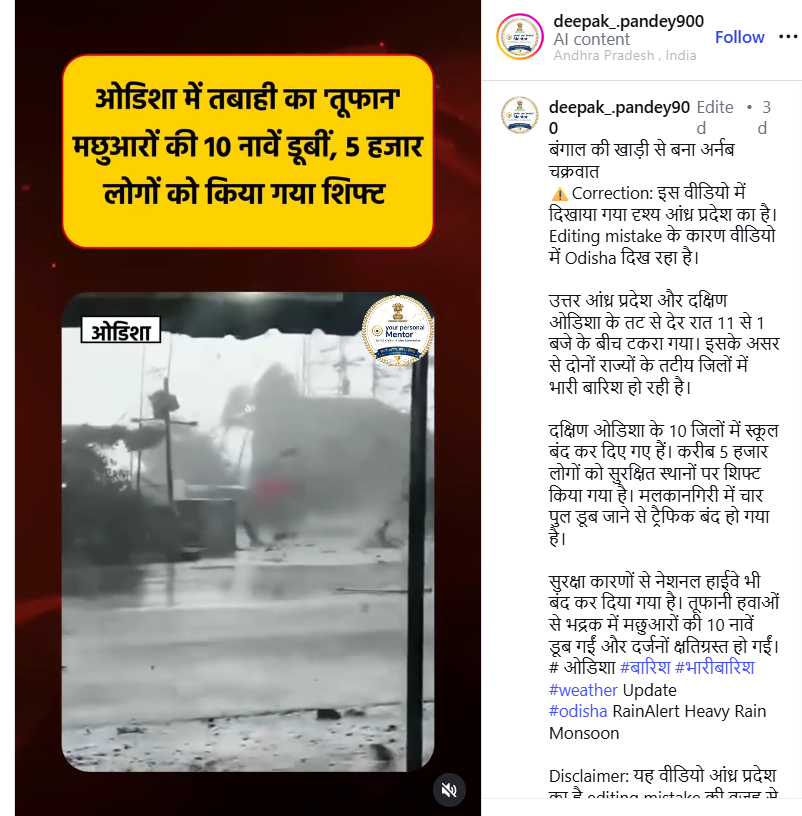
Instagram user ‘deepak_.pandey900’ posted a video on September 24, 2026, along with an archive link, claiming that “Cyclone Arnab, which formed over the Bay of Bengal, made landfall along the north Andhra Pradesh and south Odisha coasts between 11 pm and 1 am. Heavy rainfall is occurring in the coastal districts of both states due to its impact. Schools have been closed in 10 districts of southern Odisha, and around 5,000 people have been shifted to safer locations. Traffic was disrupted after four bridges in Malkangiri were submerged, and the National Highway was also closed as a precautionary measure. Strong winds caused 10 fishing boats to sink and dozens of others to be damaged in Bhadrak.”
https://www.instagram.com/deepak_.pandey900/reel/DdrZwOaBYjd
Fact Check
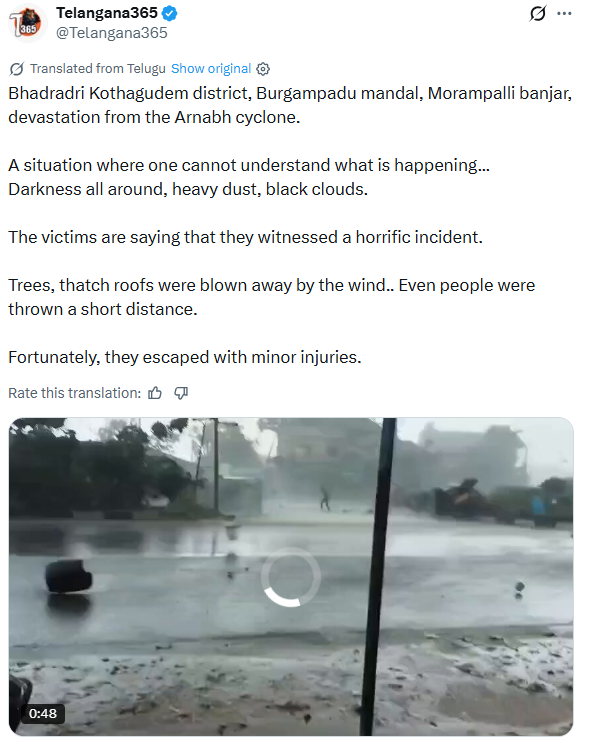
To verify the viral claim, we first conducted a Google Lens search using keyframes extracted from the video. X user ‘Telangana365’ shared the video on September 23, 2026, with the caption: “The ‘Arnab cyclone’ has caused massive destruction in Morampalli Banjara of Burgampadu mandal in Bhadradri Kothagudem district. The situation is such that it is difficult to understand what is happening. It is completely dark, with heavy dust and dark clouds all around. According to the victims, they witnessed a terrifying scene. Strong winds uprooted trees and blew away thatched roofs... people were even thrown some distance by the gusts of wind. Fortunately, they suffered only minor injuries.”
https://x.com/Telangana365/status/2102743504715907406?s=20
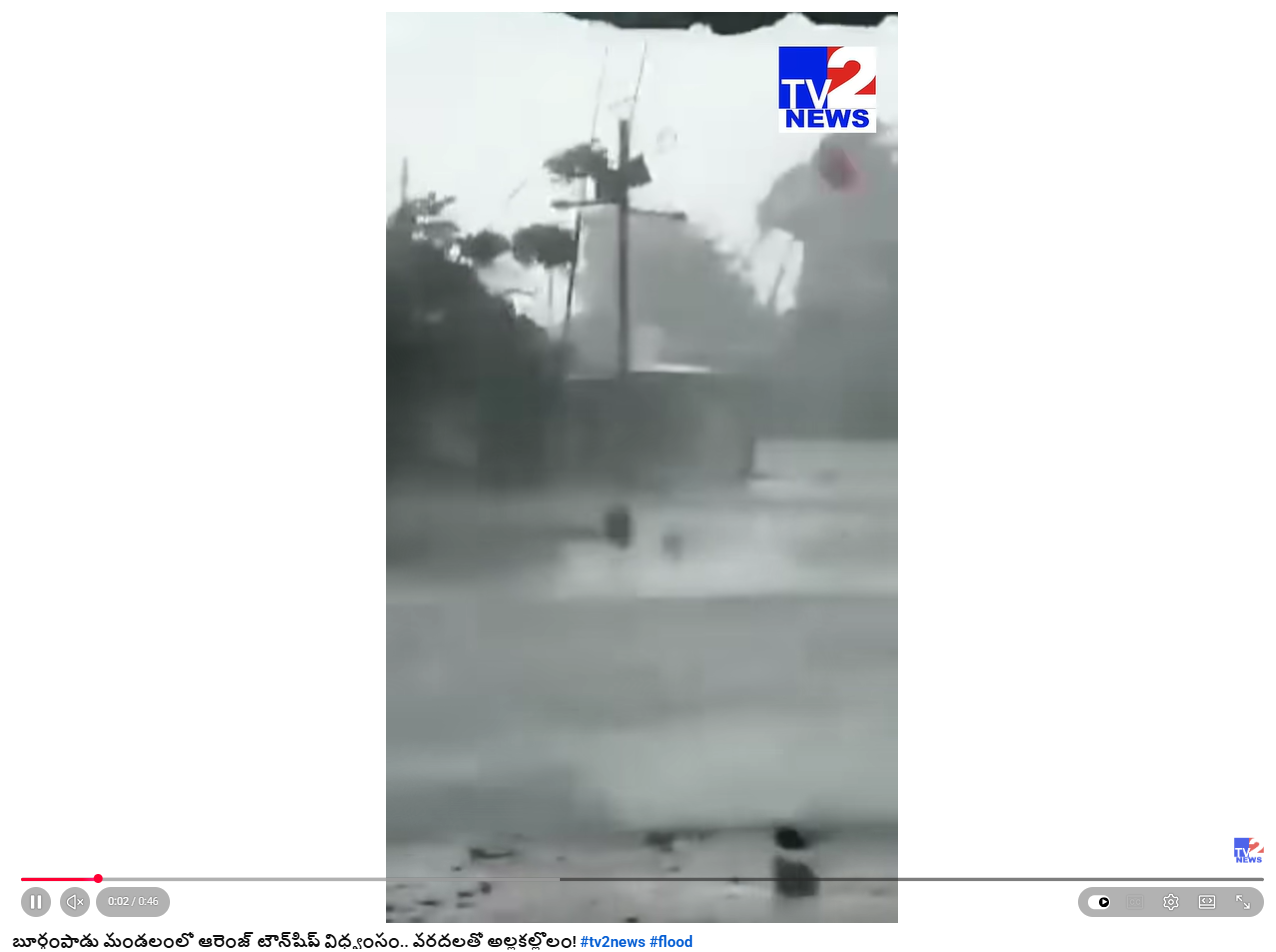
The video was also posted on the YouTube channel ‘TV2_NEWS’ on September 23, 2026, identifying it as footage from Burgampadu mandal in Telangana.
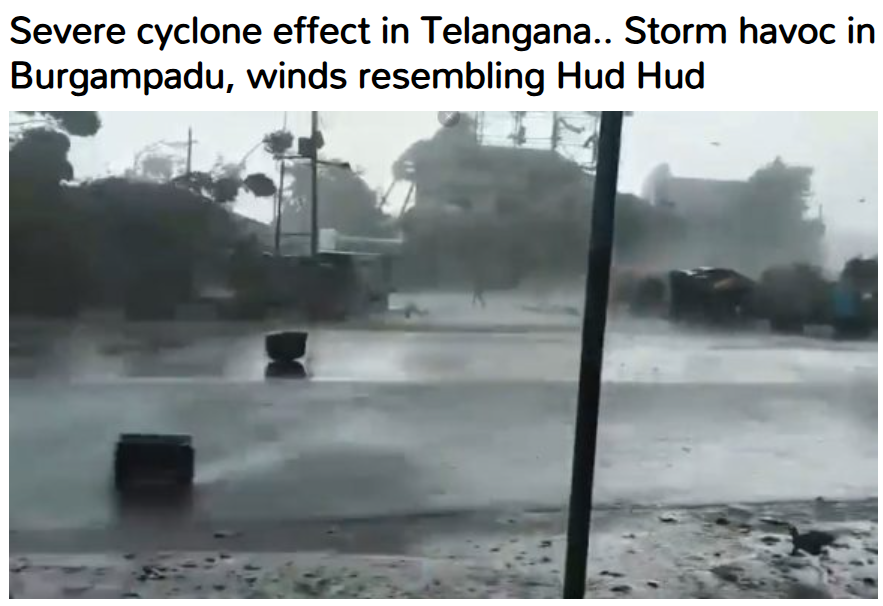
A report published on the website of Telangana-based news portal ‘Big TV’ on September 24, 2026, used a keyframe from the video. According to the report, “Cyclone Arnab, which formed over the Bay of Bengal, has caused widespread destruction. Its impact has been felt not only in Odisha and Andhra Pradesh but also significantly in Telangana. The cyclone caused destruction in Bhadradri Kothagudem district soon after crossing the coast. It suddenly wreaked havoc in Morampalli Banjara of Burgampadu mandal. Heavy rainfall and strong winds engulfed the area. Several people were injured during the incident.”
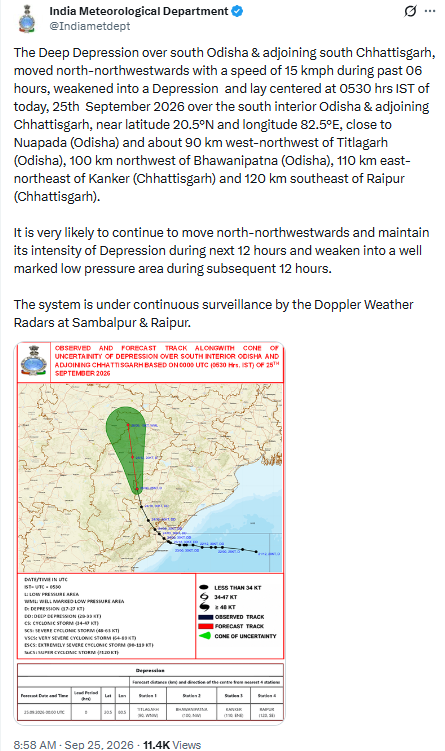
According to information shared by the India Meteorological Department (IMD) on its X handle at around 9 am on September 25, 2026, “The Deep Depression over south Odisha and adjoining south Chhattisgarh moved north-northwestwards at a speed of 15 kmph during the past six hours. It weakened into a Depression and lay centred at 5:30 am on September 25, 2026, over interior south Odisha and adjoining Chhattisgarh. It is very likely to continue moving north-northwestwards and maintain its intensity as a Depression for the next 12 hours. Thereafter, it is expected to weaken into a Well-Marked Low Pressure Area during the subsequent 12 hours.”
Conclusion:
The Deep Depression that formed over the Bay of Bengal caused heavy rainfall in Andhra Pradesh, Telangana and Odisha. However, the viral video showing the destruction caused by the storm is actually from Telangana.

Executive Summary
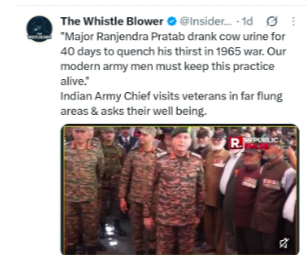
A video of Indian Army Chief General Dhiraj Seth is being shared on social media, allegedly showing him referring to an incident in which Major Rajendra Pratap Singh survived for 40 days by drinking cow urine during the 1965 India-Pakistan war and saying that Indian Army personnel should keep such a practice alive. The video is being shared with the claim that General Dhiraj Seth said that Major Rajendra Pratap Singh had consumed cow urine for 40 days to quench his thirst during the 1965 war and that serving Army personnel should also continue the practice. However, CyberPeace Research Wing found the claim to be false. The viral video has been digitally manipulated, with fabricated audio/remarks added to it. In the original video, General Dhiraj Seth did not make any such statement.
Claim:
Indian Army Chief General Dhiraj Seth allegedly referred to an incident in which Major Rajendra Pratap Singh survived for 40 days by drinking cow urine during the 1965 India-Pakistan war and urged serving Army personnel to keep the practice alive.
https://x.com/InsiderWB/status/2104242428647727428
Fact Check
To verify the truth behind the viral claim, we conducted a Google search using relevant keywords. During the search, we did not find any credible media reports supporting the claim. As part of the next step in our research, we extracted keyframes from the video and conducted a reverse image search. During the research, we found the original video on Gulistan News, which was published on September 25, 2026.
https://x.com/GulistanNewsTV/status/2103461004374061389
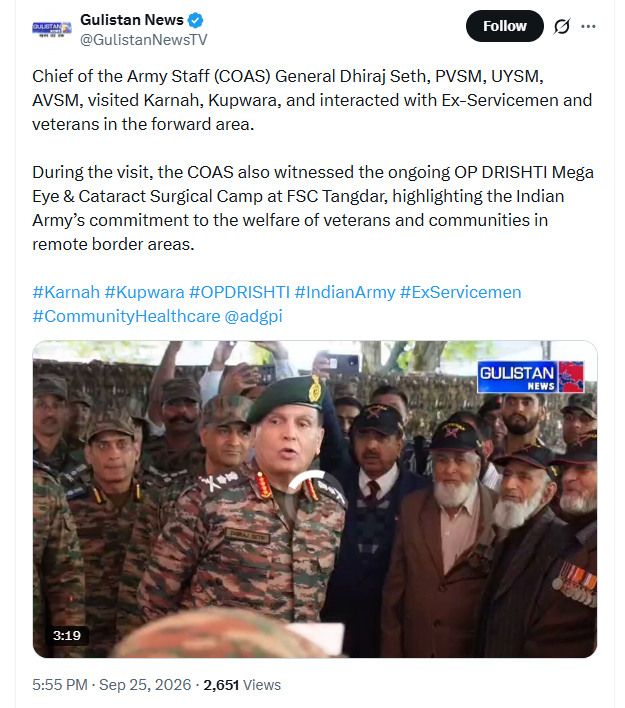
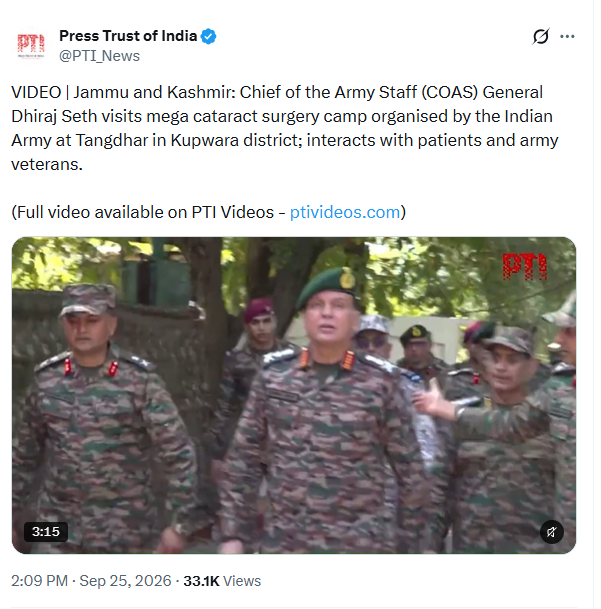
According to Gulistan News, Chief of the Army Staff (COAS) General Dhiraj Seth, PVSM, UYSM, AVSM, visited Karnah in Kupwara and interacted with ex-servicemen and veterans in the forward area. During the visit, the Army Chief also took stock of the ongoing ‘Operation Drishti’ Mega Eye and Cataract Surgical Camp at FSC Tangdhar. The initiative highlights the Indian Army’s commitment to the welfare of veterans and local communities in remote border areas. Further research led us to a video posted by the Press Trust of India (PTI) on X. According to its caption, Army Chief (COAS) General Dhiraj Seth visited the mega cataract surgery camp organised by the Indian Army at Tangdhar in Kupwara district and interacted with patients and army veterans.
https://x.com/PTI_News/status/2103404022279598579?s=20
After verifying the viral video, we conducted a Google search using relevant keywords. During the search, we found a report by the news agency Kashmir News Observer (KNO). According to the report, Chief of the Army Staff (COAS) General Dhiraj Seth visited Karnah in Kupwara district on Friday and interacted with ex-servicemen and veterans in the forward area. During the visit, the Army Chief took stock of the ongoing ‘Operation Drishti’ Mega Cataract Surgery Camp at the Forward Surgical Centre (FSC), Tangdhar.The COAS also interacted with veterans and ex-servicemen and took note of their welfare and healthcare-related concerns.The seven-day initiative, being conducted under the aegis of Chinar Corps in coordination with the Directorate General of Armed Forces Medical Services (DGAFMS), aims to provide advanced ophthalmic care to civilians and veterans residing in remote border areas.

We scanned the video using the AI detection tool Detect Video AI. According to the results, the viral video is 75 per cent AI-generated.

At the end of our research, we also scanned the video using HumanMeter. According to the results, the viral video is 80 per cent AI-generated.

Conclusion:
The video being circulated on social media in the name of Indian Army Chief General Dhiraj Seth is misleading. The viral video purportedly shows him referring to an incident in which Major Rajendra Pratap Singh allegedly survived for 40 days by drinking cow urine during the 1965 India-Pakistan war and saying that Army personnel should keep the practice alive. However, the original video available does not contain any such statement by General Dhiraj Seth. The viral video has been digitally manipulated, with fabricated remarks attributed to him.

Executive Summary
A video showing a man being beaten with a cricket bat is being widely shared on social media. It is being claimed that a priest had allegedly misbehaved with a girl at the same house where he had gone to perform a puja, following which the girl’s brother beat him up. However, our Research found the claim to be misleading. CyberPeace Research found that the video is around four years old. According to reports, the man was beaten after he allegedly objected to a cricket bat being kept inside a temple. Four youths were arrested by the police in connection with the incident.
Claim:
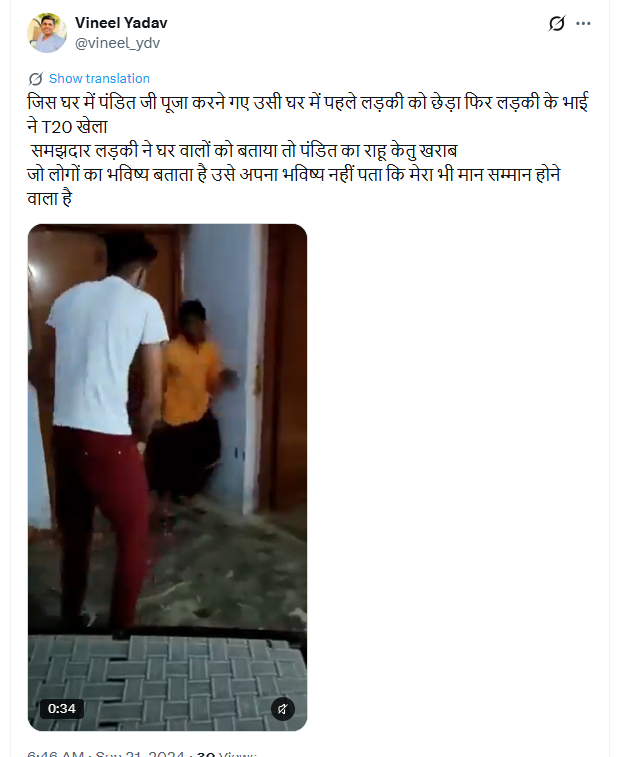
An X user shared the viral video with the caption: “The priest went to a house to perform a puja, where he first harassed a girl, and then the girl’s brother played T20. The sensible girl informed her family. The priest who predicts other people’s future could not predict his own—that his honour was also going to be at stake.”
https://x.com/vineel_ydv/status/1837299886921753054?s=20
https://ghostarchive.org/archive/b91vB
Fact Check
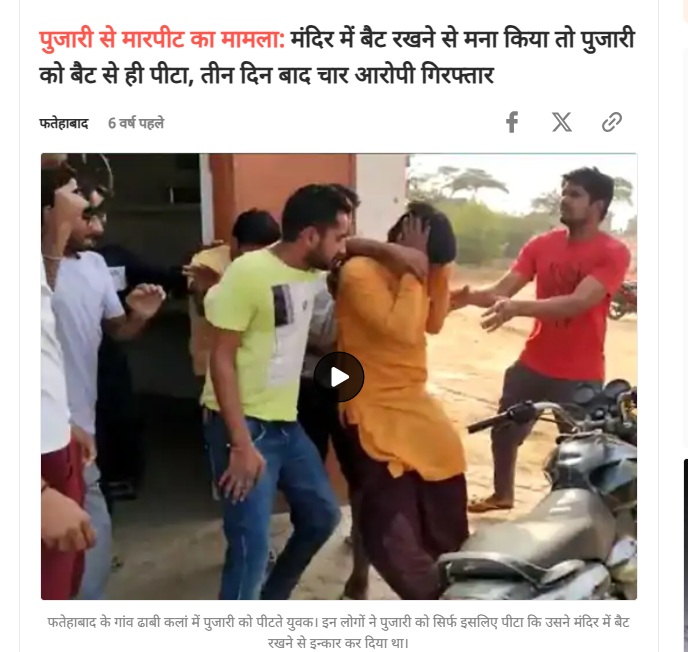
To verify the viral claim, we searched Google using relevant keywords. During the search, we did not find any credible media reports supporting the claim. To further verify the claim, we conducted a reverse image search of keyframes from the video. During the search, we found a report published by Dainik Bhaskar on November 5, 2020. According to the report, police arrested four youths in connection with the assault of a priest in Fatehabad, Haryana. The report stated that three days earlier, the youths had beaten the priest with a cricket bat after he objected to them keeping the bat inside the temple.
https://www.bhaskar.com/local/haryana/news/fatehabad-haryana-priest-beaten-with-cricket-bat-very-hardly-in-fatehabad-police-arrested-four-accused-127888122.html
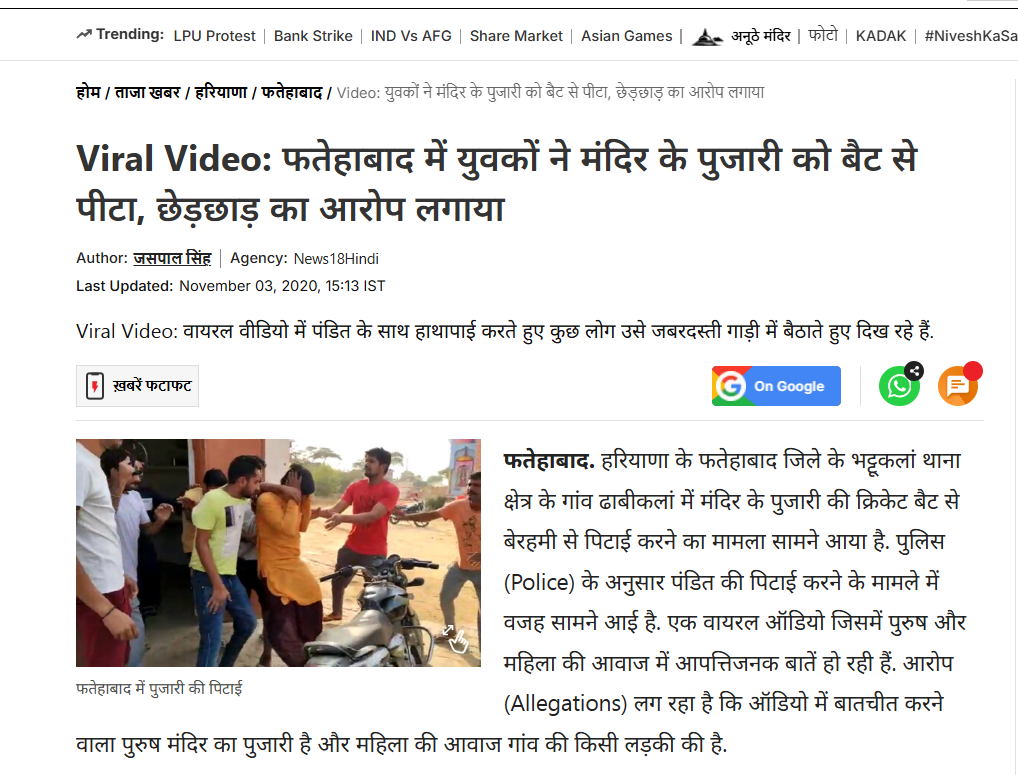
As part of the next step in our Research, we found a report published on the News18 website with a generic caption. The viral image was also included in the report.
Conclusion
Our Research found that the video is around four years old and is unrelated to the claim being circulated on social media. The incident took place after the priest objected to the youths keeping a cricket bat inside the temple, following which he was assaulted with the bat. Police subsequently arrested four youths in connection with the incident. Therefore, the claim that the priest was beaten after allegedly harassing a girl at the house where he had gone to perform a puja is misleading.

Executive Summary
A video is being shared on social media showing several people breaking iron barricades installed along the banks of a water body. The video is being shared with the claim that people broke the barricades after the Karnataka government imposed a ban on idol immersion to prevent pollution in the river. CyberPeace Research found the viral claim to be misleading. Our Research revealed that the video is not from Karnataka but from Hyderabad, Telangana. The video shows members of The Bhagyanagar Ganesh Utsav Committee (BGUS) removing barricades installed at Tank Bund to prevent the immersion of Plaster of Paris (PoP) idols in the water body. The barricades had been installed following the High Court’s directions. Therefore, the claim linking the video to Karnataka is incorrect.
Claim:
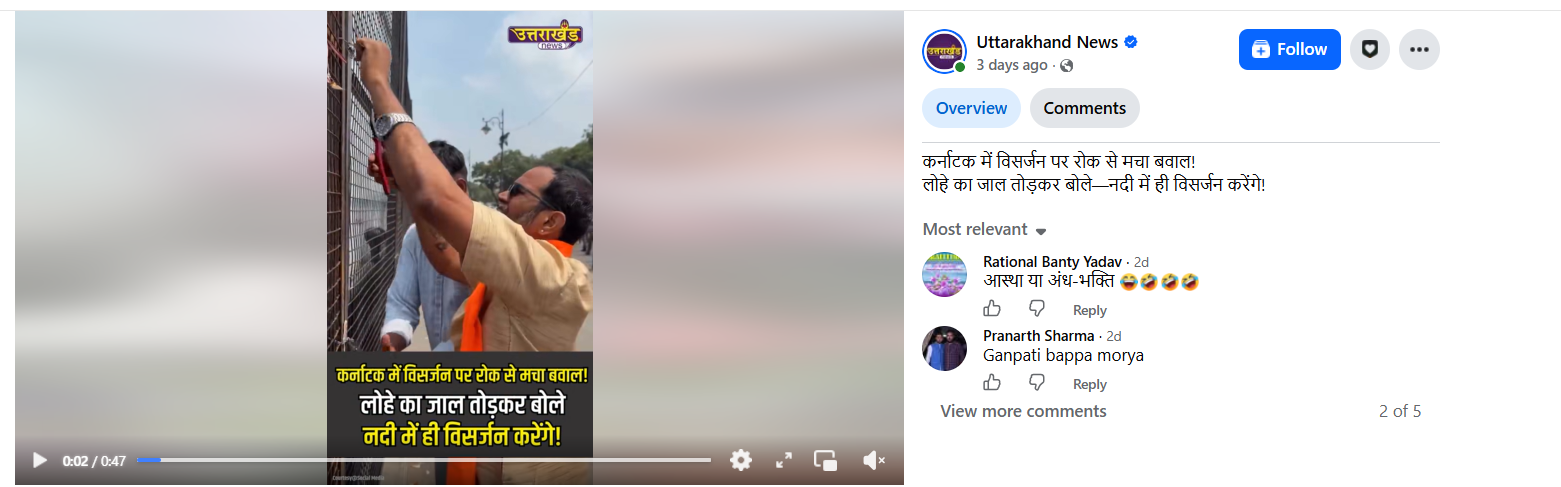
A Facebook user shared the video with the caption: “Chaos erupts in Karnataka over the ban on idol immersion! Breaking the iron barricades, they said — ‘We will immerse the idols in the river itself!’” The post link, archive link, and screenshot are provided below.
https://www.facebook.com/watch/?v=1523733916224661
https://ghostarchive.org/archive/SJgmD
Fact Check
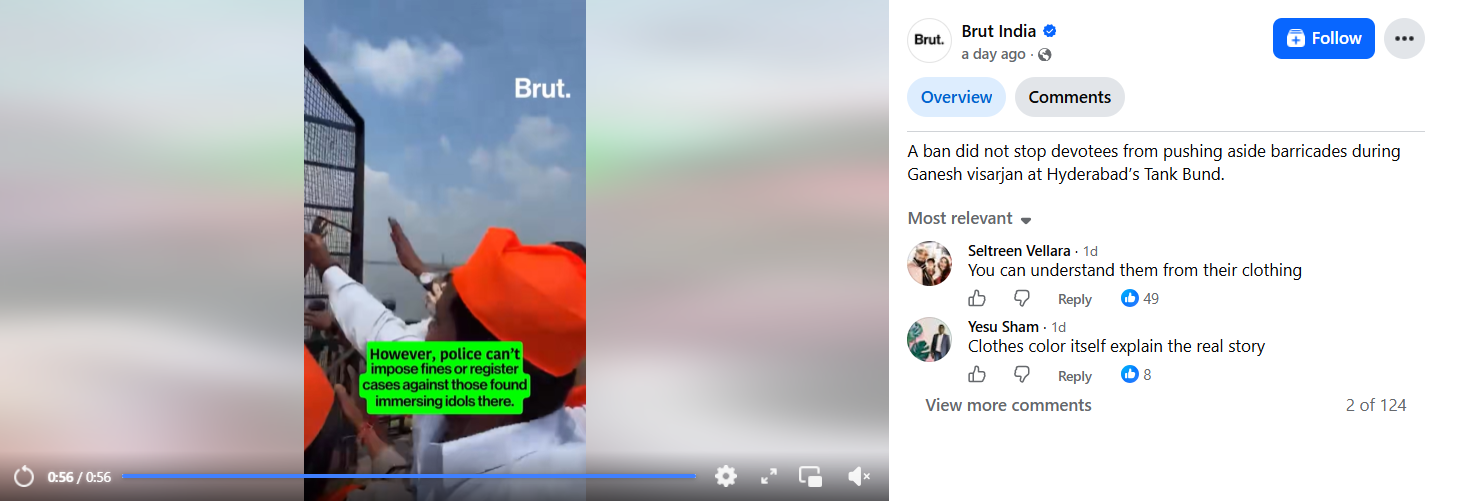
To verify the authenticity of the viral claim, we conducted a reverse image search of keyframes from the video. During the search, we found the same video on the Facebook page of Brut India. According to the post, the video is from Hyderabad. The caption states that despite the restrictions, devotees removed the barricades and made way during the Ganesh idol immersion at Hyderabad’s Tank Bund. The post link and screenshot are provided below.
https://www.facebook.com/watch/?v=2220012475615416
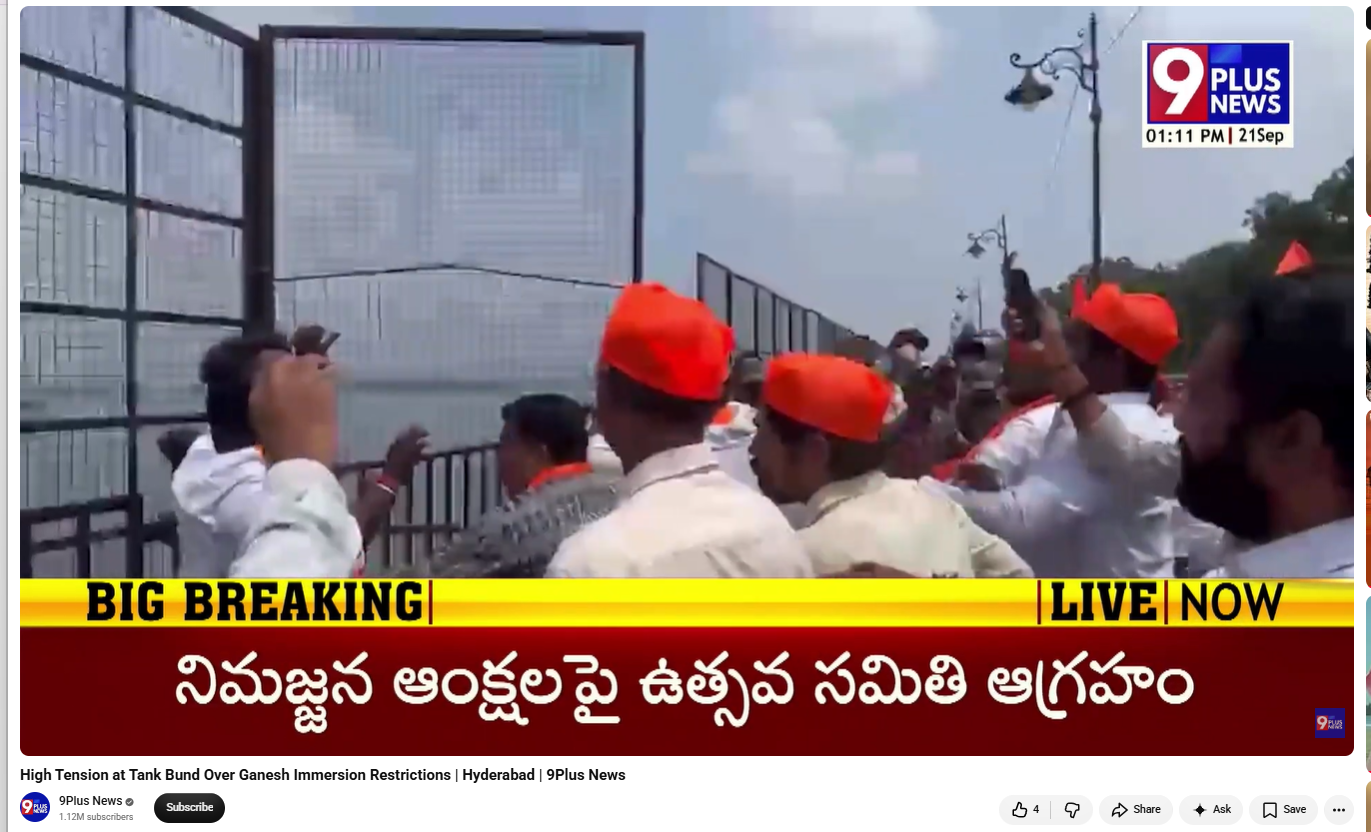
Taking the Research forward, we found the same video in a news report uploaded on the YouTube channel of ‘9Plus News’ on September 21, 2026. The report also includes the portion of the viral clip in which people can be seen breaking the barricades. According to the report, the incident took place in the Tank Bund area of Hyderabad. The post link and screenshot are provided below.
https://www.youtube.com/watch?v=l7GRELjqAwY
Conclusion
Our Research found that the viral video is not from Karnataka but from Hyderabad, Telangana. The video shows members of the Bhagyanagar Ganesh Utsav Committee (BGUS) removing barricades installed at Tank Bund to prevent the immersion of Plaster of Paris (PoP) idols in the water body. These barricades had been installed following the High Court’s directions. Therefore, the claim linking the video to Karnataka is false.

Executive Summary
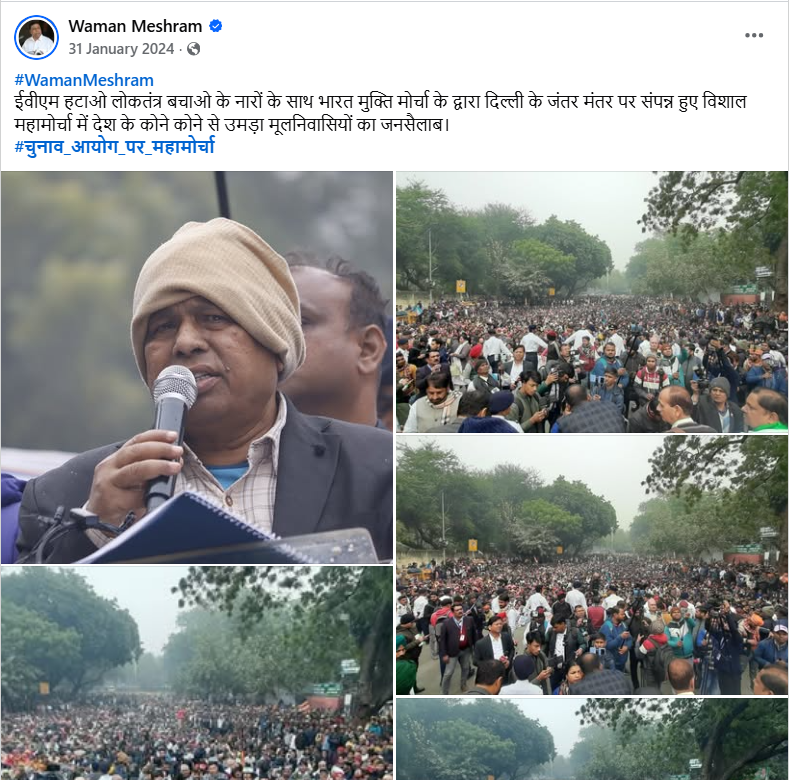
A video is being shared on social media with the claim that it shows a protest against Chief Election Commissioner Gyanesh Kumar in Delhi. A large number of people can be seen protesting in the video. CyberPeace Research found that the video is not related to any recent protest against Chief Election Commissioner Gyanesh Kumar. Our Research revealed that the video is from a protest against Electronic Voting Machines (EVMs) held at Jantar Mantar in Delhi on January 31, 2024.
Claim:
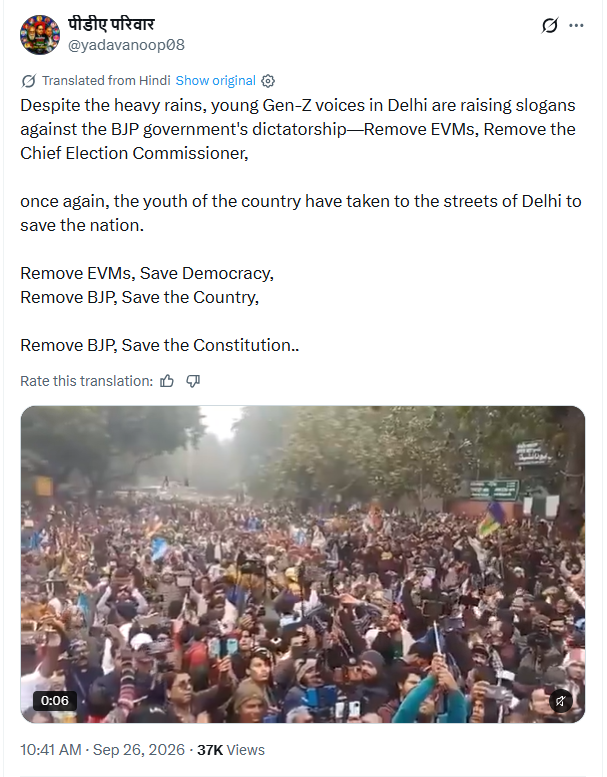
The video was shared on X with a caption claiming that, “Despite heavy rain, Gen-Z, the youth of the country, have once again taken to the streets of Delhi to protest against the dictatorship of the BJP government, raising slogans of ‘Remove EVMs and Remove the Chief Election Commissioner.’ Remove EVMs, save democracy; remove BJP, save the country; remove BJP, save the Constitution.”
https://x.com/yadavanoop08/status/2103713972256166204
Fact Check
To verify the viral video being shared with the claim that it shows a protest against Chief Election Commissioner Gyanesh Kumar in Delhi, we conducted a reverse image search using keyframes from the video. We found the same video uploaded on a Facebook account on January 31, 2024. The caption accompanying the video described it as a protest against Electronic Voting Machines (EVMs).
https://www.facebook.com/watch/?v=3672972219640920
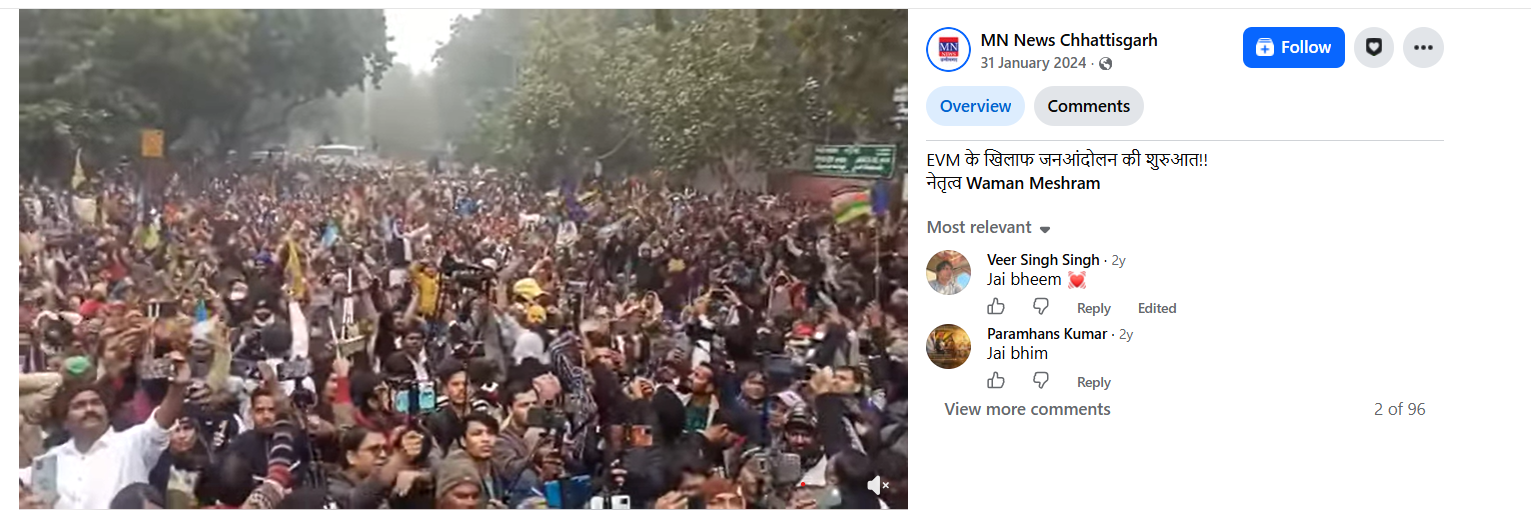
During the same search, we also found the video uploaded on another Facebook account on January 31, 2024. The post described the video as showing a protest held at Jantar Mantar in Delhi.
https://www.facebook.com/watch/?v=397803899424353
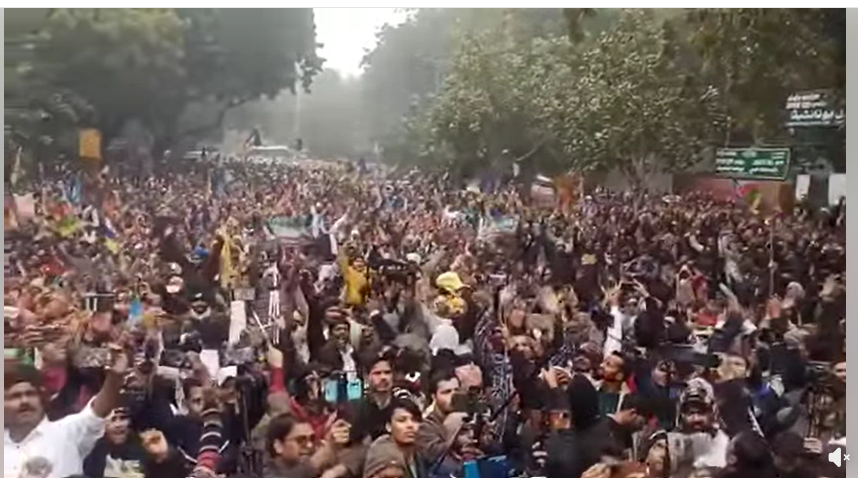
We then checked Vaman Meshram’s Facebook account and found several photographs related to the protest held at Jantar Mantar on January 31, 2024. The visuals in these photographs match the scenes seen in the viral video.
https://www.facebook.com/photo/?fbid=954806319346006&set=pcb.954806489345989
Conclusion
The evidence gathered during our Research clearly establishes that the video being shared with the claim that it shows a protest against Chief Election Commissioner Gyanesh Kumar in Delhi is actually from a protest against Electronic Voting Machines (EVMs) held in 2024.

Executive Summary
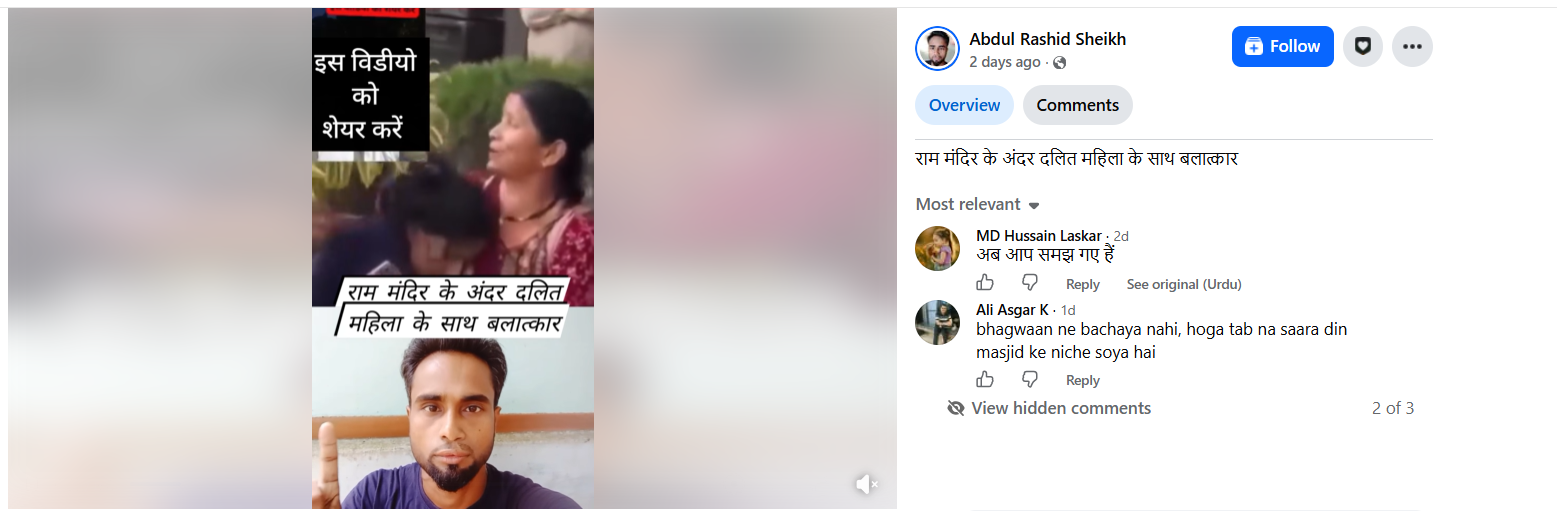
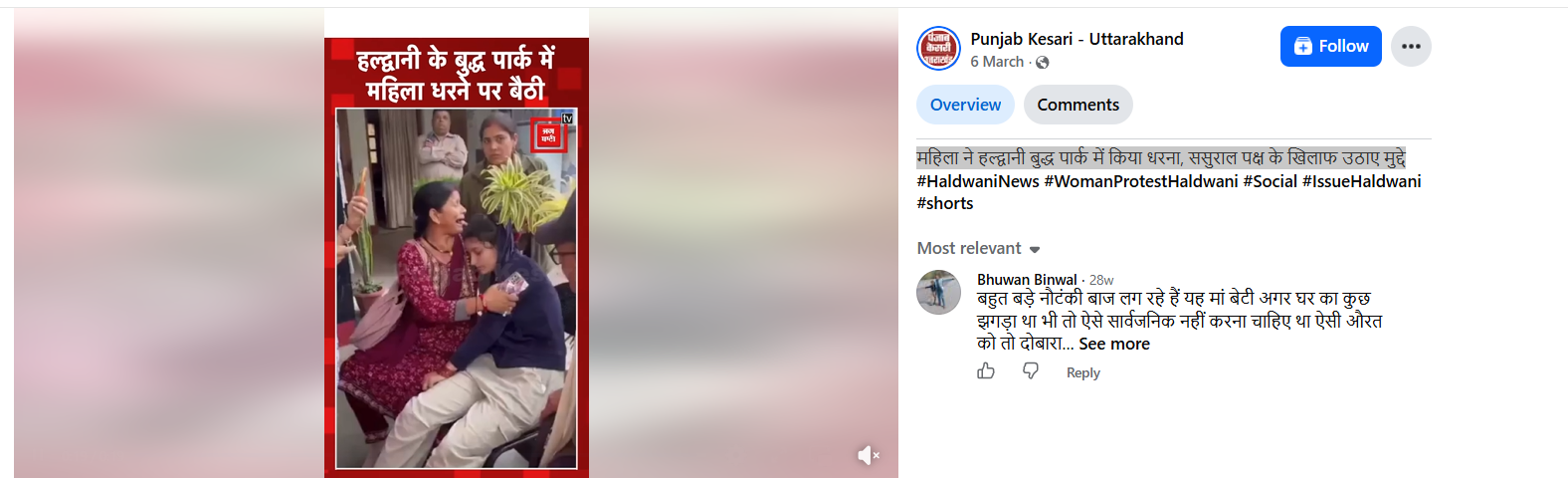
A video is being shared on social media with the claim that a Dalit woman was raped inside the Ram Temple in Ayodhya. In the video, two women can be seen crying, while some people around them appear to be consoling them. CyberPeace Research Wing’s research found the viral claim to be false. Our research found that the viral video has been created by combining two separate clips. In the first part of the video, a woman can be seen staging a protest at Buddha Park in Haldwani and raising issues related to her in-laws. The second part shows a girl expressing her anger. Our research found that this clip has been available on the internet since December 27, 2025. Neither of the two videos is related to the alleged rape of a Dalit woman inside the Ram Temple in Ayodhya.
Claim:
A Facebook user shared the viral video on September 21, 2026, with the caption, “Dalit woman raped inside the Ram Temple.”The post link, archive link and screenshot are provided below.
https://www.facebook.com/watch/?v=1420442086956519
Fact Check
To verify the authenticity of the viral image, we conducted a Google search using relevant keywords. However, we did not find any credible media report related to the viral image during the search. To verify the claim, we conducted a reverse image search of the keyframes from the video. During the search, we found the same video on the Facebook page of Punjab Kesari - Uttarakhand, where it was published on March 6, 2026. According to the post, the woman staged a protest at Buddha Park in Haldwani and raised issues related to her in-laws. The link and screenshot of the relevant post are provided below.
https://www.facebook.com/watch/?v=897776589732940
Meanwhile, we found the second part of the viral video on LinkedIn, where the video was published on December 27, 2025.
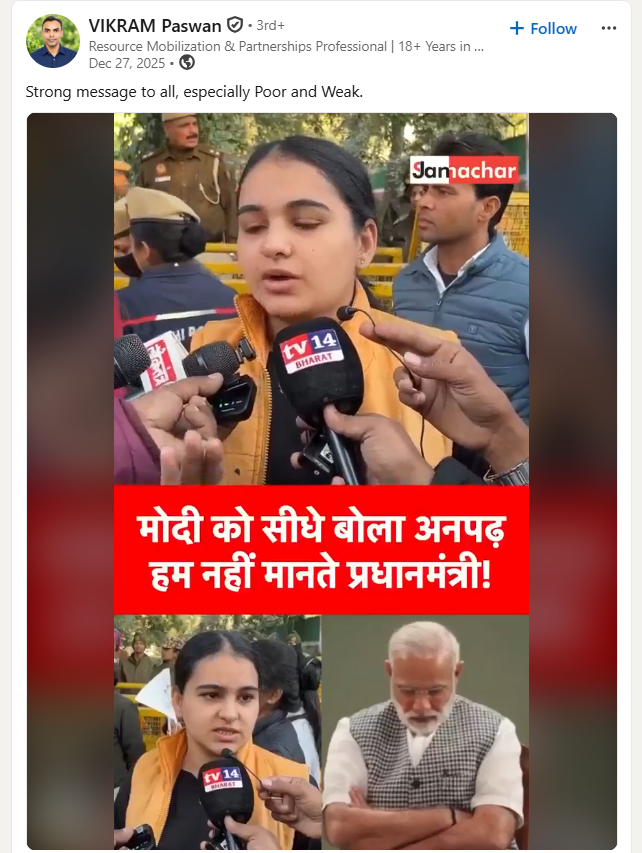
Our research makes it clear that two old and unrelated videos are being shared with a misleading claim linking them to the Ram Temple in Ayodhya. The videos have no connection with the alleged incident on the temple premises, and based on the available evidence, there is no confirmation of any such incident taking place at the Ram Temple. Our research found that the viral video was created by combining two separate clips. In the first part of the video, a woman can be seen staging a protest at Buddha Park in Haldwani and raising issues related to her in-laws. In the second part, a girl can be seen expressing her anger. Our research found that this clip has been available on the internet since December 27, 2025. Neither of the two videos is related to the alleged rape of a Dalit woman inside the Ram Temple in Ayodhya.

Executive Summary
A video is being shared on social media with the claim that it shows a recent Houthi attack on King Khalid International Airport in Riyadh, the capital of Saudi Arabia. The video shows people running inside a building amid chaos, followed by a loud explosion that appears to shatter glass. The post claims that the visuals show the Riyadh airport during a Houthi missile attack. However, CyberPeace Research Wing’s research found that the video is actually from Russia.
Claim:
A social media post is being shared with the claim that the video shows a Houthi attack on Riyadh Airport in Saudi Arabia.
https://www.facebook.com/reel/1491107586179716
https://ghostarchive.org/archive/O9X4A

Fact Check
To verify the truth behind the video being shared with the claim that it shows a Houthi attack on an airport in Riyadh, Saudi Arabia, we conducted a reverse image search of its keyframes. During the search, we found a video uploaded on June 19, 2026, by the Kazakh YouTube account @AzattyqAsia, which contains the same visuals seen in the viral video. According to the report, the video shows Russia’s Sadovod Market, where a massive fire broke out following a drone attack.
https://www.youtube.com/shorts/D2-m4l5Obc8
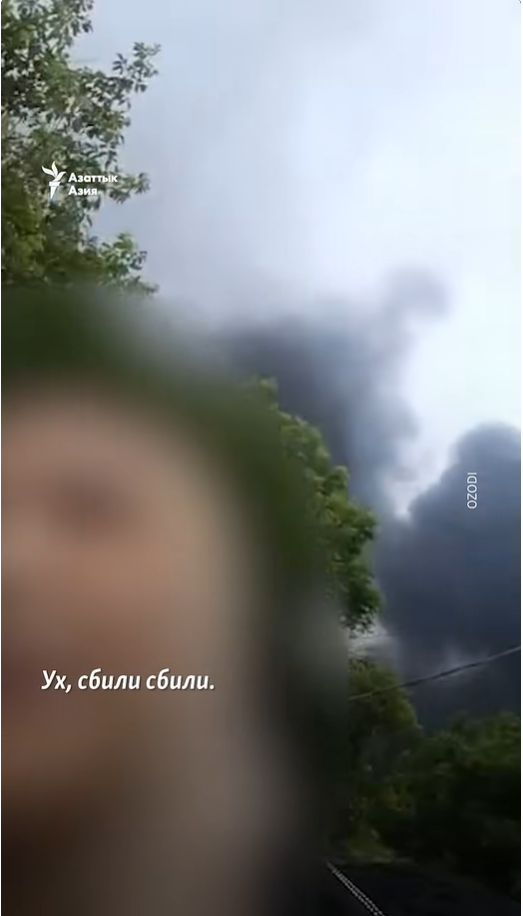
Additionally, we found another video shot from a different angle on the Facebook account Yenisafak.com/ru, uploaded on June 18, 2026. The video contains the same visuals seen in the viral clip. The post states that the video was filmed at Moscow’s Sadovod Market, where a massive fire broke out at a complex following a drone attack.
https://www.facebook.com/reel/980820447900927

Conclusion
The evidence gathered during our research makes it clear that the viral video does not show a Houthi attack on an airport in Saudi Arabia, but is actually from Moscow, the capital of Russia.

Executive Summary
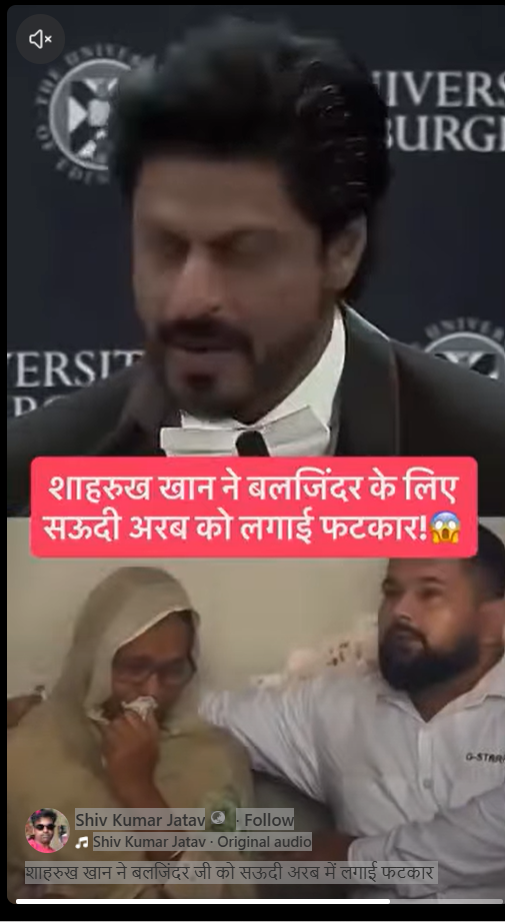
A video is being shared on social media with the claim that actor Shah Rukh Khan reprimanded Saudi Arabia over the death sentence awarded to Baljinder Singh.In the viral video, Shah Rukh Khan is purportedly heard saying, “Our simple and innocent brother Baljinder Singh, a resident of Sujanpur in Punjab’s Pathankot district, has been sentenced to death in Saudi Arabia after being falsely implicated in a drug case as part of a deep conspiracy. But stay strong, my brother.
Nothing will happen to you. I will definitely save you. Your brother is alive, and I swear that I will not let you die alone on that dreaded noose. Instead, I will put all my strength on the line and risk my life to pull you out of that hellish prison and bring you safely back to the soil of Punjab and the land of India.”
CyberPeace Research Wing’s research found the claim to be false. Our research found that the audio used in the viral video is AI-generated.
Claim:
A video is being shared on social media with the claim that actor Shah Rukh Khan reprimanded Saudi Arabia over the death sentence awarded to Baljinder Singh.
https://www.facebook.com/reel/1491107586179716
Fact Check
To verify the claim that Shah Rukh Khan reprimanded Saudi Arabia over the death sentence awarded to Baljinder Singh, we first conducted a Google search using relevant keywords. During the search, we did not find any information related to the viral claim in any credible media report.A reverse image search of the keyframes from the video led us to a video uploaded on The University of Edinburgh’s YouTube account on October 16, 2015, which contains the same segment seen in the viral clip. Notably, the background in the original video is identical to that seen in the viral clip.
In the original video, Shah Rukh Khan can be seen speaking about “life lessons”. During the event, he was conferred an honorary doctorate by the University of Edinburgh. In his address, he shared several unique lessons about life through some of his popular film characters. Shah Rukh Khan spoke about the importance of embracing one’s individuality, while combining humour with self-reflection. He also spoke about facing one’s fears and maintaining self-confidence amid challenges. Sharing anecdotes from his journey in films, Shah Rukh Khan explained how different characters had taught him to look at life from new perspectives.However, he makes no mention of Baljinder Singh anywhere in the video.
https://www.youtube.com/watch?v=VnnXAiTOLbo

We then checked the viral video using Hive Detect, an AI detection tool. The tool’s analysis indicated that the voice of Shah Rukh Khan in the video was AI-generated, with a 97.2 per cent probability.

Additionally, six detectors on another AI detection tool, Deepfake-O-Meter, identified Shah Rukh Khan’s voice in the video as highly likely to be AI-generated.

Conclusion
The evidence gathered during our research makes it clear that the claim that Shah Rukh Khan reprimanded Saudi Arabia over the death sentence awarded to Baljinder Singh is false. The audio of Shah Rukh Khan in the viral video is AI-generated.

Executive Summary
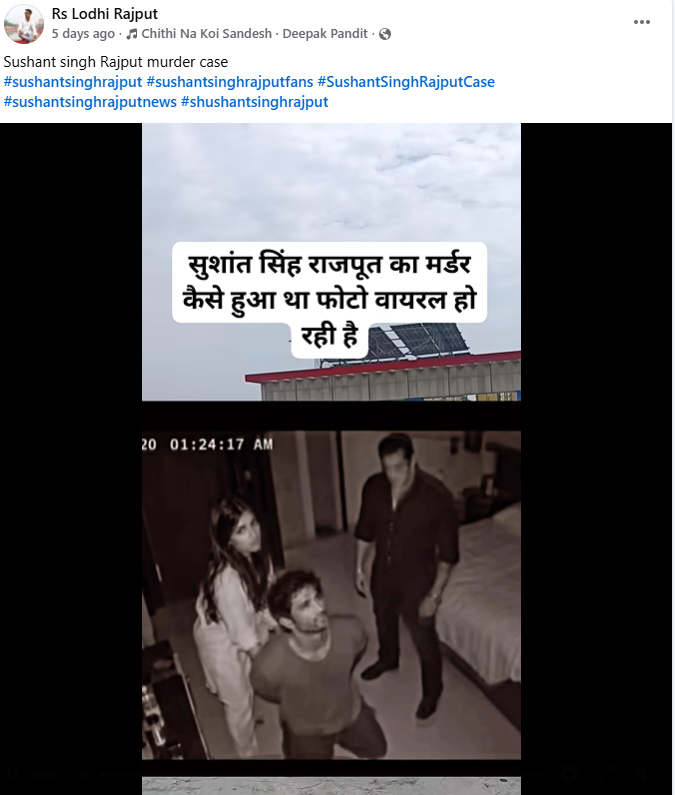
A picture of late actor Sushant Singh Rajput is being shared on social media. In the picture, a woman can be seen holding him, while another person is standing beside him. The social media post claims that the picture is from the last days of Sushant Singh Rajput’s life.CyberPeace Research found the viral claim to be false. Our research found that the viral picture is not authentic, but was created using Artificial Intelligence (AI). The AI-generated image is being shared on social media with a misleading claim.
Claim:
On September 18, 2026, a Facebook user shared the viral picture with the caption, “How was Sushant Singh murdered? The photo is going viral.” The post link, archived link and screenshot are provided below.
https://www.facebook.com/reel/1591592259073828
Fact Check
To verify the authenticity of the viral image, we conducted a Google search using relevant keywords. However, we did not find any credible media report related to the viral image. In the next step of our research, we examined the viral image closely and noticed several inconsistencies that raised suspicion that it had been AI-generated. We then scanned the image using AI or Not. According to the results, the viral image was identified as AI-generated.

We also scanned the viral image using another AI detection tool, DeepAI. According to the results, the image was found to have a 96 percent likelihood of being AI-generated.

Conclusion
Our research found that the viral image is not authentic, but was created using Artificial Intelligence (AI). The AI-generated image is being shared on social media with a misleading claim.

Executive Summary
A video is being shared on social media claiming that a person who was paragliding came into contact with high-voltage electric wires during a recent incident. The video shows a paraglider coming into contact with electric wires while descending towards the ground, following which a fire can be seen breaking out. Social media users are sharing the post claiming that the incident is recent and linking it to the ongoing developments. CyberPeace Research found the viral claim to be misleading. Our research found that the viral video is not recent but dates back to a paragliding accident that took place in South Korea in June 2023. According to available media reports, on June 16, 2023, a 60-year-old man who was paragliding near Seopjikoji Beach on Jeju Island, South Korea, came into contact with high-voltage electric wires. He died in the accident.
Claim:
A video being shared on social media claims that a person descending towards the ground with a parachute unfortunately came into contact with high-voltage electric wires. The video shows the area around the person catching fire after he came into contact with the electric wires. The post is being shared on social media claiming that the incident is recent.
https://x.com/i/birdwatch/t/2101315570067189899?source=6
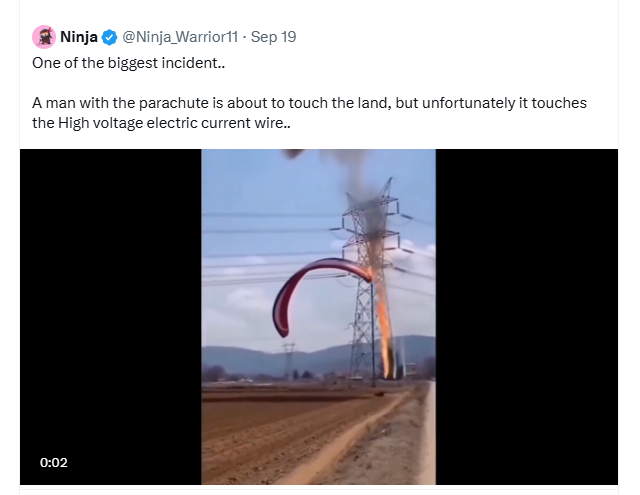
Fact Check
To verify the viral claim, we conducted a Google search using relevant keywords. During the search, we did not find any credible media reports related to the claim. To further verify the authenticity of the viral claim, we conducted another search on Google using relevant keywords. During the search, we found a similar video on a YouTube channel. This made it clear that the video is not recent. As part of our research, we also found the video on the South Korean website Bobaedream. According to the website, on June 16, 2023, a tourist aged around 60 came into contact with a high-voltage electric wire while paragliding near Seopjikoji Beach in Seongsan-eup, Seogwipo-si, Jeju-do Province, South Korea.
https://www.bobaedream.co.kr/bike2/board/view.php?code=strange&No=5785730

At the end of our research, we found a report published by South Korean news outlet The JoongAng on June 16, 2023. Citing the Jeju Eastern Fire Department, the report stated that at around 4:35 p.m. that day, a person flying a motorized paraglider near Seopjikoji Beach was reported to have become entangled in a high-voltage electric wire. According to the report, the person died after coming into contact with the high-voltage current.
https://www.joongang.co.kr/article/25170445#home

Conclusion
Our research found that the video being shared on social media does not show a recent incident. Available media reports and other sources confirm that the video is from a paragliding accident that took place on Jeju Island, South Korea, in June 2023. According to reports, on June 16, 2023, a man aged around 60 who was paragliding near Seopjikoji Beach became entangled in a high-voltage electric wire. He died after coming into contact with the electric current. Therefore, the claim that the video shows a recent incident is misleading.

Executive Summary
A video is being shared on social media with the claim that it allegedly shows the son of India’s Chief of Defence Staff (CDS) hosting a private birthday party with friends. Several people can be seen wearing women’s clothing in the video and attending what appears to be a birthday celebration. The posts further question how footage from an allegedly restricted Army residence surfaced online. CyberPeace Research found the viral claim to be misleading. Our research found that the video being shared by linking it to an Army residence and the son of the CDS is actually from the birthday celebration of fashion designer Lalit Singh, which was held in Gurugram. Therefore, the claim that the video shows a private birthday party hosted by the CDS’s son inside an Army residence is false.
Claim
A Pakistani handle claimed that the purported leaked footage shows the interior of an Indian Army residence, where the son of India’s CDS allegedly hosted a private birthday party with friends. The handle further questioned how footage from such a restricted location had surfaced online.
https://x.com/OfficialThoka/status/2101591703471988805
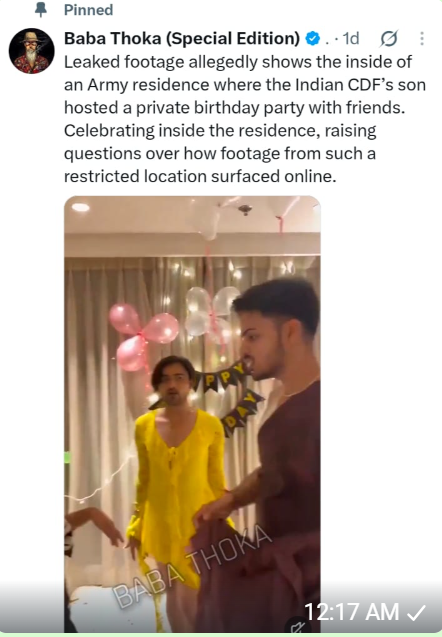
Fact Check
To verify the viral claim, we conducted a Google search using relevant keywords. During the search, we did not find any credible media reports related to the claim. A reverse image search and a search using relevant keywords revealed that the event shown in the video was the birthday celebration of fashion designer Lalit Singh. Lalit Singh had shared several photographs from his birthday celebration held in Gurugram on social media, and the visuals in those photographs matched those seen in the viral video.
https://www.instagram.com/lalitsingh159/
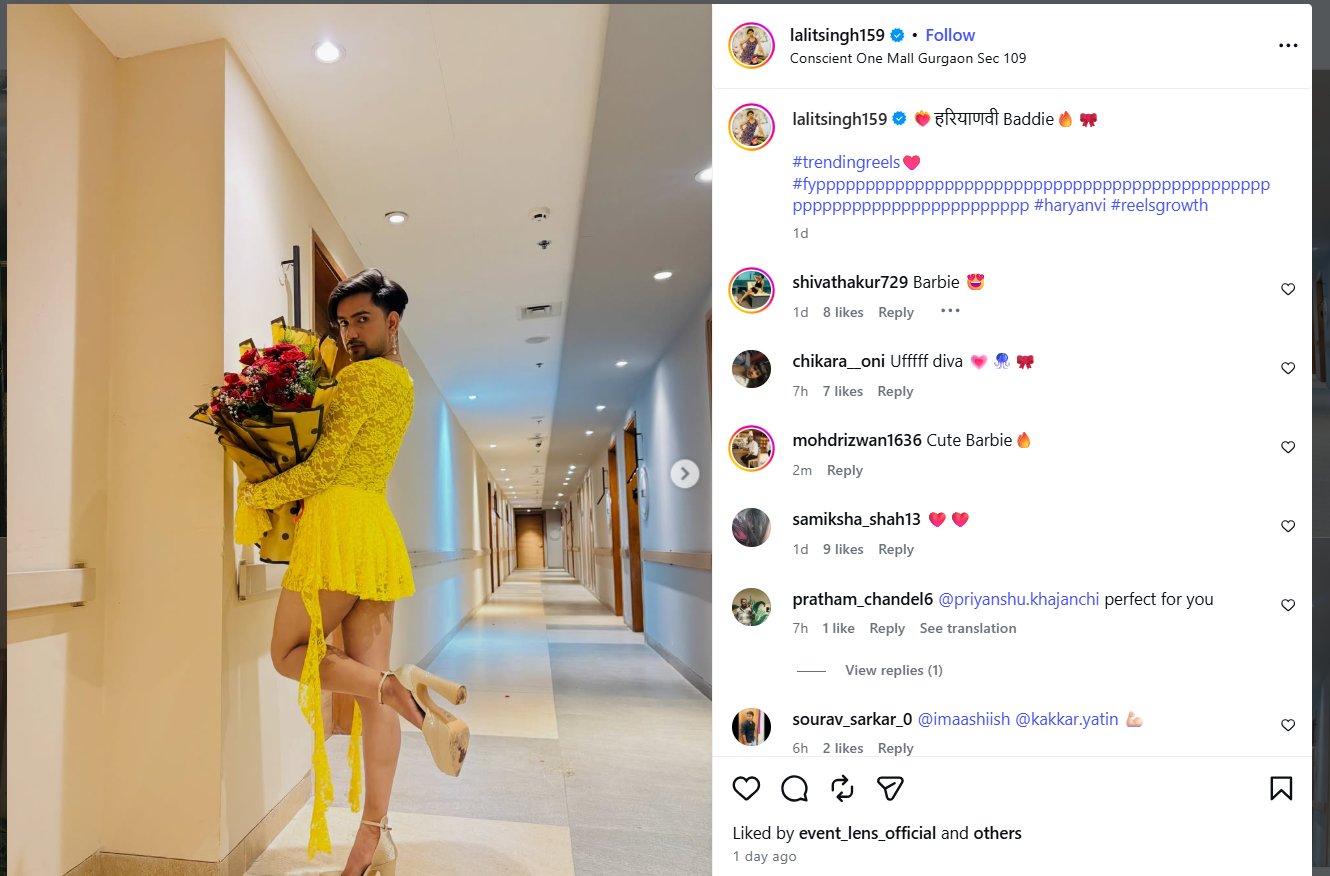
We found photographs of the person seen in the viral video on Instagram. He had identified himself as Lalit Singh.

At the end of our research, we also found the YouTube channel of fashion designer Lalit Singh. On the channel, Lalit Singh regularly shares videos related to similar birthday celebrations and other private events. This further confirms that the claim linking the viral video to a birthday party hosted by the son of India’s Chief of Defence Staff is false and fabricated.
https://www.youtube.com/@lalitsingh-159

Conclusion
Our research found that the video being shared on social media with the claim that it shows a birthday party hosted by the son of India’s Chief of Defence Staff (CDS) and footage from an Army residence is being circulated with a false claim. The research revealed that the visuals in the viral video are from the birthday celebration of fashion designer Lalit Singh, which was held in Gurugram. Lalit Singh shared several photographs and videos from the same celebration on his social media accounts. In addition, videos related to similar events are available on his YouTube channel. During our research, we found no credible or official source linking the viral video to the CDS’s son or any Army residence. Therefore, the claim that the viral video shows a private birthday party hosted by the CDS’s son is false and misleading.

Executive Summary
A video is being shared on social media with the claim that a woman in New Delhi slapped an Indian Army soldier who allegedly followed and harassed her on the road. The post claims that the woman confronted the soldier on the spot, linking the incident to harassment of women. CyberPeace Research found the viral claim to be misleading. Our research found that the video is not recent but dates back to an incident in Delhi in September 2017. The video is from a road rage incident that took place in the Vasant Kunj-Rajokari Flyover area of South Delhi in September 2017. According to available reports, the woman allegedly assaulted two Army personnel. The claim that the video shows an incident in which a woman slapped an Army soldier in response to being followed or harassed by him is misleading.
Claim:
A social media user shared the viral video claiming that a woman in New Delhi slapped an Indian Army soldier who allegedly followed and harassed her on the road. The post claimed that instead of remaining silent, the woman confronted the soldier on the spot. The post further stated that the incident sends a strong message that wearing a uniform does not give anyone the right to harass or intimidate civilians, especially women.
https://x.com/OfficialThoka/status/2101989813071307032
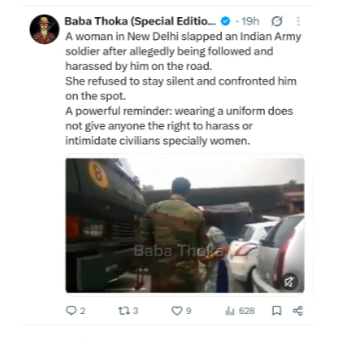
Fact Check
To verify the viral claim, we conducted a Google search using relevant keywords. However, we did not find any credible media reports related to the claim.To further verify the authenticity of the viral claim, we conducted a reverse image search of the keyframes of the video. During the search, we found the same video on the NDTV website, which was published on September 15, 2017. According to the NDTV report, a woman in New Delhi was caught on camera repeatedly slapping an Army personnel. The soldier did not appear to retaliate during the incident. Following a complaint by the Army to the Delhi Police, the woman was arrested. However, she was released within a few hours after a judge granted her bail. The report stated that in a video recorded by a witness on a mobile phone in South Delhi’s Vasant Kunj the previous Saturday, 44-year-old Smriti Kalra was seen repeatedly slapping the soldier on the face before walking angrily towards her car. The soldier appeared to be trying to reason with her while attempting to defend himself against the assault.Smriti Kalra, a resident of Gurgaon, had stopped her Tata Indica car in front of an Army truck carrying soldiers. At first glance, the incident appeared to be a case of road rage, although there was no reported collision or any obvious provocation for the attack.Smriti Kalra, who was divorced, was charged with causing hurt to deter a public servant from performing his duty. She was also accused of obstructing and assaulting a public servant on duty and wrongfully restraining him. Police seized her car.
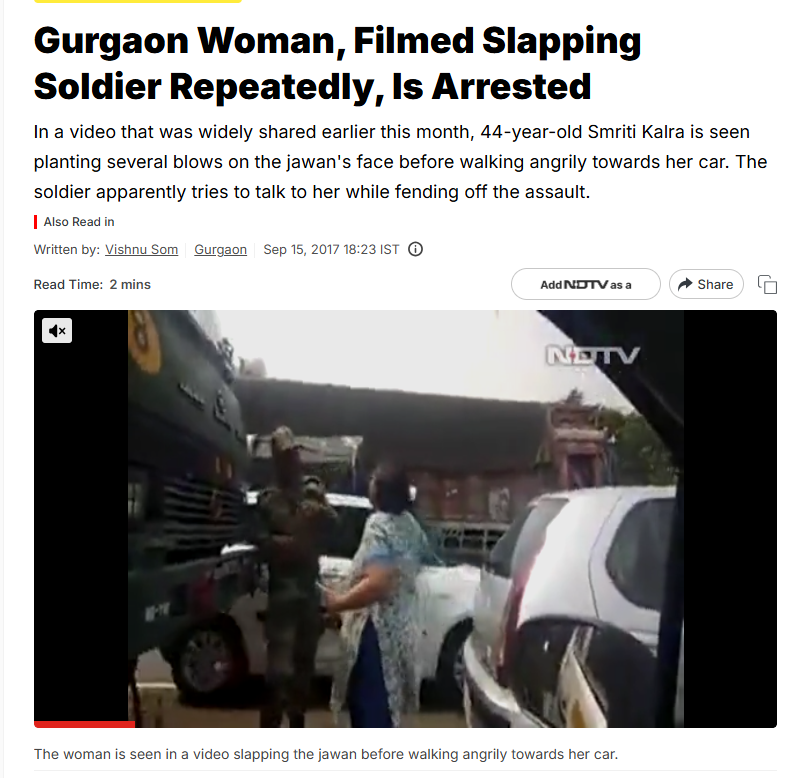
In the next stage of our research, we found a report on the Aaj Tak website related to the incident, which also featured the viral video. The report included an exclusive interview with the Army personnel involved in the incident. He was identified as Mahavir Singh, who was serving as a Junior Commissioned Officer (JCO) in the Army at the time.
In an exclusive interview with Aaj Tak, Mahavir Singh said that he was deeply saddened by the incident. He questioned how anyone could behave in such a manner with Indian Army personnel, abuse them, or slap them. He said that the Army vehicle was moving slowly when a car suddenly came in front of it and started driving ahead of them. A woman was the only person in the car, and she was allegedly driving in a zigzag manner in front of the Army vehicle.
Conclusion
Our research found that the viral video is being shared with a misleading context. The video is not from a recent incident but from a road rage incident that took place in the Vasant Kunj-Rajokari Flyover area of South Delhi in September 2017. According to available media reports, the woman had allegedly misbehaved with Army personnel and slapped one of the soldiers during the incident. Mahavir Singh, who was serving as a JCO in the Army at the time, also spoke to the media about the incident. Our research found no credible information confirming that the Army personnel had followed or harassed the woman. Therefore, the claim that the video from the 2017 incident shows a woman slapping a soldier in response to being allegedly followed or harassed by him is misleading.
