
#FactCheck: AI-Generated Image Falsely Shared as Sushant Singh Rajput’s Last Moments
Executive Summary
A picture of late actor Sushant Singh Rajput is being shared on social media. In the picture, a woman can be seen holding him, while another person is standing beside him. The social media post claims that the picture is from the last days of Sushant Singh Rajput’s life.CyberPeace Research found the viral claim to be false. Our research found that the viral picture is not authentic, but was created using Artificial Intelligence (AI). The AI-generated image is being shared on social media with a misleading claim.
Claim:
On September 18, 2026, a Facebook user shared the viral picture with the caption, “How was Sushant Singh murdered? The photo is going viral.” The post link, archived link and screenshot are provided below.
https://www.facebook.com/reel/1591592259073828

Fact Check
To verify the authenticity of the viral image, we conducted a Google search using relevant keywords. However, we did not find any credible media report related to the viral image. In the next step of our research, we examined the viral image closely and noticed several inconsistencies that raised suspicion that it had been AI-generated. We then scanned the image using AI or Not. According to the results, the viral image was identified as AI-generated.
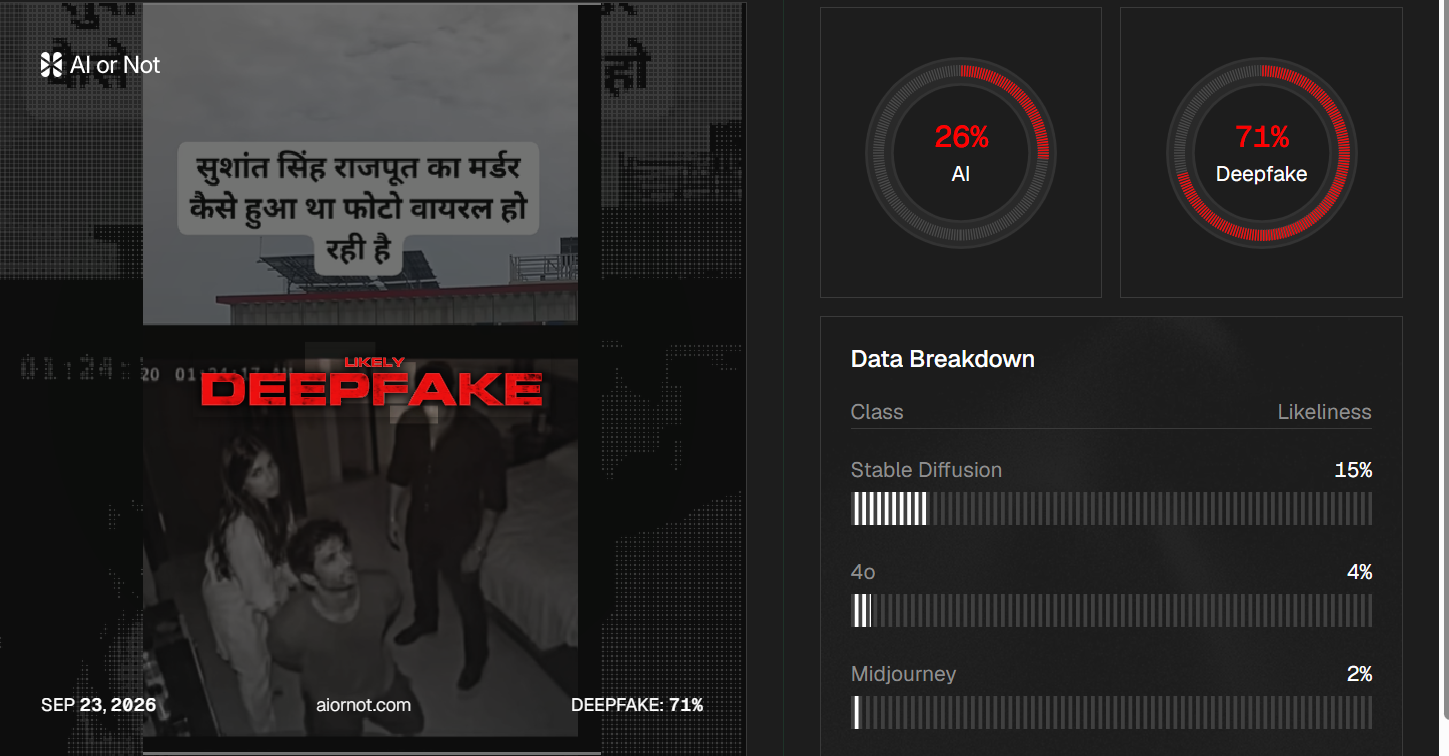
We also scanned the viral image using another AI detection tool, DeepAI. According to the results, the image was found to have a 96 percent likelihood of being AI-generated.

Conclusion
Our research found that the viral image is not authentic, but was created using Artificial Intelligence (AI). The AI-generated image is being shared on social media with a misleading claim.

Related Blogs

Introduction
Phone farms refer to setups or systems using multiple phones collectively. Phone farms are often for deceptive purposes, to create repeated actions in high numbers quickly, or to achieve goals. These can include faking popularity through increasing views, likes, and comments and growing the number of followers. It can also include creating the illusion of legitimate activity through actions like automatic app downloads, ad views, clicks, registrations, installations and in-app engagement.
A phone farm is a network where cybercriminals exploit mobile incentive programs by using multiple phones to perform the same actions repeatedly. This can lead to misattributions and increased marketing spends. Phone farming involves exploiting paid-to-watch apps or other incentive-based programs over dozens of phones to increase the total amount earned. It can also be applied to operations that orchestrate dozens or hundreds of phones to create a certain outcome, such as improving restaurant ratings or App Store Optimization(ASO). Companies constantly update their platforms to combat phone farming, but it is nearly impossible to prevent people from exploiting such services for their own benefit.
How Do Phone Farms Work?
Phone farms are a collection of connected smartphones or mobile devices used for automated tasks, often remotely controlled by software programs. These devices are often used for advertising, monetization, and artificially inflating app ratings or social media engagement. The software used in phone farms is typically a bot or script that interacts with the operating system and installed apps. The phone farm operator connects the devices to the Internet via wired or wireless networks, VPNs, or other remote access software. Once the software is installed, the operator can use a web-based interface or command-line tool to schedule and monitor tasks, setting specific schedules or monitoring device status for proper operation.
Modus Operandi Behind Phone Farms
Phone farms have gained popularity due to the growing popularity and scope of the Internet and the presence of bots. Phone farmers use multiple phones simultaneously to perform illegitimate activity and mimic high numbers. The applications can range from ‘watching’ movie trailers and clicking on ads to giving fake ratings and creating false engagements. When phone farms drive up ‘engagement actions’ on social media through numerous likes and post shares, they help perpetuate a false narrative. Through phone click farms, bad actors also earn on each ad or video watched. Phone farmers claim to use this as a side hustle, as a means of making more money. Click farms can be modeled as companies providing digital engagement services or as individual corporations to multiply clicks for various objectives. They are operated on a much larger scale, with thousands of employees and billions of daily clicks, impressions, and engagements.
The Legality of Phone Farms
The question about the legality of phone farms presents a conundrum. It is notable that phone farms are also used for legitimate application in software development and market research, enabling developers to test applications across various devices and operating systems simultaneously. However, they are typically employed for more dubious purposes, such as social media manipulation, generatiing fake clicks on online ads, spamming, spreading misinformation, and facilitating cyberattacks, and such use cases classify as illegal and unethical behaviour.
The use of the technology to misrepresent information for nefarious intents is illegitimate and unethical. Phone farms are famed for violating the terms of the apps they use to make money by simulating clicks, creating multiple fake accounts and other activities through multiple phones, which can be illegal.
Furthermore, should any entity misrepresent its image/product/services through fake reviews/ratings obtained through bots and phone farms and create deliberately-false impressions for consumers, it is to be considered an unfair trade practice and may attract liabilities.
CyberPeace Policy Recommendations
CyberPeace advocates for truthful and responsible consumption of technology and the Internet. Businesses are encouraged to refrain from using such unethical methods to gain a business advantage and mimic fake popularity online. Businesses must be mindful to avoid any actions that may misrepresent information and/ or cause injury to consumers, including online users. The ethical implications of phone farms cannot be ignored, as they can erode public trust in digital platforms and contribute to a climate of online deception. Law enforcement agencies and regulators are encouraged to keep a check on any illegal use of mobile devices by cybercriminals to commit cyber crimes. Tech and social media platforms must implement monitoring and detection systems to analyse any unusual behaviour/activity on their platforms, looking for suspicious bot activity or phone farming groups. To stay protected from sophisticated threats and to ensure a secure online experience, netizens are encouraged to follow cybersecurity best practices and verify all information from authentic sources.
Final Words
Phone farms have the ability to generate massive amounts of social media interactions, capable of performing repetitive tasks such as clicking, scrolling, downloading, and more in very high volumes in very short periods of time. The potential for misuse of phone farms is higher than the legitimate uses they can be put to. As technology continues to evolve, the challenge lies in finding a balance between innovation and ethical use, ensuring that technology is harnessed responsibly.
References
- https://www.branch.io/glossary/phone-farm/
- https://clickpatrol.com/phone-farms/
- https://www.airbridge.io/glossary/phone-farms#:~:text=A%20phone%20farm%20is%20a,monitor%20the%20tasks%20being%20performed
- https://innovation-village.com/phone-farms-exposed-the-sneaky-tech-behind-fake-likes-clicks-and-more/
Introduction
India is operating on digital rails today. Even as UPI is set to hit over 130 billion transactions by 2025, it already makes up around 80% of retail payments flow by volume. That volume is really what it is all about: a single extra transaction is simply another attack surface, and fraud has correspondingly scaled up. FY 2024-25 alone saw an estimated 485 crore in losses to UPI-related fraud through 632,000 reported frauds. The response from the RBI has not been a single rulebook but a layered and dynamic regulatory infrastructure that currently spans banks, NBFCs, payment aggregators, card networks, and, by extension, the fintechs that connect into all of these components. Knowing why the infrastructure is shaped the way it is and what actual enforcement looks like is far more crucial than having a checklist in mind. This write-up moves beyond summarising the rules to outlining the thinking behind them, the latest trends shaping the segment and the reality of an implementation roadmap.
Why Has RBI Cybersecurity Compliance Become Non-Negotiable?
Three forces are converging on regulated entities at once:
1. The threat surface has outgrown legacy controls: Core banking systems were never designed for an ecosystem of APIs, third-party payment gateways, and unregulated fintech partners sitting on top of them. Every integration is a potential entry point, and attackers know it.
2. Financial stability is now a cyber question, not just a credit question: a prolonged outage at a large payment system operator doesn't just hurt one bank's balance sheet; it can freeze retail payments for hundreds of millions of people. RBI treats this as systemic risk, which is why its post-2020 directions lean so heavily on resilience (the ability to keep operating through an attack) rather than just prevention.
3. Enforcement has escalated: The RBI's May 2025 single order penalised five different banks, including levying a 97.80 lakh penalty on ICICI Bank with one part attributable to its late reporting of a cybersecurity incident and another to a lapse in account alert systems; this demonstrates this rise in intensity. Remember, under Sections 46 and 47A of the Banking Regulation Act 1949, the RBI has the power to levy penalties irrespective of the occurrence of an actual breach if an individual fails to comply with procedures like not properly assessing vendor access or reporting incidents late or failing to update crisis plans or timely reports. Now this is a significant development, an issue even in the absence of a full-scale 'hack'.
The Regulatory Architecture: What Actually Applies to Whom
Rather than one framework, regulated entities are governed by several overlapping directions depending on their category:
- Banks: The original RBI Cyber Security Framework requires board-approved cybersecurity policies, 24x7 Security Operations Centres, and defined incident reporting timelines.
- NBFCs: NBFCs were initially governed under the Master Direction on IT Framework for NBFC Sector, which escalates accordingly as per size of asset – the framework underwent substantial change in shape with the RBI notifying Cybersecurity, Technology Risk, Resilience and Assurance Framework directions, 2026 for NBFCs, which lays specific obligations based on tier level (NBFC-Base Layer, Middle Layer, Upper Layer & Top Layer entities) on issues like MIS reporting, fraud analytics & impact of incident reporting.
- PSOs: Non-bank Payment system Operators PSOs have been regulated under the Master Direction on Cyber Resilience and Digital Payment Security Controls, 2024 (July 2024). Card networks, payment aggregators, PPI issuers and other PSOs come under its umbrella, with staged compliance based on the volume/business size (large – NPCI, card networks and the largest PPI issuers will meet requirements on April 1, 2025; medium ones by April 1, 2026; and small ones by April 1, 2028).
- Other Bodies: IT Governance (on all regulated entities broadly) The Master Direction on Information Technology Governance, Risk, Controls and Assurance Practices, 2023, became effective on April 1, 2024, and has set basic benchmarks for information technology (IT) strategy committees, IT risk management processes & IT assurance functions.
Overall trends' information across all these is clear: escalating tier requirements as per size and board-led controls are mandatory; a conscious acceptance that there will inevitably be data breaches in the future; and increasing emphasis on response and recovery.
Governance: Where RBI Compliance Actually Starts
A recurring theme across every RBI direction is that cybersecurity cannot be delegated entirely to the IT department. The Board of Directors is expected to own information security risk, with oversight typically delegated to a board subcommittee that meets at least quarterly. A board-approved information security policy, reviewed annually, must define the following:
- Roles and responsibilities across the Board, senior management, and the CISO
- Processes to identify, assess, monitor, and manage cyber risk
- Employee and stakeholder training and awareness programs
RBI's own 2022 thematic review of IT governance across 20 banks found unmanaged third-party vendor access, with vendors retaining privileged access to core systems long after a project ended at more than half the institutions reviewed. That kind of gap is a governance failure as much as a technical one: it happens because nobody owns the review cycle, not because the firewall is misconfigured.
Key Technical and Operational Controls
Once governance is in place, RBI's expectations translate into concrete control domains:
Infrastructure and access hardening: Network segmentation, endpoint protection, server hardening baselines, and multi-factor authentication for privileged access. Access reviews should be continuous or, at minimum, periodic, enforcing least privilege and separation of duties, not a one-time onboarding checkbox.
Vulnerability and patch management: Regular vulnerability scanning, risk-prioritised remediation, and a documented process for feeding vulnerability data into risk decisions, not just a scanner report sitting in an inbox.
Data security and localisation: Encryption at rest, in transit, and during processing; sound key management; data classification and masking; and adherence to the RBI's data localisation requirements for payment data.
Vendor and third-party risk: This has become one of the sharpest areas of regulatory focus. The 2024 PSO Master Directions explicitly require oversight of "unregulated entities" in the payment chain like payment gateways, third-party service providers, and vendors with due diligence, contractual security clauses, and ongoing monitoring baked in. For a bank or fintech, this means your compliance posture is only as strong as your weakest vendor's; the RBI increasingly holds the regulated entity accountable for its partners' failures, not just its own.
Security operations and incident response: 24x7 SOC capability, threat intelligence integration, and tested incident response plans via tabletop exercises and simulated attacks. A Cyber Crisis Management Plan (CCMP) drafted once and never rehearsed is, in practice, treated by RBI examiners as functionally absent.
Incident Reporting
This is where two separate regulatory clocks run in parallel, and conflating them is a common compliance mistake:
- RBI requirements: Regulated entities will normally have around 2-6 hours of detection to report most security incidents to the RBI with follow-up notifications as and when the nature of the incident unfolds.
- CERT-In's 6-hour rule: The CERT-In Directions dated April 2022 stipulate that every body corporate, which includes any bank, NBFC or payment aggregator, is obligated to report specified categories of cyber incidents to CERT-In within 6 hours of noticing them and not after fully confirming details at an additional 6 hours after noticing them. CERT-In directions also mandated that ICT system clocks are to be synced to NIC/NPL time servers, and system logs are to be maintained for a rolling 180 days within India.
- The Digital Personal Data Protection Act overlay: In the case of a data breach involving personal data, there will additionally be a 72-hour notification obligation from the data fiduciary to the Data Protection Board under the Digital Personal Data Protection Act, 2023, which runs in parallel to, and not in substitution of, the CERT-In time.
The practical consequences: If an SOP for incident response only maps one regime, then it would fail in an actual incident. We need a single intake process whereby multiple notification tracks are automatically triggered at the precise time an incident is detected, given that the inability to report "because we were still figuring it out" does not constitute an acceptable justification for a late notification under either regime.
Why Penetration Testing Sits at the Center of Compliance
RBI's VAPT (Vulnerability Assessment and Penetration Testing) mandate isn't a box-ticking annual scan. It's meant to validate, under real attack conditions, whether the governance and technical controls described above actually hold up. Automated scanning finds known vulnerabilities; penetration testing, ideally combining automated coverage with manual, business-context-aware testing, finds the logic flaws, chained exploits, and privilege escalation paths that scanners miss and that attackers actually use.
For most regulated entities, a realistic testing cadence looks like:
- Semi-annual vulnerability assessments across critical systems
- Annual (at minimum) penetration testing of applications, networks, and infrastructure supporting payment and customer-data systems
- Testing triggered by events before go-live, after major changes, and post-deployment.
- Documented remediation cycles and rescans, with reports mapped directly to the relevant compliance clauses for audit purposes
The Cost of Getting It Wrong
RBI's enforcement history grounds the financial impact of enforcement actions. In addition to the May 2025 fines levied on ICICI, Axis, IDBI, Bank of Baroda and Bank of Maharashtra, the RBI's published Enforcement Guidelines differentiate three levels of severity; procedural breaches such as delayed policy review or late incident notifications usually warrant 10 lakh to 1 crore fines plus formal reprimands and remediation orders with deadlines. Recurring governance breaches go farther than fines, resulting in restrictions on business activities and more stringent supervisory reporting, with egregious breaches leading to inclusion under the RBI's Prompt Corrective Action regime. Penalty orders are also publicly available, and the resulting toll on customer trust, partner trust, and investor confidence often dwarfs the fines.
A Practical Implementation Roadmap
For an organisation building or maturing its RBI compliance programme, a sensible sequence looks like this:
- Establish board-level ownership first: Form or formalise the Board IT/Risk sub-committee, appoint or empower a CISO with real authority, and get the information security policy formally approved, and this is the foundation every RBI examiner checks first.
- Mapping: A mid-sized NBFC, a large payment aggregator, and a scheduled commercial bank face different, overlapping obligations. Get this scoping wrong and you'll either over-engineer or leave gaps.
- Secure third-party access: Audit every vendor with system access, revoke stale privileges, and build vendor security clauses into contracts going forward, not retroactively.
- Build one incident response SOP: Run one compiled playbook that satisfies RBI, Cert-In and DPDP.
- Schedule and actually rehearse tabletop exercises: not just write a CCMP and file it away.
- Institutionalise VAPT as a continuous, risk-triggered programme rather than an annual compliance event, and ensure reports are structured to map directly onto RBI's compliance clauses for audit readiness.
- Track the regulatory calendar actively: 2024–2026 has brought new NBFC directions, PSO phase-ins, and ITG-RC&AP obligations in quick succession, and the pace shows no sign of slowing.
Conclusion
RBI's shift from perimeter-focused prevention to a risk-based, resilience-first model reflects a broader reality: in a digital payments ecosystem processing billions of transactions a month, breaches are not a hypothetical to plan around; they're an operational certainty to plan for. The frameworks discussed here, cyber resilience directions, IT governance mandates, CERT-In's reporting clock and the new NBFC cybersecurity directions aren't separate hurdles to clear individually. They're converging into a single expectation: that regulated entities can detect an incident quickly, contain it, recover fast, and prove with documentation, tested plans, and independent penetration test evidence that they were ready for it in the first place.
For banks, NBFCs, and fintechs operating in India today, that readiness is no longer just a regulatory requirement. It's the baseline cost of operating in the financial system at all.
References
Sources
- Astra Security — RBI Cybersecurity Compliance Checklist for Banks & NBFCs in 2026: https://www.getastra.com/blog/compliance/rbi-cybersecurity-compliance-checklist/
- TaxGuru — RBI Issues NBFC Cybersecurity and Technology Risk Directions, 2026: https://taxguru.in/rbi/rbi-issues-nbfc-cybersecurity-technology-risk-directions-2026-governance-framework.html
- Mondaq — Cyber Resilience and Digital Payment Security Governance (Master Directions, 2024): https://www.mondaq.com/india/fin-tech/1527836/cyber-resilience-and-digital-payment-security-governance-a-step-towards-secured-payments-systems
- TaxGuru — Master Directions on Cyber Resilience & Digital Payment Security Controls for Non-bank PSOs: https://taxguru.in/rbi/master-directions-cyber-resilience-digital-payment-security-controls-non-bank-payment-system-operators.html
- CyberNX — Ultimate Guide on RBI Master Directions for Cyber Resilience: https://www.cybernx.com/rbi-master-directions-guide/
- SIRI Law LLP — A Comprehensive Guide to India's CERT-In 6-Hour Cyber Incident Reporting Mandate: https://sirilawllp.com/a-comprehensive-guide-to-indias-cert-in-6-hour-cyber-incident-reporting-mandate/
- CreativeCyber — CERT-In 6-Hour Incident Reporting SOP for Indian Banks & NBFCs: https://creativecyber.in/resources/cert-in-6-hour-incident-reporting/
- BW Businessworld — RBI Slaps Penalties on ICICI, Axis and Three Others Over Compliance Failures (May 2025): https://www.businessworld.in/article/rbi-slaps-penalties-on-icici-axis-three-others-over-compliance-failures-555643
- FluxForce — RBI Cyber Framework: Banks' Requirements & Penalties: https://www.fluxforce.ai/regulations/rbi-cyber-security-framework-banks
- MYITMANAGER — RBI Cybersecurity Guidelines 2026: What Banks and NBFCs Must Do: https://myitmanager.in/rbi-cybersecurity-guidelines-2026-banks-nbfcs/

Introduction
A Pew Research Center survey conducted in September 2023, found that among 1,453 age group of 13-17 year olds projected that the majority of the age group uses TikTok (63%), Snapchat (60%) and Instagram (59%) in the U.S. Further, in India the 13-19 year-olds age group makes up 31% of social media users in India, according to a report by Statista from 2021. This has been the leading cause of young users inadvertently or deliberately accessing adult content on social media platforms.
Brief Analysis of Meta’s Proposed AI Age Classifier
It can be seen as a step towards safer and moderated content for teen users, by placing age restrictions on teen social media users as sometimes they do not have enough cognitive skills to understand what content can be shared and consumed on these platforms and what can not as per their age. Moreover, there needs to be an understanding of platform policies and they need to understand that nothing can be completely erased from the internet.
Unrestricted access to social media exposes teens to potentially harmful or inappropriate online content, raising concerns about their safety and mental well-being. Meta's recent measures aim to address this, however striking a balance between engagement, protection, and privacy is also an essential part.
The AI-based Age Classifier proposed by Meta classifies users based on their age and places them in the ‘Teen Account’ category which has built-in limits on who can contact them, the content they see and more ways to connect and explore their interests. According to Meta, teens under 16 years of age will need parental permission to change these settings.
Meta's Proposed Solution: AI-Powered Age Classifier
This tool uses Artificial Intelligence (AI) to analyze users’ online behaviours and other profile information to estimate their age. It analyses different factors such as who follows the user, what kind of content they interact with, and even comments like birthday posts from friends. If the classifier detects that a user is likely under 18 years old, it will automatically switch them to a “Teen Account.” These accounts have more restricted privacy settings, such as limiting who can message the user and filtering the type of content they can see.
The adult classifier is anticipated to be deployed by next year and will start scanning for such users who may have lied about their age. All users found to be under 18 years old will be placed in the category of teen accounts, but 16-17 year olds will be able to adjust these settings if they want more flexibility, while younger teens will need parental permission. The effort is part of a broader strategy to protect teens from potentially harmful content on social media. This is especially important in today’s time as the invasion of privacy for anyone, particularly, can be penalised due to legal instruments like GDPR, DPDP Act, COPPA and many more.
Policy Implications and Compliances
Meta's AI Age Classifier addresses the growing concerns over teen safety on social media by categorizing users based on age, restricting minors' access to adult content, and enforcing parental controls. However, reliance on behavioural tracking might potentially impact the online privacy of teen users. Hence the approach of Meta needs to be aligned with applicable jurisdictional laws. In India, the recently enacted DPDP Act, of 2023 prohibits behavioural tracking and targeted advertising to children. Accuracy and privacy are the two main concerns that Meta should anticipate when they roll out the classifier.
Meta emphasises transparency to build user trust, and customizable parental controls empower families to manage teens' online experiences. This initiative reflects Meta's commitment to creating a safer, regulated digital space for young users worldwide, it must also align its policies properly with the regional policy and law standards. Meta’s proposed AI Age Classifier aims to protect teens from adult content, reassure parents by allowing them to curate acceptable content, and enhance platform integrity by ensuring a safer environment for teen users on Instagram.
Conclusion
Meta’s AI Age Classifier while promising to enhance teen safety and putting certain restrictions and parental controls on accounts categorised as ‘teen accounts’, must also properly align with global regulations like GDPR, and the DPDP Act with reference to India. This tool offers reassurance to parents and aims to foster a safer social media environment for teens. To support accurate age estimation and transparency, policy should focus on refining AI methods to minimise errors and ensure clear disclosures about data handling. Collaborative international standards are essential as privacy laws evolve. Meta’s initiative is intended to prioritise youth protection and build public trust in AI-driven moderation across social platforms, while it must also balance the online privacy of users while utilising these advanced tech measures on the platforms.
References
- https://familycenter.meta.com/in/our-products/instagram/
- https://www.indiatoday.in/technology/news/story/instagram-will-now-take-help-of-ai-to-check-if-kids-are-lying-about-their-age-on-app-2628464-2024-11-05
- https://www.bloomberg.com/news/articles/2024-11-04/instagram-plans-to-use-ai-to-catch-teens-lying-about-age
- https://tech.facebook.com/artificial-intelligence/2022/6/adult-classifier/
- https://indianexpress.com/article/technology/artificial-intelligence/too-young-to-use-instagram-metas-ai-classifier-could-help-catch-teens-lying-about-their-age-9658555/
