
#FactCheck: Viral Video of Storm Destruction in Odisha Is Actually From Telangana
Executive Summary
A ‘deep depression’ formed over the Bay of Bengal made landfall along the Andhra Pradesh and Odisha coasts in late September 2026, affecting several districts. A video is going viral on social media in connection with the weather system, purportedly showing its impact. Some users are sharing the video claiming that it shows the effects of the storm in Odisha. CyberPeace Research fact-checked the viral claim and found that the impact of the storm was reported in Andhra Pradesh, Odisha, Telangana and Chhattisgarh. However, the viral video showing the destruction caused by the storm is actually from Bhadradri Kothagudem in Telangana.
Claim
Instagram user ‘deepak_.pandey900’ posted a video on September 24, 2026, along with an archive link, claiming that “Cyclone Arnab, which formed over the Bay of Bengal, made landfall along the north Andhra Pradesh and south Odisha coasts between 11 pm and 1 am. Heavy rainfall is occurring in the coastal districts of both states due to its impact. Schools have been closed in 10 districts of southern Odisha, and around 5,000 people have been shifted to safer locations. Traffic was disrupted after four bridges in Malkangiri were submerged, and the National Highway was also closed as a precautionary measure. Strong winds caused 10 fishing boats to sink and dozens of others to be damaged in Bhadrak.”
https://www.instagram.com/deepak_.pandey900/reel/DdrZwOaBYjd

Fact Check
To verify the viral claim, we first conducted a Google Lens search using keyframes extracted from the video. X user ‘Telangana365’ shared the video on September 23, 2026, with the caption: “The ‘Arnab cyclone’ has caused massive destruction in Morampalli Banjara of Burgampadu mandal in Bhadradri Kothagudem district. The situation is such that it is difficult to understand what is happening. It is completely dark, with heavy dust and dark clouds all around. According to the victims, they witnessed a terrifying scene. Strong winds uprooted trees and blew away thatched roofs... people were even thrown some distance by the gusts of wind. Fortunately, they suffered only minor injuries.”
https://x.com/Telangana365/status/2102743504715907406?s=20

The video was also posted on the YouTube channel ‘TV2_NEWS’ on September 23, 2026, identifying it as footage from Burgampadu mandal in Telangana.
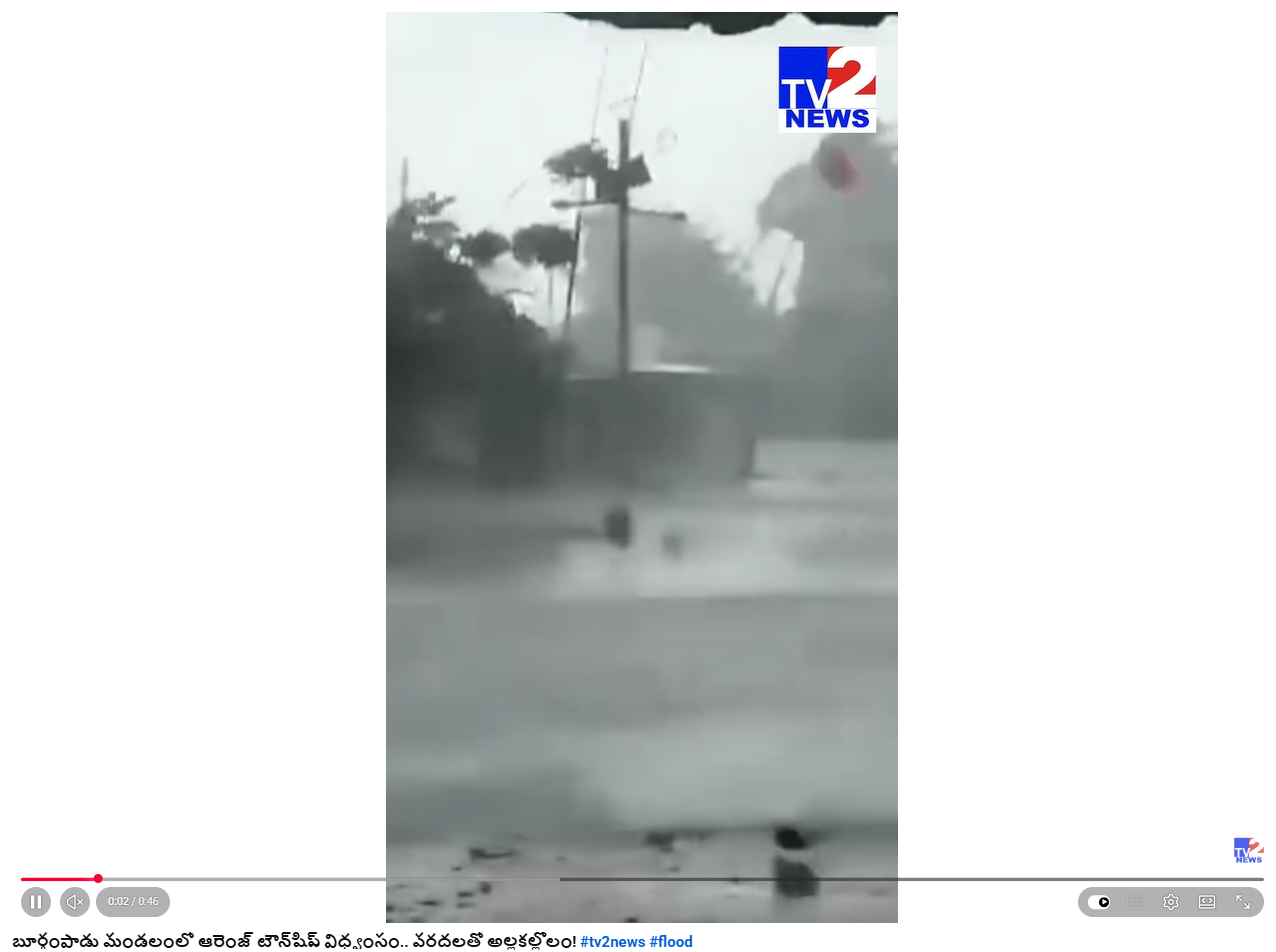
A report published on the website of Telangana-based news portal ‘Big TV’ on September 24, 2026, used a keyframe from the video. According to the report, “Cyclone Arnab, which formed over the Bay of Bengal, has caused widespread destruction. Its impact has been felt not only in Odisha and Andhra Pradesh but also significantly in Telangana. The cyclone caused destruction in Bhadradri Kothagudem district soon after crossing the coast. It suddenly wreaked havoc in Morampalli Banjara of Burgampadu mandal. Heavy rainfall and strong winds engulfed the area. Several people were injured during the incident.”

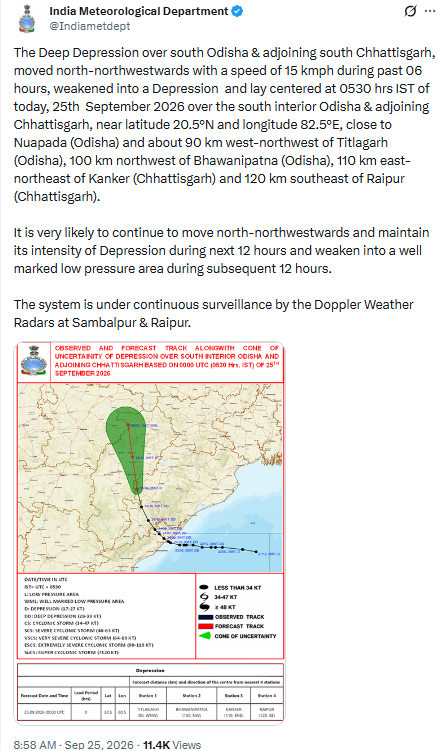
According to information shared by the India Meteorological Department (IMD) on its X handle at around 9 am on September 25, 2026, “The Deep Depression over south Odisha and adjoining south Chhattisgarh moved north-northwestwards at a speed of 15 kmph during the past six hours. It weakened into a Depression and lay centred at 5:30 am on September 25, 2026, over interior south Odisha and adjoining Chhattisgarh. It is very likely to continue moving north-northwestwards and maintain its intensity as a Depression for the next 12 hours. Thereafter, it is expected to weaken into a Well-Marked Low Pressure Area during the subsequent 12 hours.”
Conclusion:
The Deep Depression that formed over the Bay of Bengal caused heavy rainfall in Andhra Pradesh, Telangana and Odisha. However, the viral video showing the destruction caused by the storm is actually from Telangana.

Related Blogs
Artificial Intelligence (AI) continues to grow in importance in today’s world not just as technological advancement but also becoming the backbone of economic growth, national security, scientific research, and digital governance. However, AI innovations of such a sophisticated kind require significant computing power that is currently only within the reach of a few countries. Against this backdrop, India and the United Arab Emirates (UAE) have taken a significant step by partnering to build one of India's most powerful AI supercomputing infrastructures. What began as a discussion about digital infrastructure under the ambit of the new found India-UAE tech relationship, has come to a stage that is likely to usher in new AI-centric developments in the country, while bolstering the partnership between India and UAE.
From Vision to Concrete Action
This collaboration stemmed from the strengthening relationship between India and the UAE. The goal is to focus more on digital cooperation after the 2023 G20 Summit held in India. During this period, Artificial Intelligence, digital public infrastructure, and strong digital ecosystems became key topics of discussion between the two countries. This partnership received formal recognition with the India-UAE Digital Infrastructure Memorandum of Understanding (MoU) signed in 2024. This agreement identified Artificial Intelligence, high-performance computing (HPC), cloud infrastructure, and digital innovation as priority areas for cooperation.
The initiative has now moved from policy talks to actual implementation. In February 2026, the UAE announced plans to deploy an 8-exaflop AI Super Computing Cluster in partnership between CDAC and in May 2026, when our Hon’ble Prime Minister visited UAE, both governments formalized the commercial framework for establishing the system, marking one of the largest AI infrastructure collaborations between the two countries. It was one the significant agendas discussed between the two countries among others.
What Does the Agreement Include?
The agreement between the countries is for the deployment of ‘Condor Galaxy India supercomputer’, which is an AI supercomputing cluster designed specifically for complex and advanced artificial intelligence workloads. Some of the major points of agreement include:
- Deployment of an 8 Exaflop Super Computing Cluster, meaning it can perform up to eight quintillion (8 × 10¹⁸) AI-related calculations per second. This would place it among the world's most powerful AI supercomputing systems.
- This project will be implemented by G42, which is an Abu Dhabi-based AI technology company, in partnership with India's Centre for Development of Advanced Computing (C-DAC).
- The computing infrastructure will utilise 64 Cerebras CS-3 AI systems, built using wafer-scale processor technology designed for large AI models.
- G42 and C-DAC will jointly oversee installation, deployment, operation, and maintenance of the infrastructure.
- The supercomputer will support India's IndiaAI Mission, strengthening domestic AI research and innovation. It is also a step in the direction of India’ AI mission through mindful collaboration.
- Notably, the system will be physically located within India and operate under Indian governance frameworks and laws ensuring that sensitive datasets remain under India’s jurisdiction.
While beyond the infrastructure, the partnership also aims for research efforts within fields like healthcare & genomics, climate change modeling & optimization of energy, geointelligence, research studies & government usages, as well as growing startups in AI. It is hoped that the computing infrastructure will be made accessible to researchers, academic bodies, government organizations & startups from both nations to foster collaborative research.
How Are India and the UAE Collaborating?
The partnership involves more than simply sharing the hardware, the two countries are entering into a multiyear technology partnership where each brings different but complementary expertise. On one hand India offers the knowledge and experience of C-DAC, a large number of AI engineers, startups, academics and researchers, and the IndiaAI Mission, a framework to enable access to the advanced computing infrastructure needed to use these researchers.
In return, the UAE offers investment in AI infrastructure and expertise in global AI cloud infrastructure, and sovereign AI platform development, from AI cloud infrastructure company G42, a company that has deployed large AI computing clusters as part of the Condor Galaxy network. Among the biggest names involved in the new initiative is also Cerebras Systems, the artificial intelligence (AI) computing company that will supply the AI chips for the supercomputer. The leading designer of AI compute technology, Cerebras develops the world's fastest AI hardware. In particular, the flagship Wafer Scale Engine (WSE-3), a revolutionary single chip that is the largest AI processor in the world, offers significant gains in speed and computational efficiency. This partnership will spur a joint R&D effort. That allows both India and the UAE to harness their respective knowledge and resources to accelerate better results for all stakeholders in various domains.
This collaboration will enable joint research and development (R&D), allowing both countries to combine their expertise and resources to produce more effective outcomes that are mutually beneficial across multiple sectors.
Cyber and Digital Security Benefits
From a cybersecurity perspective, this partnership is particularly significant.
- Moving towards AI Sovereignty
Possessing the infrastructure within India can ensure that sensitive government, healthcare, research, and enterprise data remains within Indian jurisdiction. This will reduce dependence on foreign cloud infrastructure while improving regulatory control over sensitive and critical datasets.
- Modernising Cyber Defence
Having a high-performance computing system will improve our cyber defence through AI-based threat detection, malware flagging, vulnerability assessment and cyber testing of safeguarding critical infrastructure. These are necessary in current times considering the growing capabilities and mode of cyber attacks.
- Secure AI Development
Countries worldwide are moving toward "Sovereign AI" which is a goal of developing AI systems within nationally governed infrastructure to protect sensitive information. The India-UAE partnership directly supports this objective by combining national governance and world-class computing capability development.
- Economic Benefits for India
The project offers several long-term economic advantages. First, easing the entry barrier for startups and researchers in India as they are often reliant on expensive overseas cloud computing services. Second, enabling availability of more computing power that can accelerate innovation across sectors such as healthcare, agriculture, manufacturing, fintech, education, and logistics. Third, stronger AI computing infrastructure could foster the inflow of global capital into India’s tech ecosystem by provisioning requisite resources to run frontier AI computations. Finally, the initiative supports India's ambition of becoming a global AI innovation hub under the IndiaAI Mission by enabling domestic development of advanced AI models rather than relying solely on imported technologies that will in long-term make India a sought out destination as an AI-hub.
Why the UAE Benefits?
In the case of the UAE, the partnership further helps Abu Dhabi's vision to become a global leader in artificial intelligence by extending the reach of G42's AI capabilities internationally, while strengthening ties with one of the world’s leading digital economies as a trusted strategic technology partner. In harnessing India's extensive talent base, research communities, and growing AI capabilities, the UAE unlocks opportunities for scale and innovation, while also cementing its status as a dependable technological enabler across emerging economies. The project is a part of the UAE’s long-standing agenda to move away from hydrocarbons and towards growth in areas such as AI, digital infrastructure, and technologies of the future.
Conclusion
The India-UAE supercomputer collaboration is a step in the direction of being self-dependent in terms of having a strong computing infrastructure base in India. This also changes the outlook of international technology partnerships from traditional trade relationships to collaborations focused on AI, digital infrastructure, research, and strategic innovation. AI is becoming a defining factor in economic competitiveness and national resilience on a global scale and the access to sovereign computing infrastructure will increasingly shape our influence in world markets. By uniting UAE’s investment capacity and AI infrastructure expertise and India’s advantages. If successfully implemented, the collaboration could serve as a model of what cooperation toward sovereign and trusted AI can entail.
REFERENCES
- https://www.pib.gov.in/PressReleasePage.aspx?PRID=2006207®=48&lang=2
- https://www.pib.gov.in/PressReleaseDetail.aspx?PRID=2261385®=48&lang=1
- https://www.pib.gov.in/PressReleaseDetail.aspx?PRID=2261393®=48&lang=1

Introduction
On April 30, 2025, the Supreme Court of India delivered a landmark judgment that cast a sharp light on one of the most overlooked yet pressing issues in modern governance—digital inequity. In a country that has a staggering 900 million Internet users, the ruling highlights a disheartening reality, a paradox that brings the “digital divide” to centre stage. While India may be the world’s second-largest online market, a significant segment of its population remains digitally disenfranchised. The judgment, delivered in response to two interconnected petitions, underscored that access to the internet is no longer a luxury but a lifeline integral to exercising fundamental rights. The court pointed out in clear terms that the government must build a digital ecosystem that is inclusive and accessible to all and attributed the right to digital access as an intrinsic part of the right to life and liberty under Article 21 as enshrined under the Indian Constitution.
Understanding the Context: What Prompted the Petitions?
The judgment springs out of two writ petitions, which sought instructions or guidelines for people with blindness or limited vision and acid attack survivors, respectively, to conduct digital Know Your Customer (KYC)/e-KYC/video KYC mandated by RBI’s KYC Master Directions, 2016, which were reserved for judgment on January 28. The court delivered the judgment on April 30, 2025, emphasising the fact that true inclusion in this digital era is confounded in an inclusive digital infrastructure, and it must provide reasonable accommodation to those who face impediments due to any disability or disfigurement.
In consonance with its view, it laid down various guidelines that ensure that all persons with disabilities or acid attack survivors are treated even when digital processes are involved in accordance with the provisions of the Right of Persons with Disabilities Act, 2016 (hereinafter referred to as “RPwD Act”)
Another major observation made by the Honourable SC judges is that the mode of facilitation of government services is through digital platforms, i.e., e-governance, and access to all these welfare schemes is the right of every citizen, irrespective of the fact that they suffer from any disability. The failure of the provisioning of e-governance of these facilities to these individuals is a gross failure of the objectives of these schemes.
Key Observations and Directives
The court directed the government to release fresh guidelines that establish alternative methods to conduct digital KYC/e-KYC for all persons who suffer any impairment, low vision, or disfigurement with greater sensitivity, particularly for acid-attack survivors. The court made its intention very clear that the right to digital access is intrinsic to the right to life and liberty. All the tasks that are included within the ambit of digital KYC, such as pen-on-paper signatures, screen signatures, and the brief window for OTP entry, create an inaccessible and exclusionary framework, violating not just the dignity but the legal rights granted protection under the RPwD Act, 2016. The ruling directs a fundamental reimagining of digital governance through the lens of inclusion, equality, and dignity.
Conclusion
The court is not mincing its words when it declares digital accessibility as a constitutional imperative; it has made it clear that bridging the digital divide is no longer optional but a legal duty. The decision marks the new beginning and a propeller of digital transformation, and a delightful amalgamation of digital access and the rights of people. The effect of this judgment will not be restricted to one class of people. Still, it will cater to all those individuals who face these obstacles on a daily basis due to the exclusionary nature of digital platforms.
References

Introduction
The rise of artificial intelligence has transformed how individuals search for information, buy and compare products online. Unlike the traditional search engines like Google that presents the user with a set of links and directs users to websites, AI-powered systems provide synthesised answers and recommendations which means we don't have to click through every link to find what we are looking for, we simply have to ask an LLM and it provides recommendations based on our needs expressed through prompt. This development has raised important legal and commercial questions, one such question was addressed in the judgement of Indiamart Inter Mesh Limited v. Open AI Inc. and Others (2026 SCC OnLine Cal 5738) decided by HMJ Ravi Krishan Kapur of Calcutta High court on 20 May 2026. If an AI platform becomes a primary source of information, can a business demand inclusion in its responses? Is it a legal injury if the LLM omits a business? More fundamentally, how do the existing laws classify technologies that not only process information, but also generate new content? These were the questions that came before Calcutta High Court. Although the dispute arose from Indiamart’s complaint regarding visibility on ChatGPT search, the judgement explored beyond the disagreement between two private entities.
The Dispute
IndiaMart is one of India’s largest electronic business-to-business marketplaces since 1996, serving millions of buyers and sellers across India. They also have registered trademarks and their entire business depends on visibility on the internet considering the digitalisation of the market. Open AI launched ChatGPT search in October 2024, which is a feature that supplements AI responses with links to relevant web sources. Indiamart alleged that ChatGPT was not displaying links to their online platform in the same way that it displayed links to other competing services or individual sellers. A major grievance raised by Indiamart was that ChatGPT allegedly bypassed IndiaMart market listings by directing users to sellers’ individual websites while continuing to provide platform level links for other competing platforms. Hence, they contended that this practice diverted users away from their platform and negatively affected their business interests. The company argued that such exclusion amounted to discriminatory treatment and resulted in economic harm, diluted its trademarks and amounted to disparagement. They alleged that it violated their rights under article 14, 19, 21 under the constitution and rights under IT Act and IT Rules also. When IndiaMart sought an explanation from OpenAI, the company stated that its decision was influenced by the inclusion of IndiaMart in the United States Trade Representative (USTR) Review of Notorious Markets for Counterfeiting and Piracy 2024, a U.S. government report that identifies online and physical marketplaces alleged to facilitate intellectual property infringements. IndiaMart challenged this justification, arguing that the USTR report has no statutory or binding force in India. It further alleged selective discrimination, pointing out that several other platforms featured on the same USTR list including DHGate, Pinduoduo, Shopee, and Taobao continued to remain accessible through ChatGPT-generated responses. Consequently, IndiaMart approached the Calcutta High Court seeking interim relief directing ChatGPT to display and provide access to IndiaMart links in its responses.
ARGUMENTS BEFORE THE COURT
IndiaMart's contentions: They argued that ChatGPT, because its search feature, performs the role of an "intermediary" within the meaning of Section 2(1)(w) of the IT Act and is therefore required to comply with the obligations imposed under the Information Technology (Intermediary Guidelines and Digital Media Ethics Code) Rules, 2021. Relying on Rule 3(1)(n), IndiaMart argued that an intermediary cannot engage in discriminatory treatment of platforms or selectively restrict access to information. IndiaMart further maintained that users have a right to access information relating to its platform and that the omission of IndiaMart links from ChatGPT's responses violated this interest. They alleged violation of Articles 14, 19, and 21 of the Constitution, along with the broader principle of a user's "right to know", to argue that OpenAI owed an obligation to display IndiaMart listings in response to relevant queries. In addition, IndiaMart alleged that the exclusion of its links caused commercial harm, diluted its trademarks, amounted to disparagement, and constituted an unfair trade practice that adversely affected its business and reputation.
OpenAI's contentions: OpenAI asserted that IndiaMart had no legally enforceable ‘Right to visibility’ on ChatGPT. They argued that neither contract, statute, nor constitutional law imposed any obligation on OpenAI to display, prioritise, or recommend IndiaMart links in response to user queries. In the absence of any recognised legal right, there could be no actionable injury and therefore no valid cause of action. OpenAI also challenged the classification of ChatGPT as an "intermediary" under the Information Technology Act, 2000. According to OpenAI, ChatGPT does not merely host, transmit, or facilitate access to third-party content but also generates responses through its large language model (LLM) and therefore functions more closely as an "originator" than an intermediary. Consequently, the obligations applicable to intermediaries under the Information Technology (Intermediary Guidelines and Digital Media Ethics Code) Rules, 2021, including those relied upon by IndiaMart, were inapplicable. With respect to the USTR Notorious Markets List, OpenAI submitted that its reliance on the report formed part of its internal risk-management and business policies. Such decisions, it argued, were matters of private commercial judgment and not ordinarily subject to judicial review. OpenAI further pointed out that IndiaMart had also previously blocked ChatGPT from accessing and crawling its website that weakened the company's demand for greater visibility within ChatGPT-generated responses.
Court’s decision: The court rejected Indiamart's claim that they were entitled to be displayed in ChatGPT searches. The court emphasised the autonomy of private businesses, the court held that the right to carry on trade and business is "inviolable" and that no law can compel one private entity to operate their platform for the benefit of another, which is based on foundational economic philosophy of laissez faire. Unless there is a contractual, statutory or constitutional obligation, a platform has no duty to the other platform to promote or advance their economic interest. Applying this principle, the court found no such duty or “vested legal right” that entitled IndiaMart’s visibility on ChatGPT. The court reasoned that even if users possess the ‘right to know’, Indiamart could not convert that interest into an enforceable claim under article 19(1)(g) or other legal provision. The court looked at the dispute as one arising from commercial disadvantage rather than violation of any legally protected right. Although the reduced visibility may have had economic consequences, economic harm does not by itself create a cause of action.
The court also took into consideration whether ChatGPT should be classified as an intermediary under Section 2(1)(w) of the Information Technology Act, 2000 or as an originator under Section 2(1)(za). This was an important distinction, because the intermediaries can claim safe harbour protection under section 79 of the IT act, but the originators cannot. The court expressed a preliminary view that ChatGPT is generative capabilities, place it closer to an originator than an intermediary because, unlike conventional search engines, which identify and rank existing information, Generative AI systems, analyse the data and produce new output based on algorithms, which is in response to the user’s prompt. The Court also referenced the NITI Aayog National Strategy for Artificial Intelligence (pages 7 to 12) to support its observations that ChatGPT does not merely store, host or transmit information, it can produce essays, research material, code, creative writing, and other forms of content that did not previously exist in that exact form, hence extending beyond the conventional understanding of an intermediary. The court also recognised that it is a vexed issue and remains unsettled because AI systems operate in response to users instructions and do not function independently, which is why the court refrained from providing a definitive classification and acknowledged that the question may ultimately require legislative clarification as well.
In addition to this, the Court took the view that the IndiaMart’s grievances did not amount to an Intellectual property dispute, as they found no trademark infringement or dilution because any reference to the "IndiaMart" mark was merely descriptive and did not constitute commercial use "in the course of trade" under Section 29(4) of the Trade Marks Act. IndiaMart also hadn’t demonstrated any false or misleading use of its trademark.
Similarly, the Court found that claims of disparagement, trade libel, and injurious falsehood were unsustainable because such claims require the publication of a false statement that harms reputation and since ChatGPT had not published any derogatory statement about IndiaMart, the mere omission of links could not amount to disparagement or libel. The Court relied on Tech Plus Media v. Jyoti Janda, that allegations of unfairness or copyright infringement must be supported by specific pleadings and evidence.
Beyond the immediate dispute, the judgment shed light on the growing difficulty of applying legal categories created for an earlier internet era to generative AI systems. The Information Technology Act was enacted at a time when internet regulation focused primarily on websites, service providers, and electronic communications and therefore existing classifications may not adequately address the hybrid nature of contemporary AI technologies. The Court acknowledged OpenAI's concern that granting IndiaMart's request could trigger floodgates of litigation on similar claims from businesses dissatisfied with AI-generated visibility, however, it clarified that such concerns cannot outweigh genuine legal claims or fundamental rights. The Court suggested that legislative intervention may eventually be necessary.
Conclusion
This judgement not only addressed the visibility issue in AI generated responses, but also whether visibility itself can become a legally protected interest in AI-driven searches? As more and more users rely on AI generated output for their preference rather than traditional search engine output, the power to decide what information is displayed and what is not will eventually become economically significant. The Calcutta High Court through this judgement declined to create any such right through judicial interventions and also highlighted that the existing legal framework is not adequately equipped to address the novel challenges posed by generative AI.
(This blog is based on the judgment in Indiamart Inter Mesh Limited v. Open AI Inc. and Others, 2026 SCC OnLine Cal 5738, decided on May 20, 2026 by the Calcutta High Court, and related reporting by LiveLaw and SCC Times.)
References
- https://www.livelaw.in/high-court/calcutta-high-court/no-right-to-visibility-exists-on-private-ai-platforms-calcutta-high-court-refuses-to-direct-chatgpt-to-display-indiamart-links-536891
- https://www.scconline.com/blog/post/2026/06/03/chatgpt-intermediary-originator-it-act-calcutta-high-court/
- https://indiankanoon.org/doc/198449710/
