
#FactCheck: Video of West Bengal Police Uniforms Falsely Linked to Recent Protests in Delhi
Executive Summary
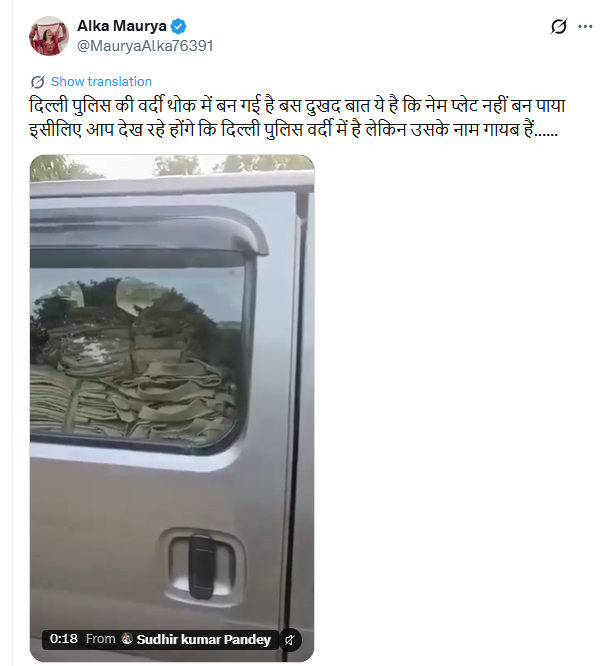
Amid reports of clashes between protesters and police at Jantar Mantar in Delhi, a video showing a car filled with khaki uniforms is going viral on social media. Several users have claimed that the video proves that goons were provided with khaki uniforms during the recent protests in Delhi. In one such video, a man claims that police personnel deployed on duty during the Jantar Mantar protests are not wearing nameplates. CyberPeace Research found that the video is from West Bengal and has no connection with the recent protests in Delhi.
Claim
An X user shared the video with the caption, “Delhi Police uniforms have been manufactured in bulk. The only unfortunate thing is that the nameplates could not be made. That is why you may have noticed that the personnel are wearing Delhi Police uniforms but their names are missing.” Online magazine Saamna also shared the video, claiming it was from Delhi.
https://x.com/MauryaAlka76391/status/2109322470411128921
https://ghostarchive.org/archive/hWCjI
Fact Check
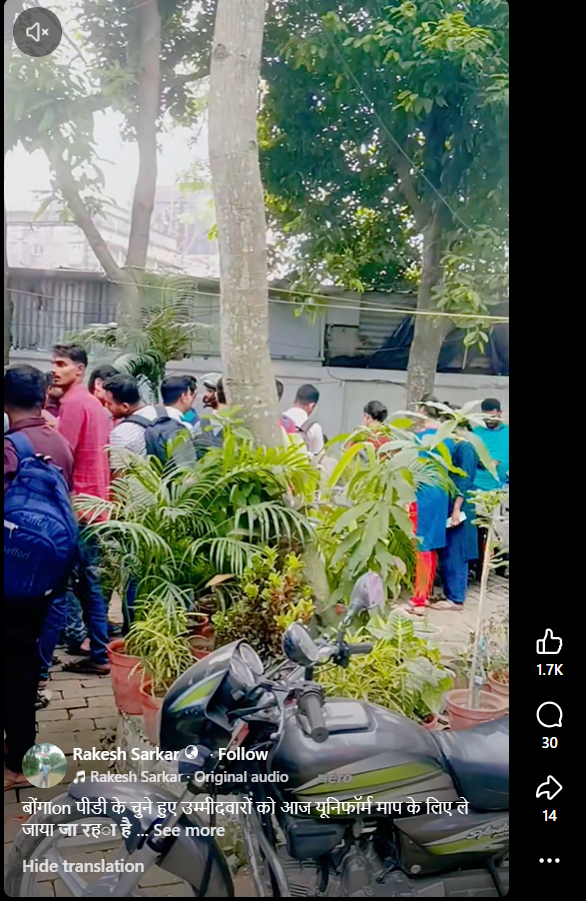
We noticed that people in the viral video could be heard speaking Bengali, which led us to suspect that the footage might be from West Bengal. A reverse search of its keyframes led us to a post shared by a Facebook user named Rakesh Sarkar on October 9. The post identified the location as Bagdah in West Bengal’s North 24 Parganas district. The post included hashtags such as ‘#WBP’, ‘#wbppolice’ and ‘West Bengal Police’. In the comments section, Sarkar stated that the uniforms shown in the video were meant for newly recruited personnel in the West Bengal Police.
https://www.facebook.com/reel/1681910233366141

The cover photo on Rakesh Sarkar’s Facebook timeline features the West Bengal Police logo. According to the information provided in his bio, Sarkar lives in Bangaon, a town in the North 24 Parganas district. On October 1, 2026, he shared a video showing several people standing in a queue while a man asked them to write something in a register one by one. The Bengali caption accompanying the post translates to: “Today, uniform measurements were taken for the selected candidates of the Bangaon Police Department.”
https://www.facebook.com/reel/1399250945143485
Conclusion
Our research found that the viral video is from West Bengal and has no connection with the recent protests in Delhi.

Related Blogs
Executive Summary
A video is rapidly going viral on social media, with the claim that transgender women assaulted an Indian Army officer in Thailand. The post further claims that the officer had failed to pay the agreed amount, following which the incident took place. A research by CyberPeace’s research wing found that the viral video is fake. In fact, the video shows an incident that took place in Pattaya, Thailand, in December 2025. The 52-year-old Indian national, Raj Jasuja, was allegedly assaulted by a group of transgender women following a dispute over payment for sexual services. Therefore, the claim made in the post is false.
Claim:
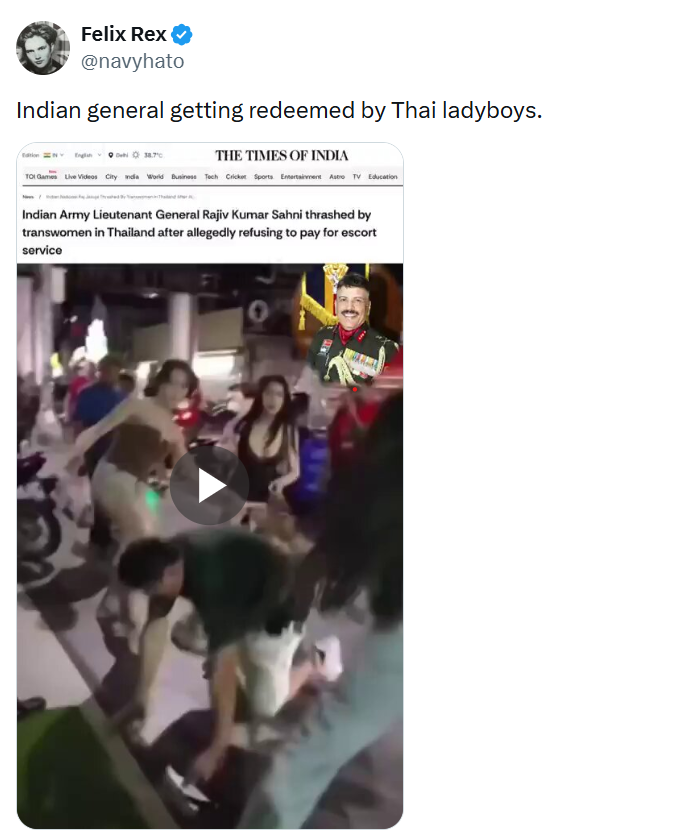
A video shared on social media claims that transgender women assaulted an Indian Army general in Thailand.
https://x.com/navyhato/status/2094322001490116659
https://archive.ph/Scfgd
Fact Check:
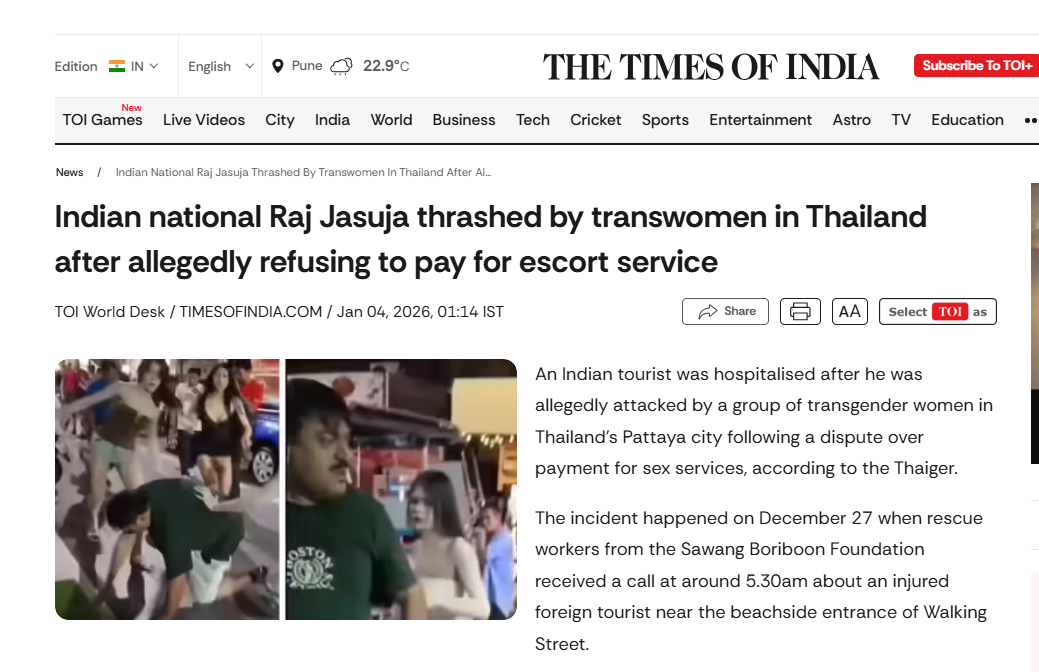
To verify the claim, we conducted a Google search using relevant keywords but found no credible media reports confirming that Indian Army Lieutenant General Rajiv Kumar Sahni was involved in the incident. During the subsequent research, we compared the viral screenshot with the original report published by The Times of India. The comparison revealed that the original headline, “Indian national Raj Jasuja thrashed by transwomen in Thailand after allegedly refusing to pay for escort service,” had been digitally altered to read, “Indian Army Lieutenant General Rajiv Kumar Sahni thrashed by transwomen in Thailand after allegedly refusing to pay for escort service.” Further, both the viral screenshot and the original report display the same breadcrumb trail — “News / Indian National Raj Jasuja Thrashed By Transwomen In T…”. This provides further evidence that the headline in the viral screenshot was digitally manipulated.
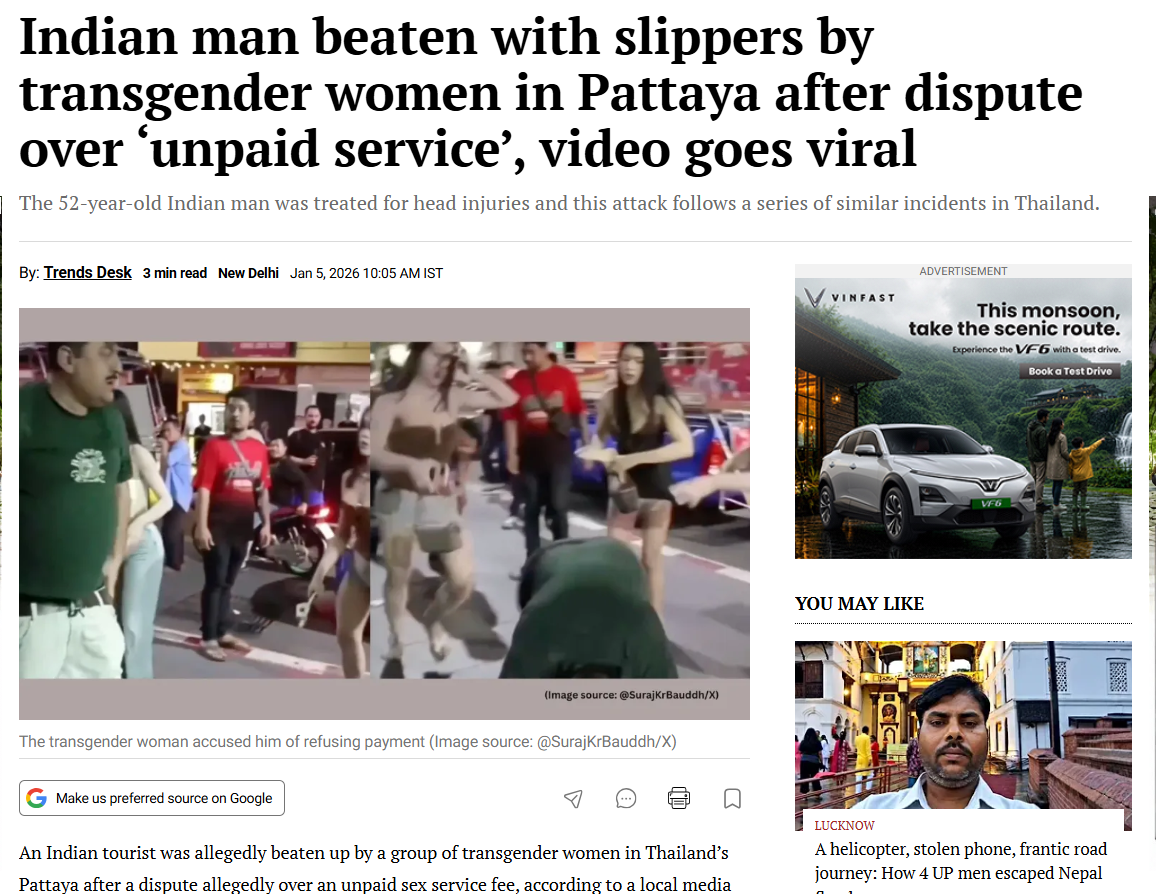
After establishing the context of the viral claim, we conducted a Google search using relevant keywords. During the search, we found a report published on The Indian Express website on January 5, 2026, which featured the same visuals as those seen in the viral video. According to the report, a 52-year-old Indian tourist was allegedly assaulted by a group of transgender women in Pattaya, Thailand. The incident reportedly stemmed from a dispute over an unpaid fee for sexual services. The viral video, recorded on December 27, shows three transgender women allegedly assaulting the man with slippers. According to the report, the dispute escalated after the man allegedly refused to pay the amount demanded and attempted to leave the spot in a car. One of the transgender women reportedly accused him of refusing to make the payment. He was subsequently kicked and beaten before emergency responders intervened.
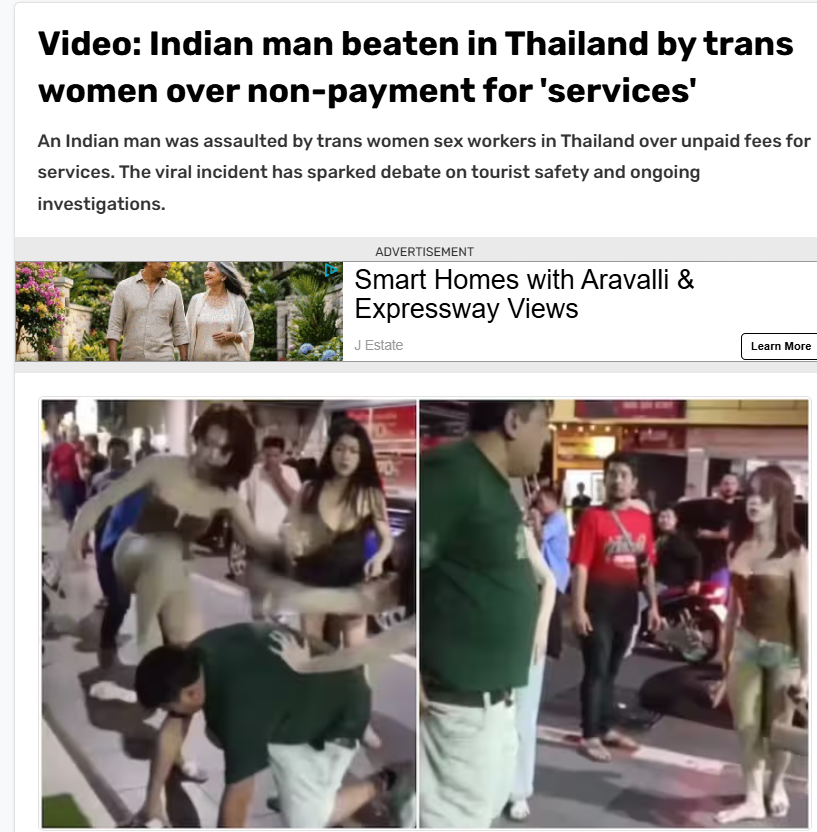
In the next step of our research, we found another report published on the India Today website on January 5, 2026. The report featured the same visuals as those seen in the viral video. According to the report, the incident took place on the morning of December 27, 2025, in the Walking Street area of Pattaya, Thailand.
Conclusion:
Our research found that the claim that Indian Army Lieutenant General Rajiv Kumar Sahni was assaulted in Thailand is false. The viral video actually shows an incident that took place in Pattaya, Thailand, in December 2025, in which 52-year-old Indian national Raj Jasuja was allegedly assaulted by a group of transgender women following a dispute over payment for sexual services. The viral post falsely links the incident to an Indian Army officer, thereby misrepresenting the identity of the person involved.

Executive Summary
A video featuring popular comedian Rajpal Yadav has recently gone viral on social media, claiming that he is currently lodged in Tihar Jail in connection with a loan default and cheque bounce case. In connection with this, another video showing Bollywood superstar Shah Rukh Khan is being widely shared online. In the viral clip, Khan is purportedly seen saying that he would help Rajpal Yadav get out of jail and also offer him a role in his upcoming film. However, research by the CyberPeace found the viral video to be fake. The clip is a deepfake, in which the audio has been manipulated using artificial intelligence. In the original video, Shah Rukh Khan is speaking about his life and personal experiences. Although several prominent Bollywood personalities have expressed support for Rajpal Yadav, the claims made in the viral video are misleading.
Claim
An Instagram user named “ayubeditz” shared the viral video on February 11, 2026, with the caption: “Rajpal Yadav bhai, stay strong, we are all with you — Shah Rukh Khan.” The link to the post and its archived version are provided below.

Fact Check
To verify the claim, we extracted key frames from the viral video and conducted a Google reverse image search. This led us to the original video uploaded on a YouTube channel titled “Locarno Film Festival” on August 11, 2024. According to the available information, Shah Rukh Khan was sharing insights about his life and career during a conversation with the festival’s Artistic Director, Giona A. Nazzaro. This raised strong suspicion that the viral video had been edited using AI.

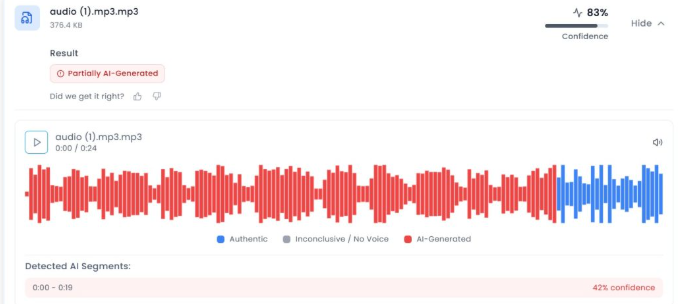
To further examine the authenticity of the audio, we analysed it using AI detection tools. The audio was first checked using Aurigin.ai, which indicated an 83 percent probability that the voice in the viral clip was AI-generated.
Conclusion
The CyberPeace’s research confirmed that the claim associated with Shah Rukh Khan’s viral video is false. The video is a deepfake in which the audio has been altered using artificial intelligence. In the original footage, Khan was discussing his life and experiences, and he did not make any statement about helping Rajpal Yadav.

Executive Summary:
In the age of virtuality, misinformation and misleading techniques shape the macula of the internet, and these threaten human safety and well-being. Recently, an alarming fake information has surfaced, intended to provide a fake Government subsidy scheme with the name of Indian Post. This serves criminals, who attack people's weaknesses, laying them off with proposals of receiving help in exchange for info. In this informative blog, we take a deep dive into one of the common schemes of fraud during this time. We will go through the stages involved which illustrates how one is deceived and offer practical tips to avoid the fall.
Introduction:
Digital communication reaches individuals faster, and as a result, misinformation and mails have accelerated their spread globally. People, therefore, are susceptible to online scams as they add credibility to phenomena. In India, the recently increased fake news draws its target with the deceptive claims of being a subsidy from the Government mainly through the Indian post. These fraudulent schemes frequently are spread via social networks and messaging platforms, influence trust of the individual’s in respectable establishments to establish fraud and collect private data.
Understanding the Claim:
There is a claim circulating on the behalf of the Government at the national level of a great subsidy of $1066 for deserving residents. The individual will be benefited with the subsidy when they complete the questionnaire they have received through social media. The questionnaire may have been designed to steal the individual’s confidential information by way of taking advantage of naivety and carelessness.
The Deceptive Journey Unveiled:
Bogus Offer Presentation: The scheme often appeals to people, by providing a misleading message or a commercial purposely targeted at convincing them to act immediately by instilling the sense of an urgent need. Such messages usually combine the mood of persuasion and highly evaluative material to create an illusion of being authentic.
Questionnaire Requirement: After the visitors land on attractive content material they are directed to fill in the questionnaire which is supposedly required for processing the economic assistance. This questionnaire requests for non private information in their nature.
False Sense of Urgency: Simultaneously, in addition to the stress-causing factor of it being a fake news, even the false deadline may be brought out to push in the technique of compliance. This data collection is intended to put people under pressure and influence them to make the information transfer that immediate without thorough examination.
Data Harvesting Tactics: Despite the financial help actually serving, you might be unaware but lies beneath it is a vile motive, data harvesting. The collection of facts through questionnaires may become something priceless for scammers that they can use for a good while to profit from identity theft, financial crimes and other malicious means.
Analysis Highlights:
- It is important to note that at this particular point, there has not been any official declaration or a proper confirmation of an offer made by the India Post or from the Government. So, people must be very careful when encountering such messages because they are often employed as lures in phishing attacks or misinformation campaigns. Before engaging or transmitting such claims, it is always advisable to authenticate the information from trustworthy sources in order to protect oneself online and prevent the spread of wrongful information
- The campaign is hosted on a third party domain instead of any official Government Website, this raised suspicion. Also the domain has been registered in very recent times.

- Domain Name: ccn-web[.]buzz
- Registry Domain ID: D6073D14AF8D9418BBB6ADE18009D6866-GDREG
- Registrar WHOIS Server: whois[.]namesilo[.]com
- Registrar URL: www[.]namesilo[.]com
- Updated Date: 2024-02-27T06:17:21Z
- Creation Date: 2024-02-11T03:23:08Z
- Registry Expiry Date: 2025-02-11T03:23:08Z
- Registrar: NameSilo, LLC
- Name Server: tegan[.]ns[.]cloudflare[.]com
- Name Server: nikon[.]ns[.]cloudflare[.]com
Note: Cybercriminal used Cloudflare technology to mask the actual IP address of the fraudulent website.
CyberPeace Advisory:
Verification and Vigilance: It makes complete sense in this case that you should be cautious and skeptical. Do not fall prey to this criminal act. Examine the arguments made and the facts provided by either party and consult credible sources before disclosures are made.
Official Channels: Governments usually invoke the use of reliable channels which can as well be by disseminating subsidies and assistance programs through official websites and the legal channels. Take caution for schemes that are not following the protocols previously established.
Educational Awareness: Providing awareness through education and consciousness about on-line scams and the approaches which are fraudulent has to be considered a primary requirement. Through empowering individuals with capabilities and targets we, as a collective, can be armed with information that will prevent erroneous scheme spreading.
Reporting and Action: In a case of mission suspicious and fraudulent images, let them understand immediately by making the authorities and necessary organizations alert. Your swift actions do not only protect yourself but also help others avoid the costs of related security compromises.
Conclusion:
The rise of the ‘Indian Post Countrywide - government subsidy fake news’ poses a stern warning of the present time that the dangers within the virtual ecosystem are. The art of being wise and sharp in terms of scams always reminds us to show a quick reaction to the hacks and try to do the things that we should identify as per the CyberPeace advisories; thereby, we will contribute to a safer Cyberspace for everyone. Likewise, the ability to critically judge, and remain alert, is important to help defeat the variety of tricks offenders use to mislead you online.
