
#FactCheck- Indian Navy Video from Seychelles Exercise Passed Off as Anti-Piracy Action
Executive Summary
A video showing armed personnel detaining individuals on board a ship is being widely shared on social media with the claim that Indian Navy’s MARCOS captured 35 Somali pirates during a recent anti-piracy operation. However, research by the CyberPeace Research Wing found the claim to be misleading. The viral video is actually from the joint military exercise ‘LAMITIYE 2026’, held in Seychelles in March, involving the Indian Armed Forces and the Seychelles Defence Forces.
Claim
Users on X (formerly Twitter) shared the clip with captions such as: “Indian Navy MARCOS captured 35 Somali pirates,” presenting it as footage of a recent anti-piracy mission.

Fact Check
To verify the claim, we extracted keyframes from the viral video and conducted a reverse image search. This led us to the same video posted on March 20 by a Facebook page named “Defence Squad.” The caption identified the visuals as showing Indian Navy MARCOS and the Seychelles Defence Forces’ Special Operations Unit during the joint military exercise LAMITIYE 2026.
Link:
- https://www.facebook.com/reel/1263962865936234
- https://www.facebook.com/reel/1263962865936234

Further keyword searches led to multiple news reports carrying screenshots from the same video. These reports confirmed that the 11th India-Seychelles joint military exercise, LAMITIYE 2026, was conducted in Seychelles from March 9 to March 20.
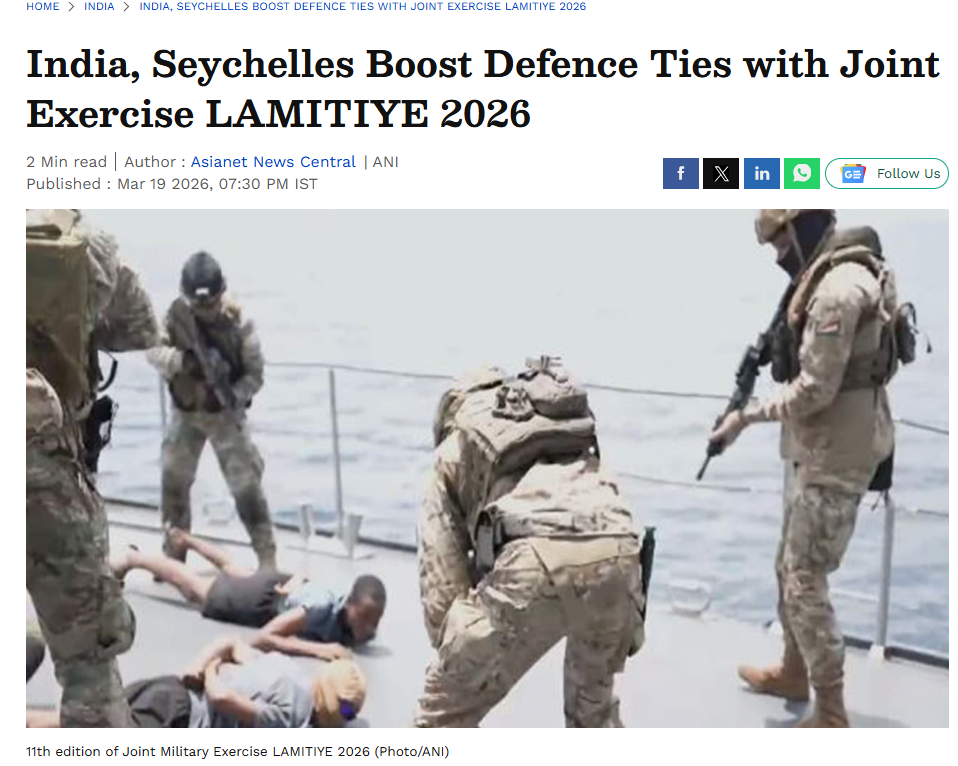
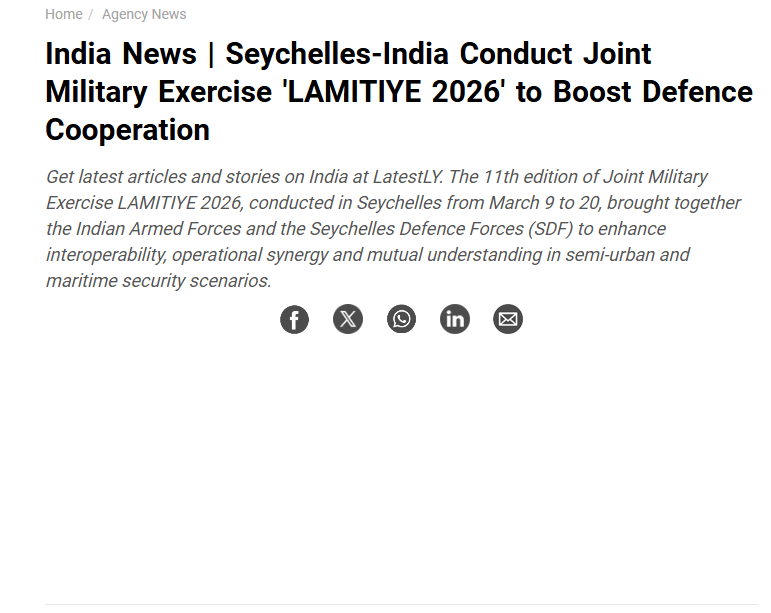
We did not find any recent reports about the Indian Navy capturing Somali pirates. However, in March 2024, the Indian Navy had captured 35 Somali pirates who had hijacked a bulk carrier and taken hostages. The suspects were later handed over to Mumbai Police for legal proceedings.
Conclusion
The viral claim is misleading. The video being circulated as footage of an anti-piracy operation by the Indian Navy does not show the capture of Somali pirates. Instead, it is from the India-Seychelles joint military exercise ‘LAMITIYE 2026’, conducted in March with the participation of the Indian Armed Forces and the Seychelles Defence Forces. While the Indian Navy had indeed captured 35 Somali pirates in a separate incident in March 2024, there are no credible or recent reports linking such an operation to the viral video. The clip has been taken out of context and is being shared with a false narrative, leading to misinformation about a routine military exercise.

Related Blogs
.webp)
Introduction
India has always been celebrated as the land of abundance, once known as the ‘golden bird’ that attracted the world with its prosperity and wisdom. In the current century, as the world moves deeper into the age where every nation is redefining its strength through advancements in every sector, including technology, India is preparing for a powerful transformation. “Viksit Bharat 2047” is an initiative aimed at achieving India's aspiration of becoming a developed nation by its centennial year of independence. India’s growth story is shifting as it takes a step towards development in every field and advances progress both in terms of generating economic growth and breakthroughs in technologies across industries.
Today, when technology touches every aspect of our lives, ‘Cyber Security’ becomes a key area that will significantly drive progress and hold strong importance under the Viksit Bharat vision, especially with the rise of emerging technologies such as AI, quantum computing, cryptography, 5G & 6G, robotics and automation, Internet of Things (IoT), augmented reality (AR) & virtual reality (VR) etc.
Key Initiatives Taken by the Centre
Indian Cyber Crime Coordination Centre:
The Indian Cybercrime Coordination Centre (I4C) was established by the Ministry of Home Affairs (MHA) to provide a framework for law enforcement agencies (LEAs) to deal with cybercrime in a coordinated and comprehensive manner. I4C is actively working on initiatives to combat emerging threats in cyberspace, and it has become a strong pillar of India’s cybersecurity and cybercrime prevention. The ‘National Cyber Crime Reporting Portal’, equipped with a 24x7 cybercrime helpline number 1930, is one of the key components of the I4C.
Recently under I4C, key initiatives were launched to strengthen cybersecurity. The Cyber Fraud Mitigation Centre (CFMC) has been incorporated to bring together banks, financial institutions, telecom companies, Internet Service Providers, and law enforcement agencies on a single platform to tackle online financial crimes efficiently. The Cyber Commandos Program will establish a specialised wing of trained Cyber Commandos in states, Union Territories, and Central Police Organisations to counter rising cyber threats. The Samanvay platform, a web-based Joint Cybercrime Investigation Facility System, has been introduced as a one-stop data repository for cybercrime to foster data sharing and collaboration. The Suspect Registry Portal, connected to the National Cybercrime Reporting Portal (NCRP), has been designed to track cybercriminals and strengthen fraud risk management.
India’s AI Mission:-
The Indian Cabinet has approved a comprehensive national-level IndiaAI Mission. The mission aims to strengthen the Indian AI innovation ecosystem by democratizing computing access, improving data quality, developing indigenous AI capabilities, attracting top AI talent, enabling industry collaboration, providing startup risk capital, ensuring socially impactful AI projects, and bolstering ethical AI. Through India AI Mission, the government is facilitating the development of India’s own foundational models, including Large Language Models (LLMs) and problem-specific AI solutions tailored to Indian needs.
The mission is implemented by the 'IndiaAI' Independent Business Division (IBD) under the Digital India Corporation (DIC) and consists of several components, such as IndiaAI Compute Capacity, IndiaAI Innovation Centre (IAIC), IndiaAI Datasets Platform, IndiaAI Application Development Initiative, IndiaAI Future Skills, IndiaAI Startup Financing, and Safe & Trusted AI. The main objective is to create and nurture an ecosystem for India’s AI innovation.
Startup India:-
With more than 1.59 lakh startups recognised by the Department for Promotion of Industry and Internal Trade (DPIIT) as of January 15, 2025, India has firmly established itself as the third-largest startup ecosystem in the world. Startup India is a flagship initiative launched by the Government of India on 16th January 2016 to build a strong ecosystem for nurturing innovation and startups in the country, which will drive economic growth and generate large-scale employment opportunities.
Key Regulations:-
The Centre, in order to better regulate the cyber domain, has come up with significant regulations. To protect the personal data of citizens, the Digital Personal Data Protection Act, 2023 has been enacted. The Intermediary Guidelines 2021 lay down obligations on social media platforms and intermediaries to ensure accountability and user safety. The Telecommunications Act 2023 has also been enacted. Further, the Promotion and Regulation of Online Gaming Bill 2025, passed by Parliament on 21st August 2025, aims to address related concerns. In addition, Cert-In issues guidelines & advisories from time to time, in order to strengthen cybersecurity.
CyberPeace Outlook
CyberPeace has been at the forefront in transforming policy, technology, and ethical growth in the cyber landscape through its key initiatives. In 2023, CyberPeace hosted the Global CyberPeace Summit in collaboration with Civil 20 and G20 India, with knowledge support from the United Service Institution of India and participation from MeitY, NCIIPC, CERT-In, Zoom, Meta, InMobi, ICANN, Internet Society, MANRS, APNIC, and leading universities, which helped shape critical global conversations on trust, safety, and collaboration in cyberspace.
Viksit Bharat 2047 is more than just a vision for economic success; it is a pledge to create a nation that is technologically secure, resilient, and globally competitive. In this journey, cybersecurity will be at the heart of India's digital reboot, securing its innovation, empowering its citizens, and ensuring its future.
References
- https://www.cyberpeace.org/resources/blogs/i4c-foundation-day-celebration-shri-amit-shah-launches-key-initiatives-to-tackle-cybercrime
- https://www.cyberpeace.org/resources/blogs/indiaai-mission
- https://bharatarticles.com/viksit-bharat-2047-vision-challenges-and-roadmap-to-a-developed-india/
- https://www.pib.gov.in/PressReleasePage.aspx?PRID=2012355
- https://www.pib.gov.in/PressReleasePage.aspx?PRID=2093125

Executive Summary:
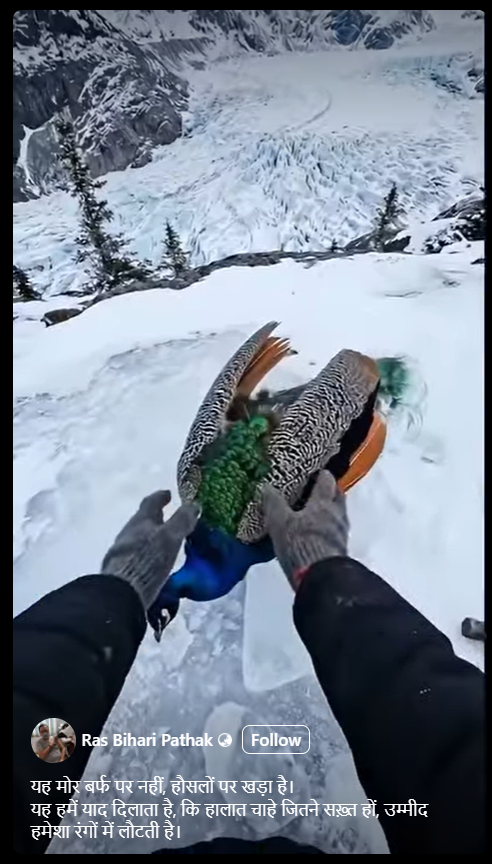
A video showing a peacock allegedly trapped in ice has been going viral on social media. In the clip, the peacock appears to be frozen in a snow-covered area. Moments later, a man is seen approaching with a hammer and breaking the ice to rescue the bird. Social media users are sharing the video as a real-life incident, praising the peacock’s resilience and describing the scene as inspiring. However, CyberPeace research found the viral claim to be misleading. Our research revealed that the video was created using Artificial Intelligence (AI) and is being falsely circulated as a real incident.
Claim:
Facebook user ‘Ras Bihari Pathak’ shared the viral video on January 25, 2026, with the caption: “This peacock is not standing on ice, but on courage. It reminds us that no matter how harsh the circumstances are, hope always returns in colours.” The archived version of the post can be accessed here.
Fact Check:
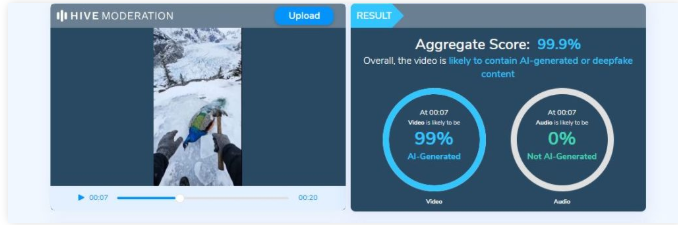
To verify the claim, we first conducted a keyword search on Google to check whether any such real incident involving a peacock trapped in ice had been reported. However, no credible or verified media reports were found. Next, we closely examined the viral video. Upon observation, the peacock’s movements and reactions appeared unnatural and artificial. The motion lacked realistic physical behaviour, raising suspicion that the video might have been digitally generated. To confirm this, we analysed the clip using the AI video detection tool Hive Moderation, which indicated a 99 per cent or higher likelihood that the video was AI-generated.
Conclusion:
CyberPeace research confirms that the viral video showing a peacock allegedly trapped in ice is not real. The clip has been created using Artificial Intelligence and is being shared on social media with a false and misleading claim.

Executive Summary:
A manipulated image showing someone making an offensive gesture towards Prime Minister Narendra Modi is circulating on social media. However, the original photo does not display any such behavior towards the Prime Minister. The CyberPeace Research Team conducted an analysis and found that the genuine image was published in a Hindustan Times article in May 2019, where no rude gesture was visible. A comparison of the viral and authentic images clearly shows the manipulation. Moreover, The Hitavada also published the same image in 2019. Further investigation revealed that ABPLive also had the image.

Claims:
A picture showing an individual making a derogatory gesture towards Prime Minister Narendra Modi is being widely shared across social media platforms.


Fact Check:
Upon receiving the news, we immediately ran a reverse search of the image and found an article by Hindustan Times, where a similar photo was posted but there was no sign of such obscene gestures shown towards PM Modi.

ABP Live and The Hitavada also have the same image published on their website in May 2019.


Comparing both the viral photo and the photo found on official news websites, we found that almost everything resembles each other except the derogatory sign claimed in the viral image.

With this, we have found that someone took the original image, published in May 2019, and edited it with a disrespectful hand gesture, and which has recently gone viral across social media and has no connection with reality.
Conclusion:
In conclusion, a manipulated picture circulating online showing someone making a rude gesture towards Prime Minister Narendra Modi has been debunked by the Cyberpeace Research team. The viral image is just an edited version of the original image published in 2019. This demonstrates the need for all social media users to check/ verify the information and facts before sharing, to prevent the spread of fake content. Hence the viral image is fake and Misleading.
- Claim: A picture shows someone making a rude gesture towards Prime Minister Narendra Modi
- Claimed on: X, Instagram
- Fact Check: Fake & Misleading
