
#FactCheck- AI-Generated Video Falsely Shows Girl Being Rescued From Debris in Nepal
Executive Summary:
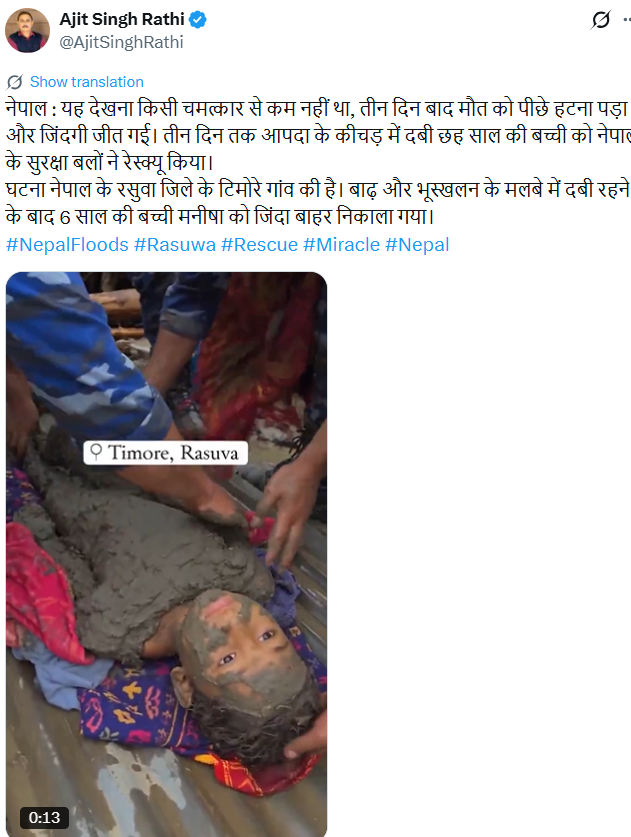
A video is being widely circulated on social media in connection with the relief and rescue operations following the devastating floods in Nepal. The video shows security personnel rescuing a girl trapped under debris and later giving her soup. The video is being shared with the claim that security personnel rescued a girl who had been buried under mud three days after the disaster in Timure village of Nepal’s Rasuwa district. A research by CyberPeace Research Wing found the viral claim to be false. Our research revealed that the viral video does not depict a real incident but is AI-generated.
Claim:
A user on social media platform X (formerly Twitter) shared the viral video with the caption: “Nepal: It was nothing short of a miracle to witness this. After three days, death had to retreat and life emerged victorious. A six-year-old girl, who had been buried under the disaster debris for three days, was rescued by Nepal’s security forces. The incident took place in Timure village of Nepal’s Rasuwa district. Six-year-old Manisha was pulled out alive after being buried under debris caused by floods and landslides.”
https://x.com/AjitSinghRathi/status/2094306889001742826?s=20
Fact Check:
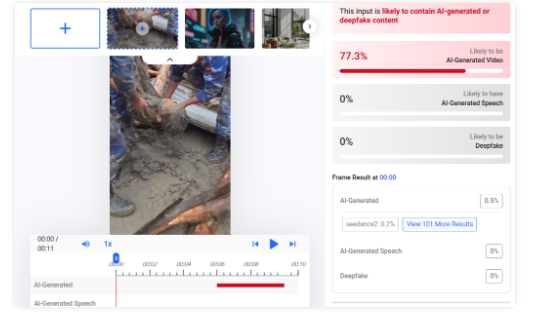
A close examination of the viral video revealed several inconsistencies, raising suspicions that the video was AI-generated. We then scanned the viral video using the AI detection tool Hive Moderation. According to the results, there is a 77 per cent likelihood that the viral video is AI-generated.
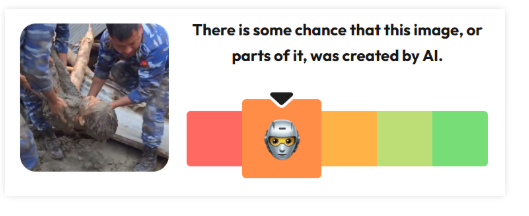
As part of our research, we scanned the video using the AI detection tool Wasitai. According to the results, the viral video is AI-generated.
Conclusion:
Our research found the viral claim to be false. Our findings revealed that the viral video does not depict a real incident but is AI-generated.

Related Blogs

Executive Summary
A viral video allegedly featuring cricketer Virat Kohli endorsing a betting app named ‘Aviator’ is being shared widely across the social platform. CyberPeace Research Team’s Investigations revealed that the same has been made using the deepfake technology. In the viral video, we found some potential anomalies that can be said to have been created using Synthetic Media, also no genuine celebrity endorsements for the app exist, we have also previously debunked such Deep Fake videos of cricketer Virat Kohli regarding the misuse of deep fake technology. The spread of such content underscores the need for social media platforms to implement robust measures to combat online scams and misinformation.

Claims:
The claim made is that a video circulating on social media depicts Indian cricketer Virat Kohli endorsing a betting app called "Aviator." The video features an Indian News channel named India TV, where the journalist reportedly endorses the betting app followed by Virat Kohli's experience with the betting app.
Fact Check:
Upon receiving the news, we thoroughly watched the video and found some featured anomalies that are usually found in regular deep fake videos such as the lip sync of the journalist is not proper, and if we see it carefully the lips do not match with the audio that we can hear in the Video. It’s the same case when Virat Kohli Speaks in the video.

We then divided the video into keyframes and reverse searched one of the frames from the Kohli’s part, we found a video similar to the one spread, where we could see Virat Kohli wearing the same brown jacket in that video, uploaded on his verified Instagram handle which is an ad promotion in collaboration with American Tourister.

After going through the entire video, it is evident that Virat Kohli is not endorsing any betting app, rather he is talking about an ad promotion collaborating with American Tourister.
We then did some keyword searches to see if India TV had published any news as claimed in the Viral Video, but we didn’t find any credible source.
Therefore, upon noticing the major anomalies in the video and doing further analysis found that the video was created using Synthetic Media, it's a fake and misleading one.
Conclusion:
The video of Virat Kohli promoting a betting app is fake and does not actually feature the celebrity endorsing the app. This brings up many concerns regarding how Artificial Intelligence is being used for fraudulent activities. Social media platforms need to take action against the spread of fake videos like these.
Claim: Video surfacing on social media shows Indian cricket star Virat Kohli promoting a betting application known as "Aviator."
Claimed on: Facebook
Fact Check: Fake & Misleading

Executive Summary
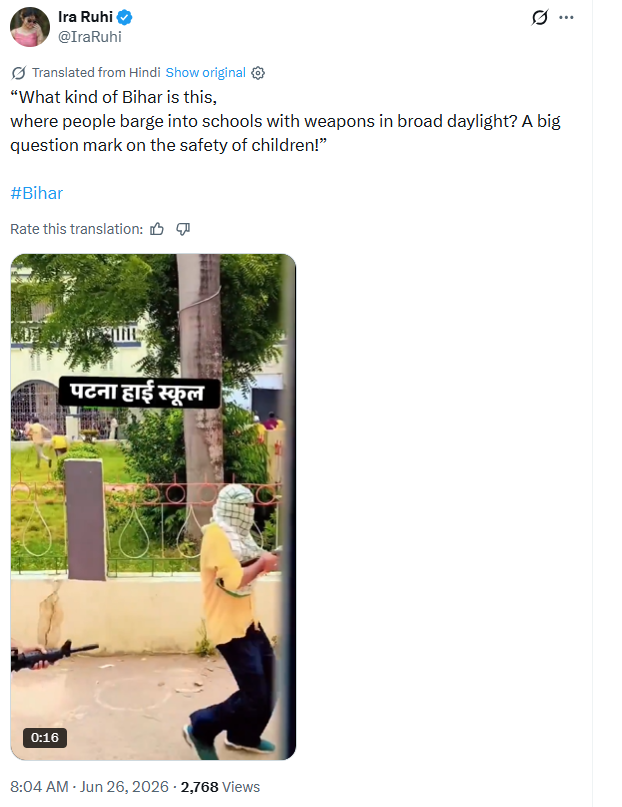
A 22-second video is circulating on social media platform X (formerly Twitter) with a claim that a shooting incident took place at Patna High School in Bihar. The video shows several masked men running around with weapons in their hands, accompanied by the sound of gunfire. A text overlay on the video reads "Patna High School." However, an research by the CyberPeace Research Wing has revealed that this claim is entirely fake and misleading. The video does not depict a real shooting; it captures an authorized movie/web series shooting on the school premises.
The Claim
Social media users are sharing the video claiming that a real firing incident occurred at Patna High School in Patna, Bihar. https://x.com/IraRuhi/status/2070334893830357499
Fact Check
Keyframes from the viral video were analyzed using reverse image search. This led to identical videos uploaded on Facebook and Instagram on June 25, 2026. The captions on both uploads explicitly stated that the footage was from a movie and web series shoot. Furthermore, a closer inspection of the videos revealed professional filmmaking equipment, such as a black flag and a skimmer, visible on the set. https://www.facebook.com/reel/2160248068089642

https://www.instagram.com/p/DaBE0gQglUF/
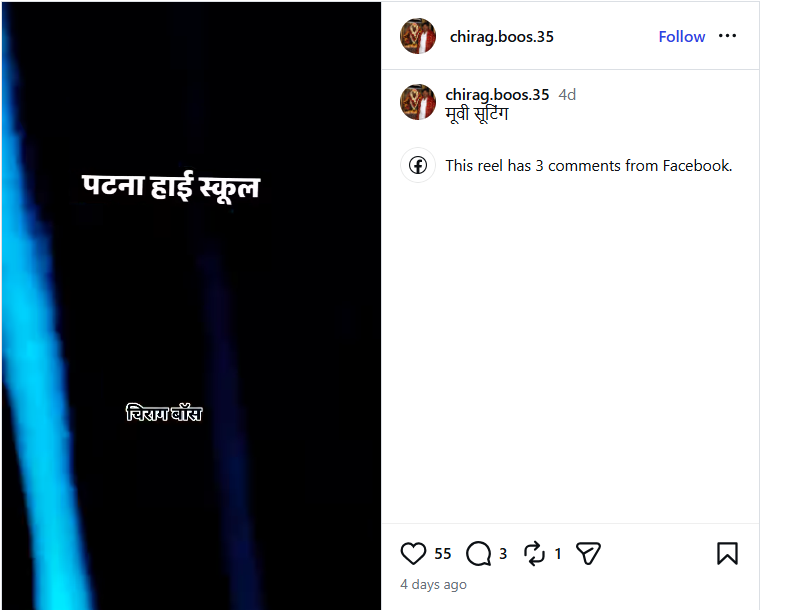
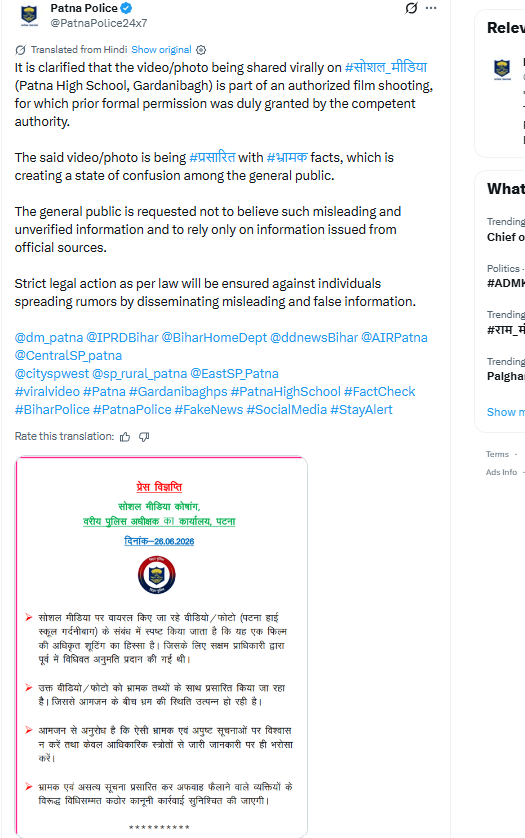
A targeted keyword search led to a YouTube video uploaded on June 20, 2026. The visuals in this video perfectly matched the viral footage, and the individuals seen in the viral clip could be spotted wearing the exact same clothes. "Regarding the video/photo being circulated on social media (Patna High School, Gardanibagh), it is clarified that this is part of an authorized film shooting, for which due permission was previously granted by the competent authority."

To verify further, official statements were checked. The Patna Police issued a formal press release on June 26, 2026, completely dismissing the viral rumors. https://x.com/PatnaPolice24x7/status/2070501501529960581
Conclusion
The evidence gathered confirms that there was no shooting incident at Patna High School. The viral video is behind-the-scenes footage from a pre-approved film production.

Introduction
According to the Finance Ministry's data, the incidence of domestic Unified Payment Interface (UPI) fraud rose by 85% in FY 2023-24 compared to FY 2022-23. Further, as of September of FY 2024-25, 6.32 lakh fraud cases had been already reported, amounting to Rs 485 crore. The data was shared on 25th November 2024, by the Finance Ministry in response to a question in Lok Sabha’s winter session about the fraud in UPI transactions during the past three fiscal years.
Statistics

UPI Frauds and Government's Countermeasures
On the query as to measures taken by the government for safe and secure UPI transactions and prevention of fraud in the transactions, the ministry has highlighted the measures as follows:
- The Reserve Bank of India (RBI) has launched the Central Payment Fraud Information Registry (CPFIR), a web-based tool for reporting payment-related frauds, operational since March 2020, and it requires requiring all Regulated Entities (RE) to report payment-related frauds to the said CPFIR.
- The Government, RBI, and National Payments Corporation of India (NPCI) have implemented various measures to prevent payment-related frauds, including UPI transaction frauds. These include device binding, two-factor authentication through PIN, daily transaction limits, and limits on use cases.
- Further, NPCI offers a fraud monitoring solution for banks, enabling them to alert and decline transactions using AI/ML models. RBI and banks are also promoting awareness through SMS, radio, and publicity on 'cyber-crime prevention'.
- The Ministry of Home Affairs has launched a National Cybercrime Reporting Portal (NCRP) (www.cybercrime.gov.in) and a National Cybercrime Helpline Number 1930 to help citizens report cyber incidents, including financial fraud. Customers can also report fraud on the official websites of their bank or bank branches.
- The Department of Telecommunications has introduced the Digital Intelligence Platform (DIP) and 'Chakshu' facility on the Sanchar Saathi portal, enabling citizens to report suspected fraud messages via call, SMS, or WhatsApp.
Conclusion
UPI is India's most popular digital payment method. As of June 2024, there are around 350 million active users of the UPI in India. The Indian Cyber Crime Coordination Centre (I4C) report indicates that ‘Online Financial Fraud’, a cyber crime category under NCRP, is the most prevalent among others. The rise of financial fraud, particularly UPI fraud is cause for alarm, the scammers use sophisticated strategies to deceive victims. It is high time for netizens to exercise caution and care with their personal and financial information, stay aware of common tactics used by fraudsters, and adhere to best security practices for secure transactions and the safe use of UPI services.
References
