
#FactCheck: Misleading Claim Amid West Asia Conflict: Old Yemen Video Shared as Iran’s Attack on Tel Aviv
Executive Summary
Amid the ongoing tensions in West Asia between the United States–Israel alliance and Iran since February 28, 2026, a video is rapidly going viral on social media. The clip shows buildings engulfed in flames and thick plumes of smoke following an attack. Several users are sharing it with the claim that it depicts Iran’s recent strike on Tel Aviv, Israel. However, an research by the CyberPeace found the claim to be misleading. The viral video is actually from August 2025, when Israel carried out airstrikes in Sanaa, the capital of Yemen. It has no connection to the current conflict.
Claim:
An Instagram user ‘iran_.news24’ posted the video on March 27, 2026, with the caption: “Iran has turned Israel’s largest city Tel Aviv into hell—fears that 200,000 people have died in the war so far.”
Fact Check
To verify the viral claim, keyframes of the video were extracted and searched using Google Lens. The same video was found posted on August 24, 2025, by a Facebook user ‘Mhmdmhywbalshrby5’. The accompanying text, when translated, stated that it showed Israeli bombardment of Sanaa, Yemen.

Similarly, another Instagram user ‘ae5ce’ had also shared the same video on August 24, 2025, identifying it as footage from Sanaa.

Media reports further support this finding. According to a report published by Egypt Today on August 24, 2025, Israel carried out multiple airstrikes in Sanaa targeting key locations, including an oil station, a power facility, and the presidential palace. Casualties were also reported. The strikes were said to be in response to attacks by Houthi forces.

Additionally, the New York Post shared another video of the same incident from a different angle on its X (formerly Twitter) handle on August 25, 2025.

Conclusion
The video being circulated with the claim of Iran attacking Tel Aviv is actually old footage from Israeli airstrikes in Yemen in August 2025. It is unrelated to the ongoing conflict.

Related Blogs

Executive Summary
Even after the conclusion of the Cockroach Janata Party (CJP) protest at Delhi’s Jantar Mantar, several misleading claims related to the demonstration continue to circulate on social media. In a similar instance, a video of Delhi Police DCP Sumit Jha is being widely shared, claiming that he resigned from the Indian Police Service in support of the student movement. In the viral video, DCP Sumit Jha is allegedly heard saying that he is resigning from his post with immediate effect and cannot be part of a system that forces him to spread false information against students. The video is being shared with the claim that Delhi Police DCP Sumit Jha resigned from his position in support of protesting students.
CyberPeace Research Wing’s research found the claim to be false. The research revealed that DCP Sumit Jha has not resigned. The viral video was digitally altered by adding AI-generated audio to an original video shared by the Delhi Police on its official X (formerly Twitter) account on July 23, 2026. The manipulated video is being circulated with a false claim.
Claim
A user on Instagram shared the viral video on July 28, 2026, claiming that Delhi Police DCP Sumit Jha had resigned from his post in support of the student protest. The post link, archive link, and screenshot are provided below.
https://www.instagram.com/reel/DbUr6CPoB13/

Another Instagram user also shared the same video with a similar claim. The post link, archive link, and screenshot are provided below.
https://www.instagram.com/reel/DbUr6CPoB13/

Fact Check
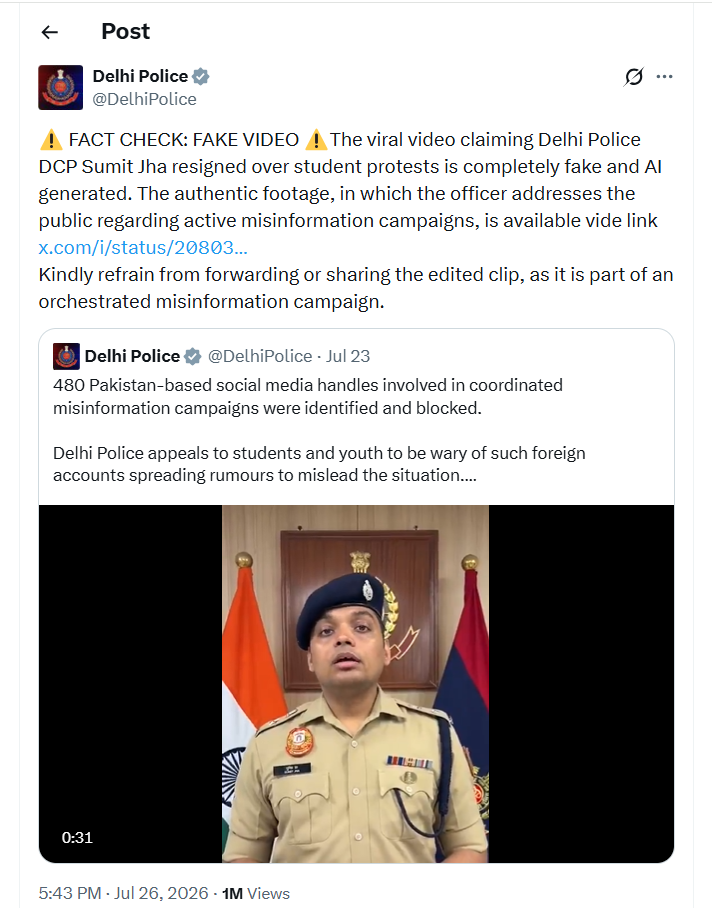
To verify the authenticity of the viral claim, we conducted a Google search using relevant keywords. However, we did not find any credible news report or official information confirming that Delhi Police DCP Sumit Jha had resigned in support of the student protest. During the research, we found a post shared by the official X account of Delhi Police on July 26, 2026. In the post, Delhi Police clarified that a fake and AI-generated video of DCP Sumit Jha was being circulated on social media, falsely showing him resigning in support of the student protest.
Delhi Police also reshared the original video of DCP Sumit Jha, which was posted on July 23, 2026. According to the caption, 480 Pakistan-based social media handles involved in coordinated disinformation campaigns were identified and blocked. Delhi Police appealed to students and young people to remain cautious of such foreign accounts attempting to spread rumours and misinformation. In the 54-second original video, DCP Sumit Jha can be seen warning people against misinformation circulating on social media. He stated that more than 400 Pakistan-based social media handles had been identified for spreading fake content and rumours. He said the objective of such accounts was to provoke people and mislead students.
DCP Sumit Jha appealed to citizens not to trust fake posts, edited videos, or content shared by anonymous social media accounts without verification. He also said that peaceful protest is a democratic right and that Delhi Police respects this right.
The original post and screenshot can be accessed below:
https://x.com/DelhiPolice/status/2081352316767396053?s=20
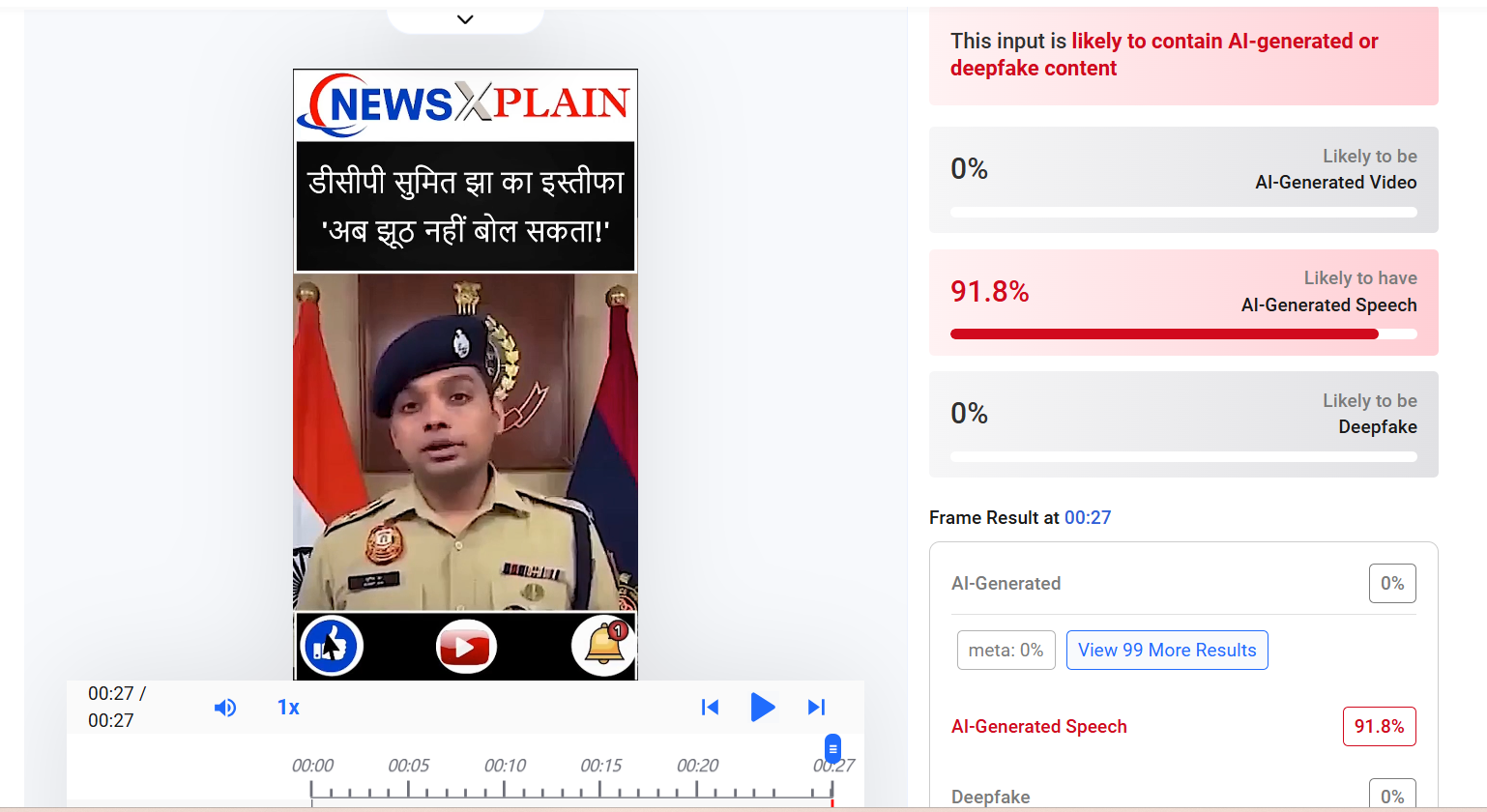
A comparison between the original video and the viral video showed that the statements in both videos are completely different. The original video of DCP Sumit Jha does not contain any statement related to his resignation or support for the student protest, as claimed in the viral video. Further, the viral video was analysed using the AI detection tool HIVE Moderation. The tool’s analysis indicated that the audio used in the video had a 91.8% probability of being AI-generated, confirming that the audio was not authentic and had been artificially created.
Conclusion
The research found that Delhi Police DCP Sumit Jha has not resigned from his post. The viral video has been digitally manipulated by adding AI-generated audio to an original video and is being shared with a false claim on social media.

Introduction
A famous quote, “Half knowledge is always dangerous”, but “Too much knowledge of anything can lead to destruction”. Recently very infamous spyware and malware named WyrmSpy and Dragon Egg were invented by a Chinese group of hackers APT41. The APT41 is a state-endorsed Clandstein active group based in the People’s Republic of China that has been active since 2012. In contrast to numerous countries-government supported, APT has a footprint record jeopardising both government organisations for clandestine activities as well as different private organisations or enterprises for their financial gain. APT41 group aims at Android devices through spyware wyrmspy and dragon egg, which masquerades as a legitimate application. According to the U.S. jury legal accusation from 2019 to 2020, the group was entangled in threatening over more than 100 public and private individuals and organisations in the United States and around the world.Moreover, a detailed analysis report was shared by the Lookout Threat Researchers, that has been actively monitoring and tracking both spyware and malware.
Briefing about how spyware attacks on Android devices take place
To begin with, this malware imitates a real source Android application to show some sort of notification. Once it is successfully installed on the user’s machine, proclaims multiple device’s permission to enable data filtration.
Wyrmspy complies with log files, photos, device locations, SMS(read and write), and audio recordings. It has also authenticated that there are no detection malware activities found on google play even after running multiple security levels. These malicious things are made with the intent to obtain rooting access privileges to the device and monitor activities to the specified commands received from the C2 servers.
Similarly, Dragon Egg can collect data files, contacts, locations, and audio recordings, and it also accesses camera photos once it successfully trade-off the device. Dragon egg receives a payload that is also known as “smallmload.jar”, which is either from APK(Android Packet Kit).
WyrmSpy initially masquerades as a default operation system application, and Dragon Egg simulates a third-party keyboard/ messaging application.
Overview of APT41 Chinese group background
APT41 is a Chinese-based stealth activity-carrying group that is said to be active since mid-2006. Rumours about APT41 that it was also a part of the 2nd Bureau of the People’s Liberation Army (PLA) General Staff Department’s (GSD) 3rd Department. Owning to that fact, 2006 has seen 140+ organisations’ security getting compromised, ranging from 20 strategically crucial companies.APT is also recognised for rationally plundering hundreds of terabytes of data from at least 141 organisations between 2006 and 2013. It typically begins with spear-phishing emails to the targeted victims. These sent emails contain official templates along with language pretending to be from a legitimate real source, carrying a malicious attachment. As the victim opens the attached file, the backdoor bestows the control of the targeted machine to the APT groups machine. Once there is an unauthorised gain of access, the attacker visits and revisits the victim’s machine. The group remains dormant for lengthy durations, more likely for months or even for years.
Advisory points need to adhere to while using Android devices
- The security patch update is necessary at least once a week
- Clearing up unwanted junk files.
- Cache files of every frequently used application need to clear out.
- Install only required applications from
Google play store. - Download only necessary APK files only it comes from trusted resources.
- Before giving device permission, it is advisable to run your files or URLs on VirusTotal.com this website will give a good closure to the malicious intent.
- Install good antivirus software.
- Individuals need to check the source of the email before opening an attachment to it.
- Never collect or add any randomly found device to your system
- Moreover, the user needs to keep track of their device activity. Rather than using devices just for entertainment purposes, it is more important to look for data protection on that device.
Conclusion
Network Crack Program Hacker Group (NCPH), which grew as an APT41 group with malicious intent, earlier performed the role of grey hat hacker, this group somehow grew up greedy to enhance more money laundering by hacking networks, devices, etc. As this group conducts a supply chain of attacks to gain unauthorised access to the network throughout the world, targeting hundreds of companies, including an extensive selection of industries such as social media, telecommunications, government, defence, education, and manufacturing. Last but not least, many more fraud-making groups with malicious intent will be forming and implementing in the future. It is on individuals and organisations to secure themselves but practise basic security levels to safeguard themselves against such threats and attacks.

Introduction
The government has announced that the new criminal laws will come into force on 1st July 2024. The Union Government notified that three recently enacted criminal laws, viz. Bhartiya Nyaya Sanhita 2023, Bharatiya Nagarik Suraksha Sanhita 2023, and Bharatiya Sakshya Adhiniyam 2023 will be effective from 1st July 2024. The Indian Penal Code 1860, Code of Criminal Procedure 1973, and Indian Evidence Act 1872 have been replaced by these new criminal laws.
On 23 February 2024, the Ministry of Home Affairs Announced the Effective Date of new criminal laws as follows:
- Bharatiya Nyaya Sanhita, 2023 Effective from 1-7-2024, except Section 106(2).
- Bharatiya Sakshya Adhiniyam, 2023 Effective from 1-7-2024.
- Bharatiya Nagarik Suraksha Sanhita, 2023 The provisions will come into force on 1-7-2024 except the provisions of the entry relating to section 106(2) of the Bharatiya Nyaya Sanhita, 2023, in the First Schedule.
Section 106(2) Will Not Be Enforced
Truckers protested against this provision, which provides 10 years imprisonment and fines for those who cause death by rash and negligent driving of a vehicle not amounting to culpable homicide, and escape without reporting it to a police officer. As of now, the government has promised truckers and transporters that subsection 2 of Section 106 of Bharatiya Nyay Sanhita (BNS) will not come into force. This subsection deals with fatal hit-and-run cases and prescribes higher penalties for not informing authorities immediately after an accident.
Section 106(2) of Bharatiya Nyaya Sanhita, 2023 read as follows;
106. Causing death by negligence.—
(2) Whoever causes death of any person by rash and negligent driving of vehicle not amounting to culpable homicide, and escapes without reporting it to a police officer or a Magistrate soon after the incident, shall be punished with imprisonment of either description of aterm which may extend to ten years, and shall also be liable to fine.
BHARATIYA SAKSHYA ADHINIYAM, 2023
The Bhartiya Sakshya Adhiniyam 2023 will replace the Indian Evidence Act 1872. The Act has undergone significant modification to maintain its fundamental principles for fair legal proceedings and adapt to technological advancements and changes in societal norms. This Act recognises electronic records as primary evidence under Section 57. It also allows the electronic presentation of oral evidence, enabling remote testimony and ensuring that electronic records will have the same legal effect as paper records.
Bharatiya Nagarik Suraksha Sanhita, 2023
The Bharatiya Nagarik Suraksha Sanhita, 2023 replaces the 1973 Code of Criminal Procedure, introducing certain modifications. This Act, under section 176, requires forensic investigation for crimes punished with seven years' imprisonment or more. Section 530 of BNSS, 2023 is a newly inserted provision which envisages the use of electronic communication audio-video electronic means for trials, inquiries, proceedings, service and issuance of summons. Electronic mode is permitted for all trials, inquiries, and proceedings under section 173 of this Act. The concept of Zero FIR is also introduced under section 173(1) and mandates police stations to register the FIR, irrespective of jurisdiction.
Conclusion
India's new criminal laws are set to take effect on 1st July 2024. These laws modernise the country's legal framework, replacing outdated statutes and incorporating technological advancements. The concerns from stakeholders led to the withholding of enforcement of Section 106(2) of Bharatiya Nyaya Sanhita 2023. The new criminal laws aim to address contemporary society's complexities while upholding justice and fairness.
References
- https://www.indiatoday.in/india/video/new-criminal-laws-to-come-into-effect-from-july-1-2506664-2024-02-24
- https://www.lawrbit.com/article/ipc-crpc-evidence-act-replaced-by-new-criminal-laws/
