
#FactCheck-No, This Video Does Not Show Soldiers Travelling to Delhi to Support CJP Protest
Executive Summary:
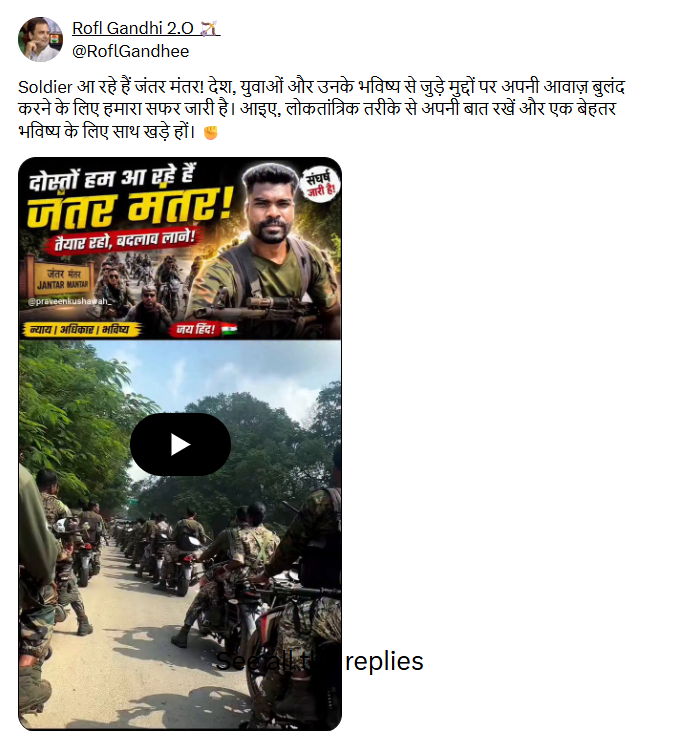
A video showing a convoy of soldiers travelling on motorcycles is being widely shared on social media with the claim that the personnel were heading towards Delhi’s Jantar Mantar to support the ongoing protest led by the Cockroach Janata Party (CJP). CyberPeace Research Wing’s research found the claim to be false. The viral video is not related to the CJP protest at Jantar Mantar. The footage predates the ongoing demonstration and is being circulated with a misleading claim.
Claim:
A social media user shared the viral video claiming that soldiers were travelling towards Delhi’s Jantar Mantar to support the youth participating in the CJP protest over issues related to the country’s education system. The post claimed that the soldiers were joining the protest to raise their voice on issues concerning the nation, youth, and their future.
https://x.com/RoflGandhee/status/2079986496556204066?s=20
A reverse image search using Google Lens led the Desk to a video uploaded on a YouTube channel named Commando Journey. Upon comparison, the Desk found that the YouTube video contained the same visuals as the viral video under research. Further verification of the video details revealed that the footage predates the ongoing Cockroach Janata Party (CJP) protest at Jantar Mantar. The protest, which began in June 2026, has been demanding the resignation of Union Education Minister Dharmendra Pradhan over alleged irregularities in examinations. The video was uploaded on the YouTube channel in February 2026, several months before the CJP protest began, confirming that it has been falsely linked to the recent demonstration.
https://www.youtube.com/shorts/cMvai580gdo

As part of the next phase of the research, the Desk reviewed several other videos uploaded on the same YouTube channel. During the analysis, the Desk identified multiple videos featuring visuals matching those seen in the viral clip. However, these videos were also uploaded before the CJP protest in Delhi, with one of the videos dating back to October 2025.
https://www.youtube.com/shorts/7eDc9TqOpzM

Conclusion
While the Desk could not independently verify the exact origin and context of the video, the research established that the footage predates the CJP protest and has been falsely linked to the demonstration. Based on the findings, the Desk concluded that the video shared on social media does not show soldiers travelling to Delhi’s Jantar Mantar to support the Cockroach Janata Party (CJP) protest. The footage is unrelated to the ongoing protest and has been circulated with a misleading claim.

Related Blogs

Executive Summary
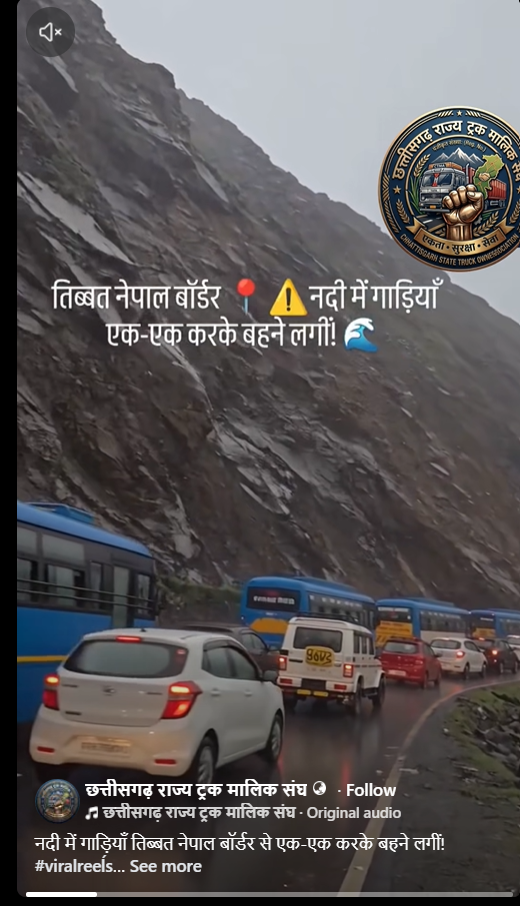
A video showing vehicles being swept away by floodwaters is going viral on social media. It is being claimed that the video shows flooding along the Nepal-Tibet border.However, CyberPeace Research found that the video is AI-generated.
Claim
The video shows debris suddenly falling from a mountain while vehicles are moving along a road. During the incident, vehicles seen on the road near a fast-flowing river are swept away into the water one after another. The archive of the post can be viewed here.
https://www.facebook.com/reel/1796949138009288
Fact Check
To verify the viral video claiming to show vehicles being swept away by floods along the Tibet-Nepal border, we conducted a reverse image search of its keyframes. However, during our research, we did not find the video in any credible media report or authentic source that identified it as genuine footage of flooding along the Nepal-Tibet border. During our research, we closely examined the video and noticed several inconsistencies that raised questions about its authenticity. In cases where heavy vehicles are caught in or swept away by fast-flowing water, the force of the current, the vehicles losing balance and being submerged are generally visible. In contrast, the vehicles in the viral video appear to float almost in a straight direction through the water without any visible resistance, raising doubts about the authenticity of the footage.
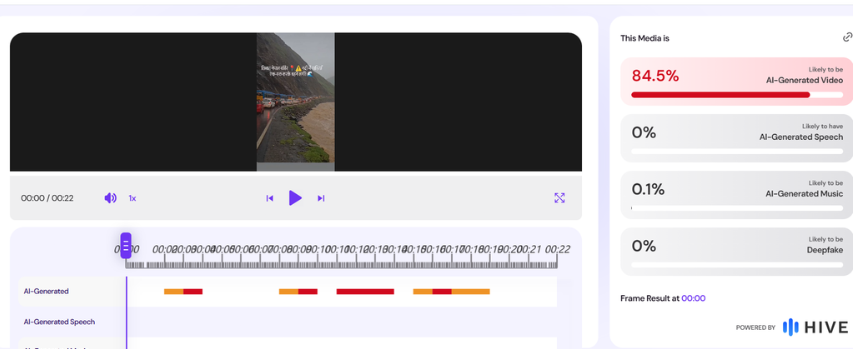
The video also shows several blue buses travelling on the road. On closer examination, the design and appearance of these buses appear to be almost identical. In addition, the letters and numbers visible on some vehicle number plates appear unusual, blurred and distorted. Such visual inconsistencies are commonly observed in AI-generated content. To further verify these findings, we scanned the viral video using the AI detection tool Hive Detect. The tool’s analysis identified the video as potentially AI-generated, with a score of 84.5 per cent.
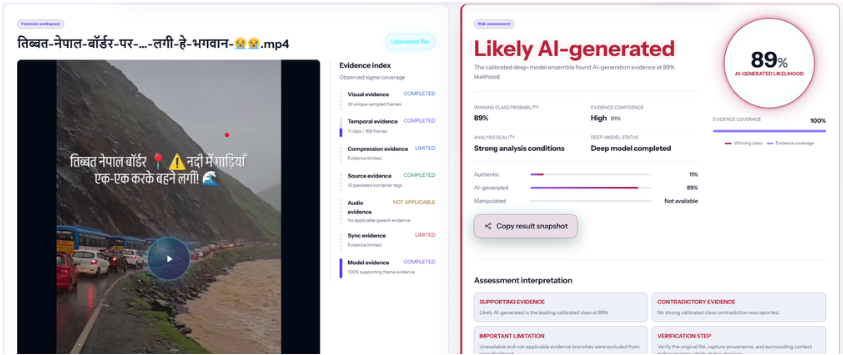
We also analysed the video using another AI detection platform, DetectVideo AI. The tool likewise identified the video as potentially AI-generated, with a score of 89 per cent.
Conclusion
The evidence gathered during our research makes it clear that the video being circulated with the claim that vehicles were swept away by floodwaters along the Tibet-Nepal border is AI-generated.

Introduction
Recently, in April 2025, security researchers at Oligo Security exposed a substantial and wide-ranging threat impacting Apple's AirPlay protocol and its use via third-party Software Development Kit (SDK). According to the research, the recently discovered set of vulnerabilities titled "AirBorne" had the potential to enable remote code execution, escape permissions, and leak private data across many different Apple and third-party AirPlay-compatible devices. With well over 2.35 billion active Apple devices globally and tens of millions of third-party products that incorporate the AirPlay SDK, the scope of the problem is enormous. Those wireless-based vulnerabilities pose not only a technical threat but also increasingly an enterprise- and consumer-level security concern.
Understanding AirBorne: What’s at Stake?
AirBorne is the title given to a set of 23 vulnerabilities identified in the AirPlay communication protocol and its related SDK utilised by third-party vendors. Seventeen have been given official CVE designations. The most severe among them permit Remote Code Execution (RCE) with zero or limited user interaction. This provides hackers the ability to penetrate home networks, business environments, and even cars with CarPlay technology onboard.
Types of Vulnerabilities Identified
AirBorne vulnerabilities support a range of attack types, including:
- Zero-Click and One-Click RCE
- Access Control List (ACL) bypass
- User interaction bypass
- Local arbitrary file read
- Sensitive data disclosure
- Man-in-the-middle (MITM) attacks
- Denial of Service (DoS)
Each vulnerability can be used individually or chained together to escalate access and broaden the attack surface.
Remote Code Execution (RCE): Key Attack Scenarios
- MacOS – Zero-Click RCE (CVE-2025-24252 & CVE-2025-24206) These weaknesses enable attackers to run code on a MacOS system without any user action, as long as the AirPlay receiver is enabled and configured to accept connections from anyone on the same network. The threat of wormable malware propagating via corporate or public Wi-Fi networks is especially concerning.
- MacOS – One-Click RCE (CVE-2025-24271 & CVE-2025-24137) If AirPlay is set to "Current User," attackers can exploit these CVEs to deploy malicious code with one click by the user. This raises the level of threat in shared office or home networks.
- AirPlay SDK Devices – Zero-Click RCE (CVE-2025-24132) Third-party speakers and receivers through the AirPlay SDK are particularly susceptible, where exploitation requires no user intervention. Upon compromise, the attackers have the potential to play unauthorised media, turn microphones on, or monitor intimate spaces.
- CarPlay Devices – RCE Over Wi-Fi, Bluetooth, or USB CVE-2025-24132 also affects CarPlay-enabled systems. Under certain circumstances, the perpetrators around can take advantage of predictable Wi-Fi credentials, intercept Bluetooth PINs, or utilise USB connections to take over dashboard features, which may distract drivers or listen in on in-car conversations.
Other Exploits Beyond RCE
AirBorne also opens the door for:
- Sensitive Information Disclosure: Exposing private logs or user metadata over local networks (CVE-2025-24270).
- Local Arbitrary File Access: Letting attackers read restricted files on a device (CVE-2025-24270 group).
- DoS Attacks: Exploiting NULL pointer dereferences or misformatted data to crash processes like the AirPlay receiver or WindowServer, forcing user logouts or system instability (CVE-2025-24129, CVE-2025-24177, etc.).
How the Attack Works: A Technical Breakdown
AirPlay sends on port 7000 via HTTP and RTSP, typically encoded in Apple's own plist (property list) form. Exploits result from incorrect treatment of these plists, especially when skipping type checking or assuming invalid data will be valid. For instance, CVE-2025-24129 illustrates how a broken plist can produce type confusion to crash or execute code based on configuration.
A hacker must be within the same Wi-Fi network as the targeted device. This connection might be through a hacked laptop, public wireless with shared access, or an insecure corporate connection. Once in proximity, the hacker has the ability to use AirBorne bugs to hijack AirPlay-enabled devices. There, bad code can be released to spy, gain long-term network access, or spread control to other devices on the network, perhaps creating a botnet or stealing critical data.
The Espionage Angle
Most third-party AirPlay-compatible devices, including smart speakers, contain built-in microphones. In theory, that leaves the door open for such devices to become eavesdropping tools. While Oligo did not show a functional exploit for the purposes of espionage, the risk suggests the gravity of the situation.
The CarPlay Risk Factor
Besides smart home appliances, vulnerabilities in AirBorne have also been found for Apple CarPlay by Oligo. Those vulnerabilities, when exploited, may enable attackers to take over an automobile's entertainment system. Fortunately, the attacks would need pairing directly through USB or Bluetooth and are much less practical. Even so, it illustrates how networks of connected components remain at risk in various situations, ranging from residences to automobiles.
How to Protect Yourself and Your Organisation
- Immediate Actions:
- Update Devices: Ensure all Apple devices and third-party gadgets are upgraded to the latest software version.
- Disable AirPlay Receiver: If AirPlay is not in use, disable it in system settings.
- Restrict AirPlay Access: Use firewalls to block port 7000 from untrusted IPs.
- Set AirPlay to “Current User” to limit network-based attack.
- Organisational Recommendations:
- Communicate the patch urgency to employees and stakeholders.
- Inventory all AirPlay-enabled hardware, including in meeting rooms and vehicles.
- Isolate vulnerable devices on segmented networks until updated.
Conclusion
The AirBorne vulnerabilities illustrate that even mature systems such as Apple's are not immune from foundational security weaknesses. The extensive deployment of AirPlay across devices, industries, and ecosystems makes these vulnerabilities a systemic threat. Oligo's discovery has served to catalyse immediate response from Apple, but since third-party devices remain vulnerable, responsibility falls to users and organisations to install patches, implement robust configurations, and compartmentalise possible attack surfaces. Effective proactive cybersecurity hygiene, network segmentation, and timely patches are the strongest defences to avoid these kinds of wormable, scalable attacks from becoming large-scale breaches.
References
- https://www.oligo.security/blog/airborne
- https://www.wired.com/story/airborne-airplay-flaws/
- https://thehackernews.com/2025/05/wormable-airplay-flaws-enable-zero.html
- https://www.securityweek.com/airplay-vulnerabilities-expose-apple-devices-to-zero-click-takeover/
- https://www.pcmag.com/news/airborne-flaw-exposes-airplay-devices-to-hacking-how-to-protect-yourself
- https://cyberguy.com/security/hackers-breaking-into-apple-devices-through-airplay/
.webp)
Executive Summary:
A post on X (formerly Twitter) has gained widespread attention, featuring an image inaccurately asserting that Houthi rebels attacked a power plant in Ashkelon, Israel. This misleading content has circulated widely amid escalating geopolitical tensions. However, investigation shows that the footage actually originates from a prior incident in Saudi Arabia. This situation underscores the significant dangers posed by misinformation during conflicts and highlights the importance of verifying sources before sharing information.

Claims:
The viral video claims to show Houthi rebels attacking Israel's Ashkelon power plant as part of recent escalations in the Middle East conflict.

Fact Check:
Upon receiving the viral posts, we conducted a Google Lens search on the keyframes of the video. The search reveals that the video circulating online does not refer to an attack on the Ashkelon power plant in Israel. Instead, it depicts a 2022 drone strike on a Saudi Aramco facility in Abqaiq. There are no credible reports of Houthi rebels targeting Ashkelon, as their activities are largely confined to Yemen and Saudi Arabia.

This incident highlights the risks associated with misinformation during sensitive geopolitical events. Before sharing viral posts, take a brief moment to verify the facts. Misinformation spreads quickly and it’s far better to rely on trusted fact-checking sources.
Conclusion:
The assertion that Houthi rebels targeted the Ashkelon power plant in Israel is incorrect. The viral video in question has been misrepresented and actually shows a 2022 incident in Saudi Arabia. This underscores the importance of being cautious when sharing unverified media. Before sharing viral posts, take a moment to verify the facts. Misinformation spreads quickly, and it is far better to rely on trusted fact-checking sources.
- Claim: The video shows massive fire at Israel's Ashkelon power plant
- Claimed On:Instagram and X (Formerly Known As Twitter)
- Fact Check: False and Misleading
