
#FactCheck- Viral ‘Army Jump Accident’ Video Is AI-Generated
Executive Summary
A video is being widely shared on social media showing a man in an army uniform jumping from a height, losing balance mid-air, and appearing to meet with an accident. The clip is being circulated as a real-life incident. However, a research by the CyberPeace found the claim to be false. The viral video is not real but AI-generated.
Claim
On social media platform Facebook, a user shared the video with a caption suggesting it shows a real accident, warning against risky stunts.
- https://archive.ph/BH6dl#selection-347.0-347.122
- https://www.facebook.com/ashok.yadav.9041083/posts/1593460528549619/

Fact Check
To verify the claim, we conducted a reverse image search using Google Lens but found no credible news reports or official sources mentioning such an incident. A closer look at the video revealed several inconsistencies commonly associated with AI-generated content. For instance, the person appears to disappear momentarily while falling, the head is not clearly visible after impact, and the background audio seems unnatural. We further analyzed the video using AI detection tools. On Hive Moderation, the video showed a 99.2% probability of being AI-generated.
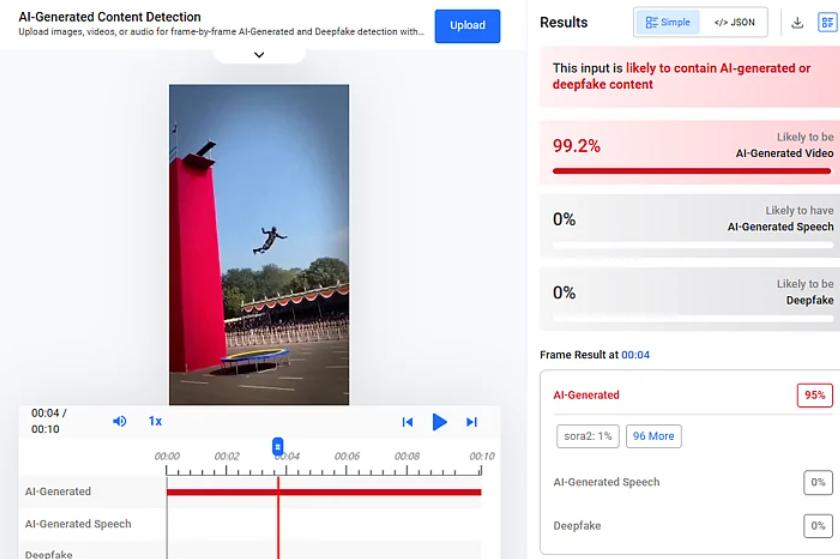
Additionally, analysis using Sightengine indicated a 98% likelihood that the video was synthetically created.
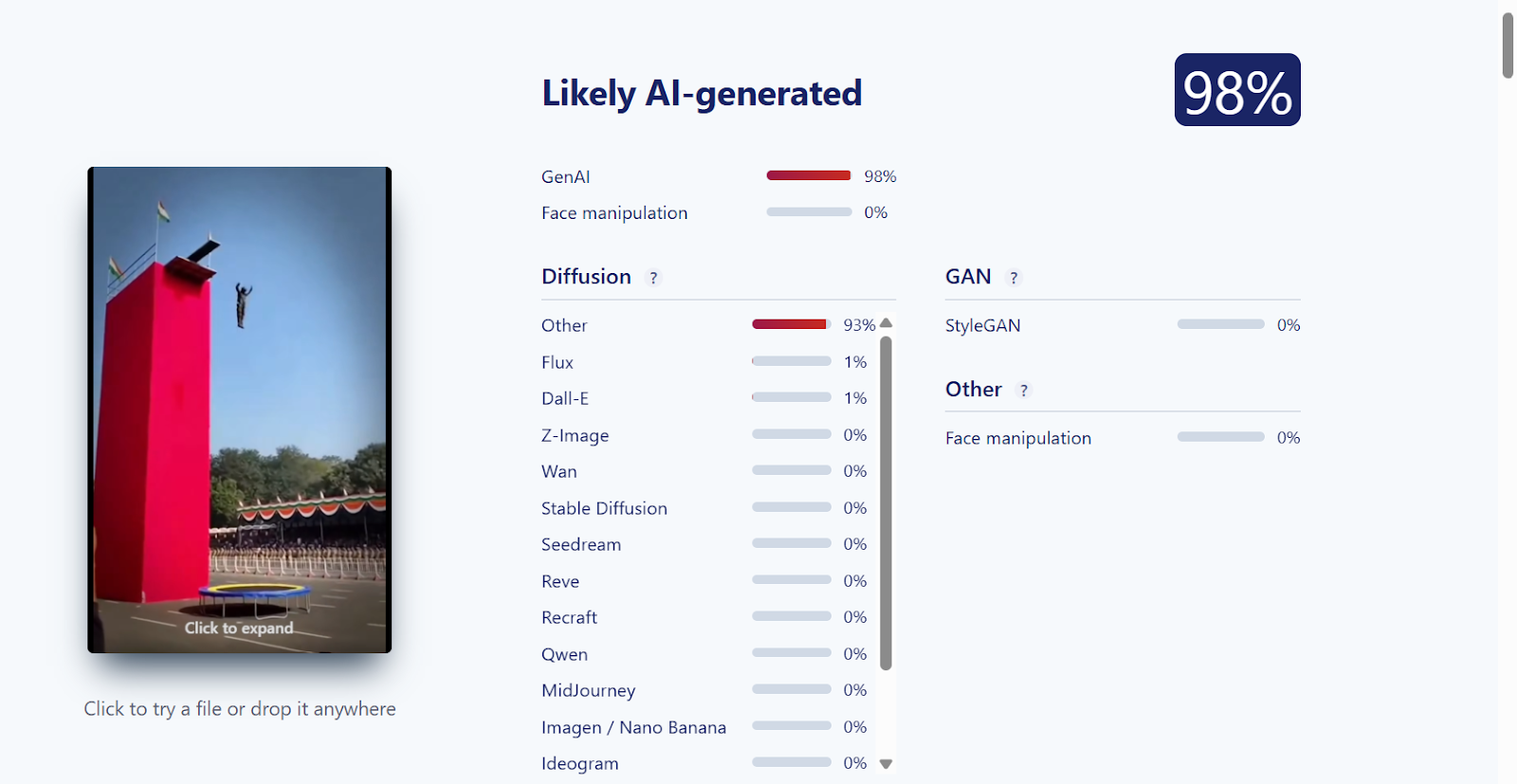
Conclusion
The viral claim is false. The video does not depict a real incident but is an AI-generated clip. It has been shared with a misleading narrative, and there is no evidence to support the claim that it shows an actual accident.

Related Blogs

Introduction
Global cybersecurity spending is expected to breach USD 210 billion in 2025, a ~10% increase from 2024 (Gartner). This is a result of an evolving and increasingly critical threat landscape enabled by factors such as the proliferation of IoT devices, the adoption of cloud networks, and the increasing size of the internet itself. Yet, breaches, misuse, and resistance persist. In 2025, global attack pressure rose ~21% Y-o-Y ( Q2 averages) (CheckPoint) and confirmed breaches climbed ~15%( Verizon DBIR). This means that rising investment in cybersecurity may not be yielding proportionate reductions in risk. But while mechanisms to strengthen technical defences and regulatory frameworks are constantly evolving, the social element of trust and how to embed it into cybersecurity systems remain largely overlooked.
Human Error and Digital Trust (Individual Trust)
Human error is consistently recognised as the weakest link in cybersecurity. While campaigns focusing on phishing prevention, urging password updates and using two-factor authentication (2FA) exist, relying solely on awareness measures to address human error in cyberspace is like putting a Band-Aid on a bullet wound. Rather, it needs to be examined through the lens of digital trust. As Chui (2022) notes, digital trust rests on security, dependability, integrity, and authenticity. These factors determine whether users comply with cybersecurity protocols. When people view rules as opaque, inconvenient, or imposed without accountability, they are more likely to cut corners, which creates vulnerabilities. Therefore, building digital trust means shifting from blaming people to design: embedding transparency, usability, and shared responsibility towards a culture of cybersecurity so that users are incentivised to make secure choices.
Organisational Trust and Insider Threats (Institutional Trust)
At the organisational level, compliance with cybersecurity protocols is significantly tied to whether employees trust employers/platforms to safeguard their data and treat them with integrity. Insider threats, stemming from both malicious and non-malicious actors, account for nearly 60% of all corporate breaches (Verizon DBIR 2024). A lack of trust in leadership may cause employees to feel disengaged or even act maliciously. Further, a 2022 study by Harvard Business Review finds that adhering to cybersecurity protocols adds to employee workload. When they are perceived as hindering productivity, employees are more likely to intentionally violate these protocols. The stress of working under surveillance systems that feel cumbersome or unreasonable, especially when working remotely, also reduces employee trust and, hence, compliance.
Trust, Inequality, and Vulnerability (Structural Trust)
Cyberspace encompasses a social system of its own since it involves patterned interactions and relationships between human beings. It also reproduces the social structures and resultant vulnerabilities of the physical world. As a result, different sections of society place varying levels of trust in digital systems. Women, rural, and marginalised groups often distrust existing digital security provisions more, and with reason. They are targeted disproportionately by cyber attackers, and yet are underprotected by systems, since these are designed prioritising urban/ male/ elite users. This leads to citizens adopting workarounds like password sharing for “safety” and disengaging from cyber safety discourse, as they find existing systems inaccessible or irrelevant to their realities. Cybersecurity governance that ignores these divides deepens exclusion and mistrust.
Laws and Compliances (Regulatory Trust)
Cybersecurity governance is operationalised in the form of laws, rules, and guidelines. However, these may often backfire due to inadequate design, reducing overall trust in governance mechanisms. For example, CERT-In’s mandate to report breaches within six hours of “noticing” it has been criticised as the steep timeframe being insufficient to generate an effective breach analysis report. Further, the multiplicity of regulatory frameworks in cross-border interactions can be costly and lead to compliance fatigue for organisations. Such factors can undermine organisational and user trust in the regulation’s ability to protect them from cyber attacks, fuelling a check-box-ticking culture for cybersecurity.
Conclusion
Cybersecurity is addressed primarily through code, firewall, and compliance today. But evidence suggests that technological and regulatory fixes, while essential, are insufficient to guarantee secure behaviour and resilient systems. Without trust in institutions, technologies, laws or each other, cybersecurity governance will remain a cat-and-mouse game. Building a trust-based architecture requires mechanisms to improve accountability, reliability, and transparency. It requires participatory designs of security systems and the recognition of unequal vulnerabilities. Thus, unless cybersecurity governance acknowledges that cyberspace is deeply social, investment may not be able to prevent the harms it seeks to curb.
References
- https://www.gartner.com/en/newsroom/press-releases/2025-07-29
- https://blog.checkpoint.com/research/global-cyber-attacks-surge-21-in-q2-2025
- https://www.verizon.com/business/resources/reports/2024-dbir-executive-summary.pdf
- https://www.verizon.com/business/resources/reports/2025-dbir-executive-summary.pdf
- https://insights2techinfo.com/wp-content/uploads/2023/08/Building-Digital-Trust-Challenges-and-Strategies-in-Cybersecurity.pdf
- https://www.coe.int/en/web/cyberviolence/cyberviolence-against-women
- https://www.upguard.com/blog/indias-6-hour-data-breach-reporting-rule
.webp)
Introduction
Union Minister of State for Electronics and IT, Rajeev Chandrasekhar, announced that rules for the Digital Personal Data Protection (DPDP) Act are expected to be released by the end of January. The rules will be subject to a month-long consultation process, but their notification may be delayed until after the general elections in April-May 2024. Chandrasekhar mentioned changes to the current IT regulations would be made in the next few days to address the problem of deepfakes on social networking sites.
The government has observed a varied response from platforms regarding advisory measures on deepfakes, leading to the decision to enforce more specific rules. During the Digital India Dialogue, platforms were made aware of existing provisions and the consequences of non-compliance. An advisory was issued, and new amended IT rules will be released if satisfaction with compliance is not achieved.
When Sachin Tendulkar reported a deepfake on a site where he was seen endorsing a gaming application, it raised concerns about the exploitation of deepfakes. Tendulkar urged the reporting of such incidents and underlined the need for social media companies to be watchful, receptive to grievances, and quick to address disinformation and deepfakes.
The DPDP Act, 2023
The Digital Personal Data Protection Act (DPDP) 2023 is a brand-new framework for digital personal data protection that aims to protect individuals' digital personal data. The act ensures compliance by the platforms collecting personal data. The act aims to provide consent-based data collection techniques. DPDP Act 2023 is an important step toward protecting individual privacy. The Act, which requires express consent for the acquisition, administration, and processing of personal data, seeks to guarantee that organisations follow the stated objective for which user consent was granted. This proactive strategy coincides with global data protection trends and demonstrates India's commitment to safeguarding user information in the digital era.
Amendments to IT rules
Minister Chandrasekhar declared that existing IT regulations would be amended in order to combat the rising problem of deepfakes and disinformation on social media platforms. These adjustments, which will be published over the next few days, are primarily aimed at countering widespread of false information and deepfake. The decision follows a range of responses from platforms to deepfake recommendations made during Digital India Dialogues.
The government's stance: blocking non-compliant platforms
Minister Chandrasekhar reaffirmed the government's commitment to enforcing the updated guidelines. If platforms fail to follow compliance, the government may consider banning them. This severe position demonstrates the government's commitment to safeguarding Indian residents from the possible harm caused by false information.
Empowering Users with Education and Awareness
In addition to the upcoming DPDP Act Rules/recommendations and IT regulation changes, the government recognises the critical role that user education plays in establishing a robust digital environment. Minister Rajeev Chandrasekhar emphasised the necessity for comprehensive awareness programs to educate individuals about their digital rights and the need to protect personal information.
These instructional programs seek to equip users to make informed decisions about giving consent to their data. By developing a culture of digital literacy, the government hopes to guarantee that citizens have the information to safeguard themselves in an increasingly linked digital environment.
Balancing Innovation with User Protection
As India continues to explore its digital frontier, the junction of technology innovation and user safety remains a difficult balance. The upcoming Rules on the DPDP Act and modifications to existing IT rules represent the government's proactive efforts to build a strong framework that supports innovation while protecting user privacy and combating disinformation. Recognising the changing nature of the digital world, the government is actively participating in continuing discussions with stakeholders such as industry professionals, academia, and civil society. These conversations promote a collaborative approach to policy creation, ensuring that legislation is adaptable to the changing nature of cyber risks and technology breakthroughs. Such inclusive talks demonstrate the government's dedication to transparent and participatory governance, in which many viewpoints contribute to the creation of effective and nuanced policy. These advances reflect an important milestone in India's digital journey, as the country prepares to set a good example by creating responsible and safe digital ecosystems for its residents.
Reference :
- https://economictimes.indiatimes.com/tech/technology/govt-may-release-personal-data-bill-rules-in-a-fortnight/articleshow/106162669.cms?from=mdr
- https://www.business-standard.com/india-news/dpdp-rules-expected-to-be-released-by-end-of-the-month-mos-chandrasekhar-124011600679_1.html
Most laws regulate what people do. This one regulates what clock everyone is doing it by, and once you sit with that idea for a moment, it stops sounding like a bureaucratic footnote and starts sounding like something genuinely foundational.
On 27 August 2026, India's Department of Consumer Affairs notified the Legal Metrology (Indian Standard Time) Rules, 2026, making Indian Standard Time the single legally binding reference for every legal, administrative, commercial, and official purpose across the country. The Rules will come into force 180 days after their publication in the Official Gazette, giving government departments, businesses, and institutions a compliance runway to align their systems before the requirement actually bites.
Why time needed a law at all
It might seem strange that a country needs legislation to tell everyone what time it is. India has used IST, a single time zone five and a half hours ahead of Coordinated Universal Time, since 1947. But using a time zone informally and legally mandating it as the sole authoritative reference for every official and commercial transaction are two very different things, and the gap between them is exactly where this rule lives.
The government's own reasoning, laid out in its official statement, centres on a shift most people experience daily without ever thinking about its plumbing. Banking and digital payments, telecommunications networks, railways, power grids, and government record systems all depend on accurate, synchronised time stamps to function correctly. When different systems quietly draw their time from different sources, even by fractions of a second, the resulting inconsistencies can affect the coordination and recording of transactions in ways that are invisible until something goes wrong. A trade executed on a stock exchange, a UPI payment cleared between banks, a railway signal handoff between two junctions, and an emergency service dispatch all depend on every clock in the chain agreeing with every other clock, and until now, India had no single rule compelling that agreement.
The quieter, more interesting part of the rule
Buried inside the announcement is a detail that matters more than the headline. The Rules do not simply declare IST the law of the land; they also authorise the use of NavIC, India's own satellite navigation system, alongside other approved domestic timing sources, as legitimate means of disseminating that time. The government's stated rationale is candid about the current state of affairs: several critical Indian systems presently draw their time from foreign satellite based sources, and building domestic timing infrastructure through NavIC and legal metrology laboratories is intended to reduce that dependence going forward.
That single sentence carries real weight once you consider how global positioning and timing systems actually work. Most of the world's precise digital time synchronisation ultimately traces back to GPS, the American satellite constellation, whose signals also happen to be notoriously easy to disrupt. GPS and other satellite navigation signals arrive at receivers on Earth as extremely weak radio transmissions, weak enough that they can be jammed with cheap equipment or spoofed, meaning an attacker broadcasts a counterfeit signal that mimics a legitimate one closely enough to fool a receiver into accepting false position or timing data. Researchers and government reports going back years have flagged that a large share of critical infrastructure sectors, power grids, financial markets, telecommunications, and transport among them, carry meaningful dependence on GPS derived timing, and a 2017 UK government assessment specifically warned that systematic satellite signal jamming could cause serious disruption to a country's financial, electricity, and communications systems all at once. Cybersecurity researchers have separately demonstrated proof of concept attacks where a deliberately falsified timing signal, rather than a falsified position, was enough to destabilise systems that assumed their clock could always be trusted.
Seen against that backdrop, embedding NavIC as an approved domestic timing source inside a legal metrology framework is not merely a nationalistic footnote about self reliance. It is a genuine resilience decision. A country that can generate, verify, and distribute its own trusted time signal, independent of a foreign satellite constellation that it does not control and cannot secure on its own, has a meaningfully smaller attack surface for an entire category of infrastructure disruption that rarely makes headlines until it actually happens.
Who actually built this, and why that composition matters
The drafting process itself offers a useful clue about how seriously this was treated. Reports on the rule making process indicate the Rules were shaped by a high powered inter ministerial committee chaired by the Secretary of Consumer Affairs, with representation from the National Physical Laboratory and the Indian Space Research Organisation for the underlying science and satellites, IIT Kanpur for engineering expertise, the National Informatics Centre and CERT In for network infrastructure and its security, the Securities and Exchange Board of India for financial market implications, and the Railways, Telecom, and Financial Services departments for the systems that will actually have to run on this new standard day to day. That is not a committee assembled around a single ministry's convenience; it is a committee assembled around the actual shape of the problem, spanning physics, engineering, finance, and network security together. As part of the broader One Nation, One Time initiative, a White Rabbit Technology based IST Dissemination Demonstration Network was already commissioned at the Regional Reference Standard Laboratory in Bengaluru back in July 2026, suggesting the infrastructure groundwork was underway well before the legal framework caught up to it.
What the 180 day window actually means in practice
It is worth being precise about what compliance actually requires here. This is not a deadline demanding new hardware overnight; for most organisations, it means auditing which internal systems currently reference time from an unverified or foreign source and ensuring they align with certified IST going forward, alongside institutions preparing to receive that certified time through the domestic infrastructure the government is simultaneously building out. The six month runway exists precisely because this touches an unusually wide spread of sectors at once, and forcing an abrupt cutover would create more operational risk than the rule is designed to remove.
The bigger picture
A rule about what time it is legally does not sound like cybersecurity news, and on the surface, it is not. But underneath the administrative language sits a genuinely forward looking recognition: as more of daily life, banking, communication, transport, and governance runs on systems that must agree, down to the second, on a shared reference point, the integrity of that reference point becomes critical infrastructure in its own right. India choosing to build, verify, and legally anchor its own trusted time source, rather than continuing to quietly rely on a foreign satellite system it cannot secure independently, is less about symbolism and more about closing a vulnerability most people never knew existed until they were asked to think about it.
References
- OpenGov Asia, "India Issues Rules to Standardise National Time Reference Systems." https://opengovasia.com/india-issues-rules-to-standardise-national-time-reference-systems/?c=us
- Daily Excelsior, "Centre notifies rules mandating IST as common time reference; 180 day window for compliance." https://www.dailyexcelsior.com/centre-notifies-rules-mandating-ist-as-common-time-reference-180-day-window-for-compliance/
- Greater Kashmir, "Department of Consumer Affairs notifies Legal Metrology Rules, 2026." https://www.greaterkashmir.com/national/department-of-consumer-affairs-notifies-legal-metrology-rules-2026-12454447
- Insights on India, "Legal Metrology (Indian Standard Time) Rules, 2026." https://www.insightsonindia.com/2026/08/31/legal-metrology-indian-standard-time-rules-2026/
- Blitz India Media, "Indian Standard Time Rules 2026: NavIC, Legal Metrology." https://blitzindiamedia.com/news/indian-standard-time-rules-2026-navic-legal-metrology/
- Observer Voice, "India Establishes Legal Framework for Standard Time." https://observervoice.com/india-establishes-legal-framework-for-standard-time-225958/
- The Live Nagpur, "Govt notifies rules to make IST the common time reference." https://thelivenagpur.com/2026/08/31/govt-notifies-rules-to-make-ist-the-common-time-reference/
- Safran Navigation and Timing, "GNSS Security and Cybersecurity: What are the Parallels?" https://safran-navigation-timing.com/gnss-security-and-cybersecurity-what-are-the-parallels/
- Safran Navigation and Timing, "Securing Critical Infrastructures from Jamming and Spoofing Cyberattacks." https://safran-navigation-timing.com/securing-critical-infrastructures-from-jamming-and-spoofing-cyberattacks/
- Combain, "The Silent Threat In The Sky: GPS Jamming, GPS Spoofing." https://combain.com/gps-jamming-spoofing/
