
#FactCheck-Elephant Video Predates Nepal Floods, Street Video Likely AI-Generated
Executive Summary
Amid the floods in Nepal, several videos are being shared on social media, claiming to show the current situation in the country. A research done by the Research Wing of the CyberPeace found that the video showing elephants is from an incident that occurred before the floods in Nepal, while the video showing the street is likely AI-generated.
Claim 1
Videos claiming to show a street being swept away by flash floods in Nepal and a herd of elephants being carried away by the floods and reaching Uttar Pradesh are going viral on social media.
https://www.instagram.com/p/DcimGaiiCa7/

Claim 2
A newly surfaced video purportedly shows the devastation caused by floods in Nepal, with cars and homes being destroyed. It is being claimed that 350 people have died and 750 are missing so far
https://x.com/UTDbrims/status/2092829398462341484?s=48

Fact Check 1
The first video claims to show a herd of wild elephants that was swept away by the floods in Nepal and reached Uttar Pradesh. We conducted a reverse image search of the first video using Google Lens and found a report by Hindi news publication Dainik Bhaskar, which shared a video featuring visuals similar to those in the viral clip. According to the report, a herd of wild elephants coming from the Gerua River reached the gates of the Chaudhary Charan Singh Ghaghra Barrage in Bahraich district, Uttar Pradesh, due to the strong current of the river. The report also quoted the Forest Range Officer as saying that the area is adjacent to an elephant corridor, which is why elephants frequently move through the region.

Fact Check 2
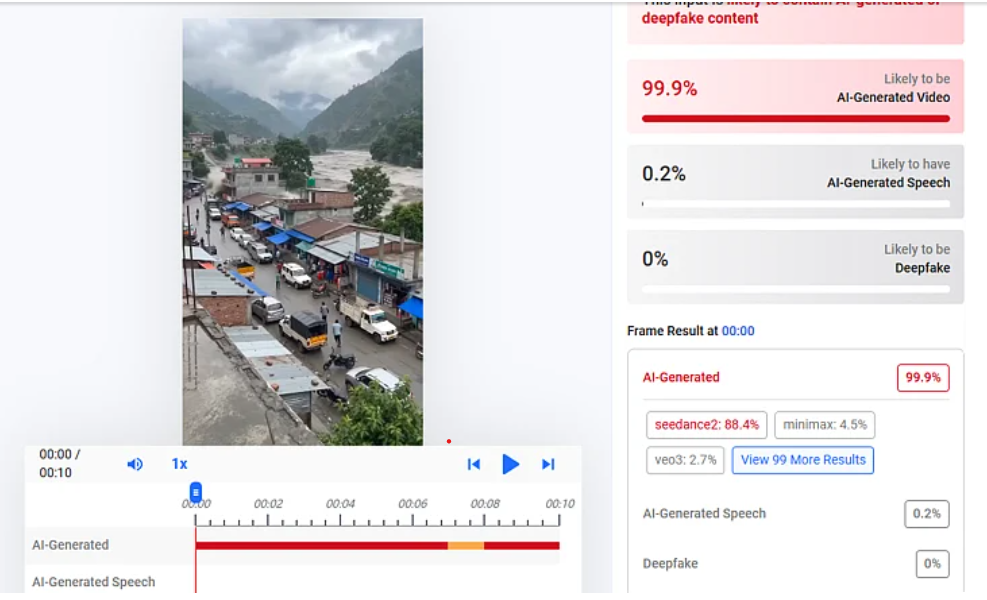
The second video shows a street being completely swept away by floodwaters. We conducted a reverse image search of the video using Google Lens but could not find any credible source that had shared the footage. Following this, we ran the video through the AI detection tool Hive Moderation, which flagged it as 99 percent likely to be AI-generated.
Conclusion
Our research found that the viral videos being shared as scenes of devastation caused by the recent floods in Nepal are misleading. The video showing a herd of elephants is from a separate incident in Bahraich, Uttar Pradesh, and predates the Nepal floods. Meanwhile, the video showing a street being swept away could not be traced to any credible source and was flagged as 99 percent likely to be AI-generated by Hive Moderation.

Related Blogs

Executive Summary:
A video circulating on Social media has claimed that Iran has launched a missile strike destroying Ben Gurion Airport in Tel Aviv. With rising tensions in geopolitics, the video quickly became popular. However, our research has detailed inspections through digital verification tools and visual analysis showed that the video is AI-generated. No incident or damage ever occurred.

Claim:
A viral video circulating on social media platforms claims to show Tel Aviv’s Ben Gurion Airport destroyed following an Iranian missile strike. The video is being shared with captions suggesting it is the last recorded visuals from the attack, with some users asserting it as evidence of escalating conflict between Iran and Israel.

Fact Check:
After looking into the video that purported to show the destruction of Tel Aviv's Ben Gurion Airport in an Iranian missile strike, we researched the topic whether the claim is accurate or not. The video depicts a damaged airport terminal, with debris and fires, but a visual analysis determined that there were a number of suspicious characteristics: asymmetrical layout, artificial-looking smoke patterns, and the absence of activity or humans—those are all typical indications of AI generation. Our research traced the origins of the video to an Instagram post, with a date of May 27, 2025, made by what seems to be a user who frequently shares AI-generated images.


In order to verify our conclusions, we used Hive Moderation, an AI content detection tool, which produced a result of an 80% probability that the video is altered, and this level of probability strongly supports the idea that the footage is not real. Additionally, reports from popular organizations like India Today and Reuters supported these results. All findings resulting from our research established that the video is synthetic and unrelated to any event occurring at Ben Gurion Airport, and therefore debunked a false narrative propagated on social media.

To confirm, we also compared the visuals with a real aerial image of Tel Aviv’s Ben Gurion Airport available on aviation stock sites.


Fig: Google Maps image of Tel Aviv’s Ben Gurion Airport
The visuals from the viral video are not real locations or scenes of Aviv’s Ben Gurion Airport's true location and configuration therefore it is fake and misleading.
Conclusion:
After thorough research it is concluded that the viral video is fake and it is not an actual missile strike at Ben Gurion Airport. The video is made with AI, and posted by a content creator of synthetic content well before any conflict update. There is no official confirmation or credible news coverage to substantiate the claim, with a high probability of AI-detection, and it has been proven to be digitally manipulated. Therefore, the claim is untrue and misleading.
- Claim: A video shows Iran's missile strike destroying Tel Aviv’s Ben Gurion Airport.
- Claimed On: Social Media
- Fact Check: False and Misleading

Introduction
Who would have predicted that the crime of slavery would haunt our lives through the digital world? In a recent unfolding of events, the cyber wing of Maharashtra has saved 60 Indian nationals from a cyber slavery racket run by armed rebel groups operating in Myanmar and arrested five suspects who acted as recruiting agents, including a foreign national. As per the reports, the racketeers made contact with various individuals, enticing them with offers of high-paying jobs in East Asian countries. The operation unfolds a carefully designed crime network that operates through bordering states, Myanmar, Thailand, and Malaysia, targeting vulnerable individuals through deceptive means and forcing them to commit cyber fraud and financial crimes, operating as an authentic industrial setup. The disturbing set of events makes up only one of many such cyber-slavery incidents that are uncovered and various other rackets that operate in the shadows of cyberspace. Another similar event was reported in March 2025, where the disturbing ordeal of a 52-year-old father from Bihar’s Gopalganj, whose son was lured into working in a scam call centre under the pretence of a data entry job in Thailand.
Counting the Unseen: The Dark Metrics of Cyber Slavery
As per the United Nations report from October 2024, a large number of young individuals are enslaved, acting under the impression they will be employed in high-paying jobs, often on social media platforms, and what follows is an intricate web of cybercriminals operating from illegal scam compounds. According to the UN Office on Drugs and Crime (UNODC), financial losses from scams in Southeast Asia reached between $18 billion (Rs 1.6 lakh crore) and $37 billion (Rs 3.2 lakh crore) in 2023, much of it linked to organised crime in these three countries. Also, acting on a similar premise, the Indian Cyber Crime Coordination Centre (I4C), a division under the Ministry of Home Affairs (MHA), organised an inter-ministerial committee to address a significant rise in cybercrime in Southeast Asian countries, which includes Cambodia, Myanmar, and Laos.
The data from the Bureau of Immigration in the Union Ministry of Home Affairs, which included around 29,466 Indians who travelled on visitor visas to Thailand, Vietnam, Myanmar, and Cambodia between January 2022 and May 2024, has gone missing.
From Rescue to Reform: How India is Tackling Cyber Slavery
The recent events that unfolded have agitated the government to undertake vigilant rescue operations for the missing individuals who became victims of this modern-day trafficking and coordinate with foreign ministries in Myanmar, Thailand and Cambodia for extradition and repatriation. It is notable that in the year 2015, India along with seven other countries in South Asia, including Afghanistan, Bangladesh, Bhutan, Maldives, Nepal, Pakistan and Sri Lanka, came together to address transnational threats that transcend geographical and cultural borders in cooperation with the United Nations Office on Drugs and Crimes (UNODC). The collaboration brought together a Compendium of Bilateral and Regional Instruments for South Asia providing for International Cooperation in Criminal Matters. Further, in January 2025, UNODC and the European Union launched a €9 million regional project titled "Preventing and Addressing Trafficking in Human Beings and the Smuggling of Migrants in South Asia." The Government of India, through its various agencies, also lays down various guidelines and advisories on the National Cyber Crime Reporting Portal. Additionally, law enforcement agencies are actively involved, and cybersecurity NGOs are proactively spreading awareness about identifying red flags associated with threats such as cyber slavery.
Recommendations: A Call to Action
- The various advisories released by the Gov. of India emphasise the need for Indian nationals to verify the credentials of the employer through the Indian Embassy located in that country.
- The authorities and various agencies also stress the need for individuals to refrain from sharing personal information such as location details, contact information or any information pertaining to personal relationships that can be exploited by such criminals.
- The fundamental manner of tackling the crime of cyber slavery is to ensure digital literacy and increase awareness through public campaigns and educational programmes
- The need of the hour is international cooperation and collaboration to undertake a concerted effort to bring back the victims and penalise all those who facilitate such criminal activities.
References
- https://www.thehindu.com/news/national/more-than-60-indians-forced-into-cyber-slavery-rescued-from-myanmar-5-arrested/article69438991.ece
- https://www.indiatoday.in/india-today-insight/story/cyber-slavery-the-new-job-con-trapping-indian-youth-abroad-2637157-2024-11-21
- https://indianexpress.com/article/india/mha-high-powered-committee-cybercrimes-from-se-asia-9345843/
- https://www.unodc.org/documents/terrorism/Publications/SAARC%20compendium/SA_Compendium_Volume-2.pdf
.webp)
Introduction
In the labyrinthine world of digital currencies, a new chapter unfolds as India intensifies its scrutiny over the ethereal realm of offshore cryptocurrency exchanges. With nuance and determination that virtually mirrors the Byzantine complexities of the very currencies they seek to regulate, Indian authorities embark on a course of stringent oversight, bringing to the fore an ever-evolving narrative of control and compliance in the fintech sector. The government's latest manoeuvre—a directive to Apple Inc. to excise the apps of certain platforms, including the colossus Binance, from its App Store in India—signals a crescendo in the nation's efforts to rein in the unbridled digital bazaar that had hitherto thrived in a semi-autonomous expanse of cyberspace.
The directive, with ramifications as significant and intricate as the cryptographic algorithms that underpin the blockchain, stems from the Ministry of Electronics and Information Technology, which has cast eight exchanges, including Bitfinex, HTX, and Kucoin, into the shadows, rendering their apps as elusive as the Higgs boson in the vast App Store universe. The movement of these exchanges from visibility to obscurity in the digital storefront is cloaked in secrecy, with sources privy to this development remaining cloaked in anonymity, their identities as guarded as the cryptographic keys that secure blockchain transactions.
The Contention
This escalation, however, did not manifest from the vacuum of the ether; it is the culmination of a series of precipitating actions that began unfolding on December 28th, when the Indian authorities unfurled a net over nine exchanges, ensnaring them with suspicions of malfeasance. The spectre of inaccessible funds, a byproduct of this entanglement, has since haunted Indian crypto traders, prompting a migration of deposits to local exchanges that operate within the nation's regulatory framework—a fortress against the uncertainties of the offshore crypto tempest.
The extent of the authorities' reach manifests further, beckoning Alphabet Inc.'s Google to follow in Apple's footsteps. Yet, in a display of the unpredictable nature of enforcement, the Google Play Store in India still played host to the very apps that Apple's digital Eden had forsaken as of a nondescript Wednesday afternoon, marked by the relentless march of time. The triad of power-brokers—Apple, Google, and India's technology ministry—has maintained a stance as enigmatic as the Sphinx, their communications as impenetrable as the vaults that secure the nation's precious monetary reserves.
Compounding the tightening of this digital noose, the Financial Intelligence Unit of India, a sentinel ever vigilant at the gates of financial propriety, unfurled a compliance show-cause notice to the nine offshore platforms, an ultimatum demanding they justify their elusive presence in Indian cyberspace. The FIU's decree echoed with clarity amidst the cacophony of regulatory overtures: these digital entities were tethered to operations sequestered in the shadows, skirting the reach of India's anti-money laundering edicts, their websites lingering in cyberspace like forbidden fruit, tantalisingly within reach yet potentially laced with the cyanide of non-compliance.
In this chaotic tableau of constraint and control, a glimmer of presence remains—only Bitstamp has managed to brave the regulatory storm, maintaining its presence on the Indian App Store, a lone beacon amid the turbulent sea of regimentation. Kraken, another leviathan of crypto depths, presented only its Pro version to the Indian connoisseurs of the digital marketplace. An aura of silence envelops industry giants such as Binance, Bitfinex, and KuCoin, their absence forming a void as profound as the dark side of the moon in the consciousness of Indian users. HTX, formerly known as Huobi, has announced a departure from Indian operations with the detached finality of a distant celestial body, cold and indifferent to the gravitational pull of India's regulatory orbit.
Compliances
In compliance with the provisions of the Money Laundering Act (PMLA) 2002 and the recent uproar on crypto assessment apps, Apple store finally removed these apps namely Binance and Kucoin from the store after receiving show cause notice. The alleged illegal operation and failure to comply with existing money laundering laws are major reasons for their removal.
The Indian Narrative
The overarching narrative of India's embrace of rigid oversight aligns with a broader global paradigm shift, where digital financial assets are increasingly subjected to the same degree of scrutiny as their physical analogues. The persistence in imposing anti-money laundering provisions upon the crypto sector reflects this shift, with India positioning its regulatory lens in alignment with the stars of international accountability. The preceding year bore witness to seismic shifts as Indian authorities imposed a tax upon crypto transactions, a move that precipitated a downfall in trading volumes, reminiscent of Icarus's fateful flight—hubris personified as his waxen appendages succumbed to the unrelenting kiss of the sun.
On a local scale, trading powerhouses lament the imposition of a 1% levy, colloquially known as Tax Deducted at Source. This fiscal shackle drove an exodus of Indian crypto traders into the waiting, seemingly benevolent arms of offshore financial Edens, absolved of such taxational rites. As Sumit Gupta, CEO of CoinDCX, recounted, this fiscal migration witnessed the haemorrhaging of revenue. His estimation that a staggering 95% of trading volume abandoned local shores for the tranquil harbours of offshore havens punctuates the magnitude of this phenomenon.
Conclusion
Ultimately, the story of India's proactive clampdown on offshore crypto exchanges resembles a meticulously woven tapestry of regulatory ardour, financial prudence, and the inexorable progression towards a future where digital incarnations mirror the scrutinised tangibility of physical assets. It is a saga delineating a nation's valiant navigation through the tempestuous, cryptic waters of cryptocurrency, helming its ship with unwavering determination, with eyes keenly trained on the farthest reaches of the horizon. Here, amidst the fusion of digital and corporeal realms, India charts its destiny, setting its sails towards an inextricably linked future that promises to shape the contour of the global financial landscape.
References
- https://www.business-standard.com/markets/cryptocurrency/govt-escalates-clampdown-on-offshore-crypto-venues-like-binance-report-124011000586_1.html
- https://www.cnbctv18.com/technology/india-escalates-clampdown-on-offshore-crypto-exchanges-like-binance-18763111.htm
- https://economictimes.indiatimes.com/tech/technology/centre-blocks-web-platforms-of-offshore-crypto-apps-binance-kucoin-and-others/articleshow/106783697.cms?from=mdr
