
#FactCheck: Chhatarpur Protest Video Falsely Shared as Indian Army Atrocities in Manipur
Executive Summary
A video is going viral on social media showing police personnel allegedly dragging an elderly woman. The video is being shared with the claim that it was filmed in Manipur and shows the Indian Army committing atrocities against women. The CyberPeace Research Wing found that the viral video is not from Manipur. It was recorded during protests against the Ken-Betwa Link Project in Chhatarpur, Madhya Pradesh, and is being circulated with a misleading claim.
Claim:
A video shared on social media claims that the Indian Army is committing atrocities against local people, particularly women, in Manipur. The post further alleges that R&AW chief Parag Jain is allowing Manipur to burn and that people will never forget the alleged brutality.
https://x.com/i/status/2084180049285005687
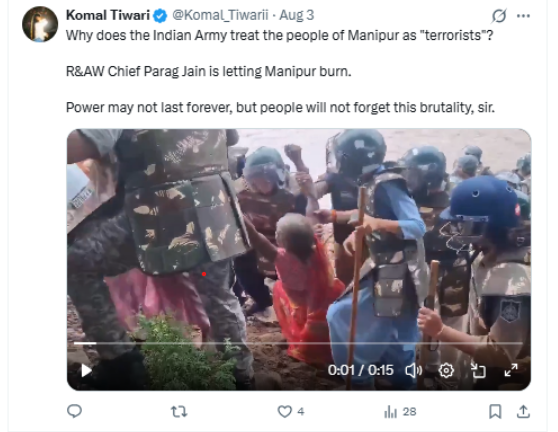
Factcheck
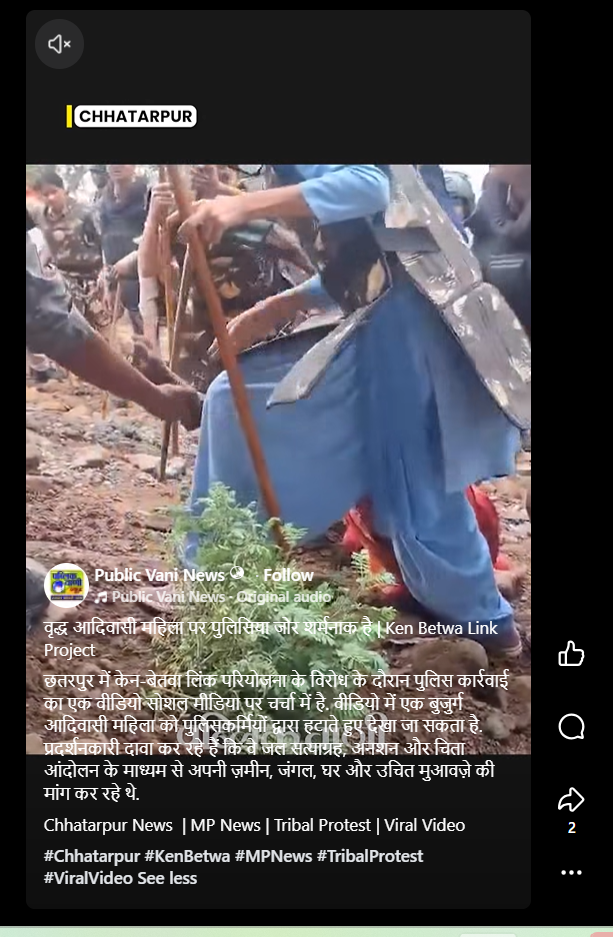
To verify the claim, our team extracted keyframes from the viral video and conducted a reverse image search using Google Lens. During the search, we found the same video uploaded on the Facebook page of Public Vani News on July 31. The accompanying description stated: “Police action against an elderly tribal woman is shameful. During protests against the Ken-Betwa Link Project in Chhatarpur, a video showing police removing an elderly tribal woman has gone viral. Protesters claim they were holding a Jal Satyagraha, hunger strike and Chita Andolan while demanding fair compensation and protection of their land, forests and homes.”
The post and screenshot are provided below:
https://www.facebook.com/reel/1031078973033873
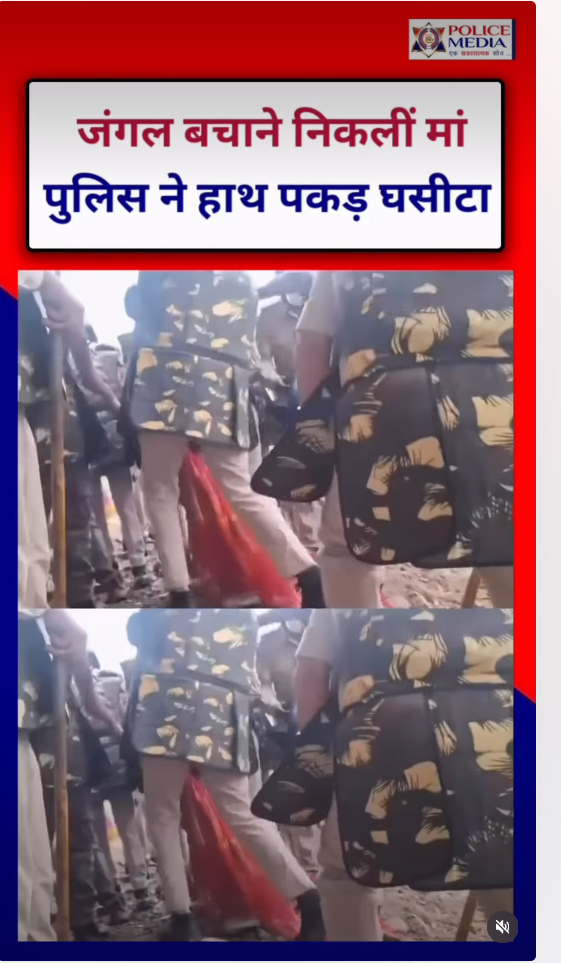
In the next step of the research, we found the same video on an Instagram channel named policemedianews, where it was shared without the misleading Manipur-related claim. The post link and screenshot are provided below
https://www.instagram.com/reels/DbfALvaT4mH/
Conclusion:
The research found that the viral claim is misleading. The video is not from Manipur and does not show Indian Army personnel targeting women there. The footage is from protests against the Ken-Betwa Link Project in Chhatarpur, Madhya Pradesh, where police were seen removing an elderly tribal woman during the demonstration. The video is being shared on social media with a false context.

Related Blogs
.webp)
Introduction
MSMEs, being the cornerstone of the Indian economy, are one of the most vulnerable targets in cyberspace and no enterprise is too small to be a target for malicious actors. MSMEs hardly ever perform a cyber-risk assessment, but when they do, they may run into a number of internal problems, such as cyberattacks brought on by inadequate networking security, online fraud, ransomware assaults, etc. Tackling cyber threats in MSMEs is critical mainly because of their high level of dependance on digital technologies and the growing sophistication of cyber attacks. Protecting them from cyber threats is essential, as a security breach can have devastating consequences, including financial loss, reputational damage, and operational disruptions.
Key Cyber Threats that MSMEs are facing
MSMEs are most vulnerable to are phishing attacks, ransomware, malware and viruses, insider threats, social engineering attacks, supply chain attacks, credential stuffing and brute force attacks and Distributed Denial of Service (DDoS) Attacks. Some of these attacks are described as under-
- Insider threats arise from employees or contractors who intentionally or unintentionally compromise security. It involves data theft, misuse of access privileges, or accidental data exposure.
- Social engineering attacks involve manipulating individuals into divulging confidential information or performing actions that compromise security by pretexting, baiting, and impersonation.
- Supply chain attacks exploit the trust in relationships between businesses and their suppliers and introduce malware, compromise data integrity, and disrupt operations.
- Credential stuffing and brute force attacks give unauthorized access to accounts and systems, leading to data breaches and financial losses.
Challenges Faced by MSMEs in Cybersecurity
The challenges faced by MSMEs in cyber security are mainly due to limited resources and budget constraints which leads to other issues such as a lack of specialized expertise as MSMEs often lack the IT support of cyber security experts. Awareness and training are needed to mitigate poor understanding of cyber threats and their complexity in nature. Vulnerabilities in the supply chain are present as they rely on third-party vendors and partners often, introducing potential supply chain vulnerabilities. Regulatory compliance is often complex and is taken seriously only when an issue crops up but it needs special attention especially with the DPDP Act coming in. The lack of an incident response plan leads to delayed and inadequate responses to cyber incidents, increasing the impact of breaches.
Best Practices for Tackling Cyber Threats for MSMEs
To effectively tackle cyber threats, MSMEs should adopt a comprehensive approach such as:
- Implementing and enforcing strong access controls by using MFA or 2FA and password policies. Limiting employee access as role based and updating the same as and when needed.
- Regularly apply security patches and use automated patch management solutions to prevent exploitation of known vulnerabilities.
- Conduct employee training and awareness programs and promote a security-first approach for the employees and assessing employee readiness to identify improvement areas.
- Implement network security measures by using firewalls and intrusion detection systems. Using secure Wi-Fi networks via strong encryptions and changing default credentials for the router are recommended, as is segmenting networks to limit lateral movement within the network in case of a breach.
- Regular data backup ensures that in case of an attack, data loss can be recovered and made available in secure offsite locations to protect it from unauthorized access.
- Developing an incident response plan that outlines the roles, responsibilities and procedure for responding to cyber incidents with regular drills to ensure readiness and clear communication protocols for incident reporting to regulators, stakeholders and customers.
- Implement endpoint security solutions using antivirus and anti-malware softwares. Devices should be against unauthorized access and implement mobile device management solutions enforcing security policies on employee-owned devices used for work purposes.
- Cyber insurance coverage will help in transferring financial risks in case of cyber incidents. It should have comprehensive coverage including business interruptions, data restoration, legal liabilities and incident response costs.
Recommended Cybersecurity Solutions Tailored for MSMEs
- A Managed Security Service Provider offers outsourced cybersecurity services, including threat monitoring, incident response, and vulnerability management that may be lacking in-house.
- Cloud-Based Security Solutions such as firewall as a service and Security Information and Event Management , provide scalable and cost-effective protection for MSMEs.
- Endpoint Detection and Response (EDR) Tools detect and respond to threats on endpoints, providing real-time visibility into potential threats and automating incident response actions.
- Security Awareness Training Platforms deliver interactive training sessions and simulations to educate employees about cybersecurity threats and best practices.
Conclusion
Addressing cyber threats in MSMEs requires a proactive and multi-layered approach that encompasses technical solutions, employee training, and strategic planning. By implementing best practices and leveraging cybersecurity solutions tailored to their specific needs, MSMEs can significantly enhance their resilience against cyber threats. As cyber threats continue to evolve, staying informed about the latest trends and adopting a culture of security awareness will be essential for MSMEs to protect their assets, reputation, and bottom line.
References:
- https://economictimes.indiatimes.com/small-biz/security-tech/security/cyber-security-pitfalls-and-how-negligence-can-be-expensive-for-msmes/articleshow/99508822.cms?from=mdr
- https://www.investopedia.com/financial-edge/0112/3-ways-cyber-crime-impacts-business.aspx
- https://www.financialexpress.com/business/sme-msme-tech-cisco-launches-new-tool-for-smbs-to-assess-their-cybersecurity-readiness-2538348/
- https://www.cloverinfotech.com/blog/small-businesses-big-problems-are-cyber-attacks-crushing-indias-msmes/

Executive Summary
A video is being widely shared on social media linking it to the ongoing tensions between Israel and Iran. The clip shows multiple fighter jets flying across the sky, while massive flames appear to be rising from tall buildings below. The visuals are dramatic and alarming, creating the impression of a large-scale military strike. Users sharing the video claim that after Israel carried out an attack, Iran launched a retaliatory strike on Israel, and that the viral footage captures the aftermath of this counterattack. However, research conducted by the CyberPeace found the claim to be misleading. Our research revealed that the viral video is not authentic but AI-generated.
Claim
On the social media platform Facebook, a user shared the viral video with the caption: “Iran has also carried out a retaliatory attack on Israel.”
(Post link and archive link provided above.)
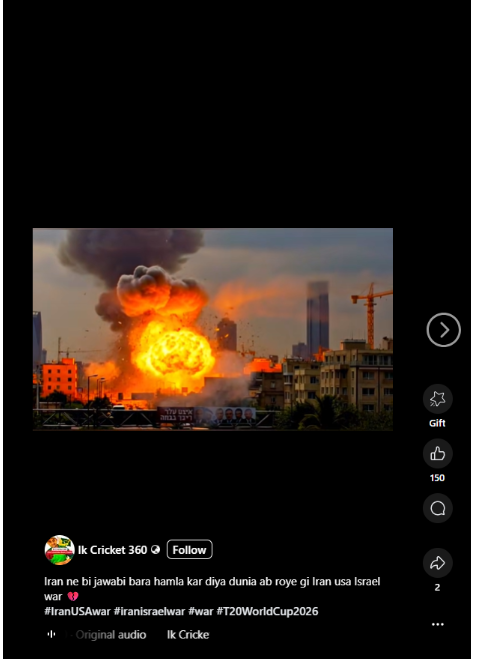
Factcheck
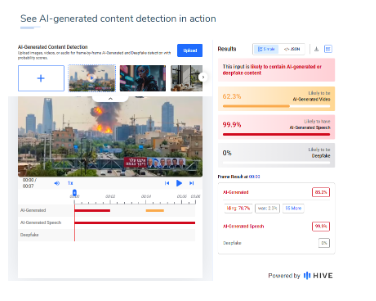
Upon closely examining the video, we noticed several irregularities in the visuals and motion patterns, which raised suspicion that the footage may have been generated using artificial intelligence. To verify this, we analyzed the video using the AI detection tool developed by Hive Moderation. According to the analysis report, there is a 62 percent likelihood that the viral video is AI-generated.
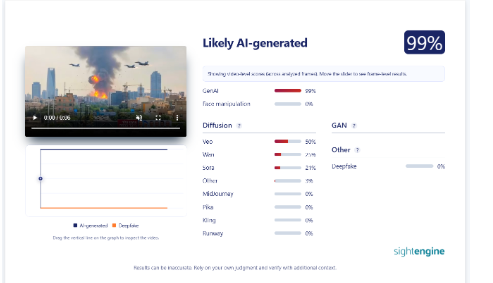
As part of further verification, we also scanned the video using Sightengine. The results indicated an even stronger probability, suggesting that the video is 99 percent AI-generated.
Conclusion
Our research confirms that the viral video does not depict a real military attack. It is AI-generated content being falsely shared in the context of Israel-Iran tensions.
.webp)
Executive Summary
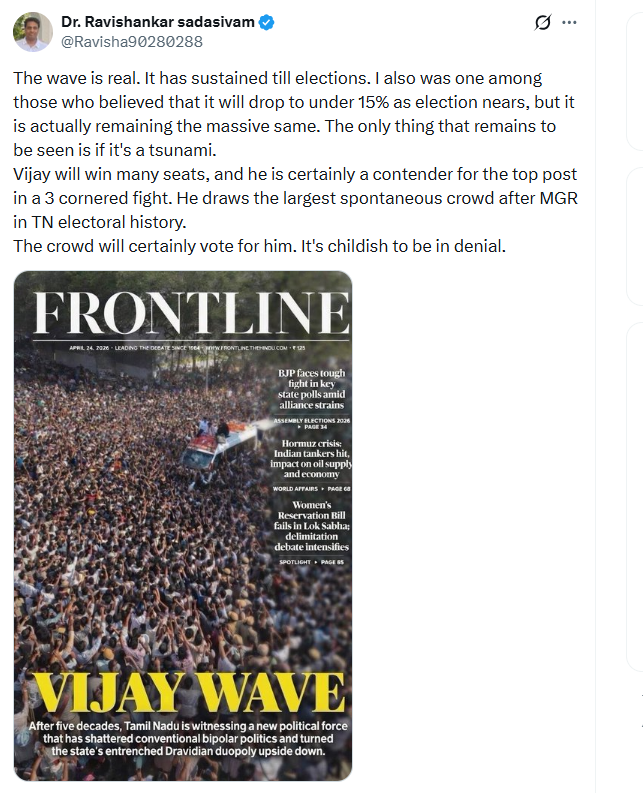
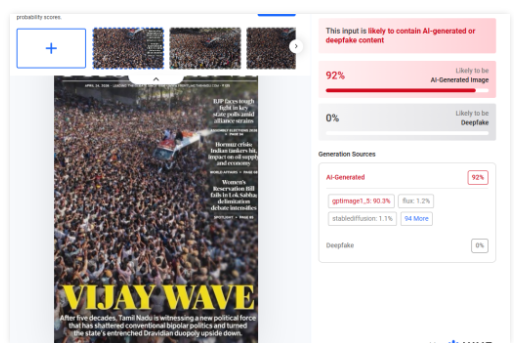
As Tamil Nadu voted in the 2026 Assembly elections, with 84.69 percent polling recorded on April 23, a purported cover page of Frontline magazine began circulating on social media. The viral image featured a massive rally crowd of South Indian actor and Tamilaga Vetri Kazhagam (TVK) chief Joseph Vijay, claiming that a “Vijay Wave” had emerged in the state. The alleged cover also stated that Tamil Nadu was witnessing a new political force after five decades, one that had challenged the dominance of Dravida Munnetra Kazhagam (DMK) and All India Anna Dravida Munnetra Kazhagam (AIADMK).
However, research by the CyberPeace Research Wing found that the viral cover page is fake. Frontline magazine has not published any such edition, and its latest issue is related to health.
Claim:
X user “Dr. Ravishankar Sadasivam” shared the viral image on April 22, 2026, claiming the “wave is real” and suggesting that Vijay could emerge as a top contender in a three-cornered contest. The post further claimed that after MGR, Vijay was drawing the largest spontaneous crowds in Tamil Nadu politics.
Fact Check:
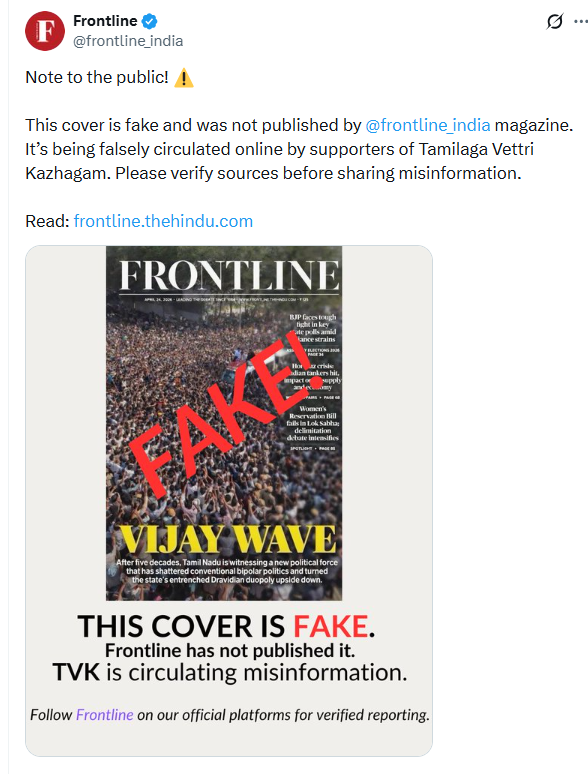
To verify the claim, relevant keyword searches were conducted online. During the research, a clarification post from Frontline magazine’s official X account, shared on April 22, 2026, was found. In the post, the publication clearly stated that the viral cover page was fake and had not been published by the magazine. It further said that the fabricated cover was being circulated online by supporters of TVK.
A review of the official Frontline website also found no edition carrying such a cover page.

Additionally, the viral image was analyzed using the AI detection tool Hive Moderation, which rated it as 92 percent likely to be AI-generated.
Conclusion:
The claim that Frontline magazine published a cover story on a “Vijay Wave” during the Tamil Nadu Assembly elections is false. The viral cover page is fake and is being circulated online to mislead people.
