
#FactCheck-Claim Linking UP School Hostel Video of Injured Children to Delhi CJP Protest is False
Executive Summary
A video showing several children in an injured condition is being widely shared on social media with the claim that the footage is from the ‘Sansad March’ protest organised by the Cockroach Janata Party (CJP) on July 20, 2026. The video is being circulated with the allegation that Delhi Police lathi-charged children during the protest in Delhi. CyberPeace Research Wing’s research found the claim to be false. The viral video is not related to the CJP protest in Delhi. The footage is from an old incident at a private school hostel in Farrukhabad, Uttar Pradesh, where a warden was accused of assaulting students. The old video has been falsely linked to the recent protest with a misleading claim.
Claim:
A Facebook user named ‘The sociopolitics’ shared the video on July 23, 2026, claiming that children were beaten by Delhi Police during the protest.The post stated, “What had the children done wrong? Were they beaten with their eyes covered, or was the anger of their bosses taken out on the public?” The viral post was shared widely on social media by users who believed the claim to be true. The archived version of the post can be accessed here:
https://www.instagram.com/reels/DbKiqy8lOu5/

Fact Check:
To verify the authenticity of the viral video, the Desk first analysed the footage carefully and examined its audio. The conversation of the children in the video made it clear that the visuals were not connected to the student protest at Delhi’s Jantar Mantar or any police lathi-charge. In the video, the children can be heard mentioning the name of their school and speaking about the warden who allegedly assaulted them. The video also displayed the Instagram username ‘parulpatel4618’, which provided a lead for further research.
https://www.instagram.com/p/DbFcdAjxvG5

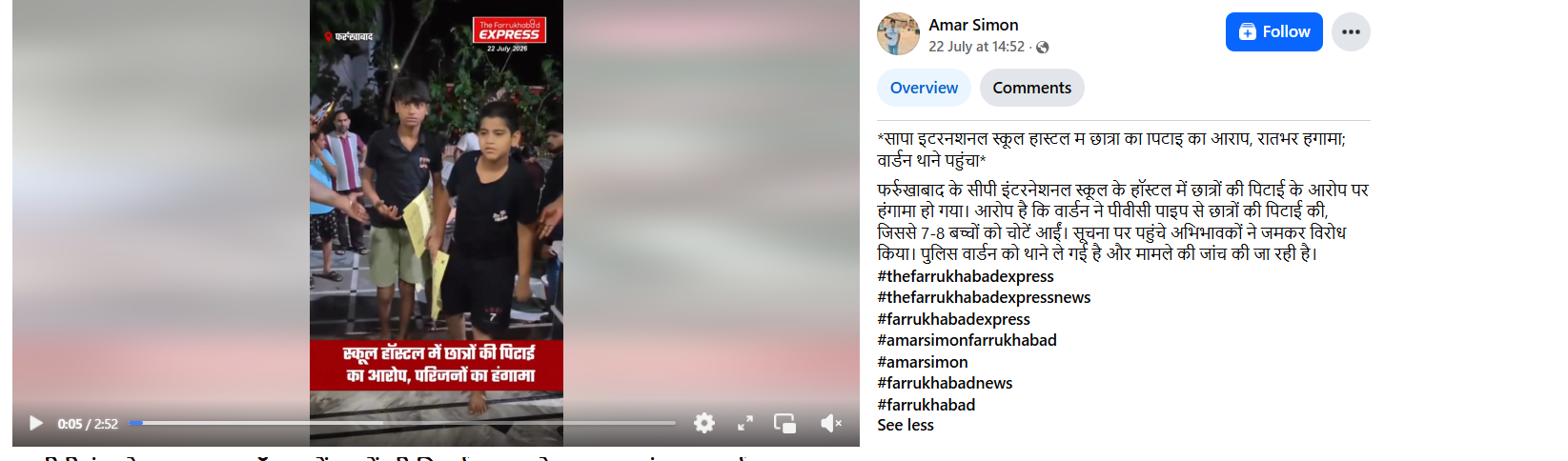
In the next stage of the research, the Desk found a Facebook post dated July 22, 2026, related to the incident. According to the post, students at CP International School hostel in Farrukhabad, Uttar Pradesh, were allegedly beaten, following which a protest was reported. The post stated that the hostel warden was accused of assaulting students with a PVC pipe, leaving several children injured. After receiving information about the incident, parents reached the spot and protested. Police took the warden to the police station and initiated an research.
https://www.facebook.com/watch/?v=992060370500487
Conclusion:
The research established that the viral video is not from the CJP ‘Sansad March’ protest in Delhi. The footage is from an old incident at a private school hostel in Farrukhabad, Uttar Pradesh, where a warden was accused of assaulting students. The video is being circulated with a false claim by linking it to a recent protest.

Related Blogs
Executive Summary
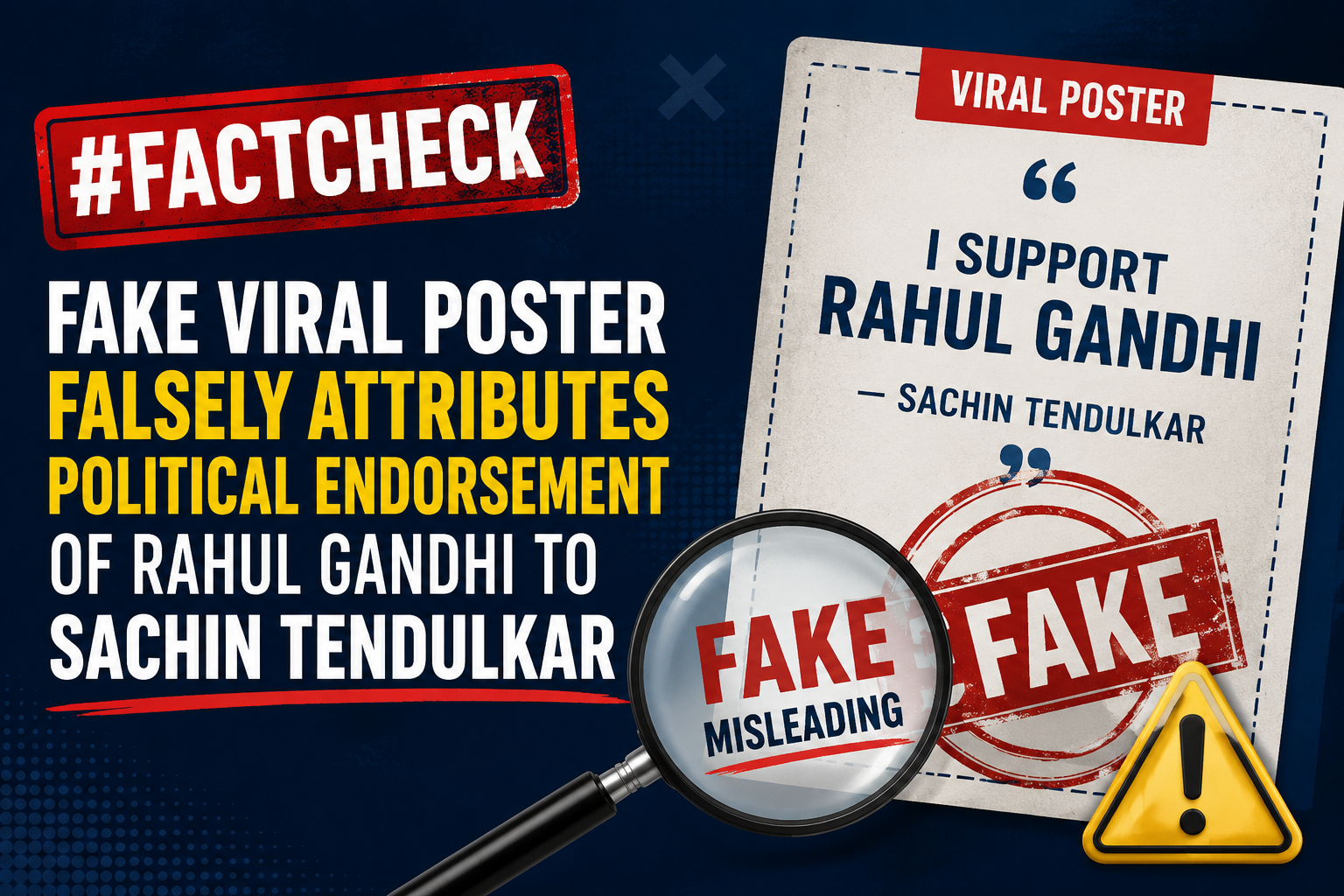
A post claiming that former Indian cricketer Sachin Tendulkar praised Congress leader Rahul Gandhi and urged people to elect him as Prime Minister is being widely circulated on social media.The viral poster falsely attributes a political statement to Sachin Tendulkar, suggesting that he has endorsed Rahul Gandhi for the post of Prime Minister. However, CyberPeace Research Wing research found the claim to be fake. Sachin Tendulkar has not made any such appeal or statement supporting Rahul Gandhi for Prime Minister.
Claim
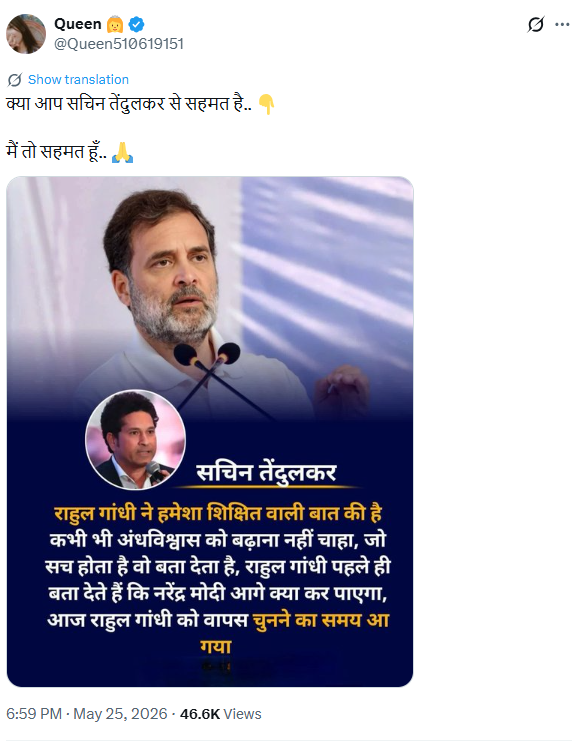
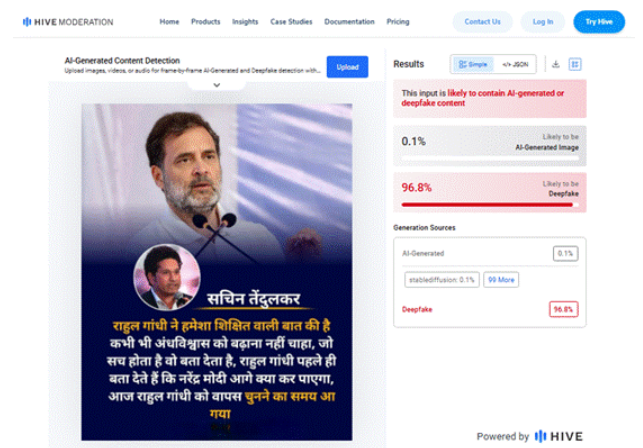
On X (formerly Twitter), a verified user “Queen” shared a viral poster claiming:“Sachin Tendulkar has always supported education and never promoted superstition. Rahul Gandhi always predicts what Narendra Modi will do next. It is time to choose Rahul Gandhi again.”
Fact Check
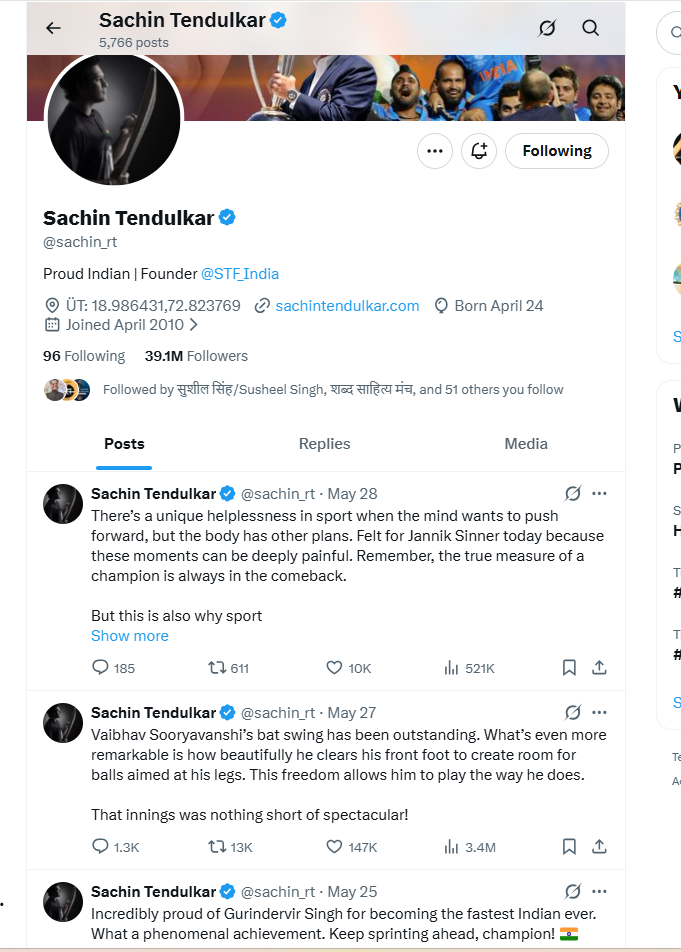
To verify the claim, we first searched for any news reports, interviews, or credible references linking Sachin Tendulkar to such a political statement. However, we found no evidence in any reliable media source or public record suggesting that he made any such remark about Rahul Gandhi or the Prime Ministership. We also reviewed Sachin Tendulkar’s official social media accounts, but found no post, video, or statement endorsing any political leader in this manner.
Finally, the viral poster was analysed using the AI detection tool Hive Moderation. The analysis indicated a 96.8% probability that the poster was digitally created or manipulated, suggesting possible AI-generated or edited content.
Conclusion
CyberPeace Research Wing research found the claim to be fake. Sachin Tendulkar has not made any appeal to elect Rahul Gandhi as Prime Minister. The viral poster appears to be digitally fabricated and is being shared to spread misinformation.

Introduction
In a world teeming with digital complexities, where information wends through networks with the speed and unpredictability of quicksilver, companies find themselves grappling with the paradox of our epoch: the vast potential of artificial intelligence (AI) juxtaposed with glaring vulnerabilities in data security. It's a terrain fraught with risks, but in the intricacies of this digital age emerges a profound alchemy—the application of AI itself to transmute vulnerable data into a repository as secure and invaluable as gold.
The deployment of AI technologies comes with its own set of challenges, chief among them being concerns about the integrity and safety of data—the precious metal of the information economy. Companies cannot afford to remain idle as the onslaught of cyber threats threatens to fray the fabric of their digital endeavours. Instead, they are rallying, invoking the near-miraculous capabilities of AI to transform the very nature of cybersecurity, crafting an armour of untold resilience by empowering the hunter to become the hunted.
The AI’s Untapped Potential
Industries spanning the globe, varied in their scopes and scales, recognize AI's potential to hone their processes and augment decision-making capabilities. Within this dynamic lies a fertile ground for AI-powered security technologies to flourish, serving not merely as auxiliary tools but as essential components of contemporary business infrastructure. Dynamic solutions, such as anomaly detection mechanisms, highlight the subtle and not-so-subtle deviances in application behaviour, shedding light on potential points of failure or provoking points of intrusion, turning what was once a prelude to chaos into a symphony of preemptive intelligence.
In the era of advanced digital security, AI, exemplified by Dynatrace, stands as the pinnacle, swiftly navigating complex data webs to fortify against cyber threats. These digital fortresses, armed with cutting-edge AI, ensure uninterrupted insights and operational stability, safeguarding the integrity of data in the face of relentless cyber challenges.
India’s AI Stride
India, a burgeoning hub of technology and innovation, evidences AI's transformative powers within its burgeoning intelligent automation market. Driven by the voracious adoption of groundbreaking technological paradigms such as machine learning (ML), natural language processing (NLP), and Automated Workflow Management (AWM), sectors as disparate as banking, finance, e-commerce, healthcare, and manufacturing are swept up in an investment maelstrom. This is further bolstered by the Indian government’s supportive policies like 'Make in India' and 'Digital India'—bold initiatives underpinning the accelerating trajectory of intelligent automation in this South Asian powerhouse.
Consider the velocity at which the digital universe expands: IDC posits that the 5 billion internet denizens, along with the nearly 54 billion smart devices they use, generate about 3.4 petabytes of data each second. The implications for enterprise IT teams, caught in a fierce vice of incoming cyber threats, are profound. AI's emergence as the bulwark against such threats provides the assurance they desperately seek to maintain the seamless operation of critical business services.
The AI integration
The list of industries touched by the chilling specter of cyber threats is as extensive as it is indiscriminate. We've seen international hotel chains ensnared by nefarious digital campaigns, financial institutions laid low by unseen adversaries, Fortune 100 retailers succumbing to cunning scams, air traffic controls disrupted, and government systems intruded upon and compromised. Cyber threats stem from a tangled web of origins—be it an innocent insider's blunder, a cybercriminal's scheme, the rancor of hacktivists, or the cold calculation of state-sponsored espionage. The damage dealt by data breaches and security failures can be monumental, staggering corporations with halted operations, leaked customer data, crippling regulatory fines, and the loss of trust that often follows in the wake of such incidents.
However, the revolution is upon us—a rising tide of AI and accelerated computing that truncates the time and costs imperative to countering cyberattacks. Freeing critical resources, businesses can now turn their energies toward primary operations and the cultivation of avenues for revenue generation. Let us embark on a detailed expedition, traversing various industry landscapes to witness firsthand how AI's protective embrace enables the fortification of databases, the acceleration of threat neutralization, and the staunching of cyber wounds to preserve the sanctity of service delivery and the trust between businesses and their clientele.
Public Sector
Examine the public sector, where AI is not merely a tool for streamlining processes but stands as a vigilant guardian of a broad spectrum of securities—physical, energy, and social governance among them. Federal institutions, laden with the responsibility of managing complicated digital infrastructures, find themselves at the confluence of rigorous regulatory mandates, exacting public expectations, and the imperative of protecting highly sensitive data. The answer, increasingly, resides in the AI pantheon.
Take the U.S. Department of Energy's (DOE) Office of Cybersecurity, Energy Security, and Emergency Response (CESER) as a case in point. An investment exceeding $240 million in cybersecurity R&D since 2010 manifests in pioneering projects, including AI applications that automate and refine security vulnerability assessments, and those employing cutting-edge software-defined networks that magnify the operational awareness of crucial energy delivery systems.
Financial Sector
Next, pivot our gaze to financial services—a domain where approximately $6 million evaporates with each data breach incident, compelling the sector to harness AI not merely for enhancing fraud detection and algorithmic trading but for its indispensability in preempting internal threats and safeguarding knightly vaults of valuable data. Ventures like the FinSec Innovation Lab, born from the collaborative spirits of Mastercard and Enel X, demonstrate AI's facility in real-time threat response—a lifeline in preventing service disruptions and the erosion of consumer confidence.
Retail giants, repositories of countless payment credentials, stand at the threshold of this new era, embracing AI to fortify themselves against the theft of payment data—a grim statistic that accounts for 37% of confirmed breaches in their industry. Best Buy's triumph in refining its phishing detection rates while simultaneously dialling down false positives is a testament to AI's defensive prowess.
Smart Cities
Consider, too, the smart cities and connected spaces that epitomize technological integration. Their web of intertwined IoT devices and analytical AI, which scrutinize the flows of urban life, are no strangers to the drumbeat of cyber threat. AI-driven defense mechanisms not only predict but quarantine threats, ensuring the continuous, safe hum of civic life in the aftermath of intrusions.
Telecom Sector
Telecommunications entities, stewards of crucial national infrastructures, dial into AI for anticipatory maintenance, network optimization, and ensuring impeccable uptime. By employing AI to monitor the edges of IoT networks, they stem the tide of anomalies, deftly handle false users, and parry the blows of assaults, upholding the sanctity of network availability and individual and enterprise data security.
Automobile Industry
Similarly, the automotive industry finds AI an unyielding ally. As vehicles become complex, mobile ecosystems unto themselves, AI's cybersecurity role is magnified, scrutinizing real-time in-car and network activities, safeguarding critical software updates, and acting as the vanguard against vulnerabilities—the linchpin for the assured deployment of autonomous vehicles on our transit pathways.
Conclusion
The inclination towards AI-driven cybersecurity permits industries not merely to cope, but to flourish by reallocating their energies towards innovation and customer experience enhancement. Through AI's integration, developers spanning a myriad of industries are equipped to construct solutions capable of discerning, ensnaring, and confronting threats to ensure the steadfastness of operations and consumer satisfaction.
In the crucible of digital transformation, AI is the philosopher's stone—an alchemic marvel transmuting the raw data into the secure gold of business prosperity. As we continue to sail the digital ocean's intricate swells, the confluence of AI and cybersecurity promises to forge a gleaming future where businesses thrive under the aegis of security and intelligence.
References
- https://timesofindia.indiatimes.com/gadgets-news/why-adoption-of-ai-may-be-critical-for-businesses-to-tackle-cyber-threats-and-more/articleshow/106313082.cms
- https://blogs.nvidia.com/blog/ai-cybersecurity-business-resilience/

Executive Summary:
A viral post currently circulating on various social media platforms claims that Reliance Jio is offering a ₹700 Holi gift to its users, accompanied by a link for individuals to claim the offer. This post has gained significant traction, with many users engaging in it in good faith, believing it to be a legitimate promotional offer. However, after careful investigation, it has been confirmed that this post is, in fact, a phishing scam designed to steal personal and financial information from unsuspecting users. This report seeks to examine the facts surrounding the viral claim, confirm its fraudulent nature, and provide recommendations to minimize the risk of falling victim to such scams.
Claim:
Reliance Jio is offering a ₹700 reward as part of a Holi promotional campaign, accessible through a shared link.

Fact Check:
Upon review, it has been verified that this claim is misleading. Reliance Jio has not provided any promo deal for Holi at this time. The Link being forwarded is considered a phishing scam to steal personal and financial user details. There are no reports of this promo offer on Jio’s official website or verified social media accounts. The URL included in the message does not end in the official Jio domain, indicating a fake website. The website requests for the personal information of individuals so that it could be used for unethical cyber crime activities. Additionally, we checked the link with the ScamAdviser website, which flagged it as suspicious and unsafe.


Conclusion:
The viral post claiming that Reliance Jio is offering a ₹700 Holi gift is a phishing scam. There is no legitimate offer from Jio, and the link provided leads to a fraudulent website designed to steal personal and financial information. Users are advised not to click on the link and to report any suspicious content. Always verify promotions through official channels to protect personal data from cybercriminal activities.
- Claim: Users can claim ₹700 by participating in Jio's Holi offer.
- Claimed On: Social Media
- Fact Check: False and Misleading
