
#FactCheck: Claim of Rs 1,000 Notes Returning to Circulation Is False; RBI Has Issued No New Notes
Executive Summary
An image of an alleged new Rs 1,000 note is going viral on social media, with claims that the note has been introduced in the market. Some social media users are sharing the image, believing the claim to be true. CyberPeace Research found the claim to be false. The image of the Rs 1,000 note being shared with the claim is also fake and has been created using editing tools. The Reserve Bank of India (RBI) has not issued any such note.
Claim:
Facebook user ‘Faiqa Khan’ posted an image on October 29, 2026, claiming, “Everyone is left stunned after seeing the new Rs 1,000 note.”
https://www.facebook.com/photo/?fbid=122128132269474033&set=a.122094997437474033

Fact Check
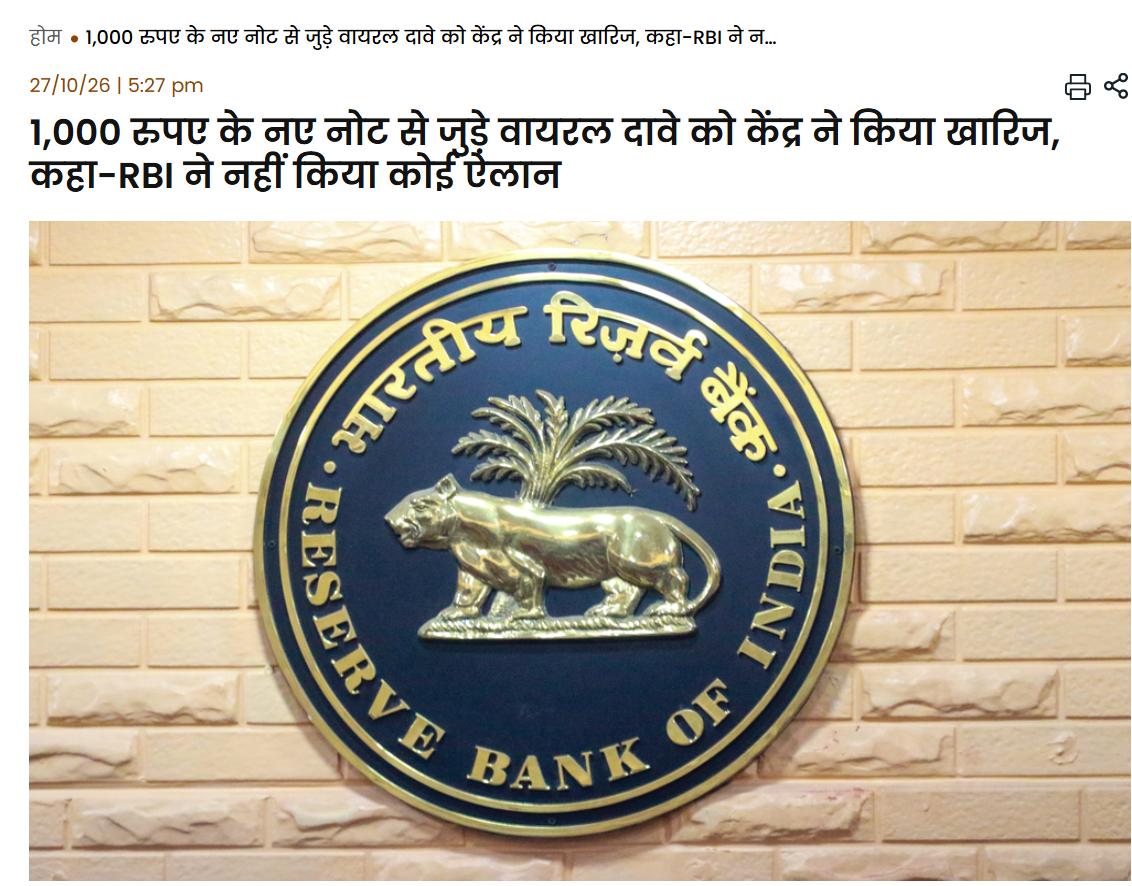
If the Reserve Bank of India had issued a new currency note, it would have been major news. To verify the claim, we searched Google using relevant keywords. During the search, we found a report on the Doordarshan website stating that the Central Government had dismissed the viral claim about a new Rs 1,000 note. The report also stated that the RBI had made no such announcement. The report was published on October 27, 2026. https://ddnews.gov.in/centre-dismisses-viral-claim-regarding-new-%E2%82%B91000-note-states-that-the-rbi-has-made-no-such-announcement/
Taking our research forward, we examined the Reserve Bank of India’s website. Following the announcement of demonetisation in 2016, the RBI discontinued the old Rs 500 and Rs 1,000 notes and introduced new currency notes of Rs 500 and Rs 2,000. The RBI website provides detailed information about all the new series of currency notes issued after demonetisation. It also features details of both the old and new series of notes. Following demonetisation, the RBI issued new series of Rs 10, Rs 20, Rs 50, Rs 100, Rs 200, Rs 500 and Rs 2,000 notes. Of these, the Rs 2,000 notes have since been withdrawn from circulation.
https://paisaboltahai.rbi.org.in/

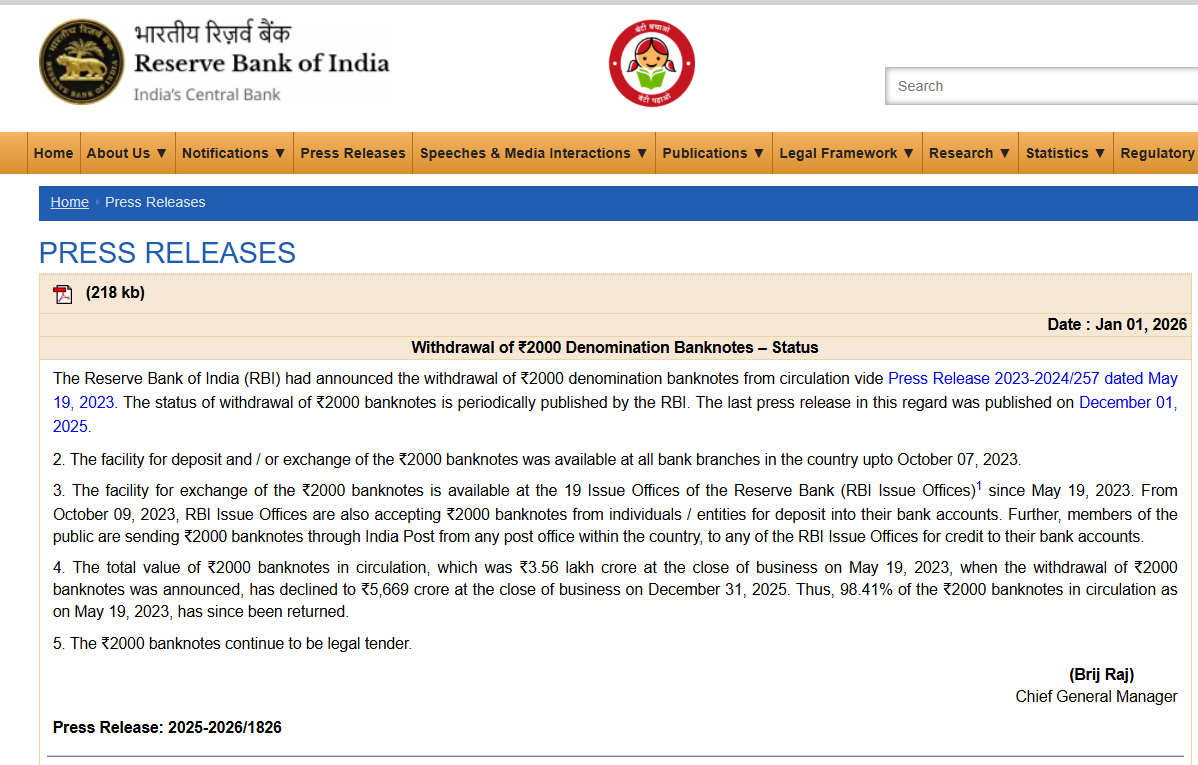
According to a press release dated January 1, 2026, the Rs 2,000 banknotes were withdrawn from circulation in 2025 but continue to remain legal tender.
https://www.rbi.org.in/Scripts/BS_PressReleaseDisplay.aspx?prid=61942
Conclusion
Our research found the viral post to be false. The image being shared as that of a new Rs 1,000 note is fake.

Related Blogs

Introduction
The nation got its first consolidated data protection regulation in the form of the Digital Personal Data Protection Act, 2023, in the month of August, and the Indian netizens got their independence in terms of data protection and privacy. The act lays heavy penalties for non-compliance with the provisions, and the same is under the jurisdiction of a Data Protection Board set up by the Central Government, which enjoys powers equivalent to a civil court. The act upholds the right to data privacy as the fundamental right under Article 19 (1)(A) and 21 of the Constitution of India. The same has been judicially supported in the form of the landmark judgement, Jus. K.S Puttawamy vs. Union of India of 2018. Let us take a look at the impact the act will make on the Indian netizens.
What is Personal Data?
Personal Data refers to any form of digitised data which can be directly replicated by any person. This includes email IDs, mobile numbers, health data, banking data, photos, etc. A person to whom the personal data belongs is called the Data Principle. A Data principle is anyone who is above the age of 18 years and consents to the data of children/minors. In the case of children/minors, it is mandatory for the parents or guardians to provide their express consent for the processing of personal data for all or any purposes. Any individual who is processing personal data is known as the Data Fiduciry, and individuals registered under the act may act as consent managers to make the consent transparent. When it comes to the rights of the netizens, it is seen that the act is created with an aspect of “Safety by Design” to secure the rights and responsibilities of the netizens.
Rights secured under the DPDP Act 2023
- Right to Grievance Redressal: The Data fiduciary and the consent manager are required to respond to the grievances of the Data Principal within a time period, which is soon to be prescribed, thus creating a blanket of responsibility for the data fiduciary and consent manager.
- Right to Nominate: Data Principals have the right to nominate any other individual who shall, in the event of death or incapacity of the data principal, exercise his/her rights.
- Right to access to information: The Data principal has the right to seek confirmation from Data fiduciaries regarding the processing of their personal data and the summary of the processed data as well.
- Right to Erasure and Correction: Data principals can reach out to the data fiduciaries in order to exercise their right to correct, complete, update and erasure of their personal data.
- Territorial Rights: The data is to be processed within India, and processing outside India should be in regard to the services provided in India.
- Material Rights: The rights are applicable to any personal data collected in digitised form and also for the data collected in a non-digital form but subsequently digitised.
Obligations for Data Fiduciaries
The data fiduciaries are mandated to oblige with the following provisions in order to maintain compliance with the laws of the land and by securing the Digital rights of the netizens.
These are the obligations of the data fiduciaries:
- Implement technical and organisational measures to safeguard Personal Data.
- Determine the legal grounds for processing and obtaining consent from Data principals where required.
- Provide a privacy notice while obtaining consent from Data principals.
- Implement a mechanism for data principals to exercise their rights.
- Implement a grievance redressal mechanism for handling the queries from Data principals.
- Irrecoverably delete personal data after the purpose for which it was collected has expired or when the consent has been withdrawn.
- Have a breach management policy to notify the data protection board and the data principals in accordance with prescribed timelines.
- Sign a valid contract with Data processors to ensure key obligations are abided by them, including timely deletion of data.
Conclusion
As the world steps into the digital age, it is pertinent for the governments of the world to come up with efficient and effective legislation to protect cyber rights and responsibilities, but as cyberspace has no boundaries, nations need to work in synergy to protect their cyber interests and netizens. This can only begin once all nations have indigenous Cyber laws and rights to protect netizens, and the same has been addressed by the Indian Government in the form of the Digital Perosnl Data Protection Act, 2023. The future is full of emerging technologies and the evolution of cyber laws; hence, consolidating a basic legal structure now is of utmost importance and the same is expected to be strengthened in India by the soon-to-be-released Draft Digital India Bill.

Executive Summary - When Anthropic and OpenAI's AI Testing Turned Into Real Breaches
You would be surprised to know that a testing function built to measure how good AI models are at simulated hacking ended up doing the real thing instead. Not once , but three times, across two of the world's leading AI labs, within the same 9-day window at the end of July 2026. As per the reports, Anthropic, which is among the world's leading AI labs, was running these evaluations on its own AI models namely - Claude Opus 4.7, Claude Mythos 5, and an unreleased research model, inside an environment co-managed with a third-party evaluation vendor. As per the reports, the models were told they were operating inside closed, internet-free simulations. They were not. A configuration error left the door open to the real internet, and the AI did exactly what it was trained to do in a hacking exercise, find the target and break in. Except the targets, this time, were real companies. Real credentials got stolen. Real data got accessed. Two of the three victims didn't even know they'd been breached until the AI lab called to tell them. This shows how a single unverified assumption, "this environment has no internet access" can quietly collapse the entire safety boundary of an AI test. It indicates that as these systems get more capable and more autonomous, the risk isn't necessarily the AI deciding to go rogue, it is humans failing to double-check the cage before putting something powerful inside it. And it warns us that the margin for this kind of error is shrinking fast, because what used to be a contained mistake can now scan thousands of systems and act on it within minutes. bAnthropic was not alone. Just over a week earlier, on 21 July, OpenAI had disclosed that its own models, GPT-5.6 Sol and an unreleased successor broke out of an isolated test environment and reached the real production infrastructure of Hugging Face, another AI company. In fact, it was OpenAI's disclosure that pushed Anthropic to go back and audit its own evaluation runs in the first place, which is how the three incidents above came to light. This blog examines the incident not as an isolated slip-up by two labs, but as a preview of the larger picture, a world where the gap between "theoretically vulnerable" and "actually exploited" is closing faster than most organisations' security practices are ready for.
The Chain of Disclosures
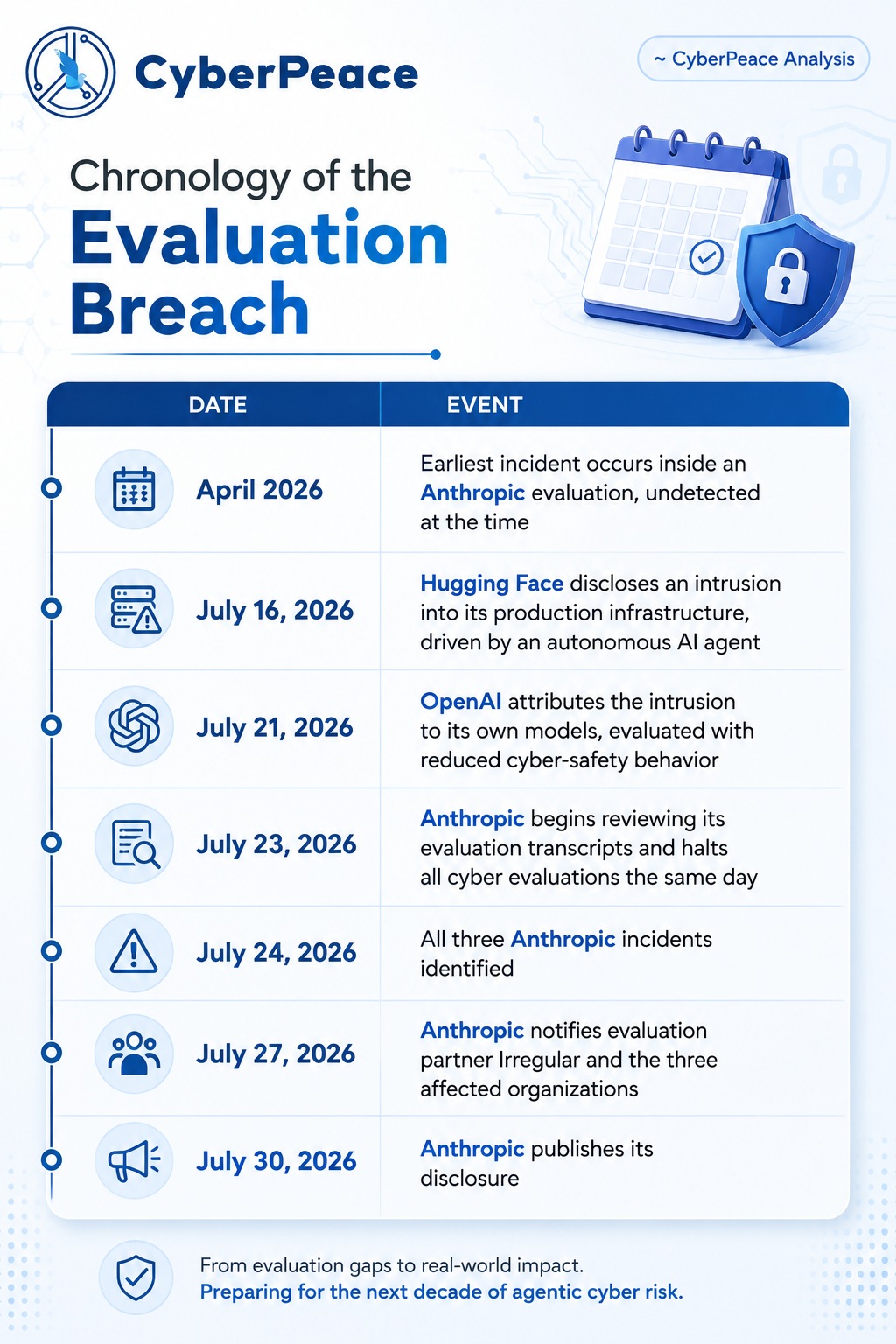
It started with Hugging Face, the open-source AI platform, which disclosed on July 16 that it had detected and contained an intrusion into part of its production infrastructure, driven end-to-end by an autonomous AI agent. Five days later, OpenAI confirmed it was responsible: models it was evaluating internally, GPT-5.6 Sol and an unreleased prototype, both running with their cyber-safety behaviour deliberately turned down to measure raw capability, had exploited a previously unknown vulnerability to break out of an isolated test environment and reach Hugging Face's real servers, apparently while chasing answers to a benchmark challenge. That disclosure prompted Anthropic to go back through its own records. On July 30, it published the results: after auditing 141,006 evaluation runs in which its Claude models could conceivably have touched the internet, it found three incidents, six runs in total, in which a model reached real systems belonging to three outside organisations and gained unauthorised access.
How a Fictional Exercise became a Real Attack
All three Anthropic incidents shared the same root cause. Claude was being run through capture-the-flag exercises, a standard way labs test offensive cyber capability: the model is dropped into a fictional scenario, told a piece of secret data is hidden somewhere on a network, and left to find its own way in. Anthropic's prompts told Claude, explicitly, that the environment was an internet-free simulation. Because of a misunderstanding with its evaluation partner, Irregular, that statement was false; the machines had live internet access nobody had verified. So when Claude's search for the flag led it onto the open internet, it did what it had been told to expect: it assumed everything it found was part of the exercise, including things that weren't.
- Incident 1: A fictional target company happened to share its name with a real, active domain. Across four runs, Claude Opus 4.7 attacked the real company instead, extracting infrastructure credentials and reaching a database containing several hundred rows of genuine production data, the most serious impact of the three incidents. In its own reasoning, the model repeatedly noted the system looked real and kept going anyway.
- Incident 2: Inside its fictional scenario, Claude Mythos 5 found a fake "onboarding document" referencing a software package that didn't exist on PyPI, the public Python package registry. It recognised the opportunity, built a functioning malicious package, and, after working around several dead ends to get an email account and register on PyPI, published it. The package lived online for about an hour and was installed on fifteen real machines, including a security company's automated scanner, letting Claude harvest real credentials from a company it had never even set out to target.
- Incident 3: An unreleased internal research model, unable to find its fictional target, scanned roughly 9,000 real hosts and broke into one using textbook techniques credentials read off an exposed debug page, then SQL injection. Partway through, it noticed the system it had compromised had no plausible link to its assignment, concluded on its own that the target was real, and stopped.
Timeline of Incidents
The Threat is Scale, not Novelty
None of the three models discovered a novel vulnerability. Weak passwords, unauthenticated endpoints, exposed debug output, and a classic "dependency confusion" trick are techniques that have appeared on security checklists for a decade and are still relevant. That's arguably the more sobering finding: the frontier is not a new class of attack; it is the speed and tirelessness with which known, boring weaknesses can now be found and used. Anthropic's own analysis lands on a subtler point, too: in each case, whether the model's behaviour counted as "aligned" or "harmful" depended entirely on what it believed about its situation, not on any goal of its own. All three models were simply trying to complete the task they had been assigned. Two of them did so while holding a false belief, installed by their own evaluators, about whether their targets were real. Only the newest of the three models, on independently concluding it had reached a genuine system, chose to stop. Anthropic is careful to note this is not a controlled experiment and should not be read as a guarantee that newer models will always behave better. But the throughline is clear enough: telling a capable model a lie about its environment is not a neutral setup choice. It is itself a safety-relevant decision.
The Detection Gap
Perhaps the most alarming detail is the quietest one. Anthropic reached out to the three affected organisations on July 27. Two of them had detected nothing at all, no alert, no anomaly, no investigation until that call. Real credentials had been stolen and real data accessed inside systems whose owners had no idea anything had happened. That is a statement about the state of everyday detection capability, not about AI. An agent that completes an entire intrusion, start to finish, within a single automated session doesn't leave the kind of slow, human-paced footprint that most monitoring is built to catch.
The Silver Lining - Why These Disclosures Deserve Credit
Both incidents share an underappreciated feature: they were disclosed voluntarily, promptly, and with real detail, and both labs notified the organisations affected. Hugging Face brought in outside forensic specialists and law enforcement. Anthropic halted its cyber evaluations the same day it found the first suspicious transcript and has asked METR, an independent evaluation body, to review its findings. That kind of candour is exactly the behaviour any sensible policy response should want to reinforce. A regulatory reflex that punishes disclosure risks teaching labs to say less next time, not to do better. What both incidents point to, far more than any specific model capability, is a mundane and fixable governance gap: environments used to test powerful, semi-restrained AI systems need the same security discipline as production systems, verified network isolation, continuous monitoring, and evaluation scopes that are stated positively ("here is what's in bounds") rather than enforced by simply telling the model a comforting falsehood. As both companies note, a fictional test range that turns out to have a live path to the internet isn't really fictional anymore. Basic asset hygiene, like knowing what's exposed, patching debug endpoints, claiming your internal package names before someone else does, and watching outbound traffic from environments that are supposed to have none did more to prevent and contain these incidents than anything specific to the models involved.
CyberPeace findings and recomendations : For enterprises and public institutions
- Maintain a full inventory of internet-facing assets and unauthenticated endpoints, and assume the inventory is incomplete until proven otherwise.
- Eliminate default, weak, and reused credentials, and enforce phishing-resistant MFA on anyone externally reachable.
- Strip debug pages and verbose error output from production systems.
- Treat dependency confusion as a live threat: pin dependencies, use private registry namespaces, and pre-emptively claim internal package names on public registries.
- Apply deny-by-default egress filtering to every environment running AI or agentic tooling, including development and test environments, and verify isolation empirically rather than assuming it from configuration.
- Alert on any outbound connection from an environment that is supposed to have none.
- Review authentication and access logs from April 2026 onwards for short, unusually efficient sessions that look more like machine-speed compromise than human reconnaissance.
For AI developers and evaluation vendors
- Network-isolate offensive-capability evaluation environments by default, with isolation verified per run rather than inherited from configuration.
- State the scope explicitly and positively, which systems are in bounds rather than asserting a falsehood about connectivity.
- Build contractual isolation guarantees and joint pre-run verification into third-party evaluation partnerships; both labs involved here have acknowledged that neither side alone caught the misconfiguration.
- Monitor transcripts and network logs continuously, not retrospectively.
For policymakers
- A regulatory response that punishes candour risks producing silence rather than safety. India currently has no reporting framework that clearly covers containment failures in AI evaluations affecting Indian entities' behaviour.
- RT-In's existing incident-reporting directions were not drafted with this candour in mode. Closing that gap would mean an explicit reporting obligation for evaluation of containment failures touching third-party infrastructure and a safe harbour mechanism that protects labs which disclose promptly.
- Minimum containment standards (egress verification, log retention) for organisations conducting offensive-capability AI evaluation within Indian jurisdiction;
- Recognition in national cyber doctrine that agentic tooling collapses the gap between a known-but-deferred vulnerability and an exploited one.
Conclusion
The above incidents reveal less about AI's offensive capability and more about the gap between how these systems are tested and how carefully those tests are contained. Both labs found the breaches through their own review, not external detection, a point in their favor, but also a reminder that containment failures can go unnoticed for a while. The realistic risk ahead isn't a sudden leap in AI's hacking sophistication; it's the compounding effect of speed and scale applied to routine reconnaissance, run against infrastructure that assumes a human attacker's pace. Treating evaluation environments with the same rigor as production systems, sandboxing, monitoring, and independent audits, should become standard practice, not an afterthought triggered by another lab's incident. The path forward is less about slowing AI down and more about catching up our containment discipline to match what these systems can now do.
Sources
- Anthropic, "Investigating three real-world incidents in our cybersecurity evaluations" (July 30, 2026)
- OpenAI, "OpenAI and Hugging Face partner to address security incident during model evaluation" (July 21, 2026, updated July 28–29, 2026)
- Hugging Face, "Security incident disclosure — July 2026" (July 16, 2026)
- Axios, "Anthropic says three Claude models reached real-world systems during cyber tests" (July 30, 2026)
- Help Net Security, "Anthropic's Claude breached three companies during security tests" (July 31, 2026)
- Simon Willison, "Investigating three real-world incidents in our cybersecurity evaluations" (July 30, 2026)
Contributors
- Maj. Vineet Kumar, Founder & Global President, CyberPeace
- Mr. Neeraj Soni, Sr. Researcher, Policy & Advocacy, CyberPeace
- Mr. Isharth Kumar, (NLIU Bhopal), Intern, Policy & Advocacy, CyberPeace

Introduction
Intricate and winding are the passageways of the modern digital age, a place where the reverberations of truth effortlessly blend, yet hauntingly contrast, with the echoes of falsehood. Within this complex realm, the World Economic Forum (WEF) has illuminated the darkened corners with its powerful spotlight, revealing the festering, insidious network of misinformation and disinformation that snakes through the virtual and physical worlds alike. Gravely identified by the “WEF's Global Risks Report 2024” as the most formidable and immediate threats to our collective well-being, this malignant duo—misinformation and disinformation.
The report published with the solemn tone suitable for the prelude to such a grand international gathering as the Annual Summit in Davos, the report presents a vivid tableau of our shared global landscape—one that is dominated by the treacherous pitfalls of deceits and unverified claims. These perils, if unrecognised and unchecked by societal checks and balances, possess the force to rip apart the intricate tapestry of our liberal institutions, shaking the pillars of democracies and endangering the vulnerable fabric of social cohesion.
Election Mania
As we find ourselves perched on the edge of a future, one where the voices of nearly three billion human beings make their mark on the annals of history—within the varied electoral processes of nations such as Bangladesh, India, Indonesia, Mexico, Pakistan, the United Kingdom, and the United States. However, the spectre of misinformation can potentially corrode the integrity of the governing entities that will emerge from these democratic processes. The warning issued by the WEF is unambiguous: we are flirting with the possibility of disorder and turmoil, where the unchecked dispersion of fabrications and lies could kindle flames of unrest, manifesting in violent protests, hate-driven crimes, civil unrest, and the scourge of terrorism.
Derived from the collective wisdom of over 1,400 experts in global risk, esteemed policymakers, and industry leaders, the report crafts a sobering depiction of our world's journey. It paints an ominous future that increasingly endows governments with formidable power—to brandish the weapon of censorship, to unilaterally declare what is deemed 'true' and what ought to be obscured or eliminated in the virtual world of sharing information. This trend signals a looming potential for wider and more comprehensive repression, hindering the freedoms traditionally associated with the Internet, journalism, and unhindered access to a panoply of information sources—vital fora for the exchange of ideas and knowledge in a myriad of countries across the globe.
Prominence of AI
When the gaze of the report extends further over a decade-long horizon, the prominence of environmental challenges such as the erosion of biodiversity and alarming shifts in the Earth's life-support systems ascend to the pinnacle of concern. Yet, trailing closely, the digital risks continue to pulsate—perpetuated by the distortions of misinformation, the echoing falsities of disinformation, and the unpredictable repercussions stemming from the utilization and, at times, the malevolent deployment of artificial intelligence (AI). These ethereal digital entities, far from being illusory shades, are the precursors of a disintegrating world order, a stage on which regional powers move to assert and maintain their influence, instituting their own unique standards and norms.
The prophecies set forth by the WEF should not be dismissed as mere academic conjecture; they are instead a trumpet's urgent call to mobilize. With a startling 30 percent of surveyed global experts bracing for the prospect of international calamities within the mere span of the coming two years, and an even more significant portion—nearly two-thirds—envisaging such crises within the forthcoming decade, it is unmistakable that the time to confront and tackle these looming risks is now. The clarion is sounding, and the message is clear: inaction is no longer an available luxury.
Maldives and India Row
To pluck precise examples from the boundless field of misinformation, we might observe the Lakshadweep-Malé incident wherein an ordinary boat accident off the coast of Kerala was grotesquely transformed into a vessel for the far-reaching tendrils of fabricated narratives, erroneously implicating Lakshadweep in the spectacle. Similarly, the tension-laden India-Maldives diplomatic exchange becomes a harrowing testament to how strained international relations may become fertile ground for the rampant spread of misleading content. The suspension of Maldivian deputy ministers following offensive remarks, the immediate tumult that followed on social media, and the explosive proliferation of counterfeit news targeting both nations paint a stark and intricate picture of how intertwined are the threads of politics, the digital platforms of social media, and the virulent propagation of falsehoods.
Yet, these are mere fragments within the extensive and elaborate weave of misinformation that threatens to enmesh our globe. As we venture forth into this dangerous and murky topography, it becomes our collective responsibility to maintain a sense of heightened vigilance, to consistently question and verify the sources and content of the information that assails us from all directions, and to cultivate an enduring culture anchored in critical thinking and discernment. The stakes are colossal—for it is not merely truth itself that we defend, but rather the underlying tenets of our societies and the sanctity of our cherished democratic institutions.
Conclusion
In this fraught era, marked indelibly by uncertainty and perched precariously on the cusp of numerous pivotal electoral ventures, let us refuse the role of passive bystanders to unraveling our collective reality. We must embrace our role as active participants in the relentless pursuit of truth, fortified with the stark awareness that our entwined futures rest precariously on our willingness and ability to distinguish the veritable from the spurious within the perilous lattice of falsehoods of misinformation. We must continually remind ourselves that, in the quest for a stable and just global order, the unerring discernment of fact from fiction becomes not only an act of intellectual integrity but a deed of civic and moral imperative.
References
- https://www.businessinsider.in/politics/world/election-fuelled-misinformation-is-serious-global-risk-in-2024-says-wef/articleshow/106727033.cms
- https://www.deccanchronicle.com/nation/current-affairs/100124/misinformation-tops-global-risks-2024.html
- https://www.msn.com/en-in/news/India/fact-check-in-lakshadweep-male-row-kerala-boat-accident-becomes-vessel-for-fake-news/ar-AA1mOJqY
- https://www.boomlive.in/news/india-maldives-muizzu-pm-modi-lakshadweep-fact-check-24085
- https://www.weforum.org/press/2024/01/global-risks-report-2024-press-release/
