
#FactCheck:AI-Created Video Falsely Shows Car Catching Fire During Celebration
Executive Summary:
A video showing a car catching fire is rapidly going viral on social media. In the clip, a family can be seen bursting firecrackers in front of a newly purchased car. Moments later, the vehicle also appears to catch fire. The video is being shared with the claim that the family was celebrating the purchase of a new car with fireworks, which accidentally led to the vehicle going up in flames. Many users are circulating the clip as footage of a real incident. However, an research by the CyberPeace found that the video is not from a real-life event but has been created using Artificial Intelligence (AI).
Claim
On February 25, 2026, an X user named “Mamta Rajgarh” shared the viral video with the caption:“This was supposed to be a grand celebration for buying a new car, but it turned into a ceremony of burning the car. What do you say? Comment below.”
- Post link: https://x.com/rajgarh_mamta1/status/2026696175311786408?s=20
- Archived link: https://perma.cc/22AA-KBS4

Fact Check:
To verify the claim, we conducted a keyword search on Google but found no credible news reports supporting the alleged incident. Upon closely examining the video, we noticed several technical inconsistencies. The car’s number plate is unclear, a common flaw often seen in AI-generated content. Additionally, the sequence of events appears unnatural — the firecrackers seem to extinguish first, and only after a delay does the car suddenly catch fire. These irregularities raised suspicion that the video may have been artificially generated. To further verify, we analyzed the clip using AI detection tools. Hive Moderation indicated a 98.7 percent likelihood that the video was generated using Artificial Intelligence.
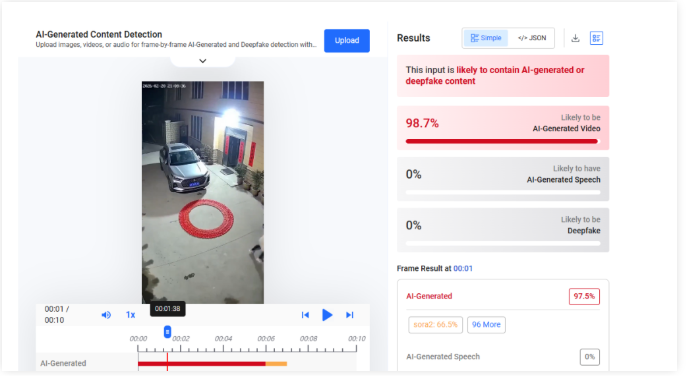
Another AI detection tool, Undetectable.ai, suggested a 77 percent probability that the video was AI-generated.
Conclusion
Our research confirms that the viral video does not depict a real incident. It has been created using Artificial Intelligence and is being misleadingly shared as genuine footage.

Related Blogs
Introduction
We stand at the edge of a reality once confined to science fiction, a world where the very creations designed to serve us could redefine what it means to be human, rewriting the paradigm we built them in. The increasing prevalence of robotics and embodied AI systems in everyday life and cyber-physical settings draws attention to a complicated network of issues at the intersection of cybersecurity, human-to-robot trust, and robotic safety. The development of robotics cannot be perceived as a novelty or a fleeting interest area for enthusiasts, it has developed into a force that enters the area of human life that is private and has historically been reserved for human connection and care. We live in an era where countries can no longer afford to fall behind, at a time when technological prowess determines global influence. The new development currency of the 21st century is “Techno-sovereign”, meaning that one must be able to innovate as well as incorporate robotics, artificial intelligence, and other technologies.
Entering the Robotic Renaissance
The recent unveiling of the humanoid “pregnancy robot” presents the next frontier in reproductive robotics, garnering both criticism and support. Although this bold innovation holds promise, it also presents unavoidable cybersecurity, privacy, and ethical conundrums. The humanoid is being developed by Kaiwa Technology under the direction of Dr. Zhang Qifeng, who is also connected to Nanyang Technological University. As per the report of ECNS, he presented his idea for a robotic surrogate that could carry a child for a full-term pregnancy at the 2025 World Robot Conference in Beijing. While the technology is indubitably groundbreaking, it raises a lot of ethical and moral concerns as well as legal concerns, as surrogacy is banned in China.
Alongside the concerns raised by various segments of doctors, feminists who argue on the devaluation and pathologising of pregnancy, it also raises various cybersecurity concerns, keeping in mind the interpersonal and intimate nature of human connections, where robotics are now making headway. Pregnancy is inherently intimate. Our understanding of bodily autonomy is blurred when we move into the realm of machinery. From artificial amniotic fluid sensors to embryo data, every layer of this technology becomes a possible attack vector. Robots with artificial wombs are essentially IoT-powered medical systems. As per the research conducted by the Department of Computer Science and Engineering, Cornell University, “our lives have been made easier by the incorporation of AI into robotics systems, but there is a significant drawback as well: these systems are susceptible to security breaches. Malicious actors may take advantage of the data, algorithms, and physical components that make up AI-Robotics systems, which can cast a debilitating impact.
The Robotic Pivot: The Market’s Greatest Disruption
The humanoid “pregnancy robot” is not the only robotic innovation planning to take the industry for a whirlwind. China is pushing the boundaries amidst the escalating trade wars. Beijing is stepping up its efforts in sectors where it has the capacity and necessity to advance before the US. China’s leaders see AI as a source of national pride, a means of enhancing its military might, and a long-standing problem of Western dominance. The proof lies in the fact that Beijing hosted the first World Humanoid Robot Games, reflecting China’s dual goals of showcasing its technological prowess as it moves closer to establishing itself as a dominant force in artificial intelligence applied to robotics and bringing people closer to machines that will eventually play a bigger role in daily life and the economy.
Despite China’s prominence, it is not the only country that sees the potential in AI-enabled robotics. Indian Space Research Organisation’s chairman V Narayanan announced that the humanoid robot Gaganyaan programme’s first uncrewed mission G1 would be launched with humanoid robot Vyommitra in December.
Conclusion
The emergence of robotics holds both great potential and significant obstacles holds both great potential and significant obstacles. Robots have the potential to revolutionise accessibility and efficiency in a variety of fields, including healthcare and space exploration, but only if human trust, ethics, and cybersecurity keep up with technological advancements. This is not a far-flung issue for India, rather, it is a pressing appeal to properly lead in a world where technological sovereignty is equivalent to world power.
References
- https://nurse.org/news/pregnancy-robot-artificial-womb-china/
- https://timesofindia.indiatimes.com/life-style/health-fitness/health-news/chinas-2026-humanoid-robot-pregnancy-with-artificial-womb-a-revolutionary-leap-in-reproductive-technology/articleshow/123357813.cms?utm_source=chatgpt.com
- https://arxiv.org/pdf/2310.08565
- https://www.theguardian.com/world/2025/apr/21/humanoid-workers-and-surveillance-buggies-embodied-ai-is-reshaping-daily-life-in-china
- https://english.elpais.com/technology/2025-08-21/china-stages-first-robot-olympics-to-showcase-its-tech-ambition.html
- https://www.tribuneindia.com/news/india/1st-non-crew-gaganyaan-mission-to-launch-in-dec-with-robot-vyommitra/
Introduction
Insurance companies hold a huge amount of sensitive data. Medical history, bank account numbers, identity proofs, years of claims records — all of it sits on insurer servers, waiting. That makes the sector an easy target. India saw close to 370 million malware attacks in a single recent year. Banking, financial services and insurance firms bore the brunt of it. That got the attention of the Insurance Regulatory and Development Authority of India (IRDAI). On 6 April 2026, it released a new set of Information and Cyber Security Guidelines. These replace the old 2023 rules and ask insurers to take much stronger responsibility for protecting their systems, and their customers' data.
Who Must Follow These New Rules
The updated guidelines are not limited to large insurance companies alone. They apply to life, general and health insurers. They also apply to foreign reinsurance branches operating in India, and to intermediaries such as brokers, corporate agents, web aggregators and third-party administrators. Insurance repositories and the Insurance Information Bureau of India fall within scope too. Individual insurance agents, point-of-sale persons and surveyors are not covered directly. But insurers must still make sure these people follow a basic security framework approved by their board. Foreign reinsurance branches get a little more room — they can depart from a specific rule, but only if they can justify it properly to the regulator. Why cast such a wide net in the first place? Because breaches rarely start at the big insurer with the well-staffed Information Technology (IT) team. They start with the small broker or corporate agent who never got around to updating a password policy.
A Stronger Role for the Boardroom
An Independent CISO (Chief Information Security Officer)
The clearest change sits right at the top. A Chief Information Security Officer (CISO) can no longer report to the Head of Information Technology (IT). Nor can the CISO (Chief Information Security Officer) be handed sales targets or any other business goal. Why does this matter so much? Picture a CISO (Chief Information Security Officer) who answers to the same person pushing hard for a product launch next week. Flagging a serious vulnerability suddenly becomes an awkward, career-risking conversation. The IRDAI (Insurance Regulatory and Development Authority of India) has simply removed that awkwardness by rule.
More Frequent Oversight
The Information Security Risk Management Committee used to meet only twice a year. Now it must meet at least once every quarter. A new Information Technology (IT) Steering Committee has also been set up to handle day-to-day technology decisions. This frees the risk committee to focus purely on oversight. There's also a new seat at the table: at least one outside cybersecurity expert must now join the Risk Management Committee. Someone with no stake in internal politics, no department to protect, just technical judgement.
Faster Action When Something Goes Wrong
A Six-Hour Reporting Deadline
No system is completely safe from attack. So the guidelines also focus heavily on how insurers respond once something goes wrong. Every cybersecurity incident now has to reach the Indian Computer Emergency Response Team within six hours of being spotted, with the IRDAI (Insurance Regulatory and Development Authority of India) and other regulators looped in at the same time. Six hours is a tight deadline. It means insurers need detection and escalation systems that work round the clock, not just during office hours.
Testing and Exceptions
Business continuity and disaster recovery plans must be tested at least once a year, and not through some comfortable, pre-planned shutdown either — the test has to feel like a real disaster. Exceptions to security policy are also handled with far more discipline now. A short exception of up to three months can be approved by the CISO (Chief Information Security Officer) alone. One lasting between three months and a year needs sign-off from the risk committee. Anything longer needs approval from the board itself. Gaps found during audits must be closed within twelve months, with the board tracking progress at every stage.
Looking Ahead to Tomorrow's Risks
The guidelines do not stop at today's threats. More insurers are moving their operations to the cloud. So the rules now demand stronger contracts with cloud vendors, and a clear plan for what happens to customer data once a vendor relationship ends. Third-party risk gets close attention too. Many security breaches in the financial sector start with a vendor, not with the insurer's own systems. Before hiring any vendor, insurers must now check their security properly. Every contract must include audit rights and a clause requiring the vendor to report incidents. One of the most forward-looking additions is early preparation for a post-quantum world. Insurers must keep a clear list of their cryptographic assets. In simple terms, this is a map of where and how encryption is used across their systems. It helps them get ready once stronger encryption standards become necessary. Quantum computers capable of breaking today's encryption are still some years away, by most estimates. Mapping out those cryptographic assets now is a lot cheaper than scrambling to do it after the threat has already landed.
Conclusion
Where does all this leave things? Cybersecurity in Indian insurance isn't a server-room problem anymore — it sits squarely in the boardroom now. Directors now own this risk, not just Information Technology (IT) managers tucked away in a basement office. Policyholders benefit too, since their data now sits behind stronger locks, watched more closely and reported on far more often than before. Insurers who treat this as a paperwork exercise will struggle to keep up. Those who actually build these habits into daily operations will likely spend less time firefighting breaches five years from now, and more time competing on service and price instead.
References
3. Medianama, 'IRDAI Updates Cybersecurity Rules, Mandates DPDP Compliance', April 2026.
4. DSCI, brief on IRDAI's Information and Cyber Security Guidelines, 2026, April 2026.
7. Deloitte India, 'IRDAI Tightens Cyber Net: Wake-up Call for Insurers'.

Introduction
This tale, the Toothbrush Hack, straddles the ordinary and the sophisticated; an unassuming household item became the tool for committing cyber crime. Herein lies the account of how three million electronic toothbrushes turned into the unwitting infantry in a cyber skirmish—a Distributed Denial of Service (DDoS) assault that flirted with the thin line that bridges the real and the outlandish.
In January, within the Swiss borders, a story began circulating—first reported by the Aargauer Zeitung, a Swiss German-language daily newspaper. A legion of cybercriminals, with honed digital acumen, had planted malware on some three million electric toothbrushes. These devices, mere slivers of plastic and circuitry, became agents of chaos, converging their electronic requests upon the servers of an undisclosed Swiss firm, hurling that digital domain into digital blackout for several hours and wreaking an economic turmoil calculated in seven-figure sums.
The entire Incident
It was claimed that three million electric toothbrushes were allegedly used for a distributed denial-of-service (DDoS) attack, first reported by the Aargauer Zeitung, a Swiss German-language daily newspaper. The article claimed that cybercriminals installed malware on the toothbrushes and used them to access a Swiss company's website, causing the site to go offline and causing significant financial loss. However, cybersecurity experts have questioned the veracity of the story, with some describing it as "total bollocks" and others pointing out that smart electric toothbrushes are connected to smartphones and tablets via Bluetooth, making it impossible for them to launch DDoS attacks over the web. Fortinet clarified that the topic of toothbrushes being used for DDoS attacks was presented as an illustration of a given type of attack and that no IoT botnets have been observed targeting toothbrushes or similar embedded devices.
The Tech Dilemma - IOT Hack
Imagine the juxtaposition of this narrative against our common expectations of technology: 'This example, which could have been from a cyber thriller, did indeed occur,' asserted the narratives that wafted through the press and social media. The story radiated outward with urgency, painting the image of IoT devices turned to evil tools of digital unrest. It was disseminated with such velocity that face value became an accepted currency amid news cycles. And yet, skepticism took root in the fertile minds of those who dwell in the domains of cyber guardianship.
Several cyber security and IOT experts, postulated that the information from Fortinet had been contorted by the wrench of misinterpretation. They and their ilk highlighted a critical flaw: smart electric toothbrushes are bound to their smartphone or tablet counterparts by the tethers of Bluetooth, not the internet, stripping them of any innate ability to conduct DDoS or any other type of cyber attack directly.
With this unraveling of an incident fit for our cyber age, we are presented with a sobering reminder of the threat spectrum that burgeons as the tendrils of the Internet of Things (IoT) insinuate themselves into our everyday fabrics. Innocuous devices, previously deemed immune to the internet's shadow, now stand revealed as potential conduits for cyber evil. The layers of impact are profound, touching the private spheres of individuals, the underpinning frameworks of national security, and the sinews that clutch at our economic realities. The viral incident was a misinformation.
IOT Weakness
IoT devices bear inherent weaknesses for twin reasons: the oft-overlooked element of security and the stark absence of a means to enact those security measures. Ponder this problem Is there a pathway to traverse the security settings of an electric toothbrush? Or to install antivirus measures within the cooling confines of a refrigerator? The answers point to an unsettling simplicity—you cannot.
How to Protect
Vigilance - What then might be the protocol to safeguard our increasingly digital space? It begins with vigilance, the cornerstone of digital self-defense. Ensure the automatic updating of all IoT devices when they beckon with the promise of a new security patch.
Self Awareness - Avoid the temptation of public USB charging stations, which, while offering electronic succor to your devices, could also stand as the Trojan horses for digital pathogens. Be attuned to signs of unusual power depletion in your gadgets, for it may well serve as the harbinger of clandestine malware. Navigate the currents of public Wi-Fi with utmost care, as they are as fertile for data interception as they are convenient for your connectivity needs.
Use of Firewall - A firewall can prove stalwart against the predators of the internet interlopers. Your smart appliances, from the banality of a kitchen toaster to the novelty of an internet-enabled toilet, if shielded by this barrier, remain untouched, and by extension, uncompromised. And let us not dismiss this notion with frivolity, for the prospect of a malware-compromised toilet or any such smart device leaves a most distasteful specter.
Limit the use of IOT - Additionally, and this is conveyed with the gravity warranted by our current digital era, resist the seduction of IoT devices whose utility does not outweigh their inherent risks. A smart television may indeed be vital for the streaming aficionado amongst us, yet can we genuinely assert the need for a connected laundry machine, an iron, or indeed, a toothbrush? Here, prudence is a virtue; exercise it with judicious restraint.
Conclusion
As we step forward into an era where connectivity has shifted from a mere luxury to an omnipresent standard, we must adopt vigilance and digital hygiene practices with the same fervour as those for our corporal well-being. Let the toothbrush hack not simply be a tale of caution, consigned to the annals of internet folklore, but a fable that imbues us with the recognition of our role in maintaining discipline in a realm where even the most benign objects might be mustered into service by a cyberspace adversary.
References
- https://www.bleepingcomputer.com/news/security/no-3-million-electric-toothbrushes-were-not-used-in-a-ddos-attack/
- https://www.zdnet.com/home-and-office/smart-home/3-million-smart-toothbrushes-were-not-used-in-a-ddos-attack-but-they-could-have-been/
- https://www.securityweek.com/3-million-toothbrushes-abused-for-ddos-attacks-real-or-not/
