
#FactCheck: AI-Generated Image Falsely Shared as Delhi Police Dragging Woman Protester
Executive Summary
The Cockroach Janata Party had called for a protest on October 10, demanding the resignation of Chief Election Commissioner Gyanesh Kumar. Before the protest could take place, Delhi Police detained thousands of supporters. During the incident, several allegations of misconduct by Delhi Police personnel against women protesters and journalists also emerged. CyberPeace Research found that such allegations against Delhi Police had indeed been reported. However, this image is AI-generated.
Claim
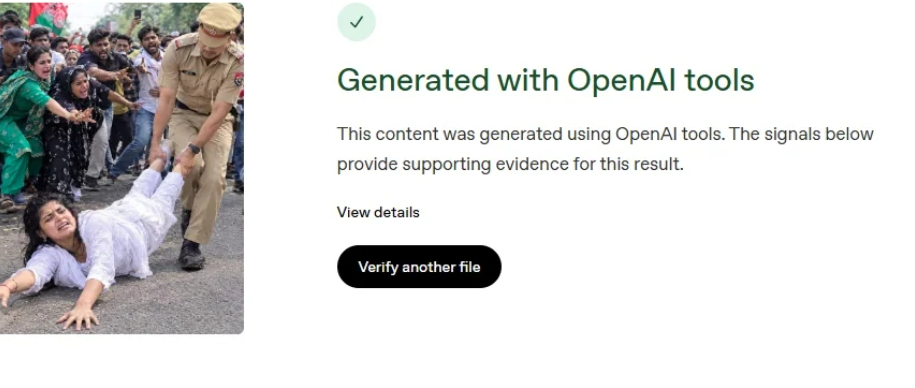
Some images are being shared on social media with the claim that Delhi Police personnel held and dragged women protesters in an inappropriate manner. The first image shows a police personnel dragging a woman by her legs. The caption reads, “Things have crossed all limits in Delhi. Atrocities against women.”
https://ghostarchive.org/archive/1LyAy

Fact Check
Upon closely examining the viral images, we found that the woman depicted in both photographs appears to be the same. However, it seems implausible that the woman’s clothing would change in the middle of a protest.We then examined both images using OpenAI’s verification tool. The tool clearly indicated that both photographs were generated using artificial intelligence (AI).
Conclusion
Our research found that such allegations against Delhi Police were indeed reported. However, the viral image is AI-generated.

Related Blogs

Introduction
In July 2025, the Digital Defence Report prepared by Microsoft raised an alarm that India is part of the top target countries in AI-powered nation-state cyberattacks with malicious agents automating phishing, creating convincing deepfakes, and influencing opinion with the help of generative AI (Microsoft Digital Defence Report, 2025). Most of the attention in the world has continued to be on the United States and Europe, but Asia-Pacific and especially India have become a major target in terms of AI-based cyber activities. This blog discusses the role of AI in espionage, redefining the threat environment of India, the reaction of the government, and what India can learn by looking at the example of cyber giants worldwide.
Understanding AI-Powered Cyber Espionage
Conventional cyber-espionage intends to hack systems, steal information or bring down networks. With the emergence of generative AI, these strategies have changed completely. It is now possible to automate reconnaissance, create fake voices and videos of authorities and create highly advanced phishing campaigns which can pass off as genuine even to a trained expert. According to the report made by Microsoft, AI is being used by state-sponsored groups to expand their activities and increase accuracy in victims (Microsoft Digital Defence Report, 2025). Based on SQ Magazine, almost 42 percent of state-based cyber campaigns in 2025 had AIs like adaptive malware or intelligent vulnerability scanners (SQ Magazine, 2025).
AI is altering the power dynamic of cyberspace. The tools previously needing significant technical expertise or substantial investments have become ubiquitous, and smaller countries can conduct sophisticated cyber operations as well as non-state actors. The outcome is the speeding up of the arms race with AI serving as the weapon and the armour.
India’s Exposure and Response
The weakness of the threat landscape lies in the growing online infrastructure and geopolitical location. The attack surface has expanded the magnitude of hundreds of millions of citizens with the integration of platforms like DigiLocker and CoWIN. Financial institutions, government portals and defence networks are increasingly becoming targets of cyber attacks that are more sophisticated. Faking videos of prominent figures, phishing letters with the official templates, and manipulation of the social media are currently all being a part of disinformation campaigns (Microsoft Digital Defence Report, 2025).
According to the Data Security Council of India (DSCI), the India Cyber Threat Report 2025 reported that attacks using AI are growing exponentially, particularly in the shape of malicious behaviour and social engineering (DSCI, 2025). The nodal cyber-response agency of India, CERT-In, has made several warnings regarding scams related to AI and AI-generated fake content that is aimed at stealing personal information or deceiving the population. Meanwhile, enforcement and red-teaming actions have been intensified, but the communication between central agencies and state police and the private platforms is not even. There is also an acute shortage of cybersecurity talents in India, as less than 20 percent of cyber defence jobs are occupied by qualified specialists (DSCI, 2025).
Government and Policy Evolution
The government response to AI-enabled threats is taking three forms, namely regulation, institutional enhancing, and capacity building. The Digital Personal Data Protection Act 2023 saw a major move in defining digital responsibility (Government of India, 2023). Nonetheless, threats that involve AI-specific issues like data poisoning, model manipulation, or automated disinformation remain grey areas. The following National Cybersecurity Strategy will attempt to remedy them by establishing AI-government guidelines and responsibility standards to major sectors.
At the institutional level, the efforts of such organisations as the National Critical Information Infrastructure Protection Centre (NCIIPC) and the Defence Cyber Agency are also being incorporated into their processes with the help of AI-based monitoring. There is also an emerging public-private initiative. As an example, the CyberPeace Foundation and national universities have signed a memorandum of understanding that currently facilitates the specialised training in AI-driven threat analysis and digital forensics (Times of India, August 2025). Even after these positive indications, India does not have any cohesive system of reporting cases of AI. The publication on arXiv in September 2025 underlines the importance of the fact that legal approaches to AI-failure reporting need to be developed by countries to approach AI-initiated failures in such fields as national security with accountability (arXiv, 2025).
Global Implications and Lessons for India
Major economies all over the world are increasing rapidly to integrate AI innovation with cybersecurity preparedness. The United States and United Kingdom are spending big on AI-enhanced military systems, performing machine learning in security operations hubs and organising AI-based “red team” exercises (Microsoft Digital Defence Report, 2025). Japan is testing cross-ministry threat-sharing platforms that utilise AI analytics and real-time decision-making (Microsoft Digital Defence Report, 2025).
Four lessons can be distinguished as far as India is concerned.
- To begin with, the cyber defence should shift to proactive intelligence in place of reactive investigation. It is not only possible to detect the adversary behaviour after the attacks, but to simulate them in advance using AI.
- Second, teamwork is essential. The issue of cybersecurity cannot be entrusted to government enforcement. The private sector that maintains the majority of the digital infrastructure in India must be actively involved in providing information and knowledge.
- Third, there is the issue of AI sovereignty. Building or hosting its own defensive AI tools in India will diminish dependence on foreign vendors, and minimise the possible vulnerabilities of the supply-chain.
- Lastly, the initial defence is digital literacy. The citizens should be trained on how to detect deepfakes, phishing, and other manipulated information. The importance of creating human awareness cannot be underestimated as much as technical defences (SQ Magazine, 2025).
Conclusion
AI has altered the reasoning behind cyber warfare. There are quicker attacks, more difficult to trace and scalable as never before. In the case of India, it is no longer about developing better firewalls but rather the ability to develop anticipatory intelligence to counter AI-powered threats. This requires a national policy that incorporates technology, policy and education.
India can transform its vulnerability to strength with the sustained investment, ethical AI governance, and healthy cooperation between the government and the business sector. The following step in cybersecurity does not concern who possesses more firewalls than the other but aims to learn and adjust more quickly and successfully in a world where machines already belong to the battlefield (Microsoft Digital Defence Report, 2025).
References:
- Microsoft Digital Defense Report 2025
- India Cyber Threat Report 2025, DSCI
- Lucknow based organisations to help strengthen cybercrime research training policy ecosystem
- AI Cyber Attacks Statistics 2025: How Attacks, Deepfakes & Ransomware Have Escalated, SQ Magazine
- Incorporating AI Incident Reporting into Telecommunications Law and Policy: Insights from India.
- The Digital Personal Data Protection Act, 2023

Executive Summary
Amid the ongoing protests in Delhi, an image of a bond paper is being widely shared on social media. The image is being shared with the claim that it shows the bond allegedly submitted in court by Cockroach Janata Party (CJP) founder Abhijeet Dipke for his release. The purported bond mentions that Abhijeet Dipke would not participate in any protest in the future and that he had furnished a bail bond of Rs 50,000. CyberPeace Research found that the image of the bond paper being shared in connection with Abhijeet Dipke is not genuine, but was created using AI.
Claim
Amid the ongoing protests in Delhi, an image of a bond paper is being widely shared on social media. It is being claimed that the image shows the bond allegedly submitted in court by Cockroach Janata Party (CJP) founder Abhijeet Dipke for his release. The purported bond mentions that Abhijeet Dipke would not participate in any protest in the future and that he had furnished a bail bond of Rs 50,000.
https://www.facebook.com/photo/?fbid=122133387387390171&set=a.122113963941390171
https://ghostarchive.org/archive/C8SDb

Fact Check
In a post shared on X, the Delhi Police stated that Abhijeet Dipke, Ashutosh Ranka and Saurav Das were taken into preventive custody on October 10, 2026, under Sections 126/170 of the Bharatiya Nagarik Suraksha Sanhita (BNSS). According to the police, all legal procedures were followed, and the three were produced before the SEM court at Delhi Cantt on October 11, 2026. In its post, the Delhi Police also stated that a bail bond (surety bond) of ₹50,000 was furnished for a period of one year to maintain peace and good behaviour.
https://x.com/DelhiPolice/status/2109151954438136069
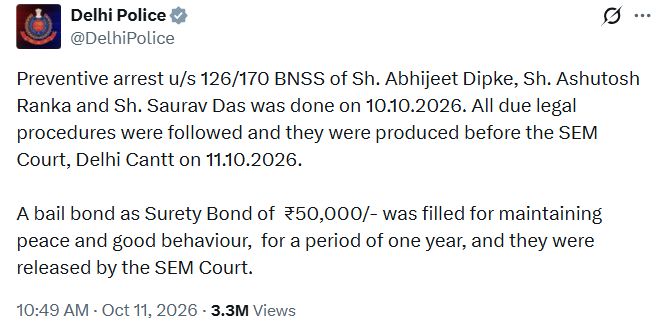
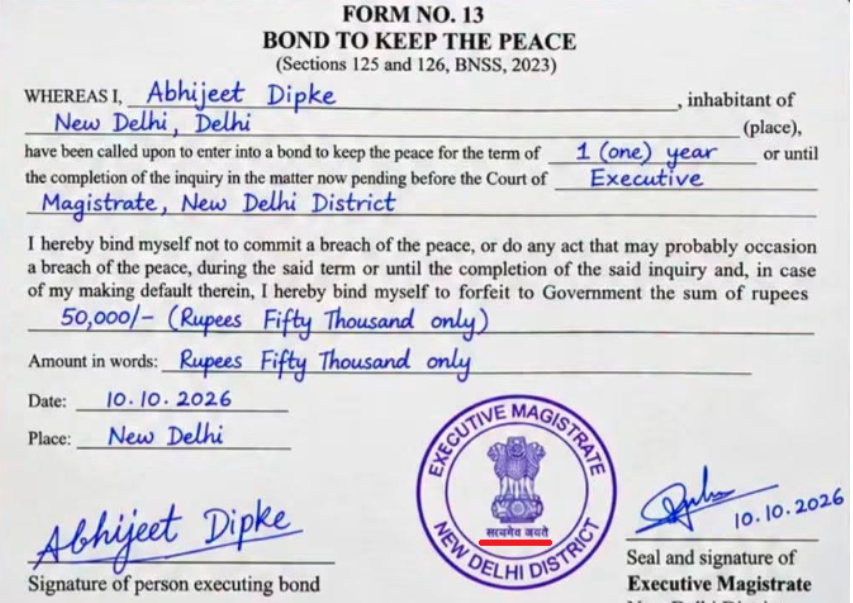
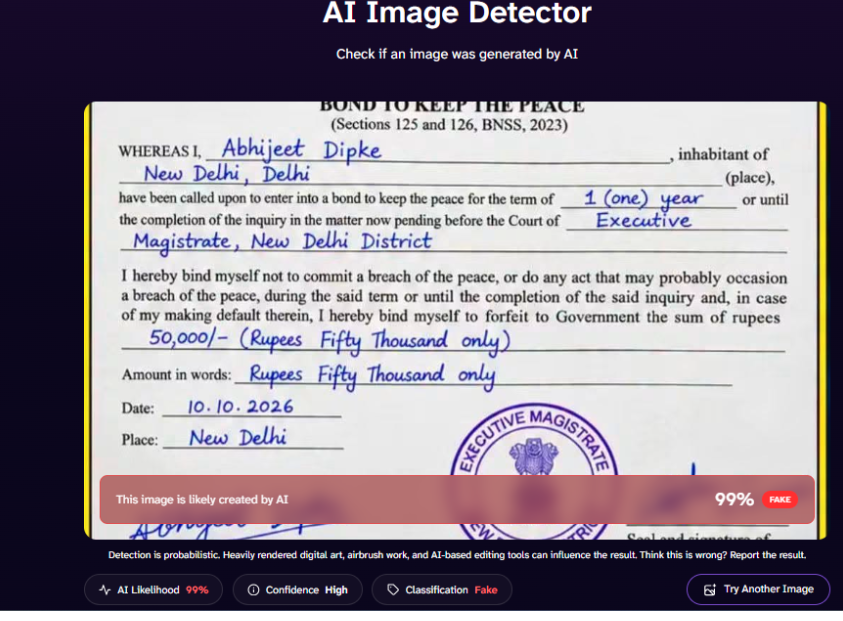
To verify the viral image of the bond paper, we examined the Delhi Police’s social media handles and searched other media reports. However, we did not find the viral image of the bond paper in any article or X post published by a credible source. We then closely examined the viral bond paper. During our analysis, we noticed a clear error. The spelling of “Satyamev Jayate” on the seal affixed to the document is incorrect. Based on this error, we suspected that the purported image of the bond paper being circulated on social media may have been created using AI.
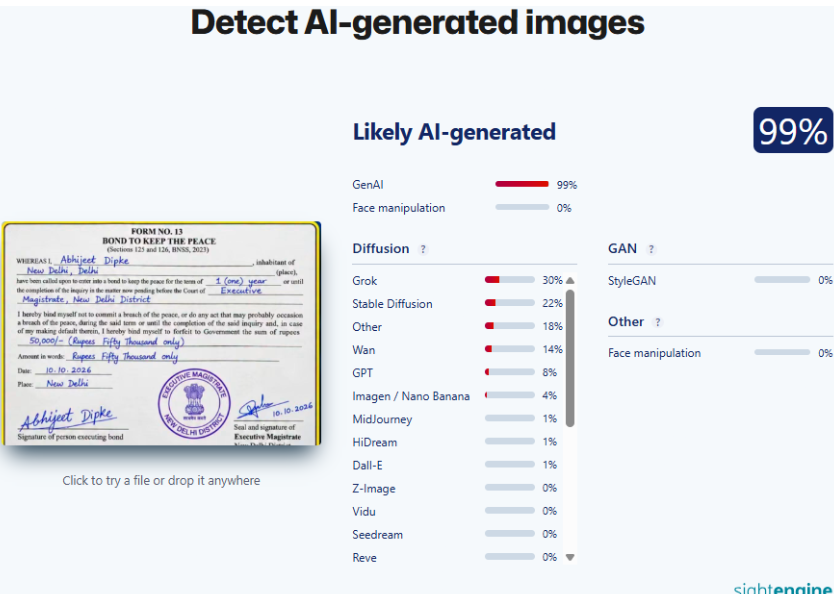
As the next step in our research, we used AI detection tools to analyse the viral image. We scanned the image using Sightengine, which indicated that the viral image is 99% likely to be AI-generated.
DeepAI, in its analysis, estimated a 99% likelihood that the viral bond paper was created using AI.
Conclusion
Our research found that the image of the bond paper being shared in connection with Abhijeet Dipke is not genuine but was created using AI.

The United Nations in December 2019 passed a resolution that established an open-ended ad hoc committee. This committee was tasked to develop a ‘comprehensive international convention on countering the use of ICTs for criminal purposes’. The UN Convention on Cybercrime is an initiative of the UN member states to foster the principles of international cooperation and establish legal frameworks to provide mechanisms for combating cybercrime. The negotiations for the convention had started in early 2022. It became the first binding international criminal justice treaty to have been negotiated in over 20 years upon its adoption by the UN General Assembly.
This convention addresses the limitations of the Budapest Convention on Cybercrime by encircling a broader range of issues and perspectives from the member states. The UN Convention against Cybercrime will open for signature at a formal ceremony hosted in Hanoi, Viet Nam, in 2025. The convention will finally enter into force 90 days after being ratified by the 40th signatory.
Objectives and Features of the Convention
- The UN Convention against Cybercrime addresses various aspects of cybercrime. These include prevention, investigation, prosecution and international cooperation.
- The convention aims to establish common standards for criminalising cyber offences. These include offences like hacking, identity theft, online fraud, distribution of illegal content, etc. It outlines procedural and technical measures for law enforcement agencies for effective investigation and prosecution while ensuring due process and privacy protection.
- Emphasising the importance of cross-border collaboration among member states, the convention provides mechanisms for mutual legal assistance, extradition and sharing of information and expertise. The convention aims to enhance the capacity of developing countries to combat cybercrime through technical assistance, training, and resources.
- It seeks to balance security measures with the protection of fundamental rights. The convention highlights the importance of safeguarding human rights and privacy in cybercrime investigations and enforcement.
- The Convention emphasises the importance of prevention through awareness campaigns, education, and the promotion of a culture of cybersecurity. It encourages collaborations through public-private partnerships to enhance cybersecurity measures and raise awareness, such as protecting vulnerable groups like children, from cyber threats and exploitation.
Key Provisions of the UN Cybercrime Convention
Some key provisions of the Convention are as follows:
- The convention differentiates cyber-dependent crimes like hacking from cyber-enabled crimes like online fraud. It defines digital evidence and establishes standards for its collection, preservation, and admissibility in legal proceedings.
- It defines offences against confidentiality, integrity, and availability of computer data and includes unauthorised access, interference with data, and system sabotage. Further, content-related offences include provisions against distributing illegal content, such as CSAM and hate speech. It criminalises offences like identity theft, online fraud and intellectual property violations.
- LEAs are provided with tools for electronic surveillance, data interception, and access to stored data, subject to judicial oversight. It outlines the mechanisms for cross-border investigations, extradition, and mutual legal assistance.
- The establishment of a central body to coordinate international efforts, share intelligence, and provide technical assistance includes the involvement of experts from various fields to advise on emerging threats, legal developments, and best practices.
Comparisons with the Budapest Convention
The Budapest Convention was adopted by the Committee of Ministers of the Council of Europe at the 109th Session on 8 November 2001. This Convention was the first international treaty that addressed internet and computer crimes. A comparison between the two Conventions is as follows:
- The global participation in the UNCC is inclusive of all UN member states whereas the latter had primarily European with some non-European signatories.
- The scope of the UNCC is broader and covers a wide range of cyber threats and cybercrimes, whereas the Budapest convention is focused on specific offences like hacking and fraud.
- UNCC strongly focuses on privacy and human rights protections and the Budapest Convention had limited focus on human rights.
- UNCC has extensive provisions for assistance to developing countries and this is in contrast to the Budapest Convention which did not focus much on capacity building.
Future Outlook
The development of the UNCC was a complex process. The diverse views on key issues have been noted and balancing different legal systems, cultural perspectives and policy priorities has been a challenge. The rapid technology evolution that is taking place requires the Convention to be adaptable to effectively address emerging cyber threats. Striking a balance remains a critical concern. The Convention aims to provide a blended approach to tackling cybercrime by addressing the needs of countries, both developed and developing.
Conclusion
The resolution containing the UN Convention against Cybercrime is a step in global cooperation to combat cybercrime. It was adopted without a vote by the 193-member General Assembly and is expected to enter into force 90 days after ratification by the 40th signatory. The negotiations and consultations are finalised for the Convention and it is open for adoption and ratification by member states. It seeks to provide a comprehensive legal framework that addresses the challenges posed by cyber threats while respecting human rights and promoting international collaboration.
References
- https://consultation.dpmc.govt.nz/un-cybercrime-convention/principlesandobjectives/supporting_documents/Background.pdf
- https://news.un.org/en/story/2024/12/1158521
- https://www.interpol.int/en/News-and-Events/News/2024/INTERPOL-welcomes-adoption-of-UN-convention-against-cybercrime#:~:text=The%20UN%20convention%20establishes%20a,and%20grooming%3B%20and%20money%20laundering
- https://www.cnbctv18.com/technology/united-nations-adopts-landmark-global-treaty-to-combat-cybercrime-19529854.htm
