
#FactCheck-Claim That Putin Ignored PM Modi in Favour of Pakistan PM Is Misleading
Executive Summary
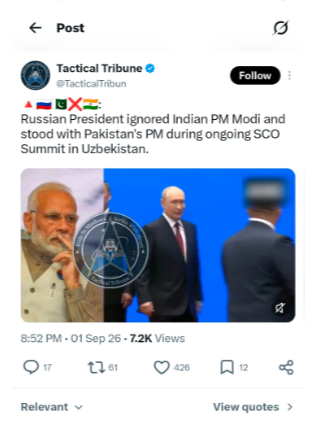
A Pakistani propaganda account on social media has claimed that Russian President Vladimir Putin ignored Indian Prime Minister Narendra Modi and stood alongside the Pakistani Prime Minister. Research by CyberPeace’s research wing found that PM Modi and President Putin held a bilateral meeting on the sidelines of the SCO Summit in Bishkek, Kyrgyzstan. During the meeting, the two leaders exchanged warm greetings and discussed several issues, including the India-Russia strategic partnership.
Claim:
A social media post claims that Russian President Vladimir Putin ignored Prime Minister Narendra Modi and stood alongside the Pakistani Prime Minister.
https://x.com/TacticalTribun/status/2094808040973172786
Fact Check:
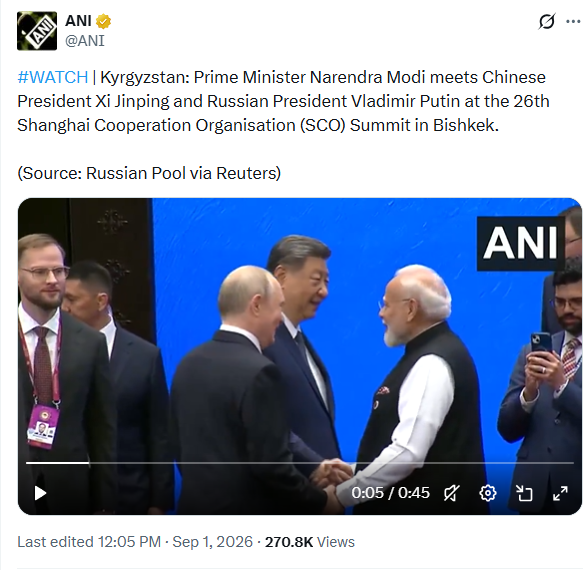
To verify the truth behind the viral claim, we searched Google using relevant keywords related to Prime Minister Narendra Modi’s official visit to Kyrgyzstan. During the search, we found a video posted on ANI’s X handle on September 1, 2026. According to the video, Prime Minister Narendra Modi met Chinese President Xi Jinping and Russian President Vladimir Putin in Bishkek during the 26th Shanghai Cooperation Organisation (SCO) Summit.
https://x.com/ANI/status/2094675518897692896
In the next step of our research, we scanned Prime Minister Narendra Modi’s X account, where we found a post dated August 31, 2026. In the post, PM Modi wrote, “Had extensive discussions with President Putin. Discussed the full range of the India-Russia Special and Privileged Strategic Partnership. It is gladdening to see significant progress across various sectors in recent years. Focus areas for the India-Russia friendship remain energy, innovation, space, fertilisers and people-to-people linkages.”
https://x.com/narendramodi/status/2094433881714032725?s=20

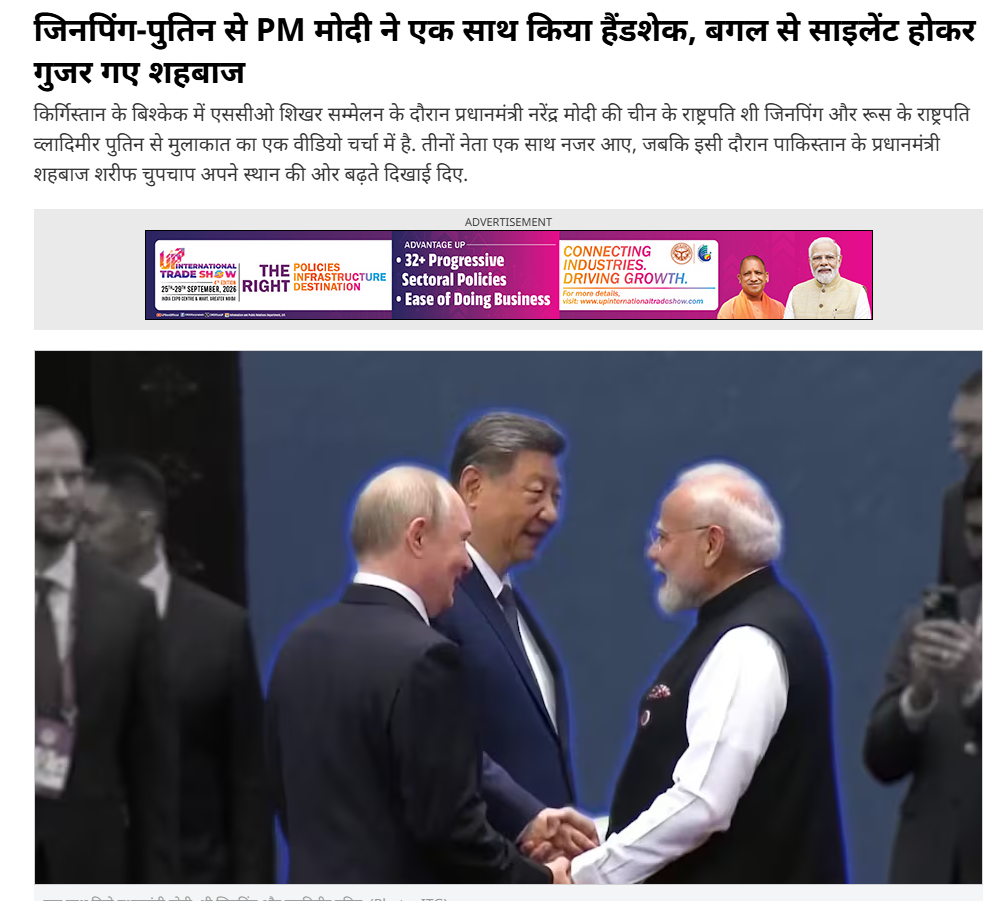
At the end of our research, we found a report published on the Aaj Tak website on September 1, 2026. According to the report, Prime Minister Narendra Modi was in Bishkek, the capital of Kyrgyzstan, where he attended the Shanghai Cooperation Organisation (SCO) Summit. Several leaders of the organisation, including Chinese President Xi Jinping, Russian President Vladimir Putin and Pakistani Prime Minister Shehbaz Sharif, also attended the summit. During the summit, a moment was captured in which PM Modi warmly greeted Chinese President Xi Jinping and Russian President Vladimir Putin together, while Shehbaz Sharif was seen quietly walking past them.
Conclusion:
Our research established that the claim that Russian President Vladimir Putin ignored Prime Minister Narendra Modi and gave preference to the Pakistani Prime Minister is misleading. The viral post presents video footage from different occasions out of context. In reality, Prime Minister Narendra Modi and President Putin held a bilateral meeting, during which the two leaders discussed several key issues, including the India-Russia strategic partnership.

Related Blogs

Introduction
India’s digital growth journey has been moving at a tremendous pace. According to MeitY’s report, India’s digital economy is expected to rise to US$ 500 billion by 2025, up from US$ 200 billion in 2019. The digitisation drive that we are experiencing is likely to foster and boost a favourable business environment that will attract rapid investment and augment economic growth across sectors. This will, in turn, compel businesses to adopt digital platforms as solutions to meet customer expectations. Due to accelerated digitisation, cyber risks often deter business growth. Cybercrimes are becoming more rampant and complex and the costs associated with such breaches are not only increasing but also becoming more systemic.
Development of the Cyber Insurance Landscape
Digitization of businesses started in the 1980s with the use of mainframes. Personal computers entered the game and further modified the landscape from the 2000s along with LANs, the internet and the dot-com boom of the 2000s. In the late 1990s, cyber-insurance was developed as a risk management tool to ensure information security. Coverage was limited, and clients included SMEs in need of insurance to qualify for tenders, or community banks too small to hedge the risks of their online banking operations. The first cyber insurance policy was written in 1997 through AIG, against hacking as a third-party liability policy.
The current trends in the cyber insurance space are focused on the prevention of cyber risks, which by nature are hard to outline and constantly evolving. The result is that the buyers have limited clarity on the types of cyber risks covered under cyber insurance, and even lesser visibility on the scope and amount of optimum coverage. Unfamiliarity with the claim procedure and resolutions, ambiguous claim thresholds during settlements, and confusion around exclusions and coverage of regulatory fines and penalties under a purchased scheme further discourage potential buyers from seriously investing in cyber insurance products.
Key Factors in Cyber Insurance Evolution and Its Role in Risk Management
The cyber insurance market in India has three key influencing factors, namely the speed of achieving digital maturity, government initiatives to digitise and enforce stringent cyber laws, and the evolving landscape with technology giants and MNCs entering the cyber insurance domain. The latter are the catalyst for intensifying competition in this market.
Advancements in technology in terms of AI, machine learning, big data, robotics, blockchain, augmented and virtual reality, and IoT are expected to reshape the insurance industry and help reach untapped audiences in a more digital-forward manner. With the absence of a standard cyber insurance policy, regulators need to take the following variables into consideration while developing cyber insurance policies: the risk insured against, the scope of the loss covered and the limits/ sub-limits.
Challenges
With the complexity of cyber risks increasing exponentially the challenges to counter the same are growing too which is leading to gaps in the coverage offered for cyber threats. Resultantly, the compliance regulations are dependent on the risks which exist and cyber threat actors adopt new technologies faster and exploit them to their benefit. A lack of historical data and predictability in future cyber risks, the possibility of large overwhelming loss events, uncertainties among market participants about what is specifically covered under such policies, and legal battles over fundamental issues are some of the challenges identified.
Future Outlook/ Recommendations
India's cyber infrastructure requires a multi-faceted approach that involves collaboration between government, industry, and academia should be developed. Some recommendations are:
- Risk assessments should be a general practice and the cyber insurance policies should be simplified, clearing the mismatch between the premium paid and insurance coverage and there should be standard verbosity across cyber policy language.
- Promoting R&D tailored to India focused on education programs that have public-private partnerships and global collaborations to share threat intelligence, best practices, and expertise in critical infrastructure protection.
- Cyber insurance can also be promoted as compliance with the DPDP Act, which would lead to better development of cyber infrastructure and cyber hygiene practices.
- Regular updates to cyber insurance policies to ensure relevance and effectiveness. Insurers could create and offer holistic cyber insurance risk management plans.
Conclusion
According to a report by Deloitte in 2023, the cyber insurance market in India is expected to grow by 27-30 per cent in the coming years and it is currently valued at USD 50-60 million, while maintaining a steady 27-30 per cent CAGR in the past three years. The Indian cyber infrastructure’s nature is challenging, however, it offers opportunities for growth, innovation, and collaboration. A proactive approach, supported by robust policies, advanced technologies, and skilled professionals, will be essential to building a resilient cyber infrastructure capable of withstanding evolving threats.
Reference
- https://www2.deloitte.com/content/dam/Deloitte/nl/Documents/financial-services/deloitte-nl-fsi-demystifying-cyber-insurance-coverage-report.pdf
- https://www.dnaindia.com/business/report-what-s-cyber-liablity-insurance-and-why-you-may-need-it-2136556
- https://economictimes.indiatimes.com/industry/banking/finance/insure/cyber-insurance-gains-momentum-in-india-set-to-witness-exponential-growth-deloitte/articleshow/104189297.cms?from=mdr
Introduction
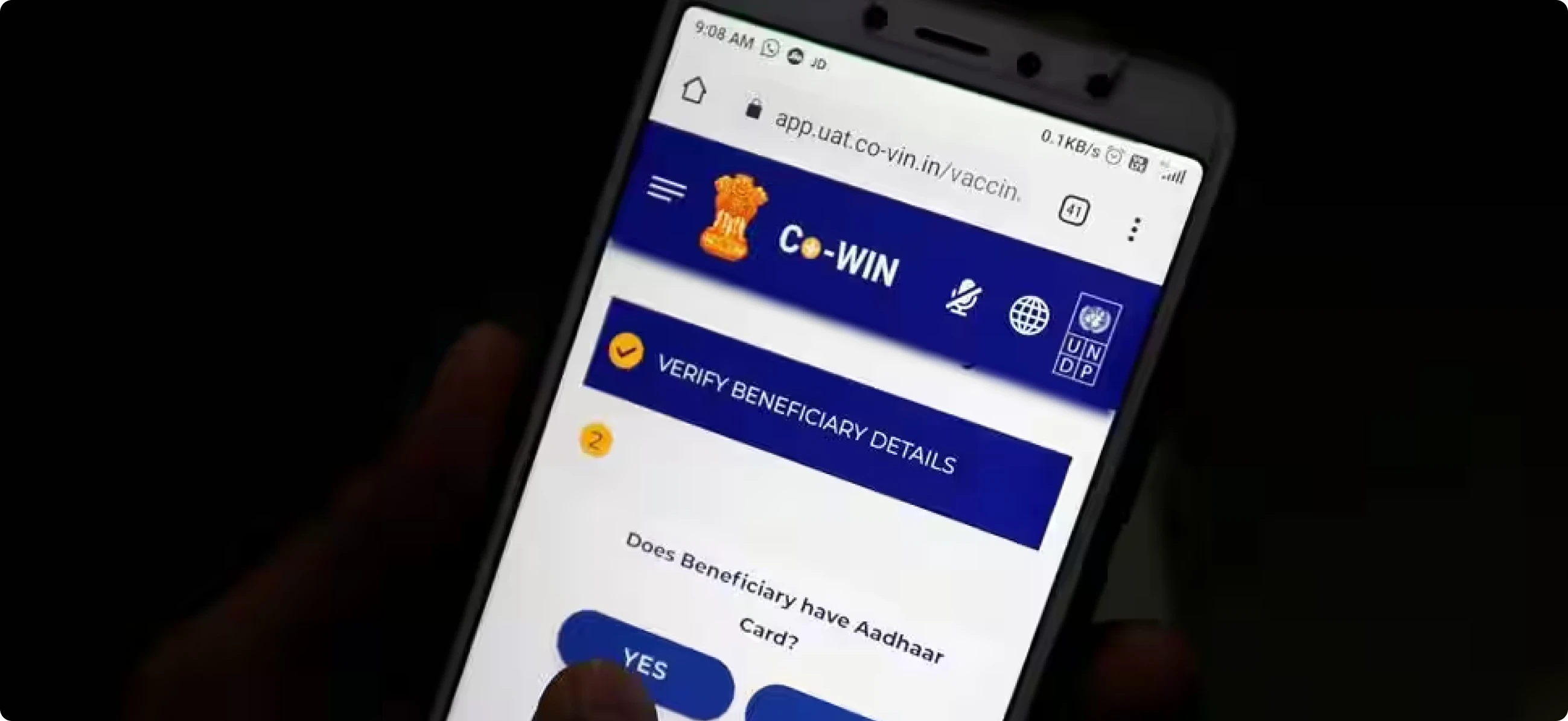
The information of hundreds of thousands of Indians who received the COVID vaccine was Leaked in a significant data breach and posted on a Telegram channel. Numerous reports claim that sensitive information, including a person’s phone number, gender, ID card details, and date of birth, leaked over Telegram. It could be obtained by typing a person’s name into a Telegram bot.
What really happened?
The records pertaining to the mobile number registered in the CoWin portal are accessible on the Malayalam news website channel. It is also feasible to determine which vaccination was given and where it was given.
According to The Report, the list of individuals whose data was exposed includes BJP Tamil Nadu president K Annamalai, Congress MP Karti Chidambaram, and former BJP union minister for health Harsh Vardhan. Telangana’s minister of information and communication technology, Kalvakuntla Taraka Rama Rao, is also on the list.
MEITY stated in response to the data leak, “It is old data, we are still confirming it. We have requested a report on the matter.
After the media Report, the bot was disabled, but experts said the incident raised severe issues because the information might be used for identity theft, phishing emails, con games, and extortion calls. The Indian Computer Emergency Response Team (CERT-In), the government’s nodal body, has opened an investigation into the situation
The central government declared the data breach reports regarding the repository of beneficiaries against Covid to be “mischievous in nature” on Monday and claimed the ‘bot’ that purportedly accessed the confidential data was not directly accessing the CoWIN database.
According to the first complaint by CERT-In, the government’s cybersecurity division, the government claimed the bot might be displaying information from “previously stolen data.” Reports.
The health ministry refuted the claim, asserting that no bots could access the information without first verifying with a one-time password.
“It is made clear that all of these rumours are false and malicious. The health ministry’s CoWIN interface is entirely secure and has sufficient data privacy protections. The security of the data on the CoWIN portal is being ensured in every way possible, according to a statement from the health ministry.
Meity said the CoWin program or database was not directly compromised, and the shared information appeared to be taken from a previous intrusion. But the hack again highlights the growing danger of cyber assaults, particularly on official websites.

Recent cases of data leak
Dominos India 2021– Dominos India, a division of Jubilant FoodWorks, faced a cyberattack on May 22, 2021, which led to the disclosure of information from 180 million orders. The breach exposed order information, email addresses, phone numbers, and credit card information. Although Jubilant FoodWorks acknowledged a security breach, it refuted any illegal access to financial data.
Air India – A cyberattack that affected Air India in May 2021 exposed the personal information of about 4.5 million customers globally. Personal information recorded between August 26, 2011, and February 3, 2021, including names, dates of birth, contact information, passport information, ticket details, frequent flyer information from Star Alliance and Air India, and credit card information, were exposed in the breach.
Bigbasket – BigBasket, an online supermarket, had a data breach in November 2020, compromising the personal information of approximately 20 million consumers. Email IDs, password hashes, PINs, phone numbers, addresses, dates of birth, localities, and IP addresses were among the information released from an insecure database containing over 15 GB of customer data. BigBasket admitted to the incident and reported it to the Bengaluru Cyber Crime Department.
Unacademy – Unacademy, an online learning platform, experienced a data breach in May 2020, compromising the email addresses of approximately 11 million subscribers. While no sensitive information, such as financial data or passwords, was compromised, user data, including IDs, passwords, date joined, last login date, email IDs, names, and user credentials, was. The breach was detected when user accounts were uncovered for sale on the dark web.
2022 Card Data- Cybersecurity researchers from AI-driven Singapore-based CloudSEK found a threat actor offering a database of 1.2 million cards for free on a Dark Web forum for crimes on October 12, 2022. This came after a second problem involving 7.9 million cardholder records that were reported on the BidenCash website. This comprised information pertaining to State Bank of India (SBI) clients. And other well-known companies were among those targeted in high-profile data breach cases that have surfaced in recent years.

Conclusion
Data breach cases are increasing daily, and attackers are mainly attacking the healthcare sectors and health details as they can easily find personal details. This recent CoWIN case has compromised thousands of people’s data. The All-India Institute of Medical Sciences’ systems were compromised by hackers a few months ago. Over 95% of adults have had their vaccinations, according to the most recent data, even if the precise number of persons impacted by the CoWin privacy breach could not be determined.

Executive Summary:
An old video dated 2023 showing the arrest of a Bangladeshi migrant for murdering a Polish woman has been going viral massively on social media claiming that he is an Indian national. This viral video was fact checked and debunked.
Claim:
The video circulating on social media alleges that an Indian migrant was arrested in Greece for assaulting a young Christian girl. It has been shared with narratives maligning Indian migrants. The post was first shared on Facebook by an account known as “Voices of hope” and has been shared in the report as well.

Facts:
The CyberPeace Research team has utilized Google Image Search to find the original source of the claim. Upon searching we find the original news report published by Greek City Times in June 2023.


The person arrested in the video clip is a Bangladeshi migrant and not of Indian origin. CyberPeace Research Team assessed the available police reports and other verifiable sources to confirm that the arrested person is Bangladeshi.
The video has been dated 2023, relating to a case that occurred in Poland and relates to absolutely nothing about India migrants.
Neither the Polish government nor authorized news agency outlets reported Indian citizens for the controversy in question.

Conclusion:
The viral video falsely implicating an Indian migrant in a Polish woman’s murder is misleading. The accused is a Bangladeshi migrant, and the incident has been misrepresented to spread misinformation. This highlights the importance of verifying such claims to prevent the spread of xenophobia and false narratives.
- Claim: Video shows an Indian immigrant being arrested in Greece for allegedly assaulting a young Christian girl.
- Claimed On: X (Formerly Known As Twitter) and Facebook.
- Fact Check: Misleading.
