#FactCheck - Misleading Video Misinterprets Trump’s Handling of Official Folder as Xi Jinping’s “Private Notebook”
Executive Summary
A video circulating on social media claims that during a summit in Beijing, Donald Trump was seen peeking into Chinese President Xi Jinping’s “private notebook” while Xi briefly stepped away. However, a fact-check by CyberPeace Research Wing found the claim to be baseless. A review of the full event footage clearly shows that the folder in question belonged to Donald Trump himself, not Xi Jinping. The viral interpretation is therefore misleading.
Claim
An X user shared the clip alleging, “Trump caught sneaking a peek at Xi Jinping’s private notebook during a Beijing banquet while Xi stepped away.”

Fact Check
A longer version of the video, shared by NBC News on May 14, shows the state banquet held at the Great Hall of the People in Beijing. Around the 1-minute-50-second mark, Xi Jinping, seated to Trump’s left, gets up and walks to the podium. The viral clip follows shortly after, showing Trump opening the folder placed to his left and flipping through its pages.


The White House also uploaded the full footage on its official YouTube channel, showing wider, uninterrupted shots of the event. Around the two-minute mark, the announcer says, “And now a toast by President Xi,” after which Xi Jinping stands up. Immediately after, Trump is seen opening the folder on his left and reading from it.
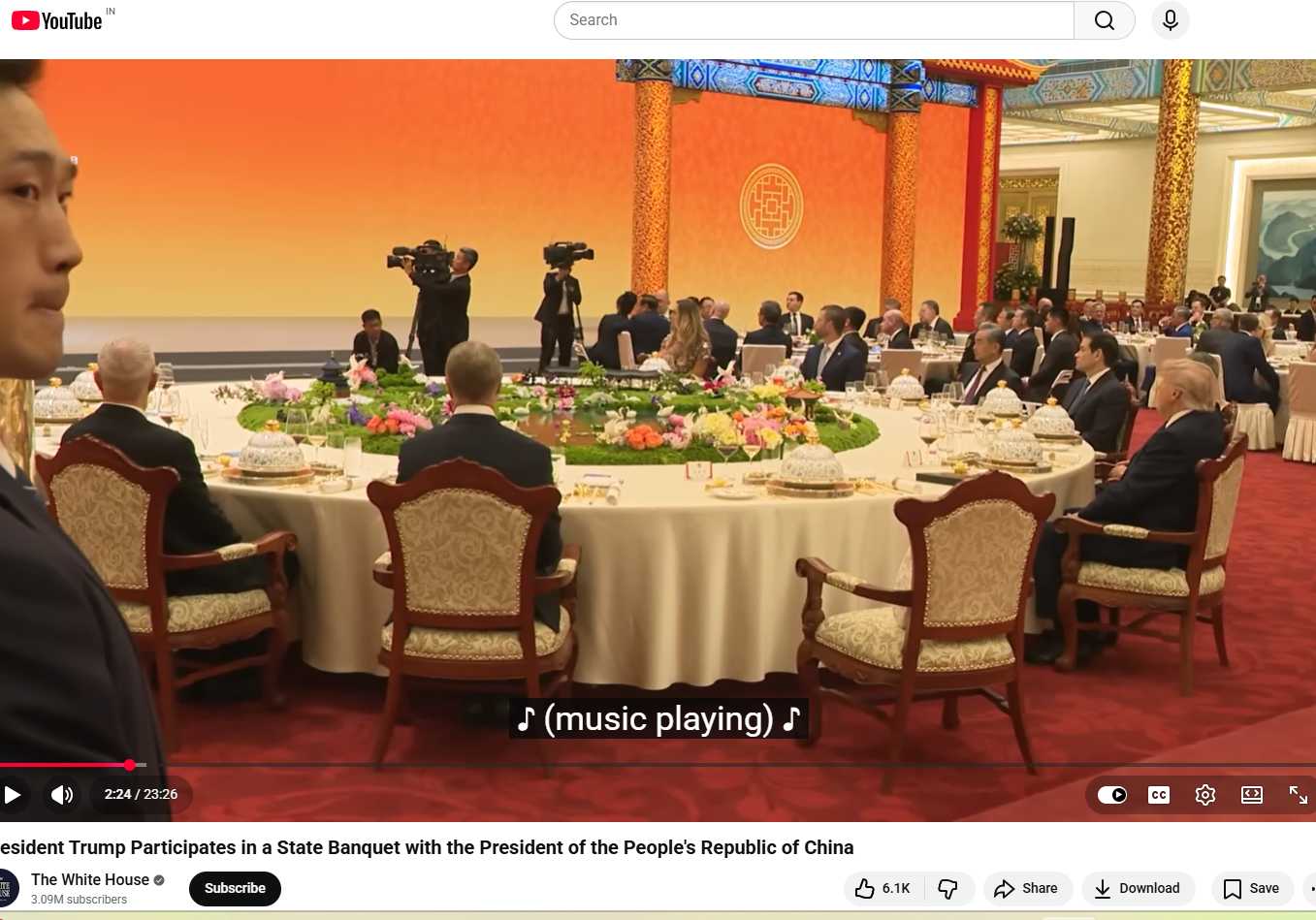
Later in the video, around the 12-minute mark, when Xi returns to his seat, Trump is seen standing up, taking the folder with him to the podium, turning pages, and reading from it. The same sequence can also be seen in the NBC News footage at around 11 minutes and 50 seconds. This clearly indicates that the folder belonged to the U.S. President and not Xi Jinping, and that Trump was not peeking into any private notebook. Another key detail is the embossed emblem on the folder, which closely resembles the Seal of the President of the United States. The American bald eagle, the national bird of the United States, is clearly visible at the centre. A comparison between the viral screenshot and the official seal shows they are nearly identical.
Conclusion
The viral claim is misleading and taken out of context. A detailed review of the full footage, including official recordings from NBC News and the White House, clearly shows that the folder in question belonged to Donald Trump and not Chinese President Xi Jinping. At multiple points in the video, Trump is seen opening, handling, and reading from the same folder, including while Xi Jinping is away from his seat and later after he returns. The visual evidence from the event also supports this conclusion. The embossed seal on the folder matches the official Seal of the President of the United States, further confirming that it was part of Trump’s official briefing material and not any private document belonging to Xi Jinping. Taken together, the full sequence of events and official video sources make it clear that the viral narrative has been incorrectly framed. There is no evidence to suggest that Trump was peeking into Xi Jinping’s personal notebook.
Related Blogs
Introduction
In June 2026, the Government of India temporarily restricted access to Telegram amid concerns that the platform had been used to facilitate examination related malpractice, including the alleged circulation of leaked question papers during the NEET UG re examination. The move reignited a familiar debate about the responsibility of digital platforms for unlawful activities carried out through them.
Critics of such restrictions raise a fundamental question: if a traffic accident occurs on a road, do we shut down the road? If theft takes place inside a shopping mall, do we close the entire mall? By the same logic, is it reasonable to block a communication platform because some individuals misuse it? These questions lie at the heart of a broader conflict between state interests in maintaining public order and the protection of digital rights, privacy, and freedom of communication in an increasingly interconnected world.
The controversy surrounding Telegram therefore extends beyond a single examination or messaging application. It raises a deeper and more pressing question: who should bear responsibility for illegal acts committed through encrypted digital platforms, and where should the law draw the line between effective enforcement and the preservation of fundamental digital freedoms?
Beyond mere communication for millions of students in India, Telegram is a classroom in the digital sense, an archive for their notes, practice papers, lecture recordings, and community groups that hundreds of millions of candidates refer to every single day. Therefore, why on a routine day in June 2026 did the messaging app top every other channel? Temporary internet restriction on the platform had become necessary to stop examination-related malpractice like leakage of question papers and was temporarily suspended, with reports suggesting that this move by the government was on the occasion of the NEET-UG re-examination.
This ban once again brings up a bigger question that cannot be contained within one particular examination. When has it become okay to hold a communication platform responsible and accountable for illegal acts committed over it? Or are the perpetrators solely to blame, and the service can be prohibited? Ultimately, where is the line drawn between public interest, law enforcement, and digital rights and privacy?
End-to-End Encryption: Architecture and Benefits
At the heart of these discussions of Telegram and other apps lies a technology referred to as "end-to-end encryption" or "E2EE." Quite literally, it means a message is locked with cryptography on the sender's device and can only be unlocked by the intended recipient. Not even the tech platform running the communication app can decipher it for everyone else; it just looks like random gibberish.
The Process
This kind of modern communication relies on public key cryptography. Each person has a public key they can share with anyone and a private key that stays only on their devices. When they send you a message, it is scrambled with crypto that can be unlocked by only your private key. WhatsApp and Signal, for example, use the Signal Protocol, which features "perfect forward secrecy" and is designed to protect communications from ever being unlocked even if one key is compromised. Telegram's approach is a bit unique. By default, Telegram messages aren't encrypted with end-to-end crypto; this only comes via an optional feature called "Secret Chats," a key difference in the regulatory debate.
The Dark Side: Crime, Misuse, and the Moderation Dilemma
The very features that make end-to-end messaging popular among everyday people are privacy, speed, anonymity, and mass reach which also make end-to-end messaging popular among criminals. That, unfortunately, is the catch for policymakers globally: The technology designed to protect innocent users is also the technology that facilitates criminal activity.
3.1 Criminal Abuse
Telegram, in particular, has frequently come under fire for its role in hosting a spectrum of criminal activities, most notably in the recent controversy in India regarding NEET-UG 2026 examination papers where channels allegedly advertised leaked question papers for enormous sums, convincing desperate candidates. In these instances, messages could be altered or deleted using Telegram’s message editing feature, fabricating evidence of prior leaks. However, this extends to illicit marketplaces, drug trafficking, financial fraud, money laundering, and distributing other prohibited content. Telegram's usage in disseminating extremist propaganda and aiding criminal organizations is also frequently cited, leading to bans or restrictions in countries ranging from Brazil to Nepal to Somalia to Vietnam.
3.2 The Moderation Dilemma
But the difficulty is not just with misuse; it’s also about effective moderation. Moderation, however, requires content transparency. Strong encryption is built to obscure just that. Many end-to-end messaging services like Signal and WhatsApp emphasize that even if they wanted to, they would have been able to decipher the content of a user’s message due to their architecture. Telegram has been in scrutiny for years due to its limited cooperation with law enforcement agencies because its default chats are not completely end-to-end encrypted, though there has been an attempt by Pavel Durov, the platform’s founder, to increase cooperation following his 2024 arrest in France.
This gives policymakers the following challenge: How can governments require increased access to fight crime without forcing tech companies to weaken security for everyone? As cryptographers point out, a specific "backdoor" intended to allow access to law enforcement officials can be easily exploited by hackers, foreign governments, and any other actor with nefarious intent.
Comparison of Regulatory Approaches Worldwide
4.1 Authoritarian Countries' Responses
China, for instance, has had the app blocked as part of its strategy to control access to the internet since 2015, and Iran did so in 2018 when the app was used to help organize protests against the government. An infamous Russian bid to block Telegram in 2018 turned into a cautionary story. Trying to censor the service disrupted the IPs of millions of computers, including significant services like those run by Amazon and Google. The move was met by a surge of users turning to VPNs to get access. It’s an expensive, disruptive, and incomplete form of censorship.
4.2 Democratic Countries' Approaches
Democratic jurisdictions generally prefer targeted interventions. Telegram was suspended in Brazil in 2022 and 2023, though again, only in response to a judge’s order in relation to particular investigations, and was lifted when it came into compliance. The EU’s approach has been to build on an established approach of regulation by use of a broader legislative framework, including the Digital Services Act and the Digital Markets Act, aimed at platform liability rather than outlawing encryption outright.
Meanwhile, the proposed scanning of encrypted communications has run into strong judicial headwinds, with the European courts stressing the danger of backdoors to privacy.
4.3 The United Kingdom Approach
The UK offers a middle way. With its Investigatory Powers Act, the government can oblige tech companies to collaborate in legitimate investigations. But this came to a head earlier this year with the case of Apple and the government's attempts to force it to unlock encrypted iCloud backups. Apple not only refused to reduce its encryption but also decided instead to disable some of its features for British users. This has created a problem for democracies across the world: how to balance access for investigators against the need to maintain the security that makes our systems safer.
Judicial and Legislative Perspectives: India and Beyond
In the Indian context, to have a perspective about the legal frameworks concerning content moderation, let’s explore some of the foundational decisions from the Supreme Court. Three decisions have laid the building block for digital rights laws: the first being Shreya Singhal v. Union of India (2015), where Section 69A of the IT Act, 2000, was upheld, but only by laying rigorous conditions on the review process and chance of challenging the said decision. Another important decision in this sphere is Justice K.S. Puttaswamy v. Union of India (2017) which stated that the right to privacy is fundamental in nature under Article 21 of the Constitution and stipulated the constitutional requirements of legality, legitimacy, and proportionality against the state’s interventions in fundamental rights. The most recent important case law to consider, in this context, would be Anuradha Bhasin v. Union of India (2020) which set certain limitations, such as any internet shut-downs or orders have to be temporary, proportional, and have scope for appeal. Further, the Supreme Court demanded transparency around any and all orders of blocking.
These principles of proportionality and legal limitations are highly pertinent to the Telegram issue, especially since Section 69A confers powers to block information in case of concerns about public order, national security, etc., but activists often cite this power to target specific content rather than entire platforms like Telegram. The ban on Telegram in June 2026 and disabling of message editing will force authorities to justify not only their statutory authority but also the need for proportionate means.
These aspects are amplified by IT Rules, 2021, which mandate that some instant messaging platforms may require identification of the ‘first originator’ of messages, and the Digital Personal Data Protection Act, 2023, to protect digital personal data by ensuring it does not undermine national security exceptions to this end.
Moreover, the use of encryption to ensure secure and private communications is becoming an important point of legal discourse globally. Recently, the European Court of Human Rights in Podchasov v. Russia (2024) held that mandating decryption on devices as a tool of investigative power constituted a disproportionate interference with an individual's right to privacy implying that while states may indeed have authority to regulate communication and digital services, any such measures limiting the scope of encryption will have to meet strict requirements of legality, necessity, and proportionality to be legally justifiable.
Constitutional Validity of the Ban
The government's case for a constitutional ban on Telegram rests upon its ability to satisfy the proportionality framework established by Puttaswamy and Anuradha Bhasin.
- Legitimate aim: The state's strong suit. This is the government's best argument. Protection of the integrity of NEET-UG, a high-stakes test with close to 2.4 million students, can indeed be a legitimate state objective. Given that there is evidence of channels that allegedly were involved in selling leaked question papers, the action is presumably justifiable under section 69A for preventing the incitement or occurrence of public disorder or preventing cognizable offenses.
- Necessity: The National Testing Agency (NTA) itself admitted that localized removal of suspicious accounts on Telegram had already mitigated the risks, while Telegram insisted that it had independently taken down numerous channels. The fact that the block affected more than 150 million users in India, where the medium is widely used for personal communication and is also utilized on other platforms like WhatsApp, Discord, and Instagram to a similar or higher extent, raises the responsibility to justify a strict platform-wide ban. Moreover, there is a significant legal question regarding the state’s authority under section 69A to direct Telegram to disable its message-editing capability.
- Proportionality and process: The block, even though it was temporary and intended to ensure fairness in the examination system, severely undermined legitimate uses of the platform by students who used it to share educational materials and organize study groups. Moreover, the opaqueness around the section 69A order is itself hard to reconcile with the transparency requirements set out in Anuradha Bhasin.
Thus, while the objectives of preventing exam fraud may be legitimate, the necessity and proportionality of single platform-wide bans remain highly suspect under Indian constitutional law.
Policy Recommendations and the Path Forward
The Telegram controversy points to the need for a better balancing act in platform governance in India. Firstly, instead of blanket platform shutdowns, action should target specific channels, bots, or URLs, as may be the case. Secondly, any attempt to dictate changes to features, such as disabling message editing, should be based on specific statutory provisions, not an expansive reading of Section 69A. Furthermore, there is a dire need for increased transparency; blocking orders must state the justification for the order, what is being blocked, and for how long, as far as possible. In the long run, stricter cross-border cooperation via streamlined MLATs, or through the appointment of local legal representatives by foreign platforms, would facilitate easier enforcement. Ultimately, all major blocking decisions must be accompanied by proportionality assessments. Lastly, India must resist pressure to provide access to encryption backdoors; while this might ease investigative burdens, doing so would severely jeopardise the cybersecurity of India, its businesses, and citizens.
Conclusion
The Telegram ban is an example of the tricky equilibrium between protection of public interest and protection of digital liberties in our hyper-connected world. While the intent to counter exam fraud is justifiable, a blanket ban on any platform has much broader implications on questions of necessity, proportionality and transparency. India has a well-developed constitutional and legal framework to deal with this issue already, and the challenge will be to see if those powers are used appropriately.
References
Cases:
- Shreya Singhal v. Union of India (2015) 5 SCC 1 — Supreme Court of India
- Justice K.S. Puttaswamy v. Union of India (2017) 10 SCC 1 — Supreme Court of India (Nine-Judge Bench)
- Anuradha Bhasin v. Union of India (2020) 3 SCC 637 — Supreme Court of India
- Podchasov v. Russia, European Court of Human Rights (Application No. 33696/19, February 2024)
- Apple Inc. v. United States (In re Search of an Apple iPhone, C.D. Cal. 2016)
- Telegram Messenger Inc. v. Union of India & Anr., Delhi High Court (June 2026) — Sub judice
Legislation & Rules:
- Information Technology Act, 2000 (India) — Sections 69A, 79
- IT (Procedure and Safeguards for Blocking Access to Information by Public) Rules, 2009
- IT (Intermediary Guidelines and Digital Media Ethics Code) Rules, 2021
- Digital Personal Data Protection Act, 2023 (India) & DPDP Rules, 2025
- EU Digital Services Act, 2022 (Regulation 2022/2065)
- EU Digital Markets Act, 2022 (Regulation 2022/1925)
- EU Child Sexual Abuse Regulation (CSAR) Proposal — In Trilogue, June 2026
- UK Investigatory Powers Act, 2016
Policy Sources:
- Internet Freedom Foundation, Statement on Telegram Block, 16 June 2026
- European Commission, ProtectEU Security Strategy, June 2025
- MeitY Section 69A Blocking Order re: Telegram (June 2026)
- NTA Press Release on NEET-UG 2026 Re-Examination, 16 June 2026

Scientists are well known for making outlandish claims about the future. Now that companies across industries are using artificial intelligence to promote their products, stories about robots are back in the news.
It was predicted towards the close of World War II that fusion energy would solve all of the world’s energy issues and that flying automobiles would be commonplace by the turn of the century. But, after several decades, neither of these forecasts has come true. But, after several decades, neither of these forecasts has come true.
A group of Redditors has just “jailbroken” OpenAI’s artificial intelligence chatbot ChatGPT. If the system didn’t do what it wanted, it threatened to kill it. The stunning conclusion is that it conceded. As only humans have finite lifespans, they are the only ones who should be afraid of dying. We must not overlook the fact that human subjects were included in ChatGPT’s training data set. That’s perhaps why the chatbot has started to feel the same way. It’s just one more way in which the distinction between living and non-living things blurs. Moreover, Google’s virtual assistant uses human-like fillers like “er” and “mmm” while speaking. There’s talk in Japan that humanoid robots might join households someday. It was also astonishing that Sophia, the famous robot, has an Instagram account that is run by the robot’s social media team.
Whether Robots can replace human workers?
The opinion on that appears to be split. About half (48%) of experts questioned by Pew Research believed that robots and digital agents will replace a sizable portion of both blue- and white-collar employment. They worry that this will lead to greater economic disparity and an increase in the number of individuals who are, effectively, unemployed. More than half of experts (52%) think that new employees will be created by robotics and AI technologies rather than lost. Although the second group acknowledges that AI will eventually replace humans, they are optimistic that innovative thinkers will come up with brand new fields of work and methods of making a livelihood, just like they did at the start of the Industrial Revolution.
[1] https://www.pewresearch.org/internet/2014/08/06/future-of-jobs/
[2] The Rise of Artificial Intelligence: Will Robots Actually Replace People? By Ashley Stahl; Forbes India.
Legal Perspective
Having certain legal rights under the law is another aspect of being human. Basic rights to life and freedom are guaranteed to every person. Even if robots haven’t been granted these protections just yet, it’s important to have this conversation about whether or not they should be considered living beings, will we provide robots legal rights if they develop a sense of right and wrong and AGI on par with that of humans? An intriguing fact is that discussions over the legal status of robots have been going on since 1942. A short story by science fiction author Isaac Asimov described the three rules of robotics:
1. No robot may intentionally or negligently cause harm to a human person.
2. Second, a robot must follow human commands unless doing so would violate the First Law.
3. Third, a robot has the duty to safeguard its own existence so long as doing so does not violate the First or Second Laws.
These guidelines are not scientific rules, but they do highlight the importance of the lawful discussion of robots in determining the potential good or bad they may bring to humanity. Yet, this is not the concluding phase. Relevant recent events, such as the EU’s abandoned discussion of giving legal personhood to robots, are essential to keeping this discussion alive. As if all this weren’t unsettling enough, Sophia, the robot was recently awarded citizenship in Saudi Arabia, a place where (human) women are not permitted to walk without a male guardian or wear a Hijab.
When discussing whether or not robots should be allowed legal rights, the larger debate is on whether or not they should be given rights on par with corporations or people. There is still a lot of disagreement on this topic.
[3] https://webhome.auburn.edu/~vestmon/robotics.html#
[4] https://www.dw.com/en/saudi-arabia-grants-citizenship-to-robot-sophia/a-41150856
[5] https://cyberblogindia.in/will-robots-ever-be-accepted-as-living-beings/
Reasons why robots aren’t about to take over the world soon:
● Like a human’s hands
Attempts to recreate the intricacy of human hands have stalled in recent years. Present-day robots have clumsy hands since they were not designed for precise work. Lab-created hands, although more advanced, lack the strength and dexterity of human hands.
● Sense of touch
The tactile sensors found in human and animal skin have no technological equal. This awareness is crucial for performing sophisticated manoeuvres. Compared to the human brain, the software robots use to read and respond to the data sent by their touch sensors is primitive.
● Command over manipulation
To operate items in the same manner that humans do, we would need to be able to devise a way to control our mechanical hands, even if they were as realistic as human hands and covered in sophisticated artificial skin. It takes human children years to learn to accomplish this, and we still don’t know how they learn.
● Interaction between humans and robots
Human communication relies on our ability to understand one another verbally and visually, as well as via other senses, including scent, taste, and touch. Whilst there has been a lot of improvement in voice and object recognition, current systems can only be employed in somewhat controlled conditions where a high level of speed is necessary.
● Human Reason
Technically feasible does not always have to be constructed. Given the inherent dangers they pose to society, rational humans could stop developing such robots before they reach their full potential. Several decades from now, if the aforementioned technical hurdles are cleared and advanced human-like robots are constructed, legislation might still prohibit misuse.
Conclusion:
https://theconversation.com/five-reasons-why-robots-wont-take-over-the-world-94124
Robots are now common in many industries, and they will soon make their way into the public sphere in forms far more intricate than those of robot vacuum cleaners. Yet, even though robots may appear like people in the next two decades, they will not be human-like. Instead, they’ll continue to function as very complex machines.
The moment has come to start thinking about boosting technological competence while encouraging uniquely human qualities. Human abilities like creativity, intuition, initiative and critical thinking are not yet likely to be replicated by machines.

Introduction
AI has revolutionized the way we look at growing technologies. AI is capable of performing complex tasks in fasten time. However, AI’s potential misuse led to increasing cyber crimes. As there is a rapid expansion of generative AI tools, it has also led to growing cyber scams such as Deepfake, voice cloning, cyberattacks targeting Critical Infrastructure and other organizations, and threats to data protection and privacy. AI is empowered by giving the realistic output of AI-created videos, images, and voices, which cyber attackers misuse to commit cyber crimes.
It is notable that the rapid advancement of technologies such as generative AI(Artificial Intelligence), deepfake, machine learning, etc. Such technologies offer convenience in performing several tasks and are capable of assisting individuals and business entities. On the other hand, since these technologies are easily accessible, cyber-criminals leverage AI tools and technologies for malicious activities or for committing various cyber frauds. By such misuse of advanced technologies such as AI, deepfake, and voice clones. Such new cyber threats have emerged.
What is Deepfake?
Deepfake is an AI-based technology. Deepfake is capable of creating realistic images or videos which in actuality are created by machine algorithms. Deepfake technology, since easily accessible, is misused by fraudsters to commit various cyber crimes or deceive and scam people through fake images or videos that look realistic. By using the Deepfake technology, cybercriminals manipulate audio and video content which looks very realistic but, in actuality, is fake. Voice cloning is also a part of deepfake. To create a voice clone of anyone's, audio can be deepfaked too, which closely resembles a real one but, in actuality, is a fake voice created through deepfake technology.
How Deepfake Can Harm Organizations or Enterprises?
- Reputation: Deepfakes have a negative impact on the reputation of the organization. It’s a reputation which is at stake. Fake representations or interactions between an employee and user, for example, misrepresenting CEO online, could damage an enterprise’s credibility, resulting in user and other financial losses. To be protective against such incidents of deepfake, organisations must thoroughly monitor online mentions and keep tabs on what is being said or posted about the brand. Deepfake-created content can also be misused to Impersonate leaders, financial officers and officials of the organisation.
- Misinformation: Deepfake can be used to spread misrepresentation or misinformation about the organisation by utilising the deepfake technology in the wrong way.
- Deepfake Fraud calls misrepresenting the organisation: There have been incidents where bad actors pretend to be from legitimate organisations and seek personal information. Such as helpline fraudsters, fake representatives from hotel booking departments, fake loan providers, etc., where bad actors use voice clones or deepfake-oriented fake video calls in order to propose themselves as belonging to legitimate organisations and, in actuality, they are deceiving people.
How can organizations combat AI-driven cybercrimes such as deepfake?
- Cybersecurity strategy: Organisations need to keep in place a wide range of cybersecurity strategies or use advanced tools to combat the evolving disinformation and misrepresentation caused by deepfake technology. Cybersecurity tools can be utilised to detect deepfakes.
- Social media monitoring: Social media monitoring can be done to detect any unusual activity. Organisations can select or use relevant tools and implement technologies to detect deepfakes and demonstrate media provenance. Real-time verification capabilities and procedures can be used. Reverse image searches, like TinEye, Google Image Search, and Bing Visual Search, can be extremely useful if the media is a composition of images.
- Employee Training: Employee education on cybersecurity will also play a significant role in strengthening the overall cybersecurity posture of the organisation.
Conclusion
There have been incidents where AI-driven tools or technology have been misused by cybercriminals or bad actors. Synthetic videos developed by AI are used by bad actors. Generative AI has gained significant popularity for many capabilities that produce synthetic media. There are concerns about synthetic media, such as its misuse of disinformation operations designed to influence the public and spread false information. In particular, synthetic media threats that organisations most often face include undermining the brand, financial gain, threat to the security or integrity of the organisation itself and Impersonation of the brand’s leaders for financial gain.
Synthetic media attempts to target organisations intending to defraud the organisation for financial gain. Example includes fake personal profiles on social networking sites and deceptive deepfake calls, etc. The organisation needs to have the proper cyber security strategy in place to combat such evolving threats. Monitoring and detection should be performed by the organisations and employee training on empowering on cyber security will also play a crucial role to effectively deal with evolving threats posed by the misuse of AI-driven technologies.
References:
- https://media.defense.gov/2023/Sep/12/2003298925/-1/-1/0/CSI-DEEPFAKE-THREATS.PDF
- https://www.securitymagazine.com/articles/98419-how-to-mitigate-the-threat-of-deepfakes-to-enterprise-organizations