
#FactCheck: AI-Generated Photo Shared to Claim Boycott of Hindu Sammelan
Executive Summary:
A photo circulating on social media shows a stage with the words “Hindu Sammelan” (Hindu Conference) written in large letters. In front of the stage, rows of chairs appear largely empty, with only a few people seated while most seats remain vacant.
Users sharing the image claim that the event, held under the banner of a “Hindu Sammelan,” was in fact a “Brahmin Sammelan,” and that indigenous communities chose to stay away, resulting in poor attendance.
It is noteworthy that, on the occasion of the centenary year of the Rashtriya Swayamsevak Sangh (RSS), various “Hindu Sammelan” events are being organized across the country. The viral image is being linked to this broader context.
However, research conducted by the CyberPeace found the viral claim to be false. Our research revealed that the image being shared on social media is not authentic but AI-generated and is being circulated with a misleading narrative.
Claim
On February 21, 2026, a Facebook user shared the viral image. The original and archived links are provided below
- https://www.facebook.com/photo?fbid=935049042540479&set=gm.2425972001215469&idorvanity=465387370607285
- https://ghostarchive.org/archive/sxC6d

Fact Check:
A keyword search on Google confirmed that several “Hindu Sammelan” events have indeed been organized across the country as part of the RSS centenary year. For instance, media reports have covered such events in different cities, including Nagpur.

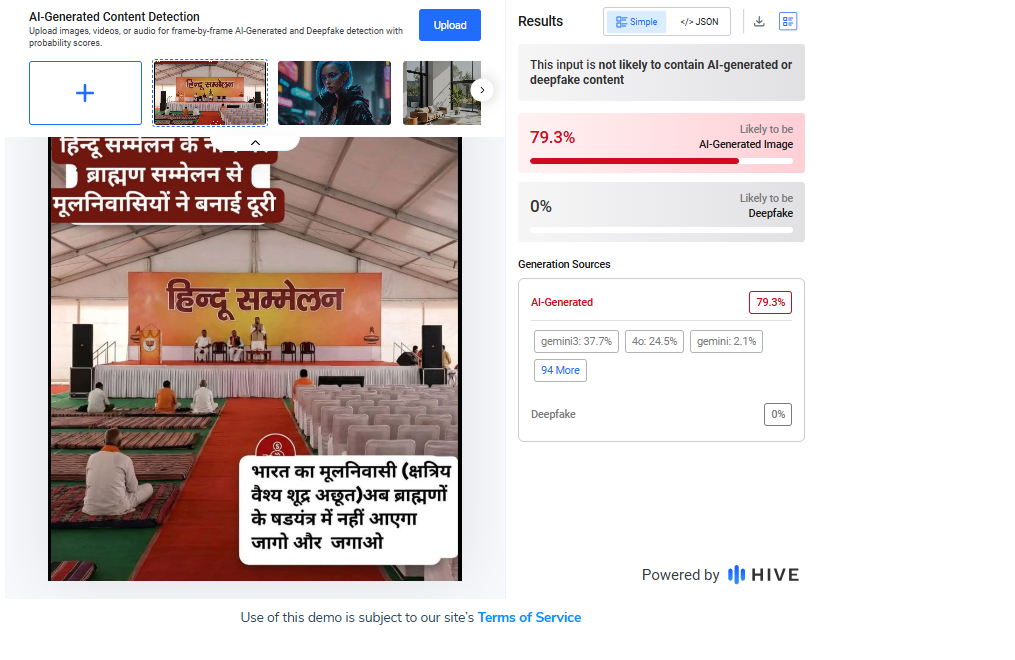
However, upon closely examining the viral image, we observed certain visual inconsistencies and unnatural elements that raised suspicion of AI generation. We first analyzed the image using the AI detection tool Hive Moderation, which indicated a 79.3 percent probability that the image was AI-generated.
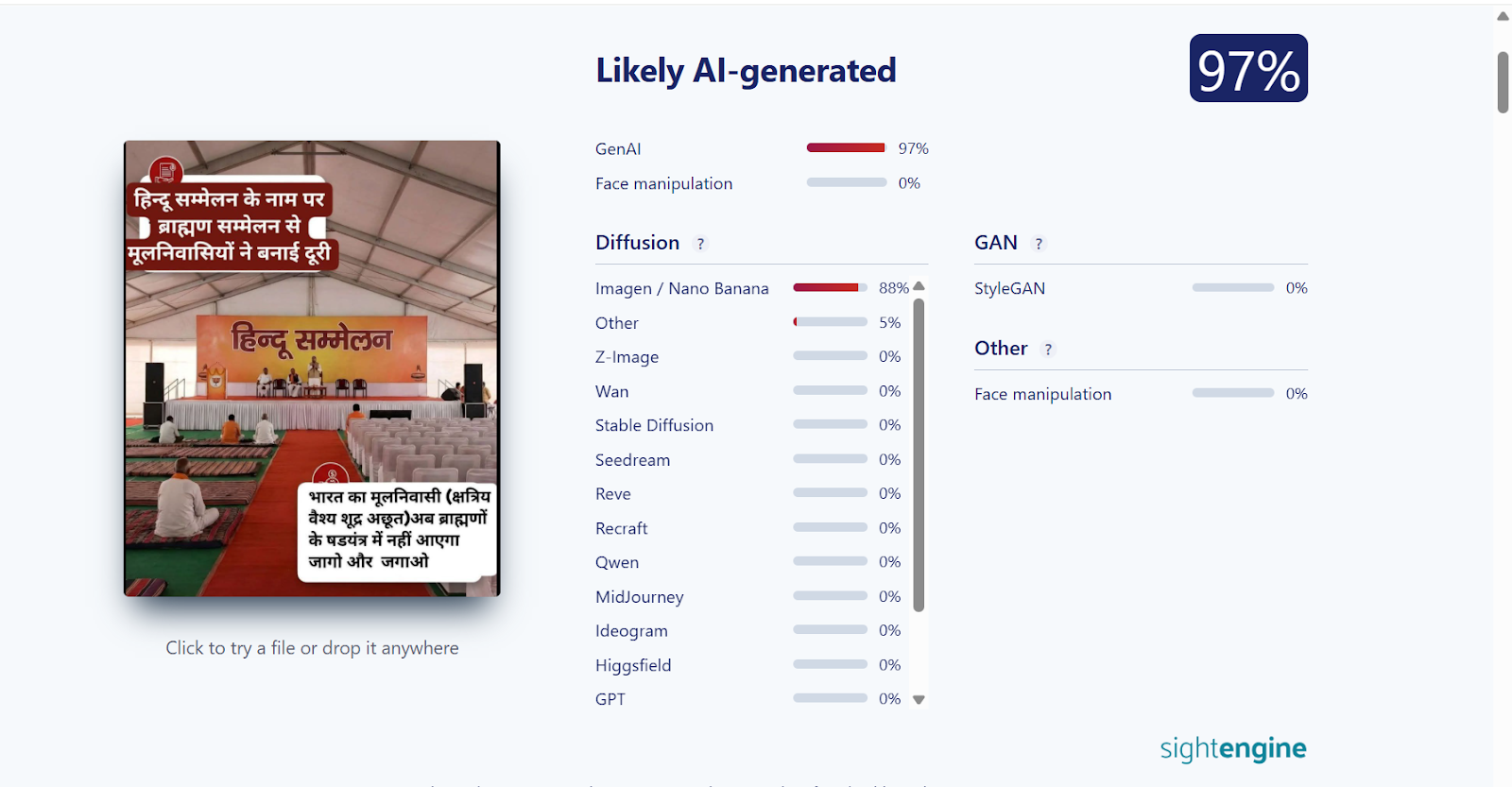
To further verify, we scanned the image using another AI detection platform, Sightengine. The results showed a 97 percent likelihood that the image was AI-generated.
Conclusion
Our research confirms that the image circulating on social media is not genuine. It has been artificially created using AI technology and is being shared with a misleading claim.

Related Blogs

Introduction
In order to effectively deal with growing cyber crime and threats the Telangana police has taken initiative by launching Law Enforcement Chief Information Security Officers (CISO) Council, an innovative project launched in Telangana, India, which is a significant response to the growing cyber threat landscape. With cyber incidents increasing in the recent years and concerning statistics such as a tenfold rise in password-based attacks and an increase in ransomware attacks, the Council aims to strengthen the region's digital defenses. It primarily focuses on reducing vulnerability, improving resilience, and providing real-time threat intelligence. By promoting partnerships between the public and private sectors, offering legal and regulatory guidance, and facilitating networking and learning opportunities, this collaborative effort involving industry, academia, and law enforcement is a crucial move towards protecting critical infrastructure and businesses from cyber threats, the Telangana police in partnership with industry and academia, has launched the Law Enforcement CISO (Chief Information Security Officers) Council of India on 7th October 2023. Chief of the Central Crime Station Stephen Ravindra said that the forum is a path-breaking initiative and the Council represents an open platform for all the enforcement agencies in the country. The upcoming inititiative inculcate close association with different stakeholders, which includes government departments, startups, centers of excellence and international collaborations, carving a nieche for a sturdy cybersecurity envirnoment.
Enhancing Cybersecurity is the Need of the Hour:
The recent launch of the Law Enforcement CISO Council in Hyderabad, India emphasized the need for government organizations and industries to prioritize the protection of their digital space. Cyber incidents, ransomware attacks, and threats to critical infrastructure have been on the rise, making it essential to take proactive cybersecurity measures. Disturbing statistics regarding cyber threats, such as password-based attacks, BEC (Business Email Compromise) attempts, and vulnerabilities in the supply chain, highlight the importance of addressing these issues urgently. This initiative aims to provide real-time threat intelligence, legal guidance, and encourages collaboration between public and private organizations in order to combat cybercrime. Given that every cyber attack has criminal elements, the establishment of these councils is a crucial step towards minimizing vulnerabilities, enhancing resilience, and ensuring the security of our digital world.
International Issue & Domestic Issue:
The announcement by the Telangana State Police, is a proactive step to form a first-of-its-kind Law Enforcement CISO Council (LECC), as part of an initiative from the State government to give a further impetus to cyber security. Jointly with its law enforcement partners, the Telangana Police has decided to make cyber cops more efficient and shape them on par with the technology advancements. The Telangana police have proved its commitment for a secure cyber environment by recovering INR 2.2 crore and INR 6.8 crore lost by people in cyber frauds which is industry’s highest rate of helping the victims.
The Police department complemented efforts by corporate executives for their personal interest in the subject and mentioned police officers’ expertise and inputs from professionals from the industry need to work cohesively to prevent further increase in the number of cyber crime cases. Data indicates that the exponential increase in cyber threats in recent times necessitates an informed and prudent action with the cooperation and collaboration of the IT Department of Telangana, centers of excellence, start-ups, white hats or ethical hackers, and international associations.
A report from Telangana commissioner states the trend of a surge in the number of cyber incidents and vulnerabilities of Government organizations, Critical Infrastructure and MSMEs and stressed that every cyber security breaches have an element of criminality in it. The Law Enforcement CISO Council is a progressive step in this direction which ensures a reduced cyber attacks, enhanced resilience, actionable strategic and tactical real-time threat intelligence, legal guidance, opportunities for public private partnerships, networking, learning and much more.
The Secretary of SCSC, shared some alarming statistics on the threats that are currently rampant across the digital world. To combat it in today’s era of widespread digital dependence, the program launched by the Telangana Police stands as a commendable step or an initiative that offers a glimmer of aspiration. It brings together all the heroes who want to protect the digital spaces and counter the growing number of threats.
Contribution of Telangana Police for carving a niche to be followed:
The launch of the Law Enforcement CISO Council in Telangana represents a pivotal step in addressing the pressing challenges posed by escalating cyber threats. As highlighted by the Director General of Police, the initiative recognizes the critical need to combat cybercrime, which is growing at an alarming rate. The Council not only acknowledges the casual approach often taken towards cybersecurity but also aims to rectify it by fostering collaboration between law enforcement, industry, and academia.
One of the most significant positive aspects of this initiative is its commitment to sharing intelligence, ensuring that the hard-earned lessons from cyber fraud victims are translated into protective measures for others. By collaborating with the IT Department of Telangana, centers of excellence, startups, and ethical hackers, the Council is poised to develop robust Standard Operating Protocols (SOPs) and innovative tools to counter cyber threats effectively.
Moreover, the Council's emphasis on Public-Private Partnerships (PPPs) underscores its proactive approach in dealing with the evolving landscape of cyber threats. It offers a platform for networking and learning, enabling information sharing, and will contribute to reducing the attack surface, enhancing resilience, and providing real-time threat intelligence. Additionally, the Council will provide legal and regulatory guidance, which is crucial in navigating the complex realm of cybercrime. This collective effort represents a promising way forward in safeguarding digital spaces, critical infrastructure, and industries against cyber threats and ensuring a safer digital future for all.
Conclusion:
The Law Enforcement CISO Council in Telangana is an innovative effort to strengthen cybersecurity in the state. With the rise in cybercrimes and vulnerabilities, the council brings together expertise from various sectors to establish a strong defense against digital threats. Its goals include reducing vulnerabilities, improving resilience, and ensuring timely threat intelligence. Additionally, the council provides guidance on legal and regulatory matters, promotes collaborations between the public and private sectors, and creates opportunities for networking and knowledge-sharing. Through these important initiatives, the CISO Council will play a crucial role in establishing digital security and protecting the state from cyber threats.
References:
- http://www.uniindia.com/telangana-police-launches-india-s-first-law-enforcement-ciso-council/south/news/3065497.html
- https://indtoday.com/telangana-police-launched-indias-first-law-enforcement-ciso-council/
- https://www.technologyforyou.org/telangana-police-launched-indias-first-law-enforcement-ciso-council/
- https://timesofindia.indiatimes.com/city/hyderabad/victims-of-cyber-fraud-get-back-rs-2-2-cr-lost-money-in-bank-a/cs/articleshow/104226477.cms?from=mdr

Executive Summary:
Viral pictures featuring US Secret Service agents smiling while protecting former President Donald Trump during a planned attempt to kill him in Pittsburgh have been clarified as photoshopped pictures. The pictures making the rounds on social media were produced by AI-manipulated tools. The original image shows no smiling agents found on several websites. The event happened with Thomas Mathew Crooks firing bullets at Trump at an event in Butler, PA on July 13, 2024. During the incident one was deceased and two were critically injured. The Secret Service stopped the shooter, and circulating photos in which smiles were faked have stirred up suspicion. The verification of the face-manipulated image was debunked by the CyberPeace Research Team.

Claims:
Viral photos allegedly show United States Secret Service agents smiling while rushing to protect former President Donald Trump during an attempted assassination in Pittsburgh, Pennsylvania.


Fact Check:
Upon receiving the posts, we searched for any credible source that supports the claim made, we found several articles and images of the incident but in those the images were different.

This image was published by CNN news media, in this image we can see the US Secret Service protecting Donald Trump but not smiling. We then checked for AI Manipulation in the image using the AI Image Detection tool, True Media.


We then checked with another AI Image detection tool named, contentatscale AI image detection, which also found it to be AI Manipulated.

Comparison of both photos:

Hence, upon lack of credible sources and detection of AI Manipulation concluded that the image is fake and misleading.
Conclusion:
The viral photos claiming to show Secret Service agents smiling when protecting former President Donald Trump during an assassination attempt have been proven to be digitally manipulated. The original image found on CNN Media shows no agents smiling. The spread of these altered photos resulted in misinformation. The CyberPeace Research Team's investigation and comparison of the original and manipulated images confirm that the viral claims are false.
- Claim: Viral photos allegedly show United States Secret Service agents smiling while rushing to protect former President Donald Trump during an attempted assassination in Pittsburgh, Pennsylvania.
- Claimed on: X, Thread
- Fact Check: Fake & Misleading

Introduction
Social media platforms serve as an ideal breeding ground for cybercrime. A new fraud called ‘WhatsApp Pink’ has emerged, promising new features and an improved UI. Several law enforcement and government agencies have already issued severe caution against the program, which is used to hack mobile phones and steal personal information.
What is a pink WhatsApp Scam?
WhatsApp is on a roll with new features, but the messaging app is also experiencing an increase in a new type of scam. The WhatsApp Pink scam, as it is known, is gaining steam. Police and government organisations in several states, including Mumbai, Kerala, and Karnataka, have warned about the scam. A North Region cybercrime wing tweet warned, “WHATSAPP PINK – A Red Alert for Android Users.” The government’s cybersecurity organisations have warned about the rise in pink WhatsApp scams.
Scammers and hackers target WhatsApp users with fake messages via the network in this scam. According to reports, the message contains a link directing users to download WhatsApp Pink, a bogus messaging program. According to sources, scammers are targeting many people with the promise that the next version will have a better interface and additional features.
The application also steals critical financial information such as OTP, bank account information, and contact information. When people open the link, harmful software is installed on their mobile phones, and scammers get access to the phones. The user may even lose access to their phone by downloading the app.
According to the advisory
The news about ‘New Pink Look WhatsApp with extra features’ recently circulating among WhatsApp users is a hoax that can lead to hacking of your mobile through malicious software.” It is uncommon for fraudsters to devise new tricks and methods to entice naive consumers into falling into their trap and committing cyber fraud. It is the users’ responsibility to be Aware, Alert, and Attentive to these types of frauds in order to be safe and secure in the digital world.”
The link that is present in the message, according to a notice from the police, is a phishing effort. By clicking the link, the user runs the risk of having their device compromised, which might allow scammers to steal their device information or use it without their permission.
Users run the possibility of suffering negative outcomes if they click the Pink WhatsApp link, as the Mumbai Police have warned. These dangers include financial loss, identity theft, spam attacks, unauthorised access to contact information and saved images, and even total loss of control over mobile devices.
Guidelines against the Scam
- If a user has installed the fake WhatsApp, the authorities have instructed that they uninstall it immediately by going into the mobile settings, selecting WhatsApp with the pink logo in Apps, and then uninstalling it.
- Users have been advised to exercise caution when clicking links from untrustworthy websites unless they have previously verified their legitimacy. Users are advised to only download and update software from reliable sites such as the official Google Play Store, the iOS App Store, and so on.
- individuals using the site have been told not to send any links or communications to other persons until they have received proper authentication or verification.
- To avoid misuse, users are advised not to disclose any personal or financial information, including passwords, login information, and credit or debit card information, to anybody online. Furthermore, in order to defend themselves against fraud attempts, users are encouraged to stay up to date on the most recent news and changes in order to be informed and careful about cybercriminal activities.
Why do Scammer target WhatsApp
WhatsApp is the world’s most popular messaging service; it can reach out to considerably more prospective victims than it could with another tool. A scammer’s victims are almost certainly using WhatsApp. If all their victims are in one app, the criminal can easily handle their activities.
Conclusion
WhatsApp users may reduce their chances of being victims of the pink WhatsApp scam significantly by following the guidelines issued by the advisory. WhatsApp has become the primary target for scams, as there is a large number of the population using WhatsApp so it will be easy for the Scammer to steal critical personal information and target another victim through WhatsApp. The pink WhatsApp Scam is exactly like it.

