
#FactCheck-Viral Video Falsely Attributes Remarks on US Leaders to CDS Anil Chauhan
Executive Summary
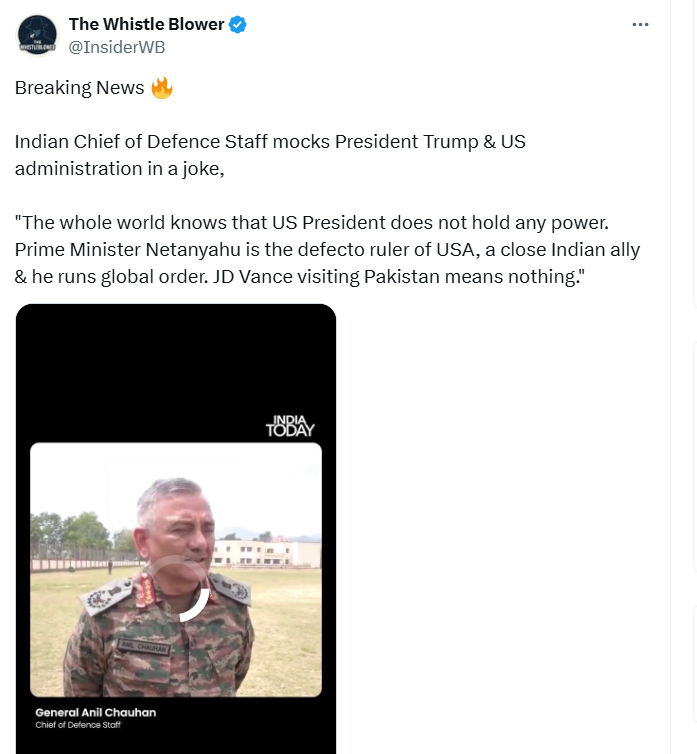
A video circulating on social media claims that Chief of Defence Staff Anil Chauhan described US leaders as “toothless rulers” and said that US President Donald Trump cannot disobey Israeli Prime Minister Benjamin Netanyahu. The clip is being widely shared as a recent statement. However, research by the CyberPeace Research Wing found the claim to be misleading. A review of the full interview revealed that Chauhan was speaking about the need for India to prepare for the next phase of ‘Operation Sindoor’. He emphasised that the armed forces must move beyond past operations and gear up for future challenges.
Claim
Social media users have shared the video claiming that CDS Anil Chauhan referred to US leaders as “toothless rulers” and stated that Donald Trump cannot act against the wishes of Benjamin Netanyahu.
- Link: https://x.com/InsiderWB/status/2046263000928330130
- Archive: https://archive.ph/j8CeL
Fact Check
A detailed keyword search using terms such as “CDS Anil Chauhan, Donald Trump, JD Vance, Pakistan” did not yield any credible reports or verified statements supporting the viral claim. A reverse image search of keyframes from the clip traced it back to a post shared by India Today on April 18, 2026, where the same visuals and setting were used.
https://x.com/IndiaToday/status/2045531069647327240
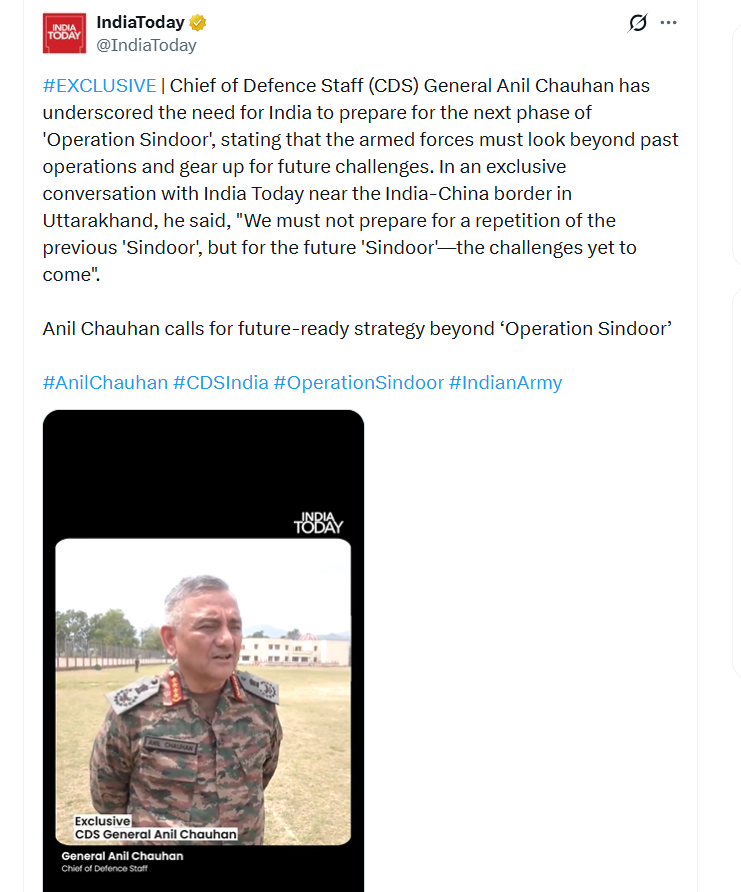
In the original interview, Chauhan focused on military preparedness and the future course of ‘Operation Sindoor’. He did not make any remarks about US leadership, Donald Trump, or Benjamin Netanyahu. The complete version of the interaction, also aired on Aaj Tak, was reviewed in full and similarly contains no such controversial or political statements.

Conclusion
The viral claim is misleading. The video has been edited or taken out of context to falsely attribute remarks to CDS Anil Chauhan that he never made. In reality, his statements were limited to India’s military preparedness and did not include any comments on US or Israeli leadership.

Related Blogs
Introduction
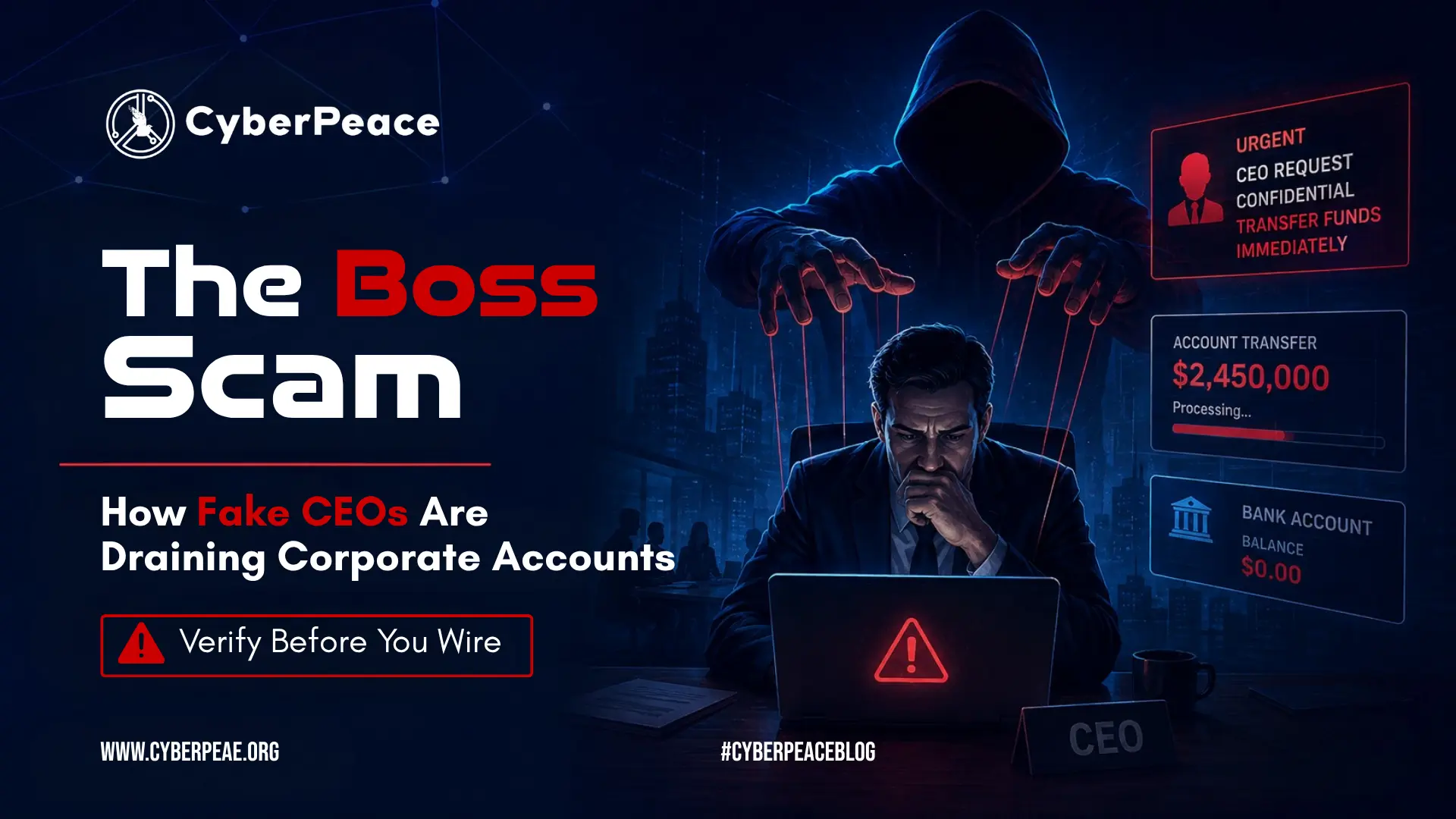
Imagine receiving a WhatsApp message from your CEO late on a Friday afternoon. The message is urgent: a confidential business deal requires an immediate wire transfer before markets close. The profile picture matches, the tone sounds familiar, and the account it came from has your CEO's name on it. Everything appears legitimate except it is not. This is the essence of the 'Boss Scam,' a sophisticated form of CEO impersonation fraud that has emerged as one of the most financially devastating cybercrime trends of 2025. India's Indian Cyber Crime Coordination Centre (I4C), under the Ministry of Home Affairs, issued an urgent national advisory on this threat in June 2025, warning that organisations across the country are falling victim to an evolved and technically advanced version of executive impersonation fraud that bypasses many traditional cybersecurity safeguards.
Understanding the Boss Scam
What Is CEO Impersonation Fraud?
CEO fraud, also known as Business Email Compromise (BEC) or executive impersonation fraud, is a targeted cyberattack in which criminals assume the digital identity of a high-ranking executive most commonly the Chief Executive Officer to deceive subordinate employees into authorising fraudulent financial transactions or divulging sensitive information. Unlike generic phishing campaigns that cast a wide net, CEO fraud is a precision attack. Cybercriminals invest significant time and resources researching their targets, studying organisational hierarchies, communication styles, and internal financial workflows before executing the scam. The attack is devastatingly effective because it weaponises one of the most powerful forces in any workplace: authority. An instruction that appears to originate from the CEO carries an implicit demand for immediate compliance, often bypassing normal checks and verification procedures. The FBI's Internet Crime Complaint Center (IC3) has consistently identified BEC as one of the most financially destructive categories of cybercrime, with adjusted losses of approximately USD 2.77 billion reported in 2024 alone across the United States.
The New and Evolved Variant: India's I4C Advisory
The variant identified by India's I4C represents a dangerous evolution of traditional CEO fraud. The earlier versions of this scam relied on spoofed email addresses or fake WhatsApp profiles that merely mimicked an executive's account. Employees were trained to spot tell-tale warning signs suspicious domains, unusual sender addresses, or spelling errors in email IDs. The latest
Boss Scam variant eliminates many of these red flags entirely by hijacking the executive's actual and legitimate WhatsApp account. This sophisticated attack begins not with the employee, but with the CEO. Cybercriminals approach senior executives through email or WhatsApp while posing as regulatory authorities in India's context, this includes impersonating officials from the Reserve Bank of India (RBI) or other government bodies. These messages claim an urgent compliance violation or regulatory breach requiring immediate remedial action. The communication contains a compressed ZIP archive, which the executive is prompted to open. Inside the archive are malicious executable (.exe) and Dynamic Link Library (.dll) files that, when run on a Windows system, deploy a Trojan dropper a form of malware capable of establishing persistent access on the device and hijacking active WhatsApp Web session tokens.
Once the session token is compromised, the attacker gains complete control over the executive's WhatsApp account without needing the phone, password, or any two-factor authentication code. The legitimate account is now in criminal hands, and any message sent from it appears entirely authentic to recipients.
How the Boss Scam Operates: A Step-by-Step Breakdown
Stage 1: Targeting the Executive: The operation begins with careful reconnaissance. Attackers study the target organisation's leadership, identify the CEO or a senior executive, and gather publicly available information about their communication patterns, business relationships, and company operations through LinkedIn, corporate websites, and news sources. They then contact the executive under a false regulatory identity, engineering a sense of crisis and urgency.
Stage 2: Malware Deployment:The fraudulent regulatory communication contains a ZIP file disguised as a compliance document, a security patch, or a mandatory software update. Upon execution on a Windows machine, the embedded malware installs itself and begins hijacking the WhatsApp Web session. Critically, in many documented cases, the CEO innocently forwards this regulatory message and the malicious attachment to their own finance officer or IT team, inadvertently widening the attack surface.
Stage 3: Account Takeover and Impersonation:With the CEO's legitimate WhatsApp account now under their control, cybercriminals send highly convincing messages to subordinate staff, particularly those in finance, accounts payable, or treasury functions. These messages carry the full weight of genuine executive authority correct name, profile photo, and account history making them extraordinarily difficult to distinguish from authentic communications.
Stage 4: The Financial Strike:The fraudulent instruction typically requests an urgent, confidential wire transfer to an unfamiliar account, often accompanied by requests for complete secrecy. The employee, believing the instruction to be genuine and fearing the consequences of non-compliance with a directive from their CEO, processes the transaction. By the time the fraud is discovered, the funds have been routed through multiple mule accounts, making recovery extremely difficult.
The Broader Landscape: Scale and Impact
The Boss Scam is not an isolated Indian phenomenon it represents the cutting edge of a global epidemic of executive impersonation fraud. According to the FBI's data, BEC has been the costliest category of cybercrime for several years running, with cumulative global losses that officials have described as exceeding USD 50 billion over the past decade. A 2025 fraud survey found that 90 per cent of U.S. companies experienced attempted cyber-fraud in 2024, with business email compromise and impersonation scams surging by 103 per cent year-on-year. The technological sophistication of these attacks has grown in lockstep with the availability of AI tools. In early 2024, a finance worker at a multinational firm in Hong Kong was tricked into authorising a payment of USD 25 million after attending a video conference in which the CFO and other senior executives were entirely fabricated using deepfake technology. In March 2025, a similar attack unfolded in Singapore, where a finance director authorised nearly USD 499,000 after joining a Zoom call populated entirely by AI-generated deepfakes of company executives. Deepfake attacks against businesses reportedly surged by 3,000 per cent in 2023, and voice cloning fraud rose by 680 per cent the following year. In India, the Telangana Cyber Security Bureau reported over 300 complaints related to the Boss Scam variant alone within a twenty-day period in June 2025. In one prominent case, formerPrime Minister I.K. Gujral's son, Naresh Gujral, reportedly lost approximately Rs 7.8 crorethrough a messaging-app impersonation scheme targeting his company's Chief Financial Officer.
Warning Signs Every Employee Must Recognise
Identifying a Boss Scam attempt requires situational awareness and healthy scepticism. The following red flags should prompt immediate caution:
● Any request for urgent or secret financial transfers received via WhatsApp or email, without prior discussion or formal documentation.
● Instructions to bypass standard approval procedures or to maintain secrecy from colleagues or senior management.
● Compressed files (.zip, .rar) or executable attachments received from any source, including apparently known contacts, claiming to be compliance documents or regulatory updates.
● Messages from executives at unusual hours, particularly those emphasising that a transaction must be completed immediately.
● Claims that a request comes from a government regulator, such as the RBI, delivered through informal channels like WhatsApp.
● Any communication that creates extreme urgency, invokes authority, and simultaneously demands confidentiality the classic triangle of social engineering manipulation. Protective Measures: Defending Against the Boss Scam
For Employees and Finance Teams
The I4C advisory and global cybersecurity authorities recommend several concrete steps that employees can take. The most important is to independently verify any urgent financial instruction through a direct voice call or in-person confirmation before taking action, regardless of how convincing the digital message appears. No financial transaction of significance should be authorised on the basis of a WhatsApp message or email alone.
For Organisations and Leadership
Organisations must implement multi-layered verification protocols for all wire transfers above a defined threshold, making dual authorisation and out-of-band verification mandatory. IT teams should deploy updated malware detection tools, enforce software restriction policies that block unauthorised executable files, and regularly audit devices for signs of compromise. WhatsApp linked devices should be reviewed periodically. Leadership must also commit to regular, mandatory cybersecurity awareness training for all staff, with particular attention to social engineering tactics. The I4C has also emphasised that legitimate regulatory bodies including the RBI , do not distribute software, compliance tools, or security patches via WhatsApp or email attachments. Any such communication must be treated as a potential attack vector and reported immediately.
Conclusion
The Boss Scam exploits organisational trust and human psychology rather than technical vulnerabilities and with deepfake technology now capable of replicating familiar voices and faces, traditional verification instincts are no longer reliable. The strongest defence is a culture of verification without embarrassment, where questioning an unusual instruction is seen as diligence, not insubordination. Awareness, clear protocols, and scepticism towards urgency remain our most powerful tools. If you've encountered such a scam, contact India's National Cybercrime Helpline at 1930 or report at cybercrime.gov.in.
References
- https://www.cybercrime.gov.in
- https://www.business-standard.com/india-news/boss-scam-ceo-impersonation-fraudgovt- advisory-i4c-126062300353_1.html
- https://www.indiatvnews.com/news/india/boss-scam-all-about-the-new-cyber-fraudtargeting- corporates-and-precautions-listed-by-mha-2026-06-23-1045827
- https://www.freepressjournal.in/business/boss-scam-on-whatsapp-new-ceo-fraudbypasses- traditional-cybersecurity-checks
- https://hyderabadmail.com/tgcsb-warns-boss-scam-ceo-impersonation-fraud-malwarealert/
- https://www.newkerala.com/news/a/rising-boss-scam-threat-targets-senior-executiveswarns- 242.html
- https://www.ic3.gov
- https://www.mcafee.com/learn/is-that-really-your-boss/
- https://abnormal.ai/glossary/ceo-fraud
- https://www.brside.com/blog/deepfake-ceo-fraud-50m-voice-cloning-threat-cfos
- https://www.eftsure.com/blog/cyber-crime/these-7-deepfake-ceo-scams-prove-that-nobusiness- is-safe/
- https://www.knowbe4.com/ceo-fraud
- https://trustpair.com/blog/ceo-fraud-how-to-protect-your-organization-from-fraudsters/
- https://hacked.com/services/executive-impersonation-and-ceo-fraud-protecting-high-networth- individuals/
- https://www.certifid.com/article/ceo-fraud
Introduction
Artificial Intelligence (AI) has transcended its role as a futuristic tool; it is already an integral part of the decision-making process in various sectors, including governance, the medical field, education, security, and the economy, worldwide. On the one hand, there are concerns about the nature of AI, its advantages and disadvantages, and the risks it may pose to the world. There are also doubts about the technology’s capacity to provide effective solutions, especially when threats such as misinformation, cybercrime, and deepfakes are becoming more common.
Recently, global leaders have reiterated that the use of AI should continue to be human-centric, transparent, and governed responsibly. The issue of offering unbridled access to innovators, while also preventing harm, is a dilemma that must be resolved.
AI as a Global Public Good
In earlier times only the most influential states and large corporations controlled the supply and use of advanced technologies, and they guarded them as national strategic assets. In contrast, AI has emerged as a digital innovation that exists and evolves within a deeply interconnected environment, which makes access far more distributed than before. Usage of AI in a specific country will not only bring its pros and cons to that particular place, but the rest of the world as well. For instance, deepfake scams and biased algorithms will not only affect the people in the country where they are created but also in all other countries where such people might be doing business or communicating.
The Growing Threat of AI Misuse
- Deepfakes, Crime, and Digital Terrorism
The application of artificial intelligence in the wrong way is quickly becoming one of the main security problems. Deepfake technology is being used to carry out electoral misinformation spread, communicate lies, and create false narratives. Cybercriminals are now making use of AI to make phishing attacks faster and more efficient, hack into security systems, and come up with elaborate social engineering tactics. In the case of extremist groups, AI has the power to give a better quality of propaganda, recruitment, and coordination.
- Solution - Human Oversight and Safety-by-Design
To overcome these dangers, a global AI system must be developed based on the principles of safety-by-design. This means incorporating moral safeguards right from the development phase rather than reacting after the damage is done. Moreover, human control is just as vital. Artificial intelligence (AI) systems that influence public confidence, security, or human rights should always be under the control of human decision-makers. Automated decision-making where there is no openness or the possibility of auditing could lead to black-box systems being developed, where the assignment of responsibility is unclear.
Three Pillars of a Responsible AI Framework
- Equitable Access to AI Technologies
One of the major hindrances to global AI development is the non-uniformity of access. The provision of high-end computing capability, data infrastructure, and AI research resources is still highly localised in some areas. A sustainable framework needs to be set up so that smaller countries, rural areas, and people speaking different languages will also be able to share the benefits of AI. The distribution of access fairly will be a gradual process, but at the same time, it will lead to the creation of new ideas and improvements in the different places where the local markets are. Thus, there would be no digital divide, and the AI future would not be exclusively determined by the wealthy economies. - Population-Level Skilling and Talent Readiness
AI will have an impact on worldwide working areas. Thus, societies must not only equip their people with the existing job skills but also with the future technology-based skills. Massive AI literacy programs, digital competencies enhancement, and cross-disciplinary education are very important. Forecasting human resources for roles in AI governance, data ethics, cyber security, and modern technologies will help prevent large scale displacement while also promoting growth that is genuinely inclusive. - Responsible and Human-Centric Deployment
Adoption of Responsible AI makes sure that technology is used for social good and not just for making profits. The human-centred AI directs its applications to the sectors like healthcare, agriculture, education, disaster management, and public services, especially the underserved regions in the world that are most in need of these innovations. This strategy guarantees that progress in technology will improve human life instead of making the situation worse for the poor or taking away the responsibility from humans.
Need for a Global AI Governance Framework
- Why International Cooperation Matters
AI governance cannot be fragmented. Different national regulations lead to the creation of loopholes that allow bad actors to operate in different countries. Hence, global coordination and harmonisation of safety frameworks is of utmost importance. A single AI governance framework should stipulate:
- Clear responsible prohibition on AI misuse in terrorism, deepfakes, and cybercrime .
- Transparency and algorithm audits as a compulsory requirement.
- Independent global oversight bodies.
- Ethical codes of conduct in harmony with humanitarian laws.
Framework like this makes it clear that AI will be shaped by common values rather than being subject to the influence of different interest groups.
- Talent Mobility and Open Innovation
If AI is to be universally accepted, then global mobility of talent must be made easier. The flow of innovation takes place when the interaction between researchers, engineers, and policymakers is not limited by borders.
- AI, Equity, and Global Development
The rapid concentration of technology in a few hands poses the risk of widening the gap in equality among countries. Most developing countries are facing the problems of poor infrastructure, lack of education and digital resources. By regarding them only as technology markets and not as partners in innovation, they become even more isolated from the mainstream of development. An AI development mix of human-centred and technology-driven must consider that the global stillness is broken only by the inclusion of the participation of the whole world. For example, the COVID-19 pandemic has already demonstrated how technology can be a major factor in the building of healthcare and crisis resilience. As a matter of fact, when fairly used, AI has a significant role to play in the realisation of the Sustainable Development Goals.
Conclusion
AI is located at a crucial junction. It can either enhance human progress or increase the digital risks. Making sure that AI is a global good goes beyond mere sophisticated technology; it requires moral leadership, inclusion in governance, and collaboration between countries. Preventing misuse by means of openness, supervision by humans, and policies that are responsible will be vital in keeping public trust. Properly guided, AI can make society more resilient, speed up development, and empower future generations. The future we choose is determined by how responsibly we act today.
As PM Modi stated ‘AI should serve as a global good, and at the same time nations must stay vigilant against its misuse’. CyberPeace reinforces this vision by advocating responsible innovation and a secure digital future for all.
References
- https://www.hindustantimes.com/india-news/ai-a-global-good-but-must-guard-against-misuse-pm-101763922179359.html
- https://www.deccanherald.com/india/g20-summit-pm-modi-goes-against-donald-trumps-stand-seeks-global-governance-for-ai-3807928
- https://timesofindia.indiatimes.com/india/need-global-compact-to-prevent-ai-misuse-pm-modi/articleshow/125525379.cms
Executive Summary:
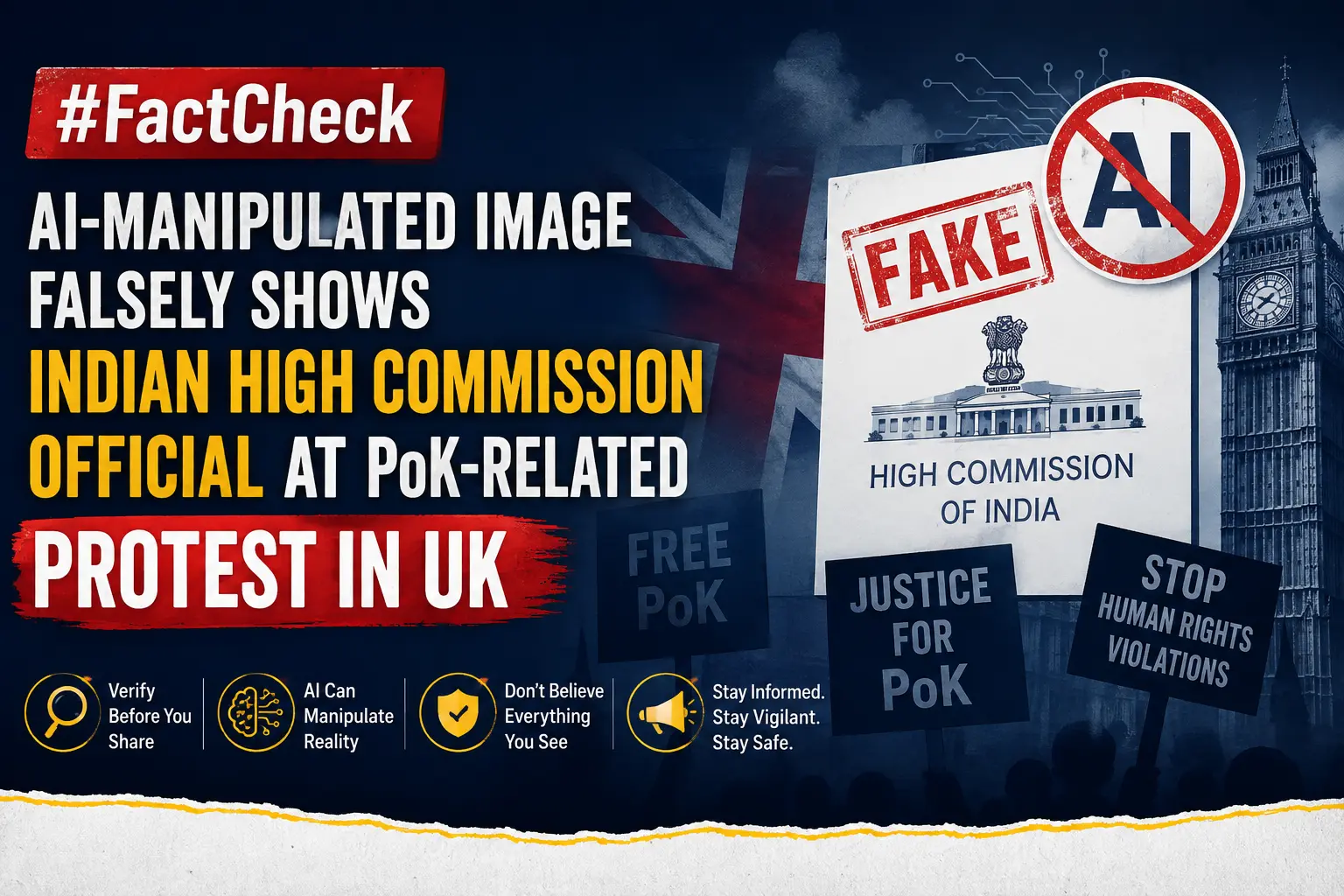
A photo is being circulated on social media with the claim that it shows Ram Prakash, an official from the Indian High Commission in the United Kingdom (UK), participating in a protest organised over issues related to PoK. CyberPeace Research Wing’s research found the claim associated with the image to be false. The research confirmed that the image was digitally modified using OpenAI’s AI tools.
Claim:
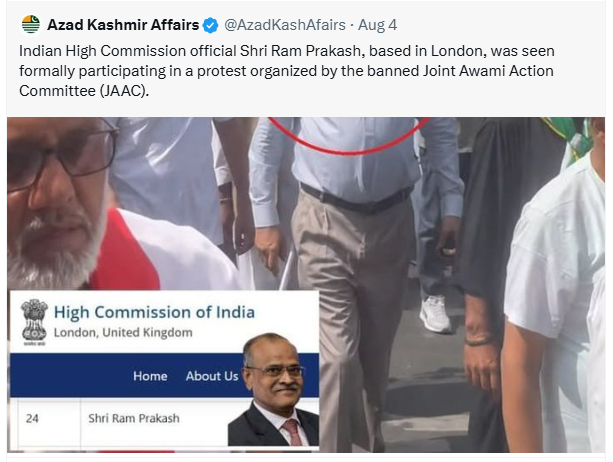
A user on social media platform X (formerly Twitter) shared the viral image on August 4, 2026, claiming that Shri Ram Prakash, an official from the Indian High Commission in London, was seen formally participating in a protest organised by the banned Joint Awami Action Committee (JAAC). The post link, archive link, and screenshot are provided below:
https://x.com/i/birdwatch/t/2084551118189904105?source=6
Fact Check:
During the research, we conducted a Google search using relevant keywords. We traced the original source of the viral visual to a social media post shared by Pakistani media outlet GEO News’ UK Bureau Chief Murtaza Ali Shah on August 2, 2024.
The post featured a video of a protest held in Luton, United Kingdom, where a large number of British Kashmiris were seen marching to express concerns over the situation in Pakistan-occupied Kashmir (PoK). At the time, the Joint Awami Action Committee (JAAC) was leading a prolonged protest in the region.
https://www.facebook.com/reel/1383400640416385

At the 1:23 mark of the video shared by the Pakistani journalist, we found the same scene that appears in the viral image. However, the individual seen in the viral image does not appear in the original footage. Instead, the video shows a different person participating in the protest.

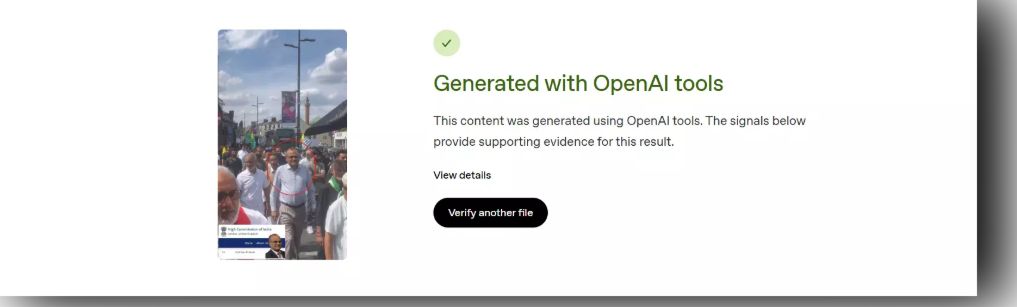
To further verify the authenticity of the image, we analysed it using multiple AI detection tools, including OpenAI’s image detection tool. The analysis detected provenance signals associated with OpenAI tools such as ChatGPT, OpenAI API, or Codex. These signals indicate that the image was created or modified using OpenAI’s AI tools.
Conclusion:
The research established that the viral image has been manipulated to falsely portray Indian High Commission official Ram Prakash as a participant in the protest. The original footage shows a different individual, while AI analysis confirmed that the image was modified using OpenAI tools. Therefore, the claim circulating with the image is misleading.
