
#FactCheck:AI-Generated Footage Misleadingly Shared as Rawalakot Protest Video
Executive Summary
A video is being widely shared on social media, showing a man firing a pistol. The video is being shared with the claim that it is from the recent protests in Rawalakot, Pakistan-administered Kashmir. It is further claimed that the person seen in the video is associated with the Indian Action Committee, who is firing at security forces and later portraying themselves as victims after facing retaliation. The CyberPeace Research Wing analysed the viral video and found several visual inconsistencies. Further analysis using AI detection tools revealed that the viral video was generated using artificial intelligence (AI).
Claim:
A video shared on social media claims to show protesters associated with the Indian Action Committee directly firing at security forces. The post further claims that these individuals later present themselves as victims after facing a response from authorities.
https://www.facebook.com/groups/1052887838090429/permalink/27742200445399139/?rdid=EMCXtwaN9n4OwqFc#

Fact Check:
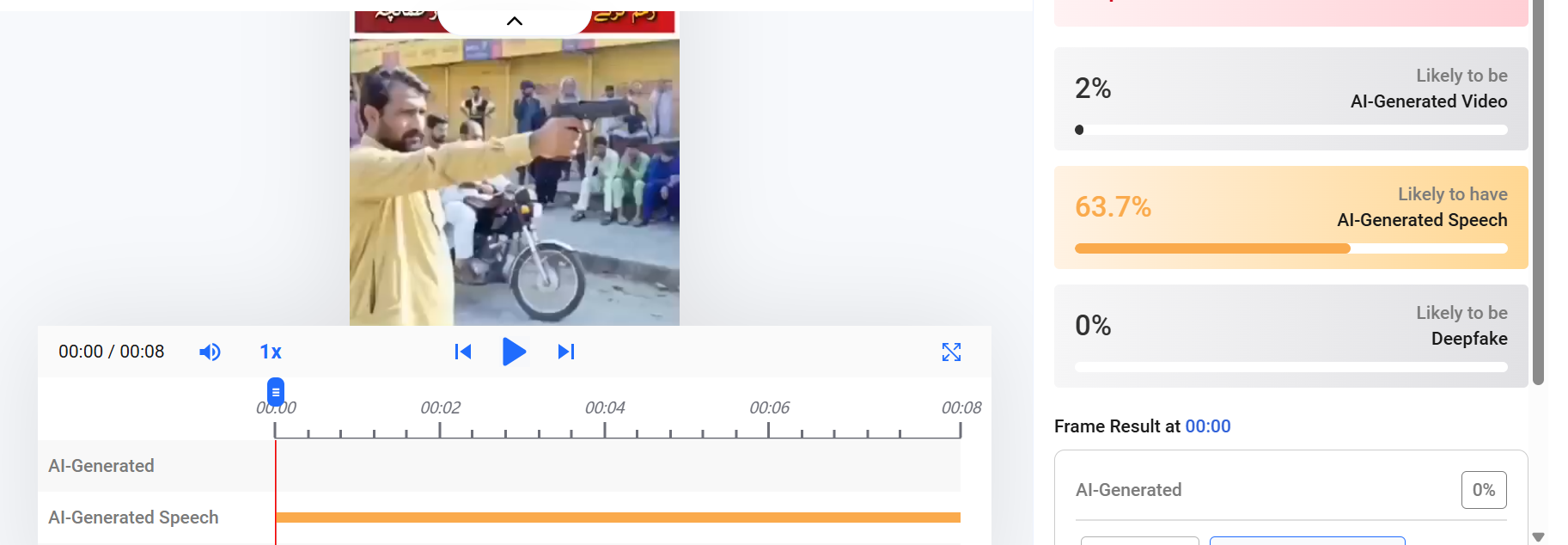
During the research, the viral video was analysed and multiple visual inconsistencies were observed. At the beginning of the clip, two men riding a motorcycle can be seen behind the person firing the gun. However, instead of moving away from the firing spot, they appear to move towards the direction where the shooting is taking place. Additionally, the hand and head movements of one of the passengers on the motorcycle appear unnatural and distorted, which are common signs of AI-generated content.
In the next step of the research, the viral video was scanned using Hive Moderation. The results indicated that the video had a 63 per cent probability of being AI-generated.
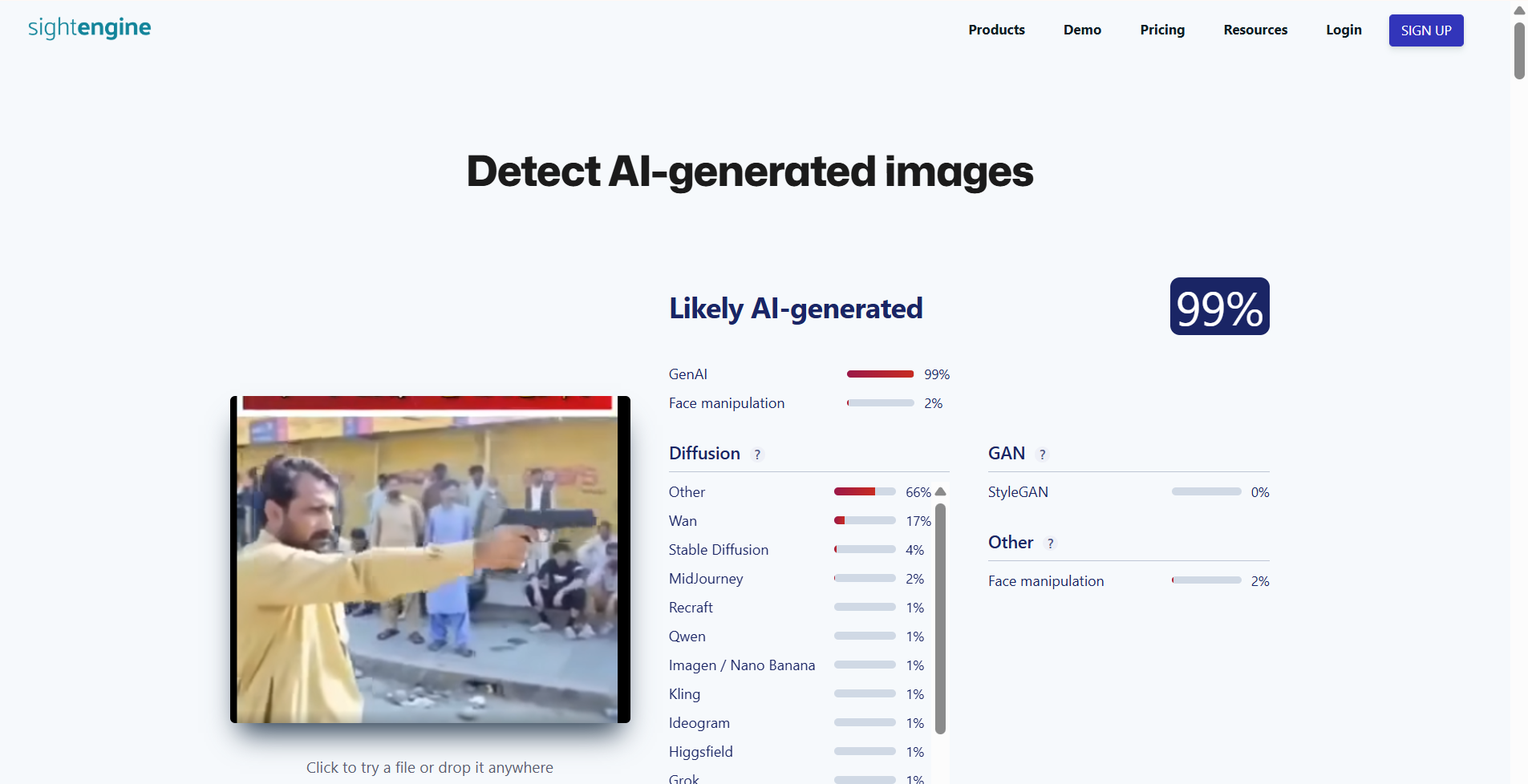
The video was also analysed using Sightengine, which flagged it as 99 per cent AI-generated.
Conclusion:
The research found that the viral video does not show a real incident from the recent protests in Rawalakot, Pakistan-administered Kashmir. The video contains multiple visual inconsistencies, and analysis through AI detection tools also confirmed that it was generated using artificial intelligence. Therefore, the claim that the video shows an Indian Action Committee member firing at security forces during the protests is false.

Related Blogs
.webp)
Introduction
In today's digital economy, data is not only a business asset but also the fuel for innovation, decision-making, and consumer trust. However, the digitisation of services has made personal or sensitive data a top target for cybercriminals. The stakes are high: a data breach can cost millions of fines, cause damage to reputation and devastate the confidence of consumers. Therefore, regulatory compliance and data protection have become a strategic imperative.
From the General Data Protection Regulation (GDPR) in the EU to the Digital Personal Data Protection (DPDP) Act of India, various sector-specific regulations like HIPAA for healthcare in the US, companies are now subject to a web of data protection and compliance laws. The challenge is to balance compliance efforts with strong security, a balance that demands both policy restraint and technical resilience. This blog examines pivotal pillars, shifting trends and actionable best practices for dominating data protection and compliance in 2025 and beyond.
Why Data Protection and Compliance Matter More Than Ever
Data protection isn't just about keeping fines at bay, it's about preserving the relationship with customers, partners and regulators. A 2024 IBM report says the average data-breach cost has now exceeded USD 4.5 million, with regulatory fines constituting a large portion of the cost. In addition to economics, breaches tend to result in intellectual property loss, customer loss and long-term brand attenuation. Compliance ensures organisations remain within certain legislative necessities for collecting, holding, transferring and setting of personal and sensitive information. Failure to conformity can lead to serious penalties: under GDPR, fines could be up to 4% of the company's annual turnover or €20 million, whichever is higher. In regulated sectors like banking and healthcare, compliance breaches can also lead to the suspension of licenses.
Important Regulatory Frameworks Informing 2025
- GDPR and Its Global Ripple Effect
GDPR was enacted in 2018 and continues to have a ripple effect on privacy legislation worldwide. Its tenets of lawfulness, transparency, data minimisation and purpose limitation have been replicated in many jurisdictions such as Brazil's LGPD and South Korea's PIPA.
- India's DPDP Act
The DPDP Act, 2023, gives high importance to consent-based processing of data, transparent notice rules and fiduciary responsibilities for data. With a penalty for default of up to INR 250 crore, it's amongst the most impactful laws for digital personal data protection.
- Sectoral Regulations
- HIPAA for healthcare information in the US.
- PCI DSS for payment card security.
- DORA (Digital Operational Resilience Act) in the EU for financial organisations.
- These industry-specific models generate overlapping compliance responsibilities, making cross-enterprise compliance programs vital.
Key Pillars of a Sound Data Protection & Compliance Program
- Data Governance and Classification
Having insight into what data you have to store, where it is stored and who can have access to it is the keystone of compliance. Organisations need to have data classification policies in place to group information based on sensitivity and impose more rigorous controls on sensitive data.
- Security Controls and Privacy by Design
Strong technical defences, encryption, multi-factor authentication, and intrusion detection are the initial defences. Privacy by design integrated in product development guarantees compliance is thought through from the initial stage, not added on afterwards.
- Consent and Transparency
Contemporary data legislation highlights informed consent. This entails simple, non-technical privacy notices, detailed opt-in choices, and straightforward withdrawal options. Transparency produces trust and lessens legal danger.
- Incident Response and Breach Notification
Most laws demand timely breach notifications, and GDPR insists on reporting within 72 hours. Having a documented incident response plan maintains legal deadlines and reduces harm.
- Employee Training and Awareness
Human mistake is the top source of data breaches. Ongoing training in prevention of phishing, password management, basic cyber hygiene and compliance requirements is crucial.
Upcoming Trends in 2025
- AI-Powered Compliance Monitoring
Organisations are embracing AI-powered solutions to systematically monitor data flows, identify policy breaches and auto-create compliance reports. The solutions assist in closing the loop between IT security teams and compliance officers.
- Cross-Border Data Transfer Mechanisms
With increasingly severe regulations, companies are spending more on secure cross-border data transfer frameworks like Standard Contractual Clauses (SCCs) and Binding Corporate Rules (BCRs).
- Privacy-Enhancing Technologies (PETs)
Methods such as homomorphic encryption and differential privacy are picking up steam, enabling organisations to sift through datasets without revealing sensitive personal data.
- ESG and Data Ethics
Data handling is increasingly becoming a part of Environmental, Social and Governance (ESG) reporting. Ethical utilisation of customer data, not just compliance, has become a reputational differentiator.
Challenges in Implementation
Despite having transparent frameworks, data protection plans encounter challenges like jurisdictions having competing needs, and global compliance is becoming expensive. The emerging technologies, such as generative AI, often bring privacy threats that haven’t been fully covered by legislation. Small and micro enterprises have neither the budget nor the skills to implement enterprise-level compliance programs. Qualifying these challenges often needs a risk-based strategy, allocations of resources to top areas of impact and automating the compliance chores wherever possible.
Best Practices for 2025 and Beyond
In 2025, regulatory compliance and data protection are no longer a precaution or a response to a breach but are strategic drivers of resilience and trust. As regulatory analysis rises, cyber threats evolve, and consumer expectations grow, administrations need to integrate compliance into the very fabric of their actions. By bringing governance and technology together, organisations can break free from a "checklist" mentality and instead adopt a proactive and risk-sensitive approach. Eventually, data protection is not just about not getting in trouble; it's about developing a kind that succeeds in the digital era.
References
- GDPR – Official EU Regulation Page: https://gdpr.eu
- India’s DPDP Act Overview – MeitY: https://www.meity.gov.in/data-protection-framework
- HIPAA – US Department of Health & Human Services: https://www.hhs.gov/hipaa
- PCI DSS Standards: https://www.pcisecuritystandards.org
- IBM Cost of a Data Breach Report 2024: https://www.ibm.com/reports/data-breach
- OECD – Privacy Guidelines: https://www.oecd.org/sti/privacy-guidelines

Introduction
The two-day Apple’s Worldwide Developer Conference (WWDC) 2023, which was held on the 6th & 7th of June, has become an essential and highly anticipated part of our calendar as frequently as the trend. This year’s keynote announcements will include all of the usual enhancements for iOS, iPadOS, watchOS, macOS, and more. However, this year is also unique due to the unveiling of the Vision Pro headset, a brand-new Apple product.
In this blog, we will examine the exciting announcements made at Apple WWDC 2023, which was a ground-breaking event.
macOS Sonoma
macOS Sonoma, the new presentation of macOS disclosed at the WWDC full of exciting features. It comes with stunning video screensavers that show stunning scenes from all over the world. Gadgets can now be added genuinely to the work area and adjusted totally based on the client’s action. Also, it changes variety and blurring out of the spotlight while utilising applications. In addition, Death Stranding: Directors Cut for Mac announced that the Game Mode is added to make Macs more suitable for gaming. A presenter overlay enhances video presentations, and viewers can respond to them with interactive responses. Updated Safari is also included in the WebApp feature that turns frequently used websites into dedicated windows, a new Profile system for separating browsing history, and secure password sharing. Currently, the developer beta is available and the public beta will be available in July, and the final release is anticipated for the fall.
ios 16
Apple WWDC 2023 shows the following iOS, and iOS 16 replication, offering plenty of energising highlights for iPhone and iPad clients. Apple maintains its commitment to privacy with iOS 16, which introduces enhanced privacy settings that give users even more control over their data and online privacy. Users can also personalise their devices according to their preferences thanks to the new operating system’s refinement and customisable user interface.Improved multitasking capabilities like redesigned Files app and advanced note-taking features are just a few of the productivity enhancements included in the iOS 16. With iOS 16, Apple also improves its AR capabilities, allowing developers to develop even more immersive and interactive AR experiences.

WatchOS 9
Apple WWDC 2023 carried energising updates to the Apple Watch with the presentation of watchOS 9. The Apple Watch is an essential companion for sustaining a healthy lifestyle because the most recent version of the operating system includes cutting-edge health and fitness features. WatchOS 9 gives users unprecedented control over their health, offering personalised fitness recommendations and advanced sleep tracking.
Additionally, new watch faces were added, enhancing communication capabilities and improving app performance in watchOS 9, making the Apple Watch even easier to use daily.
ios 17
Rather than focusing on major features, Apple focused on quality-of-life enhancements when it announced iOS 17 at WWDC 2023. Live Voicemail with real-time transcripts of voicemails, personalised personal contact “posters,” and video voicemails for FaceTime are all part of the update. Search filters, a catch-up arrow, live location sharing, and a safety feature called Check-In are all available in Messages. AirDrop now supports NameDrop for transferring contact information; stickers have been expanded. The autocorrect and recording features on the keyboard have been improved for accuracy. Standby in the lock screen is an intelligent home display that shows the weather, upcoming appointments, and notifications. Siri works on Standby and adjusts itself for the night. The developer beta is currently available now, and a public beta will take place next month before the full release is in the fall.
Vision Pro VR Headset
Apple unveiled the Vision Pro AR headset, their first foray into virtual reality (VR), during the WWDC keynote. The Vision Pro is a virtual reality headset that competes with PlayStation VR2 and Meta Quest 3. This is in contrast to the long-awaited Apple smart glasses. Apple put a lot of effort into making a thin and light headset by using premium materials when needed. Voice, hand, and eye commands are all used to operate the Digital Crown-equipped device. The showcases offer extraordinary clarity, which is fueled by Apple’s M2 processor with a committed R1 chip. The Vision Pro combines virtual reality (VR) and augmented reality (AR), enabling users to interact with Apple apps and gain access to the company’s existing ecosystem. The expanded reality space created by the headset’s sensors and cameras allows users to place apps in real-world environments and adjust their level of concentration. Optic ID is a security and unlocking eye-tracking technology that is incorporated into the Vision Pro. It allows for a more immersive screen experience because it is compatible with Apple accessories like Magic Keyboard and Mac. At launch, the Vision Pro supports over a hundred Apple game galleries. Disney gave a hint that Apple and Disney might work together in the future by announcing support for the Vision Pro and making the Disney Plus app available immediately. The show highlighted the headset’s lightweight plan and recommended Apple clients wear it for extended periods. However, widespread adoption may be difficult due to the high price of $3,499 (₹289,093.01 approx). Apple is expected to release the Vision Pro for public use in 2024.

15-inch MacBook Air
At the WWDC event, Apple revealed a new MacBook Air with a larger 15-inch model instead of the standard 13-inch model. The 15-inch MacBook Air features a powerful Apple M2 processor, a thin, light, and long-lasting design, and a stunning 15.3-inch Retina display. It comes in four colours and has a headphone jack, two USB-C ports, and MagSafe charging. The display has six spatial speakers, a 1080p webcam, and 500 nits of brightness. Apple claims a battery life of up to 18 hours.
Conclusion
At Apple’s 2023 WWDC, the company demonstrated its commitment to developing technology that is user-friendly and accessible to all. Apple’s commitment to improving the user experience across all of its products is demonstrated in the updates to operating systems, improvements of Siri, breakthroughs in augmented reality, and enhancements to health and fitness.By making complex innovations more like-minded and easy to understand, Apple is enabling people to use the maximum capacity of their gadgets. Apple’s innovations at WWDC 2023 are expected to shape the future of technology, simplifying everyday tasks and revolutionising how we interact with the digital world.As we push ahead, it is exciting to guess what these advancements will proceed to develop and decidedly mean for our lives. The future holds even more incredible possibilities for all of us because of Apple’s focus on privacy, user-centric design, and pushing the boundaries of innovation. Thus, prepare to embrace a future where innovation flawlessly incorporates into our lives because of the endeavours displayed at Apple WWDC 2023.

Introduction
Cyber attacks are becoming increasingly common and most sophisticated around the world. India's Telecom operator BSNL has allegedly suffered a data breach. Reportedly, Hackers managed to steal sensitive information of BSNL customers and the same is now available for sale on the dark web. The leaked information includes names email addresses billing details contact numbers and outgoing call records of BSNL customers victims include both BSNL fibre and landline users. The threat actor using Querel has released a sample data set on a dark web forum and the data set contains 32,000 lines of leaked information the threat actor has claimed that the total number of lines across all databases amounts to approximately 2.9 Million.
The Persistent Threat to Digital Fortresses
As we plunge into the abyssal planes of the internet, where the shadowy tendrils of cyberspace stretch out like the countless arms of some digital leviathan, we find ourselves facing a stark and chilling revelation. At its murky depths lurks the dark web, a term that brings forth images of a clandestine digital netherworld where anonymity reigns supreme and the conventional rules of law struggle to cast their net. It is here, in this murky digital landscape, where the latest trophy of cyber larceny has been flagrantly displayed — the plundered data of Bharat Sanchar Nigam Ltd (BSNL), India's state-owned telecommunications colossus.
This latest breach serves not simply as a singular incident in the tapestry of cyber incursions but as a profound reminder of the enduring fragility of our digital bastions against the onslaught wielded by the ever-belligerent adversaries in cyberspace.
The Breach
Tracing the genesis of this worrisome event, we find a disconcerting story unfold. It began to surface when a threat actor, shrouded in the mystique of the digital shadows and brandishing the enigmatic alias 'Perell,' announced their triumph on the dark web. This self-styled cyber gladiator took to the encrypted recesses of this hidden domain with bravado, professing to have extracted 'critical information' from the inner sanctum of BSNL's voluminous databases. It is from these very vaults that the most sensitive details of the company's fibre network and landline customers originate.
A portion of the looted data, a mere fragment of a more extensive and damning corpus, was brandished like a nefariously obtained banner for all to see on the dark web. It was an ostentatious display, a teaser intended to tantalize and terrify — approximately 32,000 lines of data, a hint of the reportedly vast 2.9 million lines of data that 'Perell' claimed to have sequestered in their digital domain. The significance of this compromised information cannot be overstated; it is not mere bytes and bits strewn about in the cyber-wind. It constitutes the very essence of countless individuals, an amalgamation of email addresses, billing histories, contact numbers, and a myriad of other intimate details that, if weaponized, could set the stage for heinous acts of identity theft, insidious financial fraud, and precisely sculpted phishing schemes.
Ramifications
The ramifications of such a breach extend far beyond individual concerns of privacy invasion. This event signifies an alarming clarion call highlighting the susceptibility of our digital identities. In an era where the strands of our daily lives are ever more entwined with the World Wide Web, such penetrations are not merely an affront to corporate entities; they are a direct assault on the individual's inherent right to security and the implicit trust placed in the institutions that profess to shield their most private information.
Ripples of concern have emanated throughout the cybersecurity community, prompting urgent action from Cert-In, India's cyber security sentinel. Upon notification of this digital transgression, alarms were sounded, and yet, in a disconcerting turn, BSNL has remained enigmatic, adopting a silence that seems to belie the gravity of the situation. This reticence stands in contrast to the urgency for open dialogue and transparency — it is within the anvil of these principles that the foundations of trust are laid and sustained.
Conclusion
The narrative of the BSNL data breach transcends a singular tale of digital larceny or vulnerability; it unfolds as an insistent call to action, demanding a unified and proactive response to the perpetually morphing threat landscape that haunts our technologically dependent world. It is an uncomfortable reminder that in the intricately woven web of our online existence, we each stand as potential targets with our personal data held precariously as the coveted prize for those shadow-walkers and data marauders who dwell in the secretive realms of the internet's darkest corners.
