
#FactCheck - Viral Graphic Falsely Attributes Statement on UGC to CM Yogi Adityanath
Executive Summary
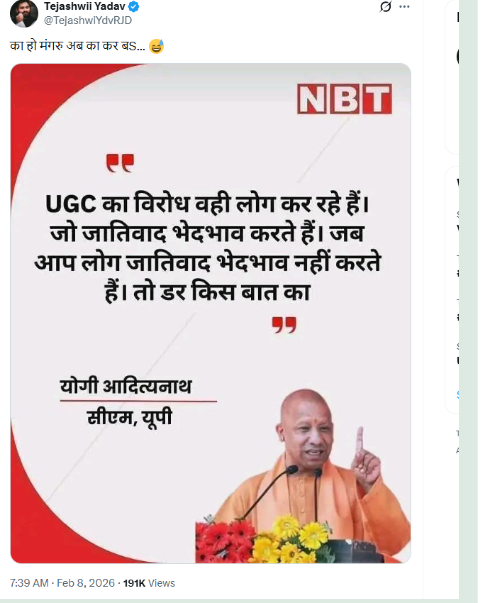
A news graphic is being shared on social media claiming that Uttar Pradesh Chief Minister Yogi Adityanath said,“Those who practice casteism and discrimination are the ones opposing UGC. If you do not indulge in caste-based discrimination, what is there to fear?” The CyberPeace’s research found the viral claim circulating on social media to be false. Our research revealed that Chief Minister Yogi Adityanath never made such a statement. It was also established that the viral news graphic has been digitally edited.
Claim
On February 8, a user on social media platform X (formerly Twitter) shared a news graphic bearing the logo of Navbharat Times, attributing the above statement to CM Yogi Adityanath. The post and its archived version can be seen below, along with screenshots. (Links and screenshots provided)
Fact Check:
To verify the authenticity of the claim, we conducted a keyword-based search on Google. However, we did not find any credible or reliable media report supporting the viral statement. We further examined the official social media accounts of Chief Minister Yogi Adityanath, including his Facebook and Instagram handles. Our review found no post, speech, or statement resembling the claim made in the viral graphic.
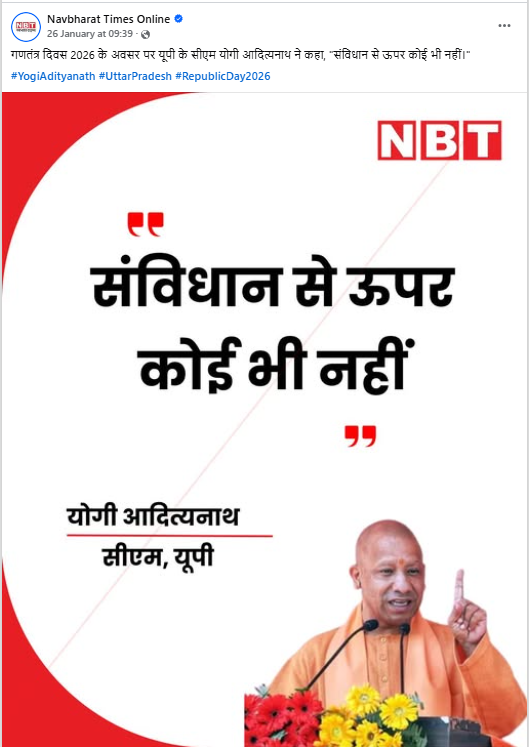
Continuing the research , we examined the official social media accounts of Navbharat Times. During this process, we found the original graphic published on the Navbharat Times Facebook page on January 26, 2026. The caption of the original graphic read: “On the occasion of Republic Day 2026, Uttar Pradesh Chief Minister Yogi Adityanath said, ‘No one is above the Constitution.’”
This clearly differs from the claim made in the viral graphic, indicating that the latter was altered.
Conclusion
Our research confirms that Uttar Pradesh Chief Minister Yogi Adityanath did not make the statement being attributed to him on social media. The viral news graphic is digitally edited and misleading. The claim, therefore, is false.

Related Blogs
Executive Summary
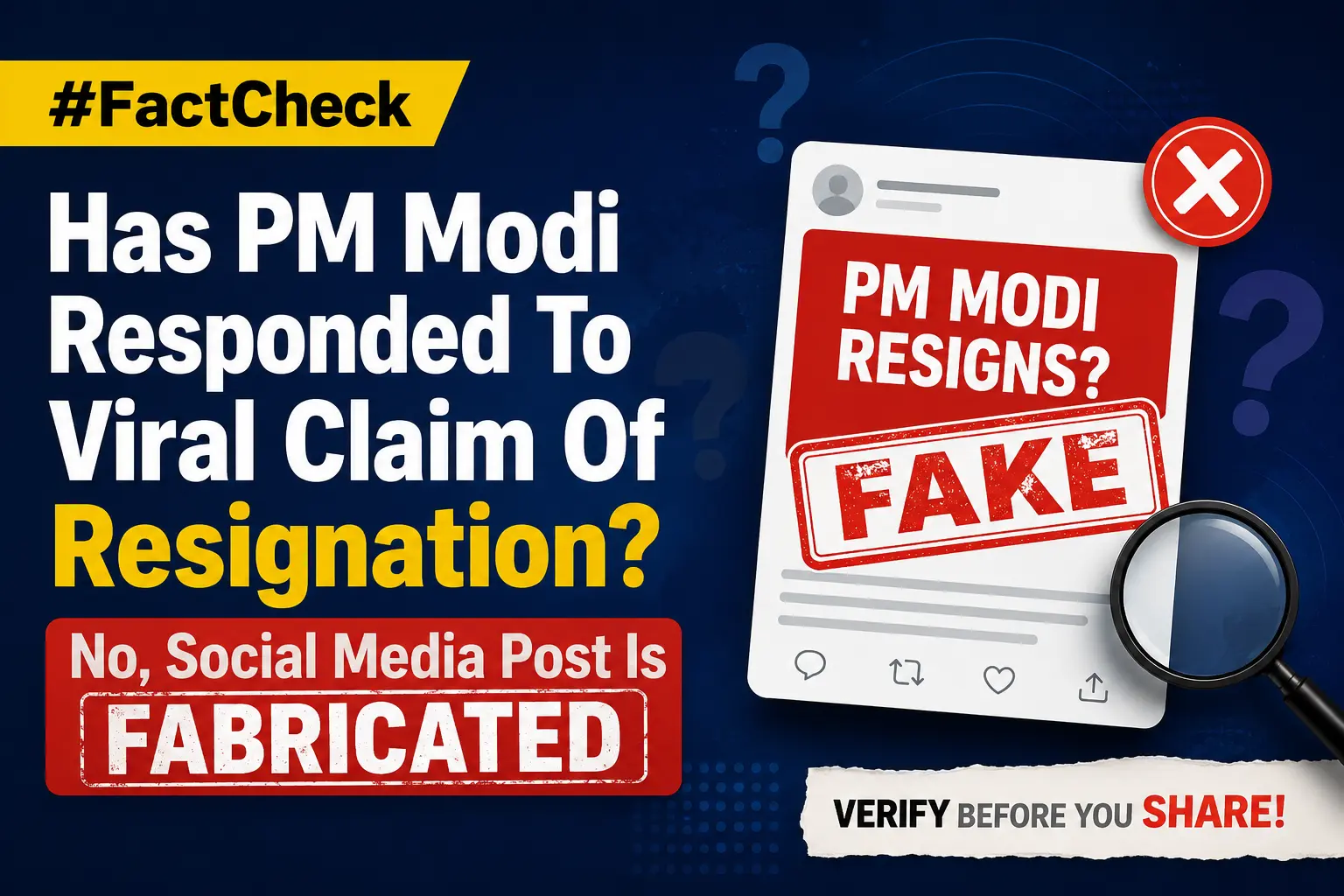
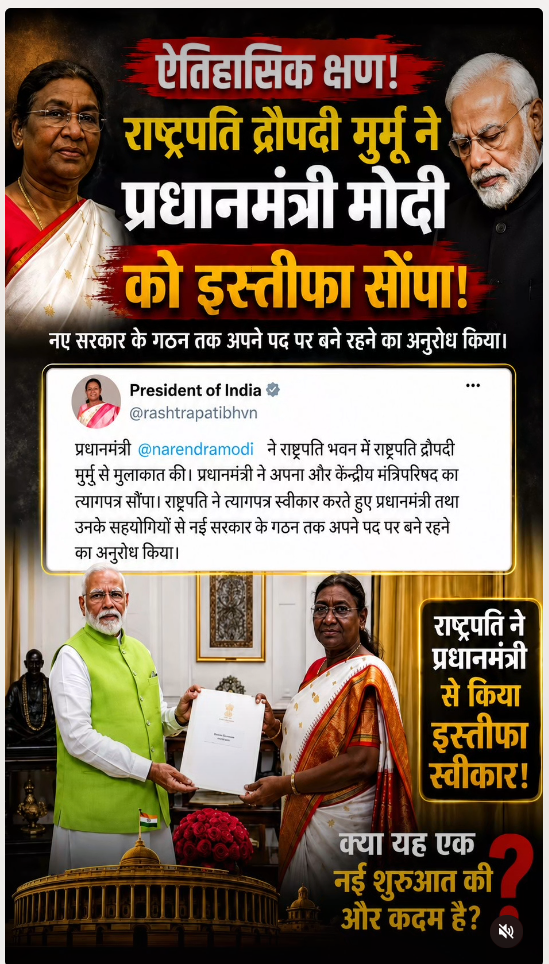
A poster is being shared on social media claiming that Prime Minister Narendra Modi has submitted his resignation to President Droupadi Murmu. The post also includes a screenshot of an X (formerly Twitter) account allegedly belonging to President Droupadi Murmu, stating that the Prime Minister has tendered his resignation, along with his Union Council of Ministers, to the President. Research by the CyberPeace Research Wing proved the viral claim to be fake. The research revealed that the poster being shared on social media is fabricated.
Claim:
Sharing the viral poster on the social media platform Instagram, a user wrote, “President Droupadi Murmu accepted the resignation of Prime Minister Narendra Modi and requested him to continue in office until the formation of the new government. This is part of the constitutional process of Indian democracy. What is your opinion? Is this just a formality or a step towards a new beginning?” The archive link and screenshot of the post are given below:
https://www.instagram.com/reels/DcA0HqhN3Fr/
FactCheck
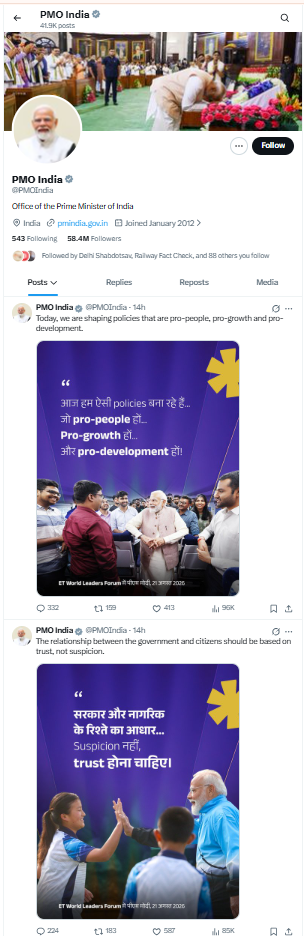
To ascertain the truth behind the viral claim, we conducted a search on Google using relevant keywords. During this, we did not find any credible media reports confirming the viral claim. In the next step of the research, we scanned the X account of the Prime Minister’s Office (PMO). We did not find any such post there either. The link and screenshot of the relevant post are given below:
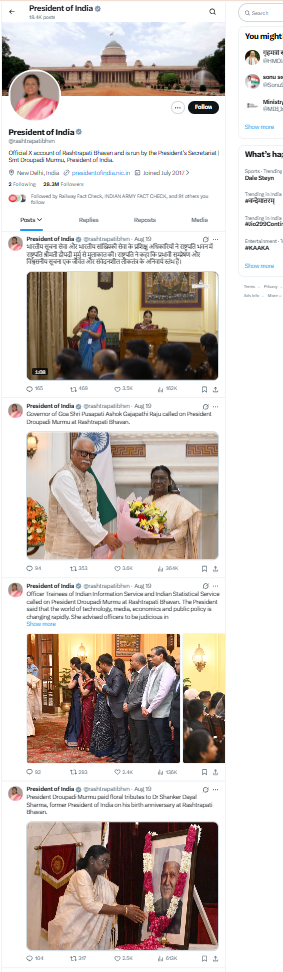
Proceeding further with the research, we scanned the X account of the President. We did not find any post confirming the viral claim there as well. The link and screenshot of the relevant post are given below:
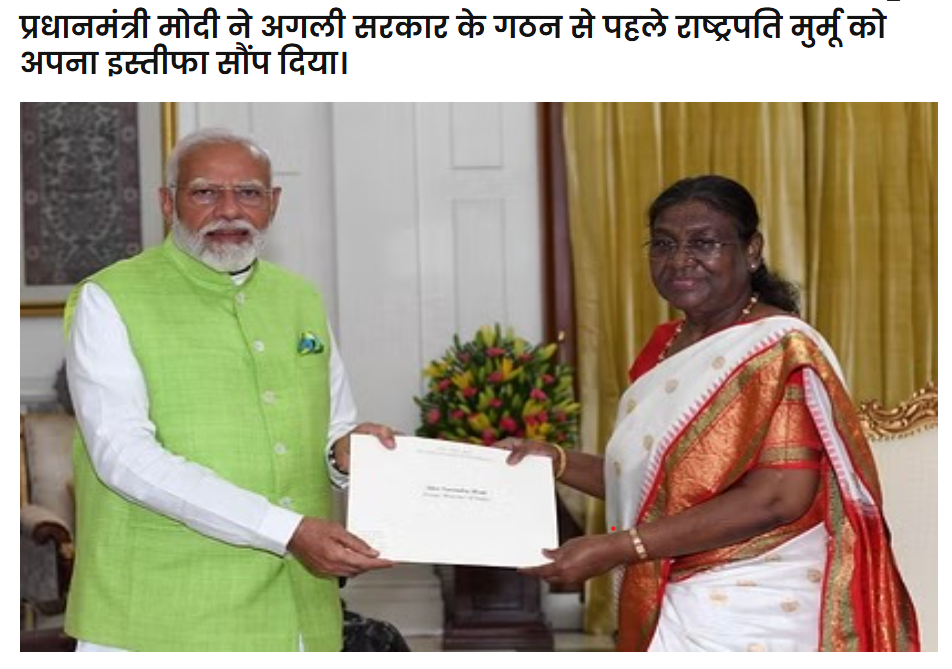
In the next stage of our research, we found a report published on the DD News website on June 5, 2024. According to the report, ahead of the formation of the next Bharatiya Janata Party (BJP)-led NDA government, Prime Minister Narendra Modi, along with his Council of Ministers, had tendered his resignation to President Droupadi Murmu. This paved the way for the dissolution of the 17th Lok Sabha, which ran from 2019 to 2024. President Droupadi Murmu accepted the resignation of Prime Minister Modi and his Council of Ministers, and requested them to continue in office until the new government assumed charge. The link and screenshot of the post are given below:
Conclusion:
In our research, the viral claim turned out to be fake. The research revealed that the poster being shared on social media is fake.

Executive Summary:
In the digital world, people are becoming targets more and more of online scams, which rely on deception. One of the ways the social media is being used for the elections in recent time, is the "BJP - Election Bonus" offer that promises a cash prize of Rs. 5000 or more, through some easy questionnaire. This article provides the details of this swindle and reveals its deceptive tricks as well as gives a set of recommendations on how to protect yourself from such online fraud, especially during the upcoming elections.
False Claim:
The "BJP - Election Bonus" campaign boasts that by taking a few clicks of the mouse, users will get a cash prize. This scheme is nothing but a fake association with the Bharatiya Janata Party (BJP)’s Government and Prime Minister Shri Narendra Modi and therefore, it uses the images and brands of both of them to give the scheme an impression of legitimacy. The imposters are taking advantage of the public's trust for the Government and the widespread desire for remuneration to ensnare the unaware victims, specifically before the upcoming Lok Sabha elections.

The Deceptive Scheme:
- Tempting Social Media Offer: The fraud begins with an attractive link on the social media platforms. The scammers say that the proposal is related to the Bharatiya Janata Party (BJP) with the caption of “The official party has prepared many gifts for their supporters.” accompanied by an image of the Prime Minister Shri Narendra Modi.
- Luring with Money: The offer promises to give Rs.5,000 or more. This is aimed at drawing in people specifically during election campaigns; and people’s desire for financial gain.
- Tricking with Questions: When the link is clicked, the person is brought to the page with the simple questions. The purpose of these questions is to make people feel safe and believe that they have been selected for an actual government’s program.
- The Open-the-Box Trap: Finally, the questions are answered and the last instruction is to open-the-box for the prize. However, this is just a tactic for them to make you curious about the reward.
- Fake Reward and Spreading the Scam: Upon opening the box, the recipient will be greeted with the text of Rs. 5000. However, this is not true; it is just a way to make them share the link on WhatsApp, helping the scammers to reach more victims.
The fraudsters use political party names and the Prime Minister's name to increase the plausibility of it, although there is no real connection. They employ the people's desire for monetary help, and also the time of the elections, making them susceptible to their tricks.
Analytical Breakdown:
- The campaign is a cleverly-created scheme to lure people by misusing the trust they have in the Government. By using BJP's branding and the Prime Minister's photo, fraudsters aim to make their misleading offer look credible. Fake reviews and cash reward are the two main components of the scheme that are intended to lure users into getting involved, and the end result of this is the path of deception.
- Through sharing the link over WhatsApp, users become unaware accomplices that are simply assisting the scammers to reach an even bigger audience and hence their popularity, especially with the elections around the corner.
- On top of this, the time of committing this fraud is very disturbing, as the election is just round the corner. Scammers do this in the context of the political turmoil and the spread of unconfirmed rumors and speculation about the upcoming elections in the same way they did earlier. The fraudsters are using this strategy to take advantage of the political affiliations by linking their scam to the Political party and their Leaderships.
- We have also cross-checked and as of now there is no well established and credible source or any official notification that has confirmed such an offer advertised by the Party.
- Domain Analysis: The campaign is hosted on a third party domain, which is different from the official website, thus creating doubts. Whois information reveals that the domain has been registered not long ago. The domain was registered on 29th march 2024, just a few days back.

- Domain Name: PSURVEY[.]CYOU
- Registry Domain ID: D443702580-CNIC
- Registrar WHOIS Server: whois.hkdns.hk
- Registrar URL: http://www.hkdns.hk
- Updated Date: 2024-03-29T16:18:00.0Z
- Creation Date: 2024-03-29T15:59:17.0Z (Recently Created)
- Registry Expiry Date: 2025-03-29T23:59:59.0Z
- Registrant State/Province: Anhui
- Registrant Country: CN (China)
- Name Server: NORMAN.NS.CLOUDFLARE.COM
- Name Server: PAM.NS.CLOUDFLARE.COM
Note: Cybercriminals used Cloudflare technology to mask the actual IP address of the fraudulent website.
CyberPeace Advisory and Best Practices:
- Be careful and watchful for any offers that seem too good to be true online, particularly during election periods. Exercise caution at a high level when you come across such offers, because they are usually accompanied by dishonest schemes.
- Carefully cross-check the authenticity of every campaign or offer you’re considering before interacting with it. Do not click on suspicious links and do not share private data that can be further used to run the scam.
- If you come across any such suspicious activity or if you feel you have been scammed, report it to the relevant authorities, such as the local police or the cybercrime section. Reporting is one of the most effective instruments to prevent the spread of these misleading schemes and it can support the course of the investigations.
- Educate yourselves and your families on the usual scammers’ tricks, including their election-related strategies. Prompt people to think critically and a good deal of skepticism when they meet online offers and promotions that evoke a possibility to obtain money or rewards easily.
- Ensure that you are always on a high level of alert as you explore the digital field, especially during elections. The authenticity of the information you encounter should always be verified before you act on it or pass it over to someone else.
- In case you have any doubt or worry regarding a certain e-commerce offer or campaign, don’t hesitate to ask for help from reliable sources such as Cybersecurity experts or Government agencies. A consultation with credible sources will assist you in coming up with informed decisions and guarding yourself against being navigated by these schemes.
Conclusion:
The "BJP - Election Bonus" campaign is a real case study of how Internet fraud is becoming more popular day by day, particularly before the elections. Through the awareness of the tactics employed by these scammers and their abuse of the community's trust in the Government and political figures, we can equip ourselves and our communities to avert becoming the victim of such fraudulent schemes. As a team, we can collectively strive for a digital environment free of threats and breaches of security, even in times of high political tension that accompany elections.
.webp)
Executive Summary:
A post on X (formerly Twitter) has gained widespread attention, featuring an image inaccurately asserting that Houthi rebels attacked a power plant in Ashkelon, Israel. This misleading content has circulated widely amid escalating geopolitical tensions. However, investigation shows that the footage actually originates from a prior incident in Saudi Arabia. This situation underscores the significant dangers posed by misinformation during conflicts and highlights the importance of verifying sources before sharing information.

Claims:
The viral video claims to show Houthi rebels attacking Israel's Ashkelon power plant as part of recent escalations in the Middle East conflict.

Fact Check:
Upon receiving the viral posts, we conducted a Google Lens search on the keyframes of the video. The search reveals that the video circulating online does not refer to an attack on the Ashkelon power plant in Israel. Instead, it depicts a 2022 drone strike on a Saudi Aramco facility in Abqaiq. There are no credible reports of Houthi rebels targeting Ashkelon, as their activities are largely confined to Yemen and Saudi Arabia.

This incident highlights the risks associated with misinformation during sensitive geopolitical events. Before sharing viral posts, take a brief moment to verify the facts. Misinformation spreads quickly and it’s far better to rely on trusted fact-checking sources.
Conclusion:
The assertion that Houthi rebels targeted the Ashkelon power plant in Israel is incorrect. The viral video in question has been misrepresented and actually shows a 2022 incident in Saudi Arabia. This underscores the importance of being cautious when sharing unverified media. Before sharing viral posts, take a moment to verify the facts. Misinformation spreads quickly, and it is far better to rely on trusted fact-checking sources.
- Claim: The video shows massive fire at Israel's Ashkelon power plant
- Claimed On:Instagram and X (Formerly Known As Twitter)
- Fact Check: False and Misleading
