
#FactCheck- Viral Zipline Accident Video from Karnaprayag is AI-Generated, Claim is False
Executive Summary
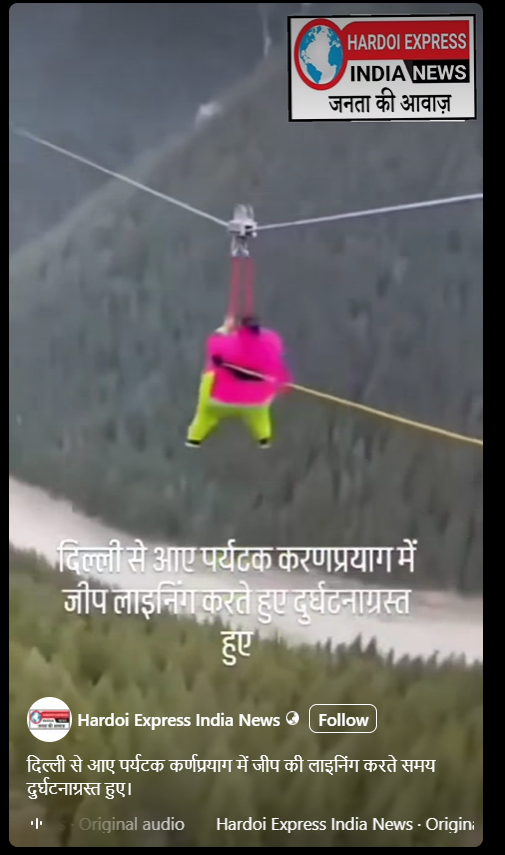
A video is being shared on social media claiming that a female tourist from Delhi fell into a deep gorge during ziplining in Karnaprayag. In the viral video, a woman dressed in bright pink and yellow clothes is seen ziplining amidst high mountains, when suddenly the zipline wire breaks and she falls from a significant height into a deep gorge. Social media users are sharing this video, presenting it as a real incident. Research by the CyberPeace Research Wing revealed that the claim of a Delhi woman tourist's death during a zipline accident in Karnaprayag is baseless. The viral video is AI-generated.
Claim
According to the claim, this accident took place in Karnaprayag, Uttarakhand, where a female tourist from Delhi became a victim of this horrific mishap. Several social media users are claiming that the woman died in this accident.
https://www.facebook.com/reel/26108544868822432
Fact Check
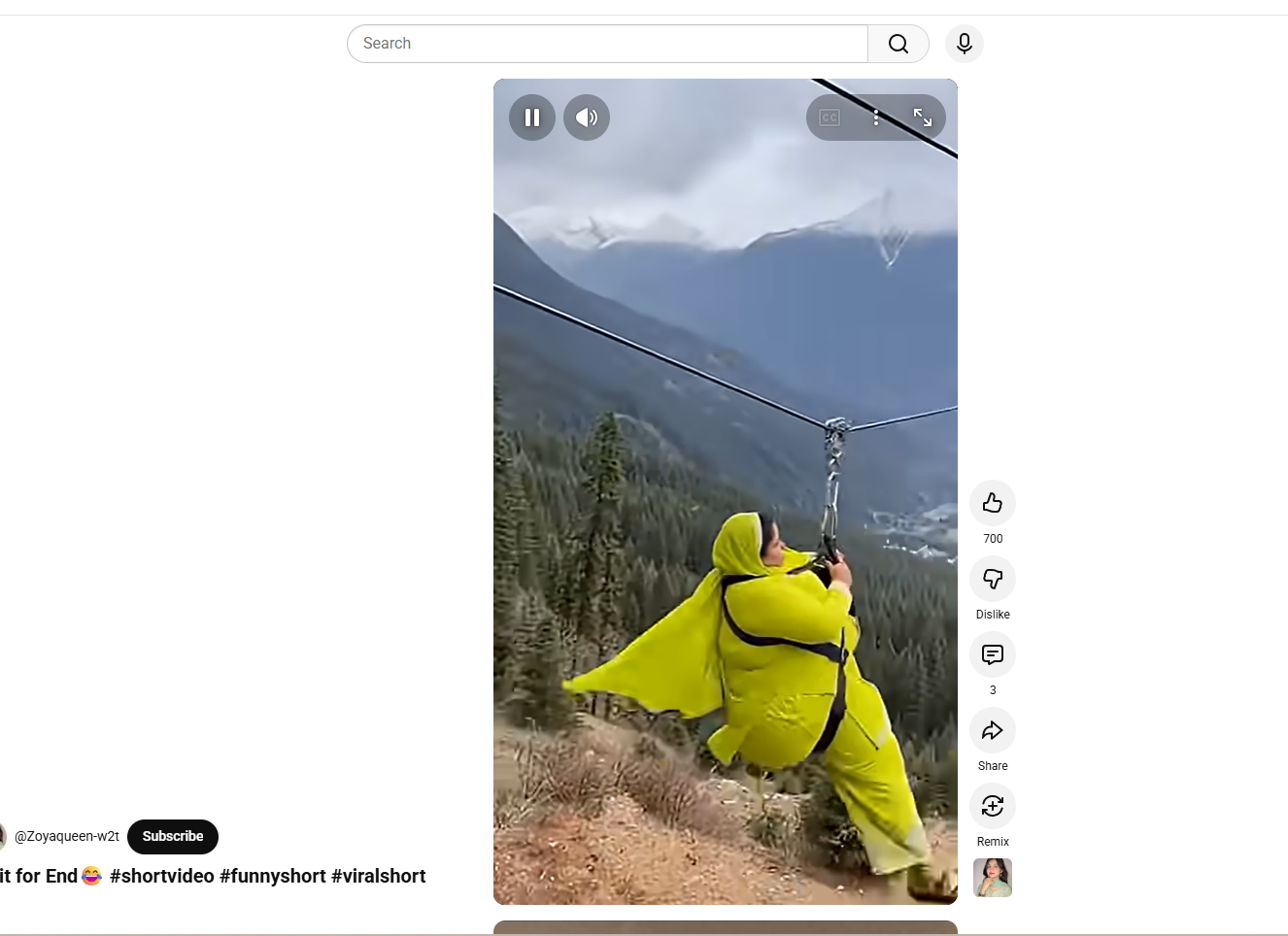
To investigate the video viral as a zipline accident in Karnaprayag, we conducted a reverse search of its keyframes. During this, we found the video uploaded as a Short on a Pakistani YouTube channel, @Zoyaqueen-w2t, on June 2, 2026. Hashtags like '#funnyshorts' were used in the caption of this video. Scanning this account revealed that several other fictional videos related to similar zipline accidents have also been uploaded here. Apart from this, the video was also shared with funny hashtags in some social media posts from May 2026.
https://www.youtube.com/shorts/Gzha_J7Fqv0
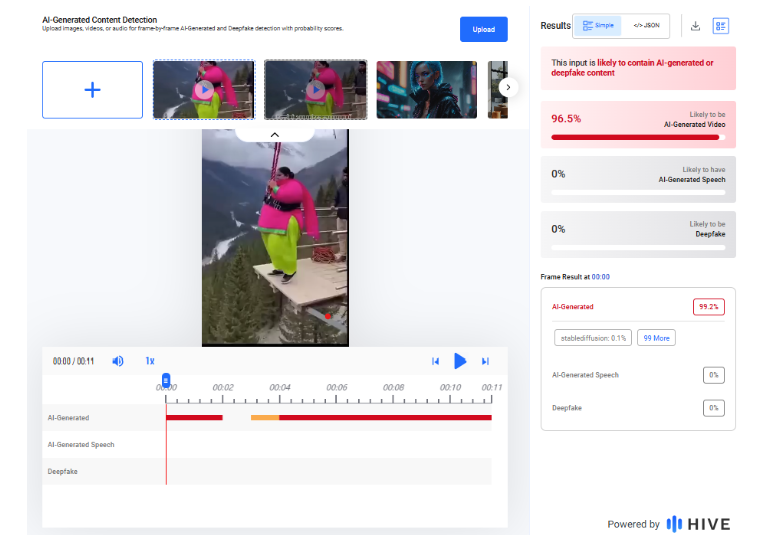
Following this, searching with relevant keywords yielded no credible media reports regarding any such zipline accident in Karnaprayag, Uttarakhand, in recent times. Subsequently, we scanned the viral video of the alleged zipline accident using the AI detection tool 'Hive Moderation'. During the analysis, the tool classified the video as highly likely to be AI-generated, with a score of 99.2%.
Conclusion
From the evidence gathered in our research , it is clear that the claim regarding the death of a female tourist from Delhi during a zipline accident in Karnaprayag is baseless. The viral video is not of a real incident, but is AI-generated.

Related Blogs

Misinformation is a scourge in the digital world, making the most mundane experiences fraught with risk. The threat is considerably heightened in conflict settings, especially in the modern era, where geographical borders blur and civilians and conflict actors alike can take to the online realm to discuss -and influence- conflict events. Propaganda can complicate the narrative and distract from the humanitarian crises affecting civilians, while also posing a serious threat to security operations and law and order efforts. Sensationalised reports of casualties and manipulated portrayals of military actions contribute to a cycle of violence and suffering.
A study conducted by MIT found the mere thought of sharing news on social media reduced the ability to judge whether a story was true or false; the urge to share outweighed the consideration of accuracy (2023). Cross-border misinformation has become a critical issue in today's interconnected world, driven by the rise of digital communication platforms. To effectively combat misinformation, coordinated international policy frameworks and cooperation between governments, platforms, and global institutions are created.
The Global Nature of Misinformation
Cross-border misinformation is false or misleading information that spreads across countries. Out-of-border creators amplify information through social media and digital platforms and are a key source of misinformation. Misinformation can interfere with elections, and create serious misconceptions about health concerns such as those witnessed during the COVID-19 pandemic, or even lead to military conflicts.
The primary challenge in countering cross-border misinformation is the difference in national policies, legal frameworks and governance policies of social media platforms across various jurisdictions. Examining the existing international frameworks, such as cybersecurity treaties and data-sharing agreements used for financial crimes might be helpful to effectively address cross-border misinformation. Adapting these approaches to the digital information ecosystem, nations could strengthen their collective response to the spread of misinformation across borders. Global institutions like the United Nations or regional bodies like the EU and ASEAN can work together to set a unified response and uniform international standards for regulation dealing with misinformation specifically.
Current National and Regional Efforts
Many countries have taken action to deal with misinformation within their borders. Some examples include:
- The EU’s Digital Services Act has been instrumental in regulating online intermediaries and platforms including marketplaces, social networks, content-sharing platforms, app stores, etc. The legislation aims to prevent illegal and harmful activities online and the spread of disinformation.
- The primary legislation that governs cyberspace in India is the IT Act of 2000 and its corresponding rules (IT Rules, 2023), which impose strict requirements on social media platforms to counter misinformation content and enable the traceability of the creator responsible for the origin of misinformation. Platforms have to conduct due diligence, failing which they risk losing their safe harbour protection. The recently-enacted DPDP Act of 2023 indirectly addresses personal data misuse that can be used to contribute to the creation and spread of misinformation. Also, the proposed Digital India Act is expected to focus on “user harms” specific to the online world.
- In the U.S., the Right to Editorial Discretion and Section 230 of the Communications Decency Act place the responsibility for regulating misinformation on private actors like social media platforms and social media regulations. The US government has not created a specific framework addressing misinformation and has rather encouraged voluntary measures by SMPs to have independent policies to regulate misinformation on their platforms.
The common gap area across these policies is the absence of a standardised, global framework for addressing cross-border misinformation which results in uneven enforcement and dependence on national regulations.
Key Challenges in Achieving International Cooperation
Some of the key challenges identified in achieving international cooperation to address cross-border misinformation are as follows:
- Geopolitical tensions can emerge due to the differences in political systems, priorities, and trust issues between countries that hinder attempts to cooperate and create a universal regulation.
- The diversity in approaches to internet governance and freedom of speech across countries complicates the matters further.
- Further complications arise due to technical and legal obstacles around the issues of sovereignty, jurisdiction and enforcement, further complicating matters relating to the monitoring and removal of cross-border misinformation.
CyberPeace Recommendations
- The UN Global Principles For Information Integrity Recommendations for Multi-stakeholder Action, unveiled on 24 June 2024, are a welcome step for addressing cross-border misinformation. This can act as the stepping stone for developing a framework for international cooperation on misinformation, drawing inspiration from other successful models like climate change agreements, international criminal law framework etc.
- Collaborations like public-private partnerships between government, tech companies and civil societies can help enhance transparency, data sharing and accountability in tackling cross-border misinformation.
- Engaging in capacity building and technology transfers in less developed countries would help to create a global front against misinformation.
Conclusion
We are in an era where misinformation knows no borders and the need for international cooperation has never been more urgent. Global democracies are exploring solutions, both regulatory and legislative, to limit the spread of misinformation, however, these fragmented efforts fall short of addressing the global scale of the problem. Establishing a standardised, international framework, backed by multilateral bodies like the UN and regional alliances, can foster accountability and facilitate shared resources in this fight. Through collaborative action, transparent regulations, and support for developing nations, the world can create a united front to curb misinformation and protect democratic values, ensuring information integrity across borders.
References
- https://economics.mit.edu/sites/default/files/2023-10/A%20Model%20of%20Online%20Misinformation.pdf
- https://www.indiatoday.in/global/story/in-the-crosshairs-manufacturing-consent-and-the-erosion-of-public-trust-2620734-2024-10-21
- https://laweconcenter.org/resources/knowledge-and-decisions-in-the-information-age-the-law-economics-of-regulating-misinformation-on-social-media-platforms/
- https://www.article19.org/resources/un-article-19-global-principles-for-information-integrity/
.webp)
Introduction
In July 2025, the Digital Defence Report prepared by Microsoft raised an alarm that India is part of the top target countries in AI-powered nation-state cyberattacks with malicious agents automating phishing, creating convincing deepfakes, and influencing opinion with the help of generative AI (Microsoft Digital Defence Report, 2025). Most of the attention in the world has continued to be on the United States and Europe, but Asia-Pacific and especially India have become a major target in terms of AI-based cyber activities. This blog discusses the role of AI in espionage, redefining the threat environment of India, the reaction of the government, and what India can learn by looking at the example of cyber giants worldwide.
Understanding AI-Powered Cyber Espionage
Conventional cyber-espionage intends to hack systems, steal information or bring down networks. With the emergence of generative AI, these strategies have changed completely. It is now possible to automate reconnaissance, create fake voices and videos of authorities and create highly advanced phishing campaigns which can pass off as genuine even to a trained expert. According to the report made by Microsoft, AI is being used by state-sponsored groups to expand their activities and increase accuracy in victims (Microsoft Digital Defence Report, 2025). Based on SQ Magazine, almost 42 percent of state-based cyber campaigns in 2025 had AIs like adaptive malware or intelligent vulnerability scanners (SQ Magazine, 2025).
AI is altering the power dynamic of cyberspace. The tools previously needing significant technical expertise or substantial investments have become ubiquitous, and smaller countries can conduct sophisticated cyber operations as well as non-state actors. The outcome is the speeding up of the arms race with AI serving as the weapon and the armour.
India’s Exposure and Response
The weakness of the threat landscape lies in the growing online infrastructure and geopolitical location. The attack surface has expanded the magnitude of hundreds of millions of citizens with the integration of platforms like DigiLocker and CoWIN. Financial institutions, government portals and defence networks are increasingly becoming targets of cyber attacks that are more sophisticated. Faking videos of prominent figures, phishing letters with the official templates, and manipulation of the social media are currently all being a part of disinformation campaigns (Microsoft Digital Defence Report, 2025).
According to the Data Security Council of India (DSCI), the India Cyber Threat Report 2025 reported that attacks using AI are growing exponentially, particularly in the shape of malicious behaviour and social engineering (DSCI, 2025). The nodal cyber-response agency of India, CERT-In, has made several warnings regarding scams related to AI and AI-generated fake content that is aimed at stealing personal information or deceiving the population. Meanwhile, enforcement and red-teaming actions have been intensified, but the communication between central agencies and state police and the private platforms is not even. There is also an acute shortage of cybersecurity talents in India, as less than 20 percent of cyber defence jobs are occupied by qualified specialists (DSCI, 2025).
Government and Policy Evolution
The government response to AI-enabled threats is taking three forms, namely regulation, institutional enhancing, and capacity building. The Digital Personal Data Protection Act 2023 saw a major move in defining digital responsibility (Government of India, 2023). Nonetheless, threats that involve AI-specific issues like data poisoning, model manipulation, or automated disinformation remain grey areas. The following National Cybersecurity Strategy will attempt to remedy them by establishing AI-government guidelines and responsibility standards to major sectors.
At the institutional level, the efforts of such organisations as the National Critical Information Infrastructure Protection Centre (NCIIPC) and the Defence Cyber Agency are also being incorporated into their processes with the help of AI-based monitoring. There is also an emerging public-private initiative. As an example, the CyberPeace Foundation and national universities have signed a memorandum of understanding that currently facilitates the specialised training in AI-driven threat analysis and digital forensics (Times of India, August 2025). Even after these positive indications, India does not have any cohesive system of reporting cases of AI. The publication on arXiv in September 2025 underlines the importance of the fact that legal approaches to AI-failure reporting need to be developed by countries to approach AI-initiated failures in such fields as national security with accountability (arXiv, 2025).
Global Implications and Lessons for India
Major economies all over the world are increasing rapidly to integrate AI innovation with cybersecurity preparedness. The United States and United Kingdom are spending big on AI-enhanced military systems, performing machine learning in security operations hubs and organising AI-based “red team” exercises (Microsoft Digital Defence Report, 2025). Japan is testing cross-ministry threat-sharing platforms that utilise AI analytics and real-time decision-making (Microsoft Digital Defence Report, 2025).
Four lessons can be distinguished as far as India is concerned.
- To begin with, the cyber defence should shift to proactive intelligence in place of reactive investigation. It is not only possible to detect the adversary behaviour after the attacks, but to simulate them in advance using AI.
- Second, teamwork is essential. The issue of cybersecurity cannot be entrusted to government enforcement. The private sector that maintains the majority of the digital infrastructure in India must be actively involved in providing information and knowledge.
- Third, there is the issue of AI sovereignty. Building or hosting its own defensive AI tools in India will diminish dependence on foreign vendors, and minimise the possible vulnerabilities of the supply-chain.
- Lastly, the initial defence is digital literacy. The citizens should be trained on how to detect deepfakes, phishing, and other manipulated information. The importance of creating human awareness cannot be underestimated as much as technical defences (SQ Magazine, 2025).
Conclusion
AI has altered the reasoning behind cyber warfare. There are quicker attacks, more difficult to trace and scalable as never before. In the case of India, it is no longer about developing better firewalls but rather the ability to develop anticipatory intelligence to counter AI-powered threats. This requires a national policy that incorporates technology, policy and education.
India can transform its vulnerability to strength with the sustained investment, ethical AI governance, and healthy cooperation between the government and the business sector. The following step in cybersecurity does not concern who possesses more firewalls than the other but aims to learn and adjust more quickly and successfully in a world where machines already belong to the battlefield (Microsoft Digital Defence Report, 2025).
References:
- Microsoft Digital Defense Report 2025
- India Cyber Threat Report 2025, DSCI
- Lucknow based organisations to help strengthen cybercrime research training policy ecosystem
- AI Cyber Attacks Statistics 2025: How Attacks, Deepfakes & Ransomware Have Escalated, SQ Magazine
- Incorporating AI Incident Reporting into Telecommunications Law and Policy: Insights from India.
- The Digital Personal Data Protection Act, 2023
Introduction
With the rise of AI deepfakes and manipulated media, it has become difficult for the average internet user to know what they can trust online. Synthetic media can have serious consequences, from virally spreading election disinformation or medical misinformation to serious consequences like revenge porn and financial fraud. Recently, a Pune man lost ₹43 lakh when he invested money based on a deepfake video of Infosys founder Narayana Murthy. In another case, that of Babydoll Archi, a woman from Assam had her likeness deepfaked by an ex-boyfriend to create revenge porn.
Image or video manipulation used to leave observable traces. Online sources may advise examining the edges of objects in the image, checking for inconsistent patterns, lighting differences, observing the lip movements of the speaker in a video or counting the number of fingers on a person’s hand. Unfortunately, as the technology improves, such folk advice might not always help users identify synthetic and manipulated media.
The Coalition for Content Provenance and Authenticity (C2PA)
One interesting project in the area of trust-building under these circumstances has been the Coalition for Content Provenance and Authenticity (C2PA). Started in 2019 by Adobe and Microsoft, C2PA is a collaboration between major players in AI, social media, journalism, and photography, among others. It set out to create a standard for publishers of digital media to prove the authenticity of digital media and track changes as they occur.
When photos and videos are captured, they generally store metadata like the date and time of capture, the location, the device it was taken on, etc. C2PA developed a standard for sharing and checking the validity of this metadata, and adding additional layers of metadata whenever a new user makes any edits. This creates a digital record of any and all changes made. Additionally, the original media is bundled with this metadata. This makes it easy to verify the source of the image and check if the edits change the meaning or impact of the media. This standard allows different validation software, content publishers and content creation tools to be interoperable in terms of maintaining and displaying proof of authenticity.
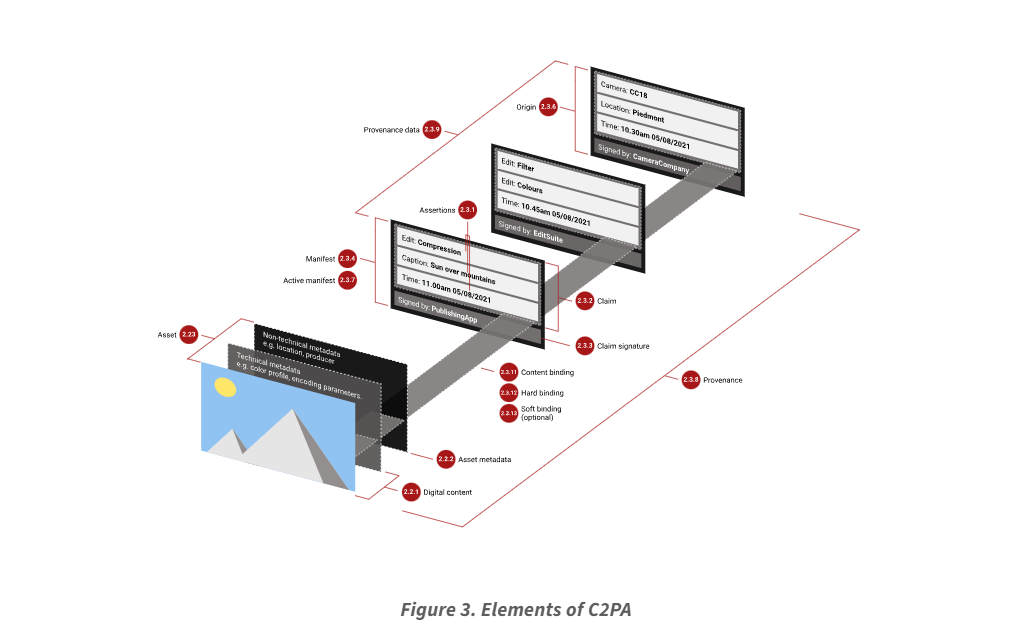
The standard is intended to be used on an opt-in basis and can be likened to a nutrition label for digital media. Importantly, it does not limit the creativity of fledgling photo editors or generative AI enthusiasts; it simply provides consumers with more information about the media they come across.
Could C2PA be Useful in an Indian Context?
The World Economic Forum’s Global Risk Report 2024, identifies India as a significant hotspot for misinformation. The recent AI Regulation report by MeitY indicates an interest in tools for watermarking AI-based synthetic content for ease of detecting and tracking harmful outcomes. Perhaps C2PA can be useful in this regard as it takes a holistic approach to tracking media manipulation, even in cases where AI is not the medium.
Currently, 26 India-based organisations like the Times of India or Truefy AI have signed up to the Content Authenticity Initiative (CAI), a community that contributes to the development and adoption of tools and standards like C2PA. However, people are increasingly using social media sites like WhatsApp and Instagram as sources of information, both of which are owned by Meta and have not yet implemented the standard in their products.
India also has low digital literacy rates and low resistance to misinformation. Part of the challenge would be showing people how to read this nutrition label, to empower people to make better decisions online. As such, C2PA is just one part of an online trust-building strategy. It is crucial that education around digital literacy and policy around organisational adoption of the standard are also part of the strategy.
The standard is also not foolproof. Current iterations may still struggle when presented with screenshots of digital media and other non-technical digital manipulation. Linking media to their creator may also put journalists and whistleblowers at risk. Actual use in context will show us more about how to improve future versions of digital provenance tools, though these improvements are not guarantees of a safer internet.
The largest advantage of C2PA adoption would be the democratisation of fact-checking infrastructure. Since media is shared at a significantly faster rate than it can be verified by professionals, putting the verification tools in the hands of people makes the process a lot more scalable. It empowers citizen journalists and leaves a public trail for any media consumer to look into.
Conclusion
From basic colour filters to make a scene more engaging, to removing a crowd from a social media post, to editing together videos of a politician to make it sound like they are singing a song, we are so accustomed to seeing the media we consume be altered in some way. The C2PA is just one way to bring transparency to how media is altered. It is not a one-stop solution, but it is a viable starting point for creating a fairer and democratic internet and increasing trust online. While there are risks to its adoption, it is promising to see that organisations across different sectors are collaborating on this project to be more transparent about the media we consume.
References
- https://c2pa.org/
- https://contentauthenticity.org/
- https://indianexpress.com/article/technology/tech-news-technology/kate-middleton-9-signs-edited-photo-9211799/
- https://photography.tutsplus.com/articles/fakes-frauds-and-forgeries-how-to-detect-image-manipulation--cms-22230
- https://www.media.mit.edu/projects/detect-fakes/overview/
- https://www.youtube.com/watch?v=qO0WvudbO04&pp=0gcJCbAJAYcqIYzv
- https://www3.weforum.org/docs/WEF_The_Global_Risks_Report_2024.pdf
- https://indianexpress.com/article/technology/tech-news-technology/ai-law-may-not-prescribe-penal-consequences-for-violations-9457780/
- https://thesecretariat.in/article/meity-s-ai-regulation-report-ambitious-but-no-concrete-solutions
- https://www.ndtv.com/lifestyle/assam-what-babydoll-archi-viral-fame-says-about-india-porn-problem-8878689
- https://www.meity.gov.in/static/uploads/2024/02/9f6e99572739a3024c9cdaec53a0a0ef.pdf
