
#FactCheck-AI-generated video falsely shared as Saudi airstrike on Yemen's Sanaa International Airport
Executive Summary
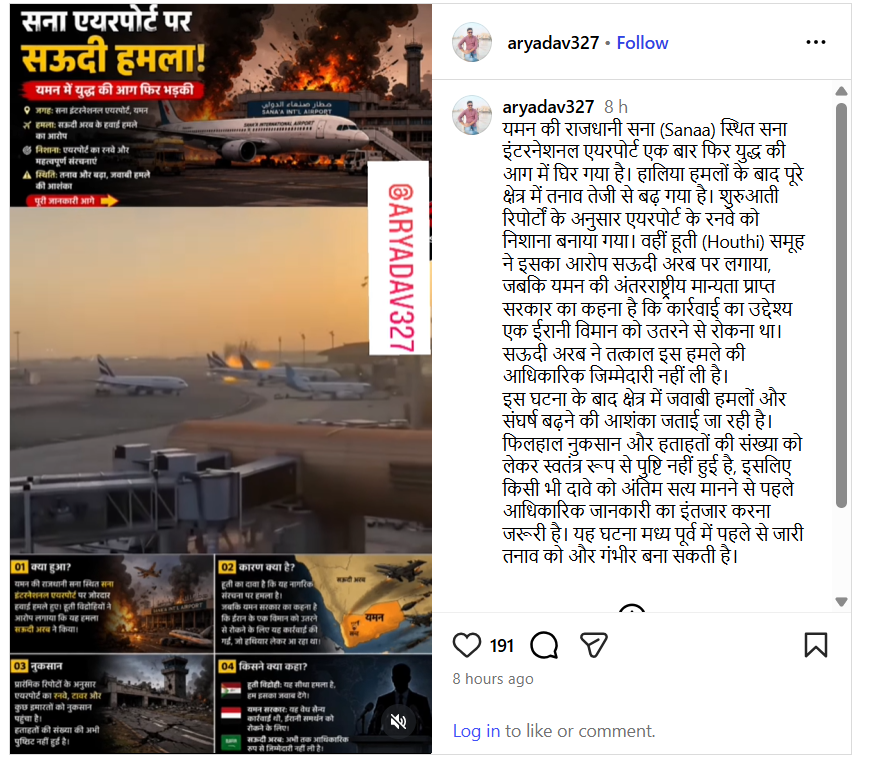
A video is being widely shared on social media claiming to show a Saudi Arabian F-15 fighter jet carrying out an airstrike on Sanaa International Airport in Yemen's capital. The footage shows several aircraft parked at what appears to be an airport before explosions erupt, followed by flames, thick smoke and people running in panic. The CyberPeace Research Wing found that the viral claim is false. Our research revealed that the circulating video is AI-generated and does not depict the actual airstrike. While it is true that Saudi Arabia carried out an airstrike at Sanaa International Airport, the viral footage is unrelated to that incident and is being shared with a misleading claim.
Claim
An Instagram post shared on July 15, 2026, claims that Saudi Arabia's F-15 fighter jets bombed Sanaa International Airport in Yemen. The post can be viewed here:
https://www.instagram.com/reel/DayBwufzn2N/?utm_source=ig_web_button_share_sheet
Fact Check
To verify the claim, we searched using relevant keywords but found no credible news reports or authentic footage matching the viral video. However, we found verified footage of the actual Saudi airstrike on The New York Post's YouTube channel. A comparison showed that the genuine footage is entirely different from the viral clip in terms of visuals, sequence and overall content.
https://www.instagram.com/reel/DawHCM_s_fn/?utm_source=ig_web_button_share_sheet

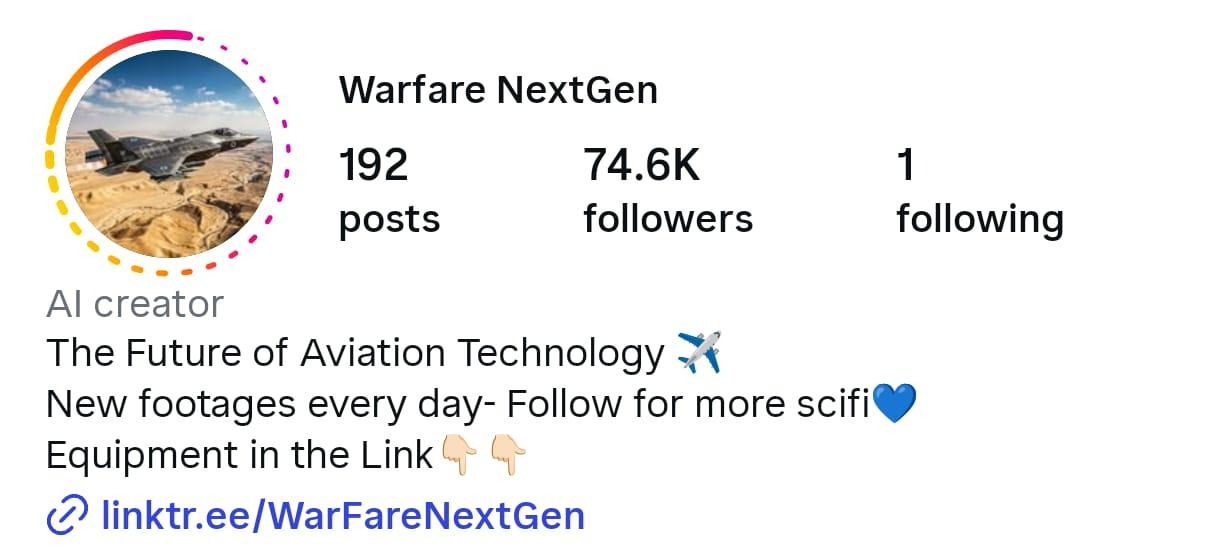
During our research, we also found the same viral video on an Instagram account named "warfarenextgen", which regularly publishes AI-generated war-related videos
We further examined the video using multiple AI detection tools: Hive Moderation assessed the video as 99.9% likely to be AI-generated.

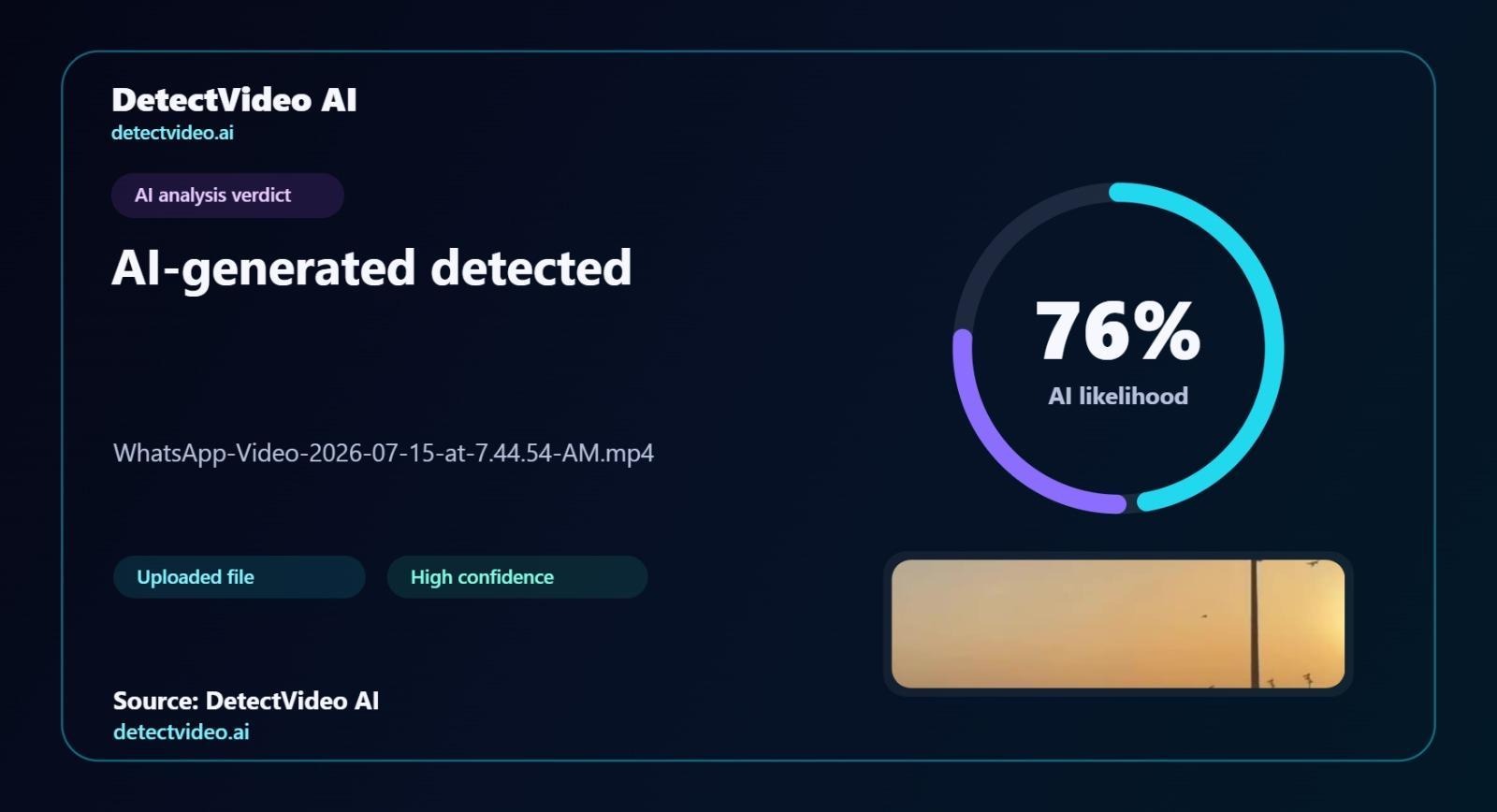
DetectVideo AI found a 76% probability that the video was AI-generated.
Sightengine also concluded that the video was approximately 99% likely to be AI-generated.

Conclusion
Our research found that Saudi Arabia did carry out an airstrike on Sanaa International Airport to prevent an Iranian aircraft carrying a Houthi delegation from landing. However, the viral video does not show that attack. It is an AI-generated video that is being falsely circulated as footage of the real incident, making the viral claim misleading.

Related Blogs
.webp)
Introduction
The rise of unreliable social media newsgroups on online platforms has significantly altered the way people consume and interact with news, contributing to the spread of misinformation and leading to sources of unverified and misleading content. Unlike traditional news outlets that adhere to journalistic standards, these newsgroups often lack proper fact-checking and editorial oversight, leading to the rapid dissemination of false or distorted information. Social media transformed individuals into active content creators. Social media newsgroups (SMNs) are social media platforms used as sources of news and information. According to a survey by the Pew Research Center (July-August 2024), 54% of U.S. adults now rely on social media for news. This rise in SMNs has raised concerns over the integrity of online news and undermines trust in legitimate news sources. Social media users are advised to consume information and news from authentic sources or channels available on social media platforms.
The Growing Issue of Misinformation in Social Media Newsgroups
Social media newsgroups have become both a source of vital information and a conduit for misinformation. While these platforms allow rapid news sharing and facilitate political and social campaigns, they also pose significant risks of unverified information. Misleading information, often driven by algorithms designed to maximise user engagement, proliferates in these spaces. This has led to increasing challenges, as SMNs cater to diverse communities with varying political affiliations, gender demographics, and interests. This sometimes results in the creation of echo chambers where information is not critically assessed, amplifying the confirmation bias and enabling the unchecked spread of misinformation. A prominent example is the false narratives surrounding COVID-19 vaccines that spread across SMNs, contributing to widespread vaccine hesitancy and public health risks.
Understanding the Susceptibility of Online Newsgroups to Misinformation
Several factors make social media newsgroups particularly susceptible to misinformation. Some of the factors are listed below:
- The lack of robust fact-checking mechanisms in social media news groups can lead to false narratives which can spread easily.
- The lack of expertise from admins of online newsgroups, who are often regular users without journalism knowledge, can result in the spreading of inaccurate information. Their primary goal of increasing engagement may overshadow concerns about accuracy and credibility.
- The anonymity of users exacerbates the problem of misinformation. It allows users to share unverified or misleading content without accountability.
- The viral nature of social media also leads to the vast spread of misinformation to audiences instantly, often outpacing efforts to correct it.
- Unlike traditional media outlets, online newsgroups often lack formal fact-checking processes. This absence allows misinformation to circulate without verification, making it easier for inaccuracies to go unchallenged.
- The sheer volume of user engagement in the form of posts has created the struggle to moderate content effectively imposing significant challenges.
- Social Media Platforms have algorithms designed to enhance user engagement and inadvertently amplify sensational or emotionally charged content, which is more likely to be false.
Consequences of Misinformation in Newsgroups
The societal impacts of misinformation in SMNs are profound. Political polarisation can fuel one-sided views and create deep divides in democratic societies. Health risks emerge when false information spreads about critical issues, such as the anti-vaccine movements or misinformation related to public health crises. Misinformation has dire long-term implications and has the potential to destabilise governments and erode trust in media, in both traditional and social media leading to undermining democracy. If unaddressed, the consequences could continue to ripple through society, perpetuating false narratives that shape public opinion.
Steps to Mitigate Misinformation in Social Media Newsgroups
- Educating users in social media literacy education can empower critical assessment of the information encountered, reducing the spread of false narratives.
- Introducing stricter platform policies, including penalties for deliberately sharing misinformation, may act as a deterrent against sharing unverified information.
- Collaborative fact-checking initiatives with involvement from social media platforms, independent journalists, and expert organisations can provide a unified front against the spread of false information.
- From a policy perspective, a holistic approach that combines platform responsibility with user education and governmental and industry oversight is essential to curbing the spread of misinformation in social media newsgroups.
Conclusion
The emergence of Social media newsgroups has revolutionised the dissemination of information. This rapid spread of misinformation poses a significant challenge to the integrity of news in the digital age. It gets further amplified by algorithmic echo chambers unchecked user engagement and profound societal implications. A multi-faceted approach is required to tackle these issues, combining stringent platform policies, AI-driven moderation, and collaborative fact-checking initiatives. User empowerment concerning media literacy is an important factor in promoting critical thinking and building cognitive defences. By adopting these measures, we can better navigate the complexities of consuming news from social media newsgroups and preserve the reliability of online information. Furthermore, users need to consume news from authoritative sources available on social media platforms.
References

Introduction
Entrusted with the responsibility of leading the Global Education 2030 Agenda through the Sustainable Development Goal 4, UNESCO’s Institute for Lifelong Learning in collaboration with the Media and Information Literacy and Digital Competencies Unit has recently launched a Media and Information Literacy Course for Adult Educators. The course aligns with The Pact for The Future adopted at The United Nations Summit of the Future, September 2024 - asking for increased efforts towards media and information literacy from its member countries. The course is free for Adult Educators to access and is available until 31st May 2025.
The Course
According to a report by Statista, 67.5% of the global population uses the internet. Regardless of the age and background of the users, there is a general lack of understanding on how to spot misinformation, targeted hate, and navigating online environments in a manner that is secure and efficient. Since misinformation (largely spread online) is enabled by the lack of awareness, digital literacy becomes increasingly important. The course is designed keeping in mind that many active adult educators are yet to get an opportunity to hone their skills with regard to media and information through formal education. Self-paced, a total of 10 hours, this course covers basics such as concepts of misinformation and disinformation, artificial intelligence, and combating hate speech, and offers a certificate on completion.
CyberPeace Recommendations
As this course is free of cost, can be done in a remote capacity, and covers basics regarding digital literacy, all eligible are encouraged to take it up to familiarise themselves with such topics. However, awareness regarding the availability of this course, alongside who can avail of this opportunity can be further worked on so a larger number can avail its benefits.
CyberPeace Recommendations To Enhance Positive Impact
- Further Collaboration: As this course is open to adult educators, one can consider widening the scope through active engagement with Independent organisations and even Individual internet users who are willing to learn.
- Engagement with Educational Institutions: After launching a course, an interactive outreach programme and connecting with relevant stakeholders can prove to be beneficial. Since this course requires each individual adult educator to sign up to avail the course, partnering with educational universities, institutes, etc. is encouraged. In the Indian context, active involvement with training institutes such as DIET (District Institute of Education and Training), SCERT (State Council of Educational Research and Training), NCERT (National Council of Educational Research and Training), and Open Universities, etc. could be initiated, facilitating greater awareness and more participation.
- Engagement through NGOs: NGOs (focused on digital literacy) with a tie-up with UNESCO, can aid in implementing and encouraging awareness. A localised language approach option can be pondered upon for inclusion as well.
Conclusion
Though a long process, tackling misinformation through education is a method that deals with the issue at the source. A strong foundation in awareness and media literacy is imperative in the age of fake news, misinformation, and sensitive data being peddled online. UNESCO’s course launch garners attention as it comes from an international platform, is free of cost, truly understands the gravity of the situation, and calls for action in the field of education, encouraging others to do the same.
References
- https://www.uil.unesco.org/en/articles/media-and-information-literacy-course-adult-educators-launched
- https://www.unesco.org/en/articles/celebrating-global-media-and-information-literacy-week-2024
- https://www.unesco.org/en/node/559#:~:text=UNESCO%20believes%20that%20education%20is,must%20be%20matched%20by%20quality.

Executive Summary:
A viral post on social media shared with misleading captions about a National Highway being built with large bridges over a mountainside in Jammu and Kashmir. However, the investigation of the claim shows that the bridge is from China. Thus the video is false and misleading.

Claim:
A video circulating of National Highway 14 construction being built on the mountain side in Jammu and Kashmir.

Fact Check:
Upon receiving the image, Reverse Image Search was carried out, an image of an under-construction road, falsely linked to Jammu and Kashmir has been proven inaccurate. After investigating we confirmed the road is from a different location that is G6911 Ankang-Laifeng Expressway in China, highlighting the need to verify information before sharing.


Conclusion:
The viral claim mentioning under-construction Highway from Jammu and Kashmir is false. The post is actually from China and not J&K. Misinformation like this can mislead the public. Before sharing viral posts, take a brief moment to verify the facts. This highlights the importance of verifying information and relying on credible sources to combat the spread of false claims.
- Claim: Under-Construction Road Falsely Linked to Jammu and Kashmir
- Claimed On: Instagram and X (Formerly Known As Twitter)
- Fact Check: False and Misleading
