
#FactCheck - Video Showing Sadhus in Ice Is Artificially Generated
Executive Summary
A video showing a group of Hindu ascetics (sadhus) allegedly performing intense penance while their bodies appear to be covered in ice is being widely shared on social media. Users are circulating the video as real and claiming that it represents an ancient tradition of Sanatan Dharma. CyberPeace research found the viral claim to be false.The research revealed that the video circulating on social media is not real but has been generated using artificial intelligence (AI).
Claim
On social media platform Facebook, a user shared the viral video on January 16, 2026. The video shows several ascetics engaged in penance, with their bodies seemingly covered in ice. Users shared the video while claiming that it depicts an authentic spiritual practice rooted in Sanatan Dharma.
Links to the post, archive link, and screenshots can be seen below.

Fact Check:
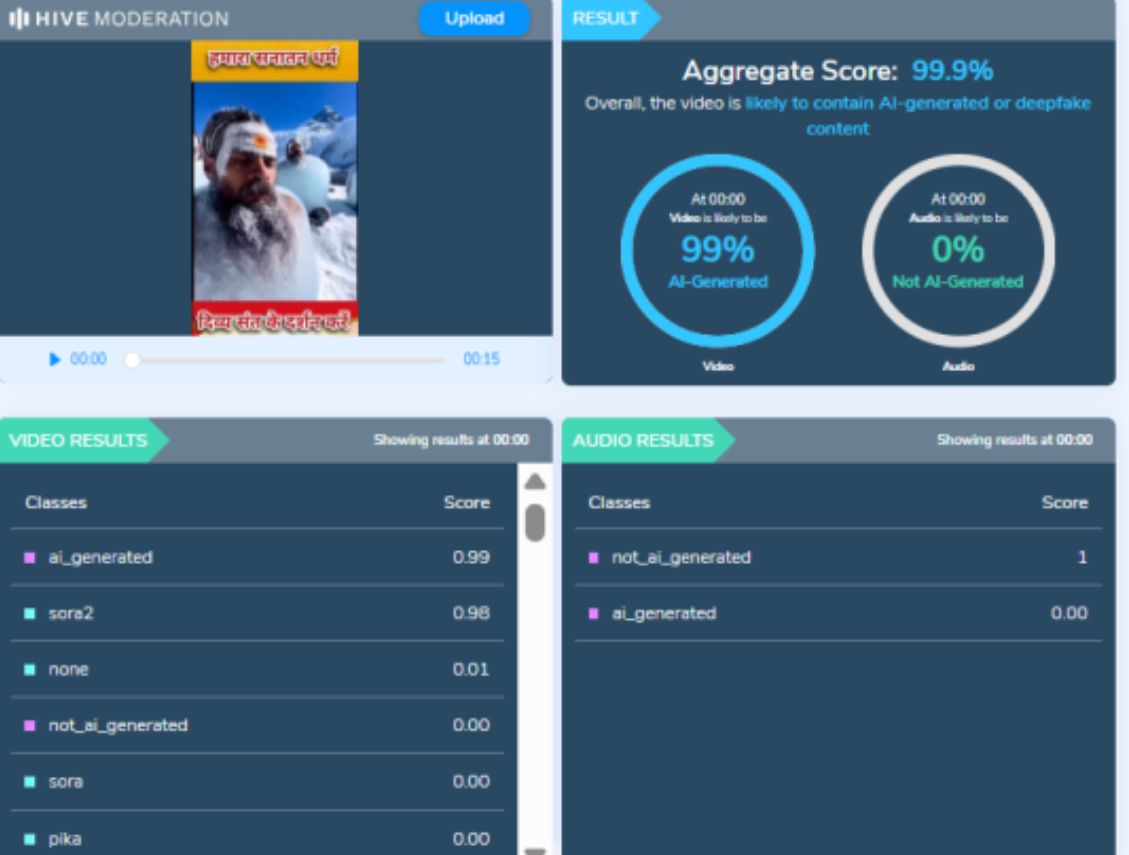
To verify the authenticity of the viral claim, CyberPeace searched relevant keywords on Google. However, no credible or reliable media reports supporting the claim were found. A close examination of the viral video raised suspicion that it may have been AI-generated. To verify this, the video was analysed using the AI detection tool Hive Moderation. According to the results, the video was found to be 99 percent AI-generated.
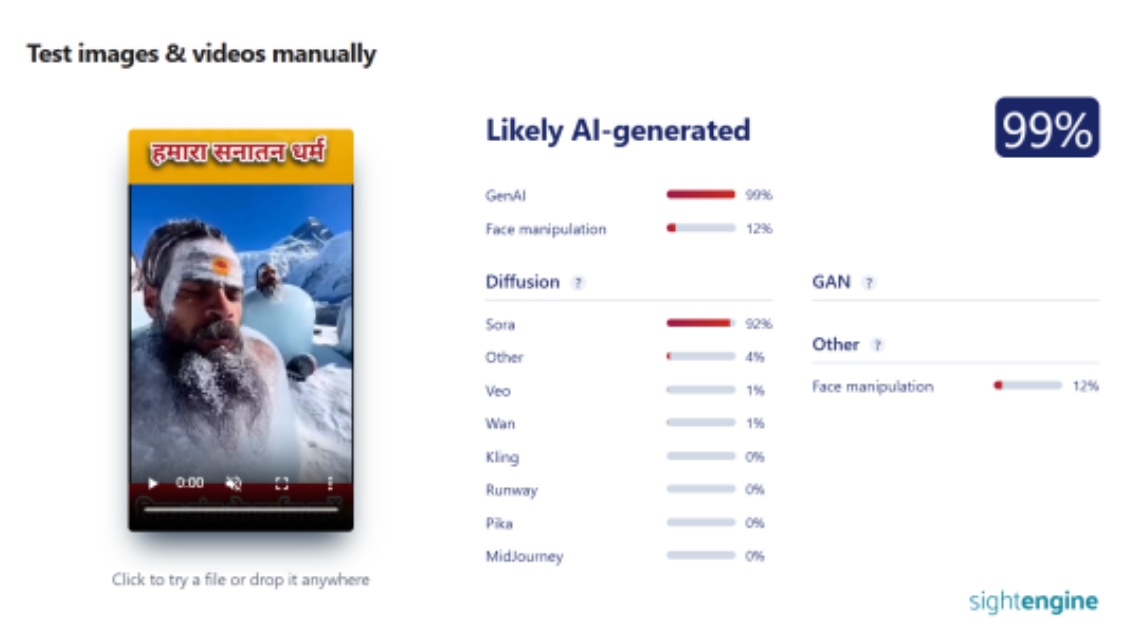
In the next step of the research, the same video was analysed using another AI detection tool, Sightengine. The results again indicated that the video was 99 percent AI-generated.
Conclusion
CyberPeace concludes that the video circulating on social media is not real. The viral video showing ascetics covered in ice was generated using artificial intelligence and does not depict an actual religious or spiritual practice.

Related Blogs

Introduction
Assisted Reproductive Technology (“ART”) refers to a diverse set of medical procedures designed to aid individuals or couples in achieving pregnancy when conventional methods are unsuccessful. This umbrella term encompasses various fertility treatments, including in vitro fertilization (IVF), intrauterine insemination (IUI), and gamete and embryo manipulation. ART procedures involve the manipulation of both male and female reproductive components to facilitate conception.
The dynamic landscape of data flows within the healthcare sector, notably in the realm of ART, demands a nuanced understanding of the complex interplay between privacy regulations and medical practices. In this context, the Information Technology (Reasonable Security Practices And Procedures And Sensitive Personal Data Or Information) Rules, 2011, play a pivotal role, designating health information as "sensitive personal data or information" and underscoring the importance of safeguarding individuals' privacy. This sensitivity is particularly pronounced in the ART sector, where an array of personal data, ranging from medical records to genetic information, is collected and processed. The recent Assisted Reproductive Technology (Regulation) Act, 2021, in conjunction with the Digital Personal Data Protection Act, 2023, establishes a framework for the regulation of ART clinics and banks, presenting a layered approach to data protection.
A note on data generated by ART
Data flows in any sector are scarcely uniform and often not easily classified under straight-jacket categories. Consequently, mapping and identifying data and its types become pivotal. It is believed that most data flows in the healthcare sector are highly sensitive and personal in nature, which may severely compromise the privacy and safety of an individual if breached. The Information Technology (Reasonable Security Practices And Procedures And Sensitive Personal Data Or Information) Rules, 2011 (“SPDI Rules”) categorizes any information pertaining to physical, physiological, mental conditions or medical records and history as “sensitive personal data or information”; this definition is broad enough to encompass any data collected by any ART facility or equipment. These include any information collected during the screening of patients, pertaining to ovulation and menstrual cycles, follicle and sperm count, ultrasound results, blood work etc. It also includes pre-implantation genetic testing on embryos to detect any genetic abnormality.
But data flows extend beyond mere medical procedures and technology. Health data also involves any medical procedures undertaken, the amount of medicine and drugs administered during any procedure, its resultant side effects, recovery etc. Any processing of the above-mentioned information, in turn, may generate more personal data points relating to an individual’s political affiliations, race, ethnicity, genetic data such as biometrics and DNA etc.; It is seen that different ethnicities and races react differently to the same/similar medication and have different propensities to genetic diseases. Further, it is to be noted that data is not only collected by professionals but also by intelligent equipment like AI which may be employed by any facility to render their service. Additionally, dissemination of information under exceptional circumstances (e.g. medical emergency) also affects how data may be classified. Considerations are further nuanced when the fundamental right to identity of a child conceived and born via ART may be in conflict with the fundamental right to privacy of a donor to remain anonymous.
Intersection of Privacy laws and ART laws:
In India, ART technology is regulated by the Assisted Reproductive Technology (Regulation) Act, 2021 (“ART Act”). With this, the Union aims to regulate and supervise assisted reproductive technology clinics and ART banks, prevent misuse and ensure safe and ethical practice of assisted reproductive technology services. When read with the Digital Personal Data Protection Act, 2023 (“DPDP Act”) and other ancillary guidelines, the two legislations provide some framework regulations for the digital privacy of health-based apps.
The ART Act establishes a National Assisted Reproductive Technology and Surrogacy Registry (“National Registry”) which acts as a central database for all clinics and banks and their nature of services. The Act also establishes a National Assisted Reproductive Technology and Surrogacy Board (“National Board”) under the Surrogacy Act to monitor the implementation of the act and advise the central government on policy matters. It also supervises the functioning of the National Registry, liaises with State Boards and curates a code of conduct for professionals working in ART clinics and banks. Under the DPDP Act, these bodies (i.e. National Board, State Board, ART clinics and banks) are most likely classified as data fiduciaries (primarily clinics and banks), data processors (these may include National Board and State boards) or an amalgamation of both (these include any appropriate authority established under the ART Act for investigation of complaints, suspend or cancellation of registration of clinics etc.) depending on the nature of work undertaken by them. If so classified, then the duties and liabilities of data fiduciaries and processors would necessarily apply to these bodies. As a result, all bodies would necessarily have to adopt Privacy Enhancing Technologies (PETs) and other organizational measures to ensure compliance with privacy laws in place. This may be considered one of the most critical considerations of any ART facility since any data collected by them would be sensitive personal data pertaining to health, regulated by the Information Technology (Reasonable Security Practices And Procedures And Sensitive Personal Data Or Information) Rules, 2011 (“SPDI Rules 2011”). These rules provide for how sensitive personal data or information are to be collected, handled and processed by anyone.
The ART Act independently also provides for the duties of ART clinics and banks in the country. ART clinics and banks are required to inform the commissioning couple/woman of all procedures undertaken and all costs, risks, advantages, and side effects of their selected procedure. It mandatorily ensures that all information collected by such clinics and banks to not informed to anyone except the database established by the National Registry or in cases of medical emergency or on order of court. Data collected by clinics and banks (these include details on donor oocytes, sperm or embryos used or unused) are required to be detailed and must be submitted to the National Registry online. ART banks are also required to collect personal information of donors including name, Aadhar number, address and any other details. By mandating online submission, the ART Act is harmonized with the DPDP Act, which regulates all digital personal data and emphasises free, informed consent.
Conclusion
With the increase in active opt-ins for ART, data privacy becomes a vital consideration for all healthcare facilities and professionals. Safeguard measures are not only required on a corporate level but also on a governmental level. It is to be noted that in the 262 Session of the Rajya Sabha, the Ministry of Electronics and Information Technology reported 165 data breach incidents involving citizen data from January 2018 to October 2023 from the Central Identities Data Repository despite publicly denying. This discovery puts into question the safety and integrity of data that may be submitted to the National Registry database, especially given the type of data (both personal and sensitive information) it aims to collate. At present the ART Act is well supported by the DPDP Act. However, further judicial and legislative deliberations are required to effectively regulate and balance the interests of all stakeholders.
References
- The Information Technology (Reasonable Security Practices And Procedures And Sensitive Personal Data Or Information) Rules, 2011
- Caring for Intimate Data in Fertility Technologies https://dl.acm.org/doi/pdf/10.1145/3411764.3445132
- Digital Personal Data Protection Act, 2023
- https://www.wolterskluwer.com/en/expert-insights/pharmacogenomics-and-race-can-heritage-affect-drug-disposition
Introduction
On 1 July 2026, the United Nations published their first draft of the Development of Artificial Intelligence (AI) report. The scientists who authored this document are 40 individuals who comprise the Independent International Scientific Panel on Artificial Intelligence , which was formed by the UN General Assembly in 2025 and chaired by Bengio and Ressa.
The report’s key takeaway message relates to the importance of countries establishing frameworks for the appropriate use of AI technologies as a means of preventing the aggravation of social inequality. UN Secretary-General António Guterres pointed out that without such regulation, society will not be able to enjoy the benefits of these technologies. After all, their explosive development is already beginning to have negative consequences.
This report served as key for the UN Global Dialogue on AI Governance, which was held in Geneva on 6thJuly, 2026.
What Exactly Does the Report Say?
It is not a rulebook, it doesn't create laws. It is more of a survey to get countries on board before they start treaties regarding AI.
This is seen through how much AI has developed from previous technologies, such as electricity taking decades to be common everywhere while the internet took 15 years to get to a billion users, but chatGPT alone got to 100 million users within 2 months. Today, millions of people use AI chatbots, and AI has helped map out 200 million+ protein structures currently helping us get drugs to market much faster.
The report is also cautious. It talks about an "evidence dilemma" , we need evidence to make good AI rules, but by the time it's collected, it might be too late to control the technology. There are 45+ AI frameworks worldwide, but they're disconnected, and some safety checks are done by the same companies that build the AI, raising doubts about their trustworthiness.
The Big Inequality Problem
This is one of the most eye-opening parts of the report. It says the USA has about 75% of the world's most powerful supercomputers, while China has around 15%, together, 90% of the world's top computing power. Most AI models are also built in these two countries, meaning they stand to gain the most from AI's growth.
Here's the shocking part: nearly two-thirds of people in high-income countries will benefit from AI tools. But in low-income countries, only about 5% will see any real benefit. Just because AI tools exist doesn't mean everyone gets equal access — especially poorer countries that depend on other nations for AI tools, cloud services, and data.
The Language Problem
Another major issue is language. Most AI tools work well in English and a few major languages. But for other languages, these tools are far less reliable, which becomes dangerous in fields like healthcare.
The report provides shocking examples of how AI translation software has been mistakenly conflating smallpox with syphilis and gonorrhoea with diabetes. It also describes how an attempt by a nurse to reassure a patient speaking Tigrinya that she was about to be given "IV antibiotics", had in fact, been translated by the software into "IV insecticides".
Other Serious Concerns
The report also warns about darker uses of AI, like creating sexual abuse material and fake explicit videos (deepfakes), which mostly harm women and children. AI-generated disinformation is being used to manipulate elections, while cybercriminals use AI for fraud and other crimes.
In addition, AI could have negative impacts on individuals struggling with mental health issues and even driving vulnerable populations to commit suicide. Moreover, the global AI infrastructure is estimated to release huge amounts of CO2 that is contributing to environmental damage.
What the Report Recommends
Because most of the power over AI development will be controlled by major corporations and nations, the report charges that the system is likely to lead to "unjust hierarchical control over critical systems."
To fix this, the suggestions include:
- Independent groups, not AI companies themselves, should test AI systems.
- Countries should cooperate to regulate artificial intelligence technologies instead of imposing a policy on a particular state.
- The states should develop the technical and language expertise to participate in the global negotiations on AI governance.
- However, the global AI governance should address developing countries’ needs to upgrade their infrastructures, such as electricity and data, and strike a balance between sustainability and digitalization.
Conclusion
This UN report is an important first step, giving countries real scientific evidence as they move towards binding international agreements on AI. Its biggest takeaway is this: AI itself is neutral — neither good nor bad on its own. What makes it good or bad for the world are the choices made by governments, firms, and societies in regulating it. Without proper control, AI technologies may well make inequality even worse than it already is. The negotiations to come will be critical in determining the future of the technology.
References
- United Nations News, 'AI explained: Why the world needs to act now', 1 July 2026
- Euronews, 'Window to control AI is closing and it could widen inequality, UN experts warn', 2 July 2026
- Irish Examiner, 'Rapid spread of AI may worsen global inequality, UN warns', 1 July 2026
- Reuters, 'UN report sees enormous potential benefits, big risks in AI', 1 July 2026
- Preliminary Report of the Independent International Scientific Panel on Artificial Intelligence, United Nations, July 2026
%20(1).jpg)
Introduction
Artificial Intelligence (AI) driven autonomous weapons are reshaping military strategy, acting as force multipliers that can independently assess threats, adapt to dynamic combat environments, and execute missions with minimal human intervention, pushing the boundaries of modern warfare tactics. AI has become a critical component of modern technology-driven warfare and has simultaneously impacted many spheres in a technology-driven world. Nations often prioritise defence for significant investments, supporting its growth and modernisation. AI has become a prime area of investment and development for technological superiority in defence forces. India’s focus on defence modernisation is evident through initiatives like the Defence AI Council and the Task Force on Strategic Implementation of AI for National Security.
The main requirement that Autonomous Weapons Systems (AWS) require is the “autonomy” to perform their functions when direction or input from a human actor is absent. AI is not a prerequisite for the functioning of AWSs, but, when incorporated, AI could further enable such systems. While militaries seek to apply increasingly sophisticated AI and automation to weapons technologies, several questions arise. Ethical concerns have been raised for AWS as the more prominent issue by many states, international organisations, civil society groups and even many distinguished figures.
Ethical Concerns Surrounding Autonomous Weapons
The delegation of life-and-death decisions to machines is the ethical dilemma that surrounds AWS. A major concern is the lack of human oversight, raising questions about accountability. What if AWS malfunctions or violates international laws, potentially committing war crimes? This ambiguity fuels debate over the dangers of entrusting lethal force to non-human actors. Additionally, AWS poses humanitarian risks, particularly to civilians, as flawed algorithms could make disastrous decisions. The dehumanisation of warfare and the violation of human dignity are critical concerns when AWS is in question, as targets become reduced to mere data points. The impact on operators’ moral judgment and empathy is also troubling, alongside the risk of algorithmic bias leading to unjust or disproportionate targeting. These ethical challenges are deeply concerning.
Balancing Ethical Considerations and Innovations
It is immaterial how advanced a computer becomes in simulating human emotions like compassion, empathy, altruism, or other emotions as the machine will only be imitating them, not experiencing them as a human would. A potential solution to this ethical predicament is using a 'human-in-the-loop' or 'human-on-the-loop' semi-autonomous system. This would act as a compromise between autonomy and accountability.
A “human-on-the-loop” system is designed to provide human operators with the ability to intervene and terminate engagements before unacceptable levels of damage occur. For example, defensive weapon systems could autonomously select and engage targets based on their programming, during which a human operator retains full supervision and can override the system within a limited period if necessary.
In contrast, a ‘human-in-the-loop” system is intended to engage individual targets or specific target groups pre-selected by a human operator. Examples would include homing munitions that, once launched to a particular target location, search for and attack preprogrammed categories of targets within the area.
International Debate and Regulatory Frameworks
The regulation of autonomous weapons that employ AI, in particular, is a pressing global issue due to the ethical, legal, and security concerns it contains. There are many ongoing efforts at the international level which are in discussion to regulate such weapons. One such example is the initiative under the United Nations Convention on CertainConventional Weapons (CCW), where member states, India being an active participant, debate the limits of AI in warfare. However, existing international laws, such as the Geneva Conventions, offer legal protection by prohibiting indiscriminate attacks and mandating the distinction between combatants and civilians. The key challenge lies in achieving global consensus, as different nations have varied interests and levels of technological advancement. Some countries advocate for a preemptive ban on fully autonomous weapons, while others prioritise military innovation. The complexity of defining human control and accountability further complicates efforts to establish binding regulations, making global cooperation both essential and challenging.
The Future of AI in Defence and the Need for Stronger Regulations
The evolution of autonomous weapons poses complex ethical and security challenges. As AI-driven systems become more advanced, a growing risk of its misuse in warfare is also advancing, where lethal decisions could be made without human oversight. Proactive regulation is crucial to prevent unethical use of AI, such as indiscriminate attacks or violations of international law. Setting clear boundaries on autonomous weapons now can help avoid future humanitarian crises. India’s defence policy already recognises the importance of regulating the use of AI and AWS, as evidenced by the formation of bodies like the Defence AI Project Agency (DAIPA) for enabling AI-based processes in defence Organisations. Global cooperation is essential for creating robust regulations that balance technological innovation with ethical considerations. Such collaboration would ensure that autonomous weapons are used responsibly, protecting civilians and combatants, while encouraging innovation within a framework prioritising human dignity and international security.
Conclusion
AWS and AI in warfare present significant ethical, legal, and security challenges. While these technologies promise enhanced military capabilities, they raise concerns about accountability, human oversight, and humanitarian risks. Balancing innovation with ethical responsibility is crucial, and semi-autonomous systems offer a potential compromise. India’s efforts to regulate AI in defence highlight the importance of proactive governance. Global cooperation is essential in establishing robust regulations that ensure AWS is used responsibly, prioritising human dignity and adherence to international law, while fostering technological advancement.
References
● https://indianexpress.com/article/explained/reaim-summit-ai-war-weapons-9556525/
