
#FactCheck -Old Video of Former CEC Rajiv Kumar Misleadingly Linked to Recent West Bengal Election Results
Executive Summary
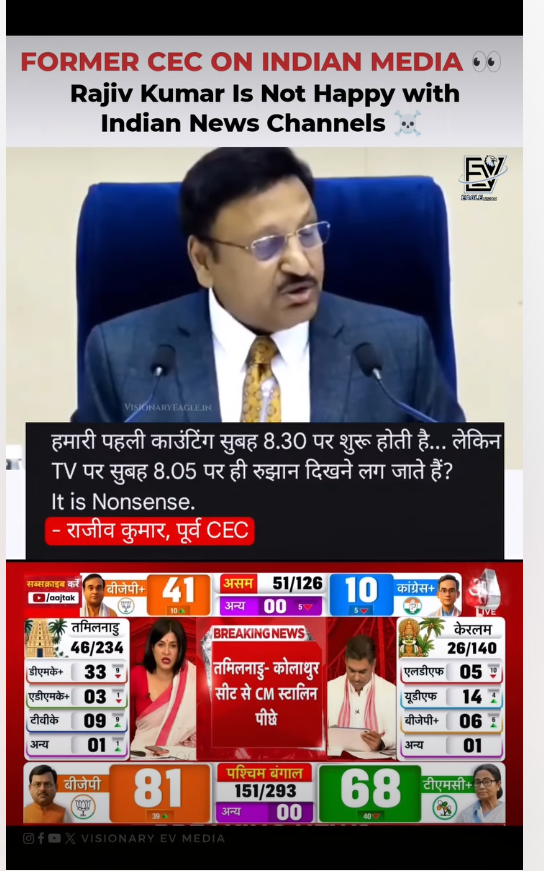
Following the results of the recent West Bengal elections, a video of former Chief Election Commissioner Rajiv Kumar has gone viral on social media. In the clip, Kumar is seen questioning television news channels over their election-result coverage and alleged early “trends” before the actual counting process begins. In the viral video, Rajiv Kumar can be heard saying, “When counting begins, channels start showing trends from 8:05 AM itself, which is nonsense. The first round of counting starts only at 8:30 AM. We have evidence that leads were being shown before that. Is it possible that these early trends are shown just to justify exit polls?”The video is being widely shared with the claim that Kumar made these remarks after the recently concluded West Bengal Assembly elections Research conducted by CyberPeace Research Wing found that a 2024 video of former Chief Election Commissioner Rajiv Kumar is being misleadingly shared as a recent statement made after the West Bengal election results.
Claim
An Instagram user shared the viral clip suggesting that the former Election Commissioner made these comments in the context of the latest West Bengal poll results.
Fact Check
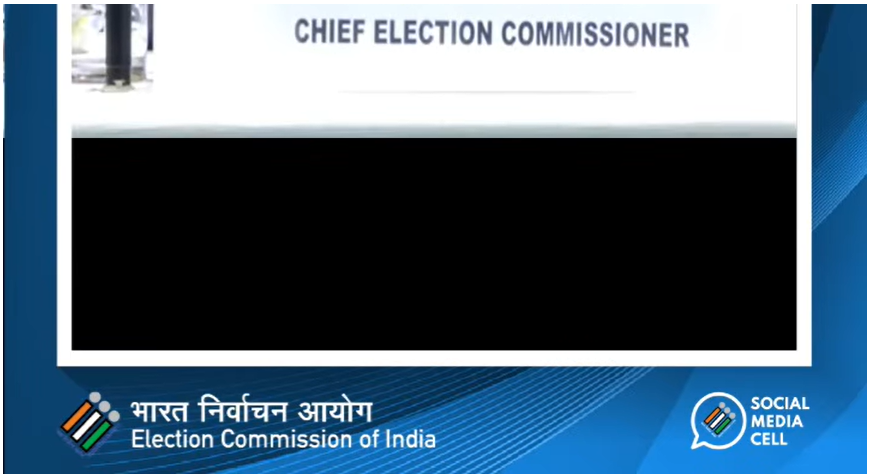
Using relevant keyword searches, we traced the original source of the clip to an official post shared by the Election Commission of Indiaon Facebook on October 15, 2024. The video was part of a press conference announcing the Assembly election schedule for Maharashtra and Jharkhand.
We also found the complete live-streamed press conference on the official YouTube channel of the Election Commission.
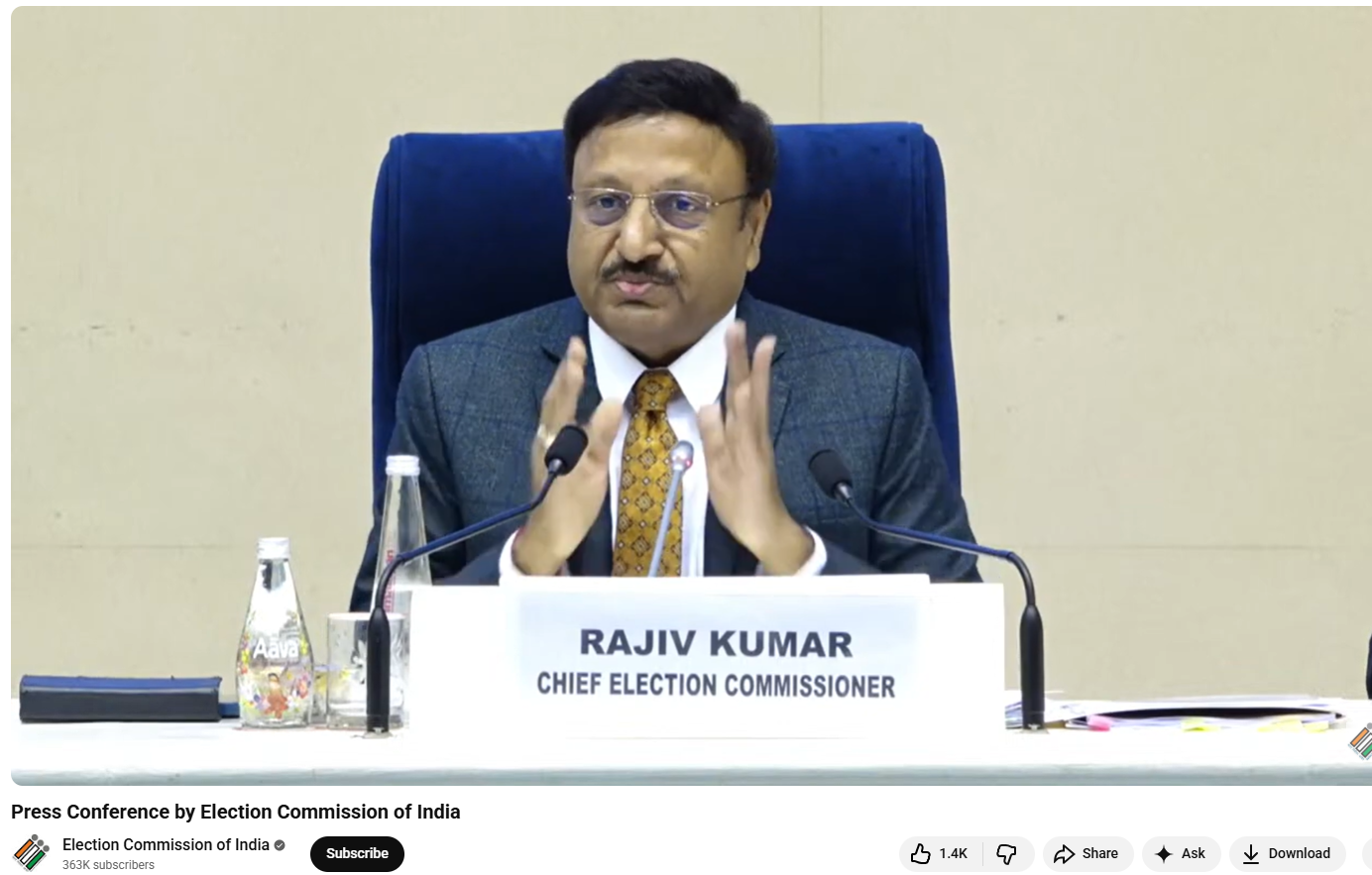
During the press conference, around the 26:45-minute mark, an ANI journalist referred to discrepancies between exit polls and actual Lok Sabha election results and asked whether such situations fuel doubts over EVMs among the public. Responding to the question at around 30:27 minutes, Rajiv Kumar spoke about the need for self-regulation in electronic media and concerns over premature “trends” shown during counting day. He said that exit polls often create public expectations despite lacking a clear scientific basis and questioned why TV channels begin displaying leads even before the first official counting round starts.
Conclusion
The viral claim is misleading. The video of former Chief Election Commissioner Rajiv Kumar is not related to the recent West Bengal election results. The clip is from an October 15, 2024 press conference held to announce the Maharashtra and Jharkhand Assembly election schedule and is now being falsely shared in a misleading context after the West Bengal polls.

Related Blogs
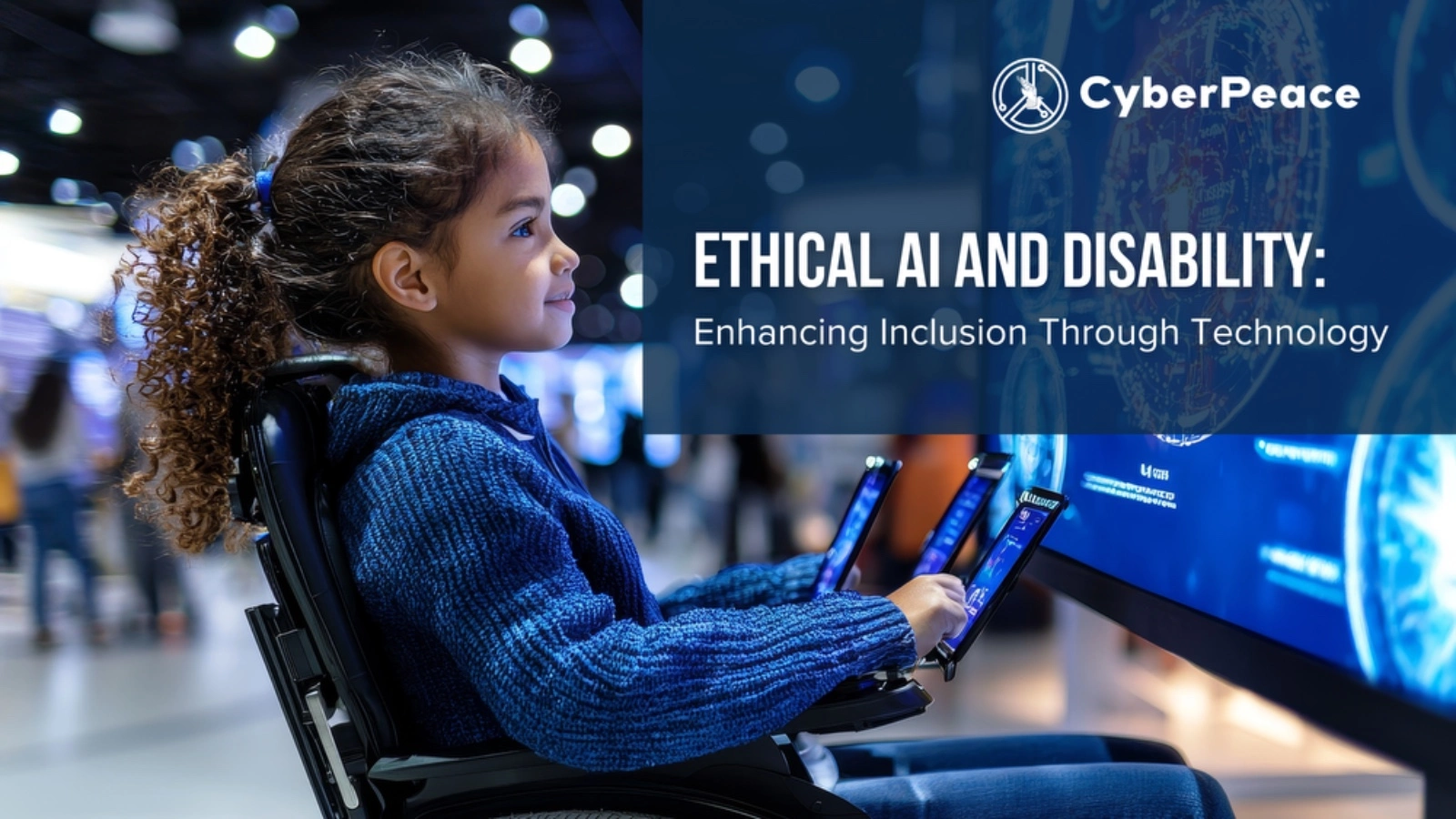
AI systems have grown in both popularity and complexity on which they operate. They are enhancing accessibility for all, including people with disabilities, by revolutionising sectors including healthcare, education, and public services. We are at the stage where AI-powered solutions that can help people with mental, physical, visual or hearing impairments perform everyday and complex tasks are being created.
Generative AI is now being used to amplify human capability. The development of tools for speech-to-text and image recognition is helping in facilitating communication and interaction for visually or hearing-impaired individuals, and smart prosthetics are providing tailored support. Unfortunately, even with these developments, PWDs have continued to face challenges. Therefore, it is important to balance innovation with ethical considerations aand ensuring that these technologies are designed with qualities like privacy, equity, and inclusivity in mind.
Access to Tech: the Barriers Faced by PWDs
PWDs face several barriers while accessing technology. Identifying these challenges is important as they lack computer accessibility, in the use of hardware and software, which has become a norm in life nowadays. Website functions that only work when users click with a mouse, self-service kiosks without accessibility features, touch screens without screen reader software or tactile keyboards, and out-of-order equipment, such as lifts, captioning mirrors and description headsets, are just some difficulties that they face in their day-to-day life.
While they are helpful, much of the current technology doesn’t fully address all disabilities. For example, many assistive devices focus on visual or mobility impairments, but they fall short of addressing cognitive or sensory conditions. In addition to this, these solutions often lack personalisation, making them less effective for individuals with diverse needs. AI has significant potential to bridge this gap. With adaptive systems like voice assistants, real-time translation, and personalised features, AI can create more inclusive solutions, improving access to both digital and physical spaces for everyone.
The Importance of Inclusive AI Design
Creating an Inclusive AI design is important. It ensures that PWDs are not excluded from technological advancements because of the impairments that they are suffering from. The concept of an ‘inclusive or universal’ design promotes creating products and services that are usable for the widest possible range of people. Tech Developers have an ethical responsibility to create advancements in AI that serve everyone. Accessibility features should be built into the core design. They should be treated as a practice rather than an afterthought. However, bias in AI development often stems from data of a non-representative nature, or assumptions can lead to systems that overlook or poorly serve PWDs. If AI algorithms are trained on limited or biased data, they risk excluding marginalised groups, making ethical, inclusive design a necessity for equity and accessibility.
Regulatory Efforts to Ensure Accessible AI
In India, the Rights of Persons with Disabilities Act of 2016 impresses upon the need to provide PWDs with equal accessibility to technology. Subsequently, the DPDP Act of 2023 highlights data privacy concerns for the disabled under section 9 to process their data.
On the international level, the newly incorporated EU’s AI Act mandates measures for transparent, safe, and fair access to AI systems along with including measures that are related to accessibility.
In the US, the Americans with Disabilities Act of 1990 and Section 508 of the 1998 amendment to the Rehabilitation Act of 1973 are the primary legislations that work on promoting digital accessibility in public services.
Challenges in implementing Regulations for AI Accessibility for PWDs
Defining the term ‘inclusive AI’ is a challenge. When working on implementing regulations and compliance for the accessibility of AI, if the primary work is left undefined, it makes the task of creating tools to address the issue an issue. The rapid pace of tech and AI development has more often outpaced legal frameworks in development. This leads to the creation of enforcement gaps. Countries like Canada and tech industry giants like Microsoft and Google are leading forces behind creating accessible AI innovations. Their regulatory frameworks focus on developing AI ethics with inclusivity and collaboration with disability rights groups.
India’s efforts in creating an inclusive AI include the redesign of the Sugamya Bharat app. The app had been created to assist PWDs and the elderly. It will now be incorporating AI features specifically to assist the intended users.
Though AI development has opportunities for inclusivity, unregulated development can be risky. Regulation plays a critical role in ensuring that AI-driven solutions prioritise inclusivity, fairness, and accessibility, harnessing AI’s potential to empower PWDs and contribute to a more inclusive society.
Conclusion
AI development can offer PWDs unprecedented independence and accessibility in leading their lives. The development of AI while keeping inclusivity and fairness in mind is needed to be prioritised. AI that is free from bias, combined with robust regulatory frameworks, together are essential in ensuring that AI serves equitably. Collaborations between tech developers, policymakers, and disability advocates need to be supported and promoted to build AI systems. This will in turn work towards bridging the accessibility gaps for PWDs. As AI continues to evolve, maintaining a steadfast commitment to inclusivity will be crucial in preventing marginalisation and advancing true technological progress for all.
References
- https://www.business-standard.com/india-news/over-1-4k-accessibility-related-complaints-filed-on-govt-app-75-solved-124090800118_1.html
- https://www.forbes.com/councils/forbesbusinesscouncil/2023/06/16/empowering-individuals-with-disabilities-through-ai-technology/ .
- https://hbr.org/2023/08/designing-generative-ai-to-work-for-people-with-disabilities
- Thehttps://blogs.microsoft.com/on-the-issues/2018/05/07/using-ai-to-empower-people-with-disabilities/andensur,personalization

Introduction
Recent advances in space exploration and technology have increased the need for space laws to control the actions of governments and corporate organisations. India has been attempting to create a robust legal framework to oversee its space activities because it is a prominent player in the international space business. In this article, we’ll examine India’s current space regulations and compare them to the situation elsewhere in the world.
Space Laws in India
India started space exploration with Aryabhtta, the first satellite, and Rakesh Sharma, the first Indian astronaut, and now has a prominent presence in space as many international satellites are now launched by India. NASA and ISRO work closely on various projects
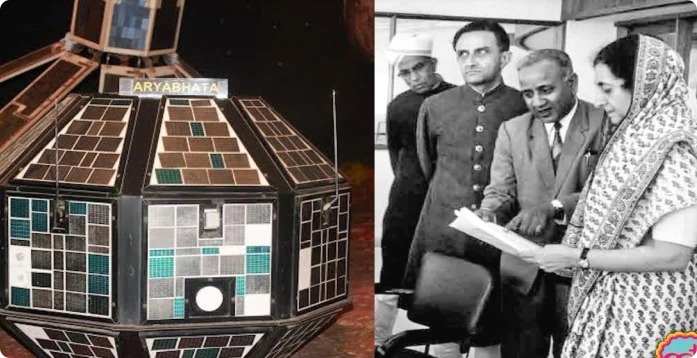
India currently lacks any space-related legislation. Only a few laws and regulations, such as the Indian Space Research Organisation (ISRO) Act of 1969 and the National Remote Sensing Centre (NRSC) Guidelines of 2011, regulate space-related operations. However, more than these rules and regulations are essential to control India’s expanding space sector. India is starting to gain traction as a prospective player in the global commercial space sector. Authorisation, contracts, dispute resolution, licencing, data processing and distribution related to earth observation services, certification of space technology, insurance, legal difficulties related to launch services, and stamp duty are just a few of the topics that need to be discussed. The necessary statute and laws need to be updated to incorporate space law-related matters into domestic laws.
India’s Space Presence
Space research activities were initiated in India during the early 1960s when satellite applications were in experimental stages, even in the United States. With the live transmission of the Tokyo Olympic Games across the Pacific by the American Satellite ‘Syncom-3’ demonstrating the power of communication satellites, Dr Vikram Sarabhai, the founding father of the Indian space programme, quickly recognised the benefits of space technologies for India.
As a first step, the Department of Atomic Energy formed the INCOSPAR (Indian National Committee for Space Research) under the leadership of Dr Sarabhai and Dr Ramanathan in 1962. The Indian Space Research Organisation (ISRO) was formed on August 15, 1969. The prime objective of ISRO is to develop space technology and its application to various national needs. It is one of the six largest space agencies in the world. The Department of Space (DOS) and the Space Commission were set up in 1972, and ISRO was brought under DOS on June 1, 1972.

Since its inception, the Indian space programme has been orchestrated well. It has three distinct elements: satellites for communication and remote sensing, the space transportation system and application programmes. Two major operational systems have been established – the Indian National Satellite (INSAT) for telecommunication, television broadcasting, and meteorological services and the Indian Remote Sensing Satellite (IRS) for monitoring and managing natural resources and Disaster Management Support.
Global Scenario
The global space race has been on and ever since the moon landing in 1969, and it has now transformed into the new cold war among developed and developing nations. The interests and assets of a nation in space need to be safeguarded by the help of effective and efficient policies and internationally ratified laws. All nations with a presence in space do not believe in good for all policy, thus, preventive measures need to be incorporated into the legal system. A thorough legal framework for space activities is being developed by the United Nations Office for Outer Space Affairs (UNOOSA). The “Outer Space Treaty,” a collection of five international agreements on space law, establishes the foundation of international space law. The agreements address topics such as the peaceful use of space, preventing space from becoming militarised, and who is responsible for damage caused by space objects. Well-established space laws govern both the United States and the United Kingdom. The National Aeronautics and Space Act, which was passed in the US in 1958 and established the National Aeronautics and Space Administration (NASA) to oversee national space programmes, is in place there. The Outer Space Act of 1986 governs how UK citizens and businesses can engage in space activity.

Conclusion
India must create a thorough legal system to govern its space endeavours. In the space sector, there needs to be a legal framework to avoid ambiguity and confusion, which may have detrimental effects. The Pacific use of space for the benefit of humanity should be covered by domestic space legislation in India. The overall scenario demonstrates the requirement for a clearly defined legal framework for the international acknowledgement of a nation’s space activities. India is fifth in the world for space technology, which is an impressive accomplishment, and a strong legal system will help India maintain its place in the space business.

Introduction
So it's that time of year when you feel bright and excited to start the year with new resolutions; your goals could be anything from going to the gym to learning new skills and being productive this year, but with cybercrime on the rise, you must also be smart and take your New Year Cyber Resolutions seriously. Yes, you heard it right: it's a new year, a new you, but the same hackers with advanced dangers. It's time to make a cyber resolution this year to be secure, smart, and follow the best cyber safety tips for 2K25 and beyond.
Best Cyber Security Tips For You
So while taking your cyber resolutions this 2k25, remember that hackers have resolutions too; so you have to make yours better! CyberPeace has curated a list of great tips and cyber hygiene practices you must practice in 2025:
- Be Aware Of Your Digital Rights: Netizens should be aware of their rights in the digital space. It's important to know where to report issues, how to raise concerns with platforms, and what rights are available to you under applicable IT and Data Protection laws. And as we often say, sharing is caring, so make sure to discuss and share your knowledge of digital rights with your family, peers, and circle. Not only will this help raise awareness, but you’ll also learn from their experiences, collectively empowering yourselves. After all, a well-informed online community is a happy one.
- Awareness Is Your First Line Of Defence: Awareness serves as the first line of defence, especially in light of the lessons learned from 2024, where new forms of cybercrimes have emerged with serious consequences. Scams like digital arrests, romance frauds, lottery scams, and investment scams have become more prevalent. As we move into 2025, remember that sophisticated cyber scams require equally advanced strategies to stay protected. As cybercrimes evolve and become more complex, it's crucial to stay updated with specific strategies and hygiene tips to defend yourself. Build your first line of defence by being aware of these growing scams, and say goodbye to the manipulative tactics used by cyber crooks.
- Customise Social Media Media Profile And Privacy Settings: With the rising misuse of advanced technologies such as deepfake, it’s crucial to share access to your profile only with people you trust and know. Customize your social media profile settings based on your convenience, such as who can add you, who can see your uploaded pictures and stories, and who can comment on your posts. Tailor these settings to suit your needs and preferences, ensuring a safer digital environment for yourself.
- Be Cautious: Choose wisely, just because an online deal seems exciting doesn’t mean it’s legitimate. A single click could have devastating consequences. Not every link leads to a secure website; it could be a malware or phishing attempt. Be cautious and follow basic cyber hygiene tips, such as only visiting websites with a padlock symbol, a secure connection, and the 'HTTPS' status in the URL.
- Don’t Let Fake News Fake You Out: Online misinformation and disinformation have sparked serious concern due to their widespread proliferation. That’s why it’s crucial to 'Spot The Lies Before They Spot You.' Exercise due care and caution when consuming, sharing, or forwarding any online information. Always verify it from trusted sources, recognize the red flags of misleading claims, and contribute to creating a truthful online information landscape.
- Turn the Tables on Cybercriminals: It is crucial to know the proper reporting channels for cybercrimes, including specific reporting methods based on the type of issue. For example, ‘unsolicited commercial communications’ can be reported on the Chakshu portal by the government. Unauthorized electronic transactions can be reported to the RBI toll-free number at 14440, while women can report incidents to the National Commission for Women. If you encounter issues on a platform, you can reach out to the platform's grievance officer. All types of cybercrimes can be reported through the National Cyber Crime Reporting Portal (cybercrime.gov.in) and the helpline at 1930. It’s essential to be aware of the right authorities and reporting mechanisms, so if something goes wrong in your digital experience, you can take action, turn the tables on cybercrooks, and stay informed about official grievances and reporting channels.
- Log Out, Chill Out: The increased use of technology can have far-reaching consequences that are often overlooked, such as procrastination, stress, anxiety, and eye strain (also known as digital eye strain or computer vision syndrome). Sometimes, it’s essential to switch off the digital curtains. This is where a ‘Digital Detox’ comes in, offering a chance to recharge and reset. We’re all aware of how our devices and phones influence our daily lives, shaping our behaviours, decisions, and lifestyles from morning until night, even impacting our sleep. Taking time to unplug can provide a much-needed psychological and physical boost. Practicing a digital detox at regular suitable intervals, such as twice a month, can help restore balance, reduce stress, and improve overall well-being.
Final Words & the Idea of ‘Tech for Good’
Remember that we are in the technological era, and these technologies are created for our ease and convenience. There are certain challenges that bad actors pose, but to counter this, the change starts from you. Remember that technology, while having its risks, also brings tremendous benefits to society. We encourage you to take a step and encourage the responsible and ethical use of the technology. The vision for ‘Tech for Good’ will have to be expanded to a larger picture. Do not engage in a behaviour that you would not ordinarily do in an offline environment, the online environment is also the same and has far-reaching effects. Use technology for good, and follow and encourage ethical and responsible behaviour in online communities. The emphasis should be on using technology in a safer environment for everyone and combatting dishonest practices.
The effective strategies for preventing cybercrime and dishonest practices requires cooperation , efforts by citizens, government agencies, and technology businesses. We intend to employ technology's good aspects to build a digital environment that values security, honesty, and moral behaviour while promoting innovation and connectedness. In 2025, together we can make a cyber safe resilient society.
