
#FactCheck : Old video of Ranveer Singh at Kashi Vishwanath Temple falsely linked to ‘Dhurandhar 2’ success
Executive Summary
Following the reported box office success of ‘Dhurandhar 2: The Revenge’, released on March 19, 2026, a video of Ranveer Singh visiting a temple is being widely shared on social media. Users claim that the actor visited the Kashi Vishwanath Temple to offer prayers after the film’s success. Research by CyberPeace found that the viral claim is misleading. The video of Ranveer Singh visiting the Kashi Vishwanath Temple is not recent. It dates back to 2024, when he visited the temple with Kriti Sanon, and is unrelated to the release or success of ‘Dhurandhar 2: The Revenge’.
Claim
An Instagram user “newsbharatplus” shared the video on March 26, 2026, with a caption stating that after the massive success of Dhurandhar 2, Ranveer Singh visited the temple and performed rituals.

Fact Check
To verify the claim, we extracted keyframes from the viral video and conducted a reverse image search. This led us to a report published by Dainik Jagran on April 14, 2024. According to the report, Ranveer Singh had visited the Kashi Vishwanath Temple along with Kriti Sanon and noted fashion designer Manish Malhotra. During the visit, the trio was seen offering prayers, wearing traditional attire, and applying sandalwood tilak.
https://www.jagran.com/entertainment/bollywood-ranveer-singh-and-kriti-sanon-visits-kashi-vishwanath-temple-with-manish-malhotra-see-photos-here-23696781.html
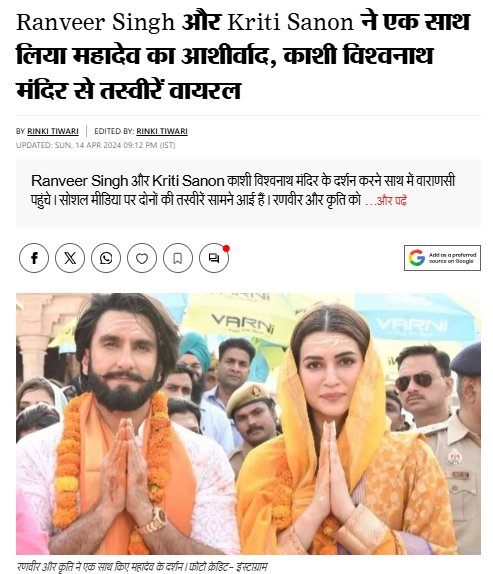
We also found a video report on the official YouTube channel of Times Now Navbharat, uploaded on April 15, 2024, showing Ranveer Singh and Kriti Sanon at the temple. The report also featured visuals from a fashion event held in Varanasi.
- https://www.youtube.com/watch?v=OMuW_SVbfb4

Conclusion
The viral claim is misleading. The video of Ranveer Singh visiting the Kashi Vishwanath Temple is not recent. It dates back to 2024, when he visited the temple with Kriti Sanon, and is unrelated to the release or success of ‘Dhurandhar 2: The Revenge’.

Related Blogs
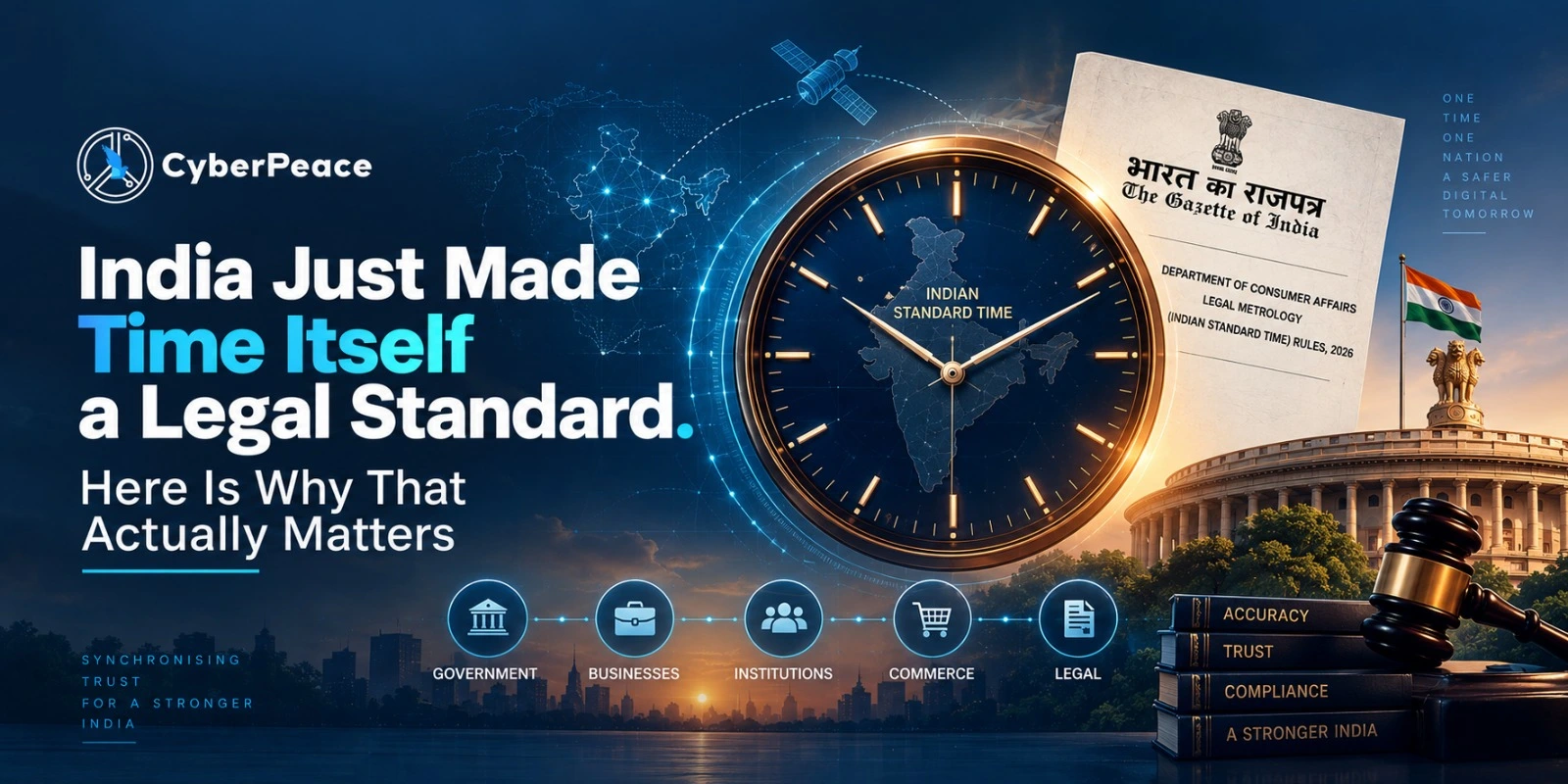
Most laws regulate what people do. This one regulates what clock everyone is doing it by, and once you sit with that idea for a moment, it stops sounding like a bureaucratic footnote and starts sounding like something genuinely foundational.
On 27 August 2026, India's Department of Consumer Affairs notified the Legal Metrology (Indian Standard Time) Rules, 2026, making Indian Standard Time the single legally binding reference for every legal, administrative, commercial, and official purpose across the country. The Rules will come into force 180 days after their publication in the Official Gazette, giving government departments, businesses, and institutions a compliance runway to align their systems before the requirement actually bites.
Why time needed a law at all
It might seem strange that a country needs legislation to tell everyone what time it is. India has used IST, a single time zone five and a half hours ahead of Coordinated Universal Time, since 1947. But using a time zone informally and legally mandating it as the sole authoritative reference for every official and commercial transaction are two very different things, and the gap between them is exactly where this rule lives.
The government's own reasoning, laid out in its official statement, centres on a shift most people experience daily without ever thinking about its plumbing. Banking and digital payments, telecommunications networks, railways, power grids, and government record systems all depend on accurate, synchronised time stamps to function correctly. When different systems quietly draw their time from different sources, even by fractions of a second, the resulting inconsistencies can affect the coordination and recording of transactions in ways that are invisible until something goes wrong. A trade executed on a stock exchange, a UPI payment cleared between banks, a railway signal handoff between two junctions, and an emergency service dispatch all depend on every clock in the chain agreeing with every other clock, and until now, India had no single rule compelling that agreement.
The quieter, more interesting part of the rule
Buried inside the announcement is a detail that matters more than the headline. The Rules do not simply declare IST the law of the land; they also authorise the use of NavIC, India's own satellite navigation system, alongside other approved domestic timing sources, as legitimate means of disseminating that time. The government's stated rationale is candid about the current state of affairs: several critical Indian systems presently draw their time from foreign satellite based sources, and building domestic timing infrastructure through NavIC and legal metrology laboratories is intended to reduce that dependence going forward.
That single sentence carries real weight once you consider how global positioning and timing systems actually work. Most of the world's precise digital time synchronisation ultimately traces back to GPS, the American satellite constellation, whose signals also happen to be notoriously easy to disrupt. GPS and other satellite navigation signals arrive at receivers on Earth as extremely weak radio transmissions, weak enough that they can be jammed with cheap equipment or spoofed, meaning an attacker broadcasts a counterfeit signal that mimics a legitimate one closely enough to fool a receiver into accepting false position or timing data. Researchers and government reports going back years have flagged that a large share of critical infrastructure sectors, power grids, financial markets, telecommunications, and transport among them, carry meaningful dependence on GPS derived timing, and a 2017 UK government assessment specifically warned that systematic satellite signal jamming could cause serious disruption to a country's financial, electricity, and communications systems all at once. Cybersecurity researchers have separately demonstrated proof of concept attacks where a deliberately falsified timing signal, rather than a falsified position, was enough to destabilise systems that assumed their clock could always be trusted.
Seen against that backdrop, embedding NavIC as an approved domestic timing source inside a legal metrology framework is not merely a nationalistic footnote about self reliance. It is a genuine resilience decision. A country that can generate, verify, and distribute its own trusted time signal, independent of a foreign satellite constellation that it does not control and cannot secure on its own, has a meaningfully smaller attack surface for an entire category of infrastructure disruption that rarely makes headlines until it actually happens.
Who actually built this, and why that composition matters
The drafting process itself offers a useful clue about how seriously this was treated. Reports on the rule making process indicate the Rules were shaped by a high powered inter ministerial committee chaired by the Secretary of Consumer Affairs, with representation from the National Physical Laboratory and the Indian Space Research Organisation for the underlying science and satellites, IIT Kanpur for engineering expertise, the National Informatics Centre and CERT In for network infrastructure and its security, the Securities and Exchange Board of India for financial market implications, and the Railways, Telecom, and Financial Services departments for the systems that will actually have to run on this new standard day to day. That is not a committee assembled around a single ministry's convenience; it is a committee assembled around the actual shape of the problem, spanning physics, engineering, finance, and network security together. As part of the broader One Nation, One Time initiative, a White Rabbit Technology based IST Dissemination Demonstration Network was already commissioned at the Regional Reference Standard Laboratory in Bengaluru back in July 2026, suggesting the infrastructure groundwork was underway well before the legal framework caught up to it.
What the 180 day window actually means in practice
It is worth being precise about what compliance actually requires here. This is not a deadline demanding new hardware overnight; for most organisations, it means auditing which internal systems currently reference time from an unverified or foreign source and ensuring they align with certified IST going forward, alongside institutions preparing to receive that certified time through the domestic infrastructure the government is simultaneously building out. The six month runway exists precisely because this touches an unusually wide spread of sectors at once, and forcing an abrupt cutover would create more operational risk than the rule is designed to remove.
The bigger picture
A rule about what time it is legally does not sound like cybersecurity news, and on the surface, it is not. But underneath the administrative language sits a genuinely forward looking recognition: as more of daily life, banking, communication, transport, and governance runs on systems that must agree, down to the second, on a shared reference point, the integrity of that reference point becomes critical infrastructure in its own right. India choosing to build, verify, and legally anchor its own trusted time source, rather than continuing to quietly rely on a foreign satellite system it cannot secure independently, is less about symbolism and more about closing a vulnerability most people never knew existed until they were asked to think about it.
References
- OpenGov Asia, "India Issues Rules to Standardise National Time Reference Systems." https://opengovasia.com/india-issues-rules-to-standardise-national-time-reference-systems/?c=us
- Daily Excelsior, "Centre notifies rules mandating IST as common time reference; 180 day window for compliance." https://www.dailyexcelsior.com/centre-notifies-rules-mandating-ist-as-common-time-reference-180-day-window-for-compliance/
- Greater Kashmir, "Department of Consumer Affairs notifies Legal Metrology Rules, 2026." https://www.greaterkashmir.com/national/department-of-consumer-affairs-notifies-legal-metrology-rules-2026-12454447
- Insights on India, "Legal Metrology (Indian Standard Time) Rules, 2026." https://www.insightsonindia.com/2026/08/31/legal-metrology-indian-standard-time-rules-2026/
- Blitz India Media, "Indian Standard Time Rules 2026: NavIC, Legal Metrology." https://blitzindiamedia.com/news/indian-standard-time-rules-2026-navic-legal-metrology/
- Observer Voice, "India Establishes Legal Framework for Standard Time." https://observervoice.com/india-establishes-legal-framework-for-standard-time-225958/
- The Live Nagpur, "Govt notifies rules to make IST the common time reference." https://thelivenagpur.com/2026/08/31/govt-notifies-rules-to-make-ist-the-common-time-reference/
- Safran Navigation and Timing, "GNSS Security and Cybersecurity: What are the Parallels?" https://safran-navigation-timing.com/gnss-security-and-cybersecurity-what-are-the-parallels/
- Safran Navigation and Timing, "Securing Critical Infrastructures from Jamming and Spoofing Cyberattacks." https://safran-navigation-timing.com/securing-critical-infrastructures-from-jamming-and-spoofing-cyberattacks/
- Combain, "The Silent Threat In The Sky: GPS Jamming, GPS Spoofing." https://combain.com/gps-jamming-spoofing/

WhatsApp messages masquerading as an offer from Maruti Suzuki with links luring unsuspecting users with the promise of Maruti Suzuki 40th Anniversary Celebration presents, have been making the rounds on the app. If you receive such messages try to stay away from it, as it can be a scam.
The Research Wing of CyberPeace Foundation along with Autobot Infosec Private Limited have conducted a study based on a WhatsApp message that contained a link pretending to be a free gift offer from Maruti Suzuki which asks users to participate in a survey in order to get a chance to win a Maruti Baleno Sigma MT car.
Warning SignsThe campaign pretends to be an offer from Maruti Suzuki but is hosted on a third party domain instead of the official Maruti Suzuki website which makes it more suspicious.
The domain names associated with the campaign have been registered in very recent times.
Multiple redirections have been noticed between the links.
No reputed site would ask its users to share the campaign on WhatsApp.
The prize is kept really attractive to lure the laymen.
Grammatical mistakes have been noticed.
A congratulations message appears on the landing page with an attractive photo of Maruti Suzuki cars that asks users to participate in a quick survey in order to get a “Maruti Suzuki BALENO Sigma MT”. Also, the bottom of the page seems to appear like a comment section with public comments establishing the truthfulness of the offer.
The survey starts with some basic questions like Do you know Maruti Suzuki?, How old are you?, How do you think of Maruti Suzuki?, Are you male or female? Etc. Once the user answers the questions a “congratulatory message” is displayed.
On clicking the OK button users are given three attempts to win the prize. After completing all the attempts a message pops up that the user has won “Maruti Suzuki BALENO Sigma MT”. It then prompts the user to share the message on WhatsApp.
Strangely enough the user has to keep clicking the WhatsApp button until the progress bar completes. After clicking on the green ‘WhatsApp’ button multiple times it shows a section where an instruction has been given to complete registration in order to get the prize.
After clicking on the green ‘Complete registration’ button, it redirects the user to multiple advertisements web pages varying each time the user clicks on the button.
During the analysis the research team found a javascript code called hm.js was being executed in the background from the host hm[.]baidu[.]com which is a subdomain of Baidu and is used for Baidu Analytics, also known as Baidu Tongji. The important part is that Baidu is a Chinese multinational technology company specializing in Internet-related services, products and artificial intelligence, headquartered in Beijing’s Haidian district, China.To read the full report, please click (https://www.cyberpeace.org/CyberPeace/Repository/20210828Research-report-on-Maruti-Suzuki-40th-Anniversary-Celebration-free-gift-scam.pdf) here:
Conclusive Summary
1. The whole research activity was performed in a secured sandbox environment where the WhatsApp application was not installed. If any user opens the link from a device like smartphones where the WhatsApp application is installed, the sharing features on the site will open the Whatsapp application on the device to share the link.
2. The campaign collects browser and system information from the users.
3. Most of the domain names associated with the campaign have the registrant country as China.
4. Cybercriminals used Cloudflare technologies to mask the real IP addresses of the front-end domain names used in this Maruti Suzuki 40th Anniversary Celebration free gift campaign. But during the phases of investigation, the research team has identified a domain name that was requested in the background and has been traced as belonging to China.
CyberPeace Advisory
1. CyberPeace Foundation and Autobot Infosec recommend that people should avoid opening such messages sent via social platforms.
2. If at all, the user gets into this trap, it could lead to whole system compromise such as access to the microphone, Camera, Text Messages, Contacts, Pictures, Videos, Banking Applications, etc as well as financial losses.
3. Do not share confidential details like login credentials, banking information with such a type of scam.
4. Do not share or forward fake messages containing links without proper verification.
5. There is a need for International Cyber Cooperation between countries to bust the cybercriminal gangs running the fraud campaigns affecting individuals and organizations, to make Cyberspace resilient and peaceful.

Executive Summary
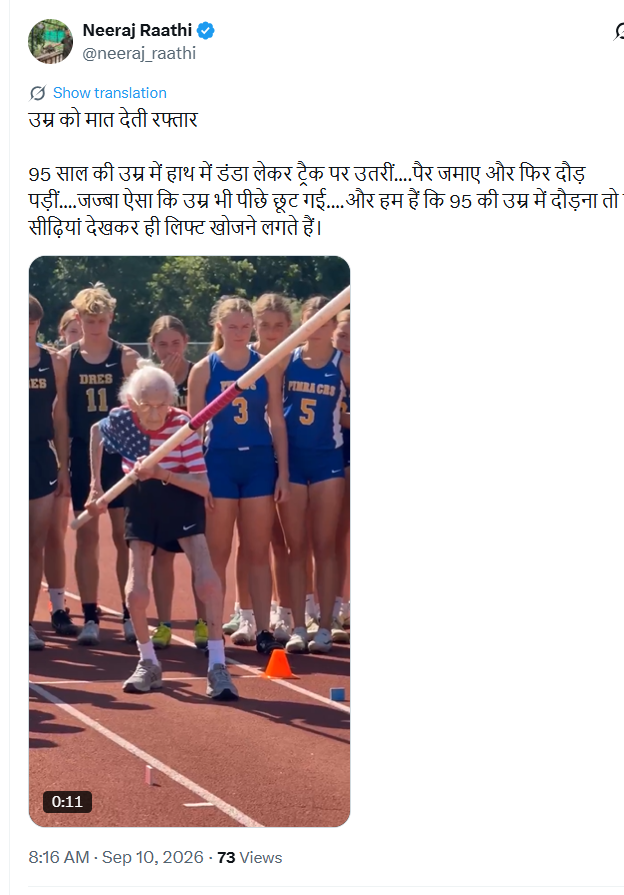
A video of an elderly woman performing a pole vault is being widely shared on social media. The video is being shared with the claim that the woman, who can be seen performing the astonishing feat, is 95 years old. Several people can also be seen around her in the video. She runs at full speed while carrying a pole and then leaps over a bar placed at a height. People present at the venue can be seen applauding her remarkable performance. A research done by the Research Wing of CyberPeace found that the video is not real but AI-generated.
Claim
An X user shared the video with the caption: “Defying age with speed. At the age of 95, she stepped onto the track with a stick in her hand… planted her feet and started running… such determination that even age was left behind… and here we are, at 95, forget running, we start looking for a lift the moment we see the stairs.”
https://x.com/neeraj_raathi/status/2097879324573798613
https://archive.ph/8Invi
Fact Check
To verify the authenticity of the viral video showing the elderly woman performing a pole vault, we first conducted a Google search using relevant keywords. However, we did not find any credible media reports or other reliable sources identifying the video as footage of a real pole vault competition.
We then conducted a keyframe search and found the same video uploaded on September 8, 2026, on a Facebook page called ‘Senior Salute’, an AI content creator. The post also carries an AI-generated content label.

Upon reviewing the Facebook account, we found several similar videos showing elderly people performing various stunts. The account appears to exclusively create and share AI-generated videos.

We also checked the video using another AI detection tool, Truth Scan. In its analysis, the tool gave the viral video a 90 percent score, indicating that it was likely AI-generated.

In addition, we checked the visuals in the viral video using another AI detection platform, AIorNOT. In its analysis, the tool also indicated a high likelihood that the visuals in the video were AI-generated.

Conclusion
The evidence gathered during our research makes it clear that the viral video showing an elderly woman performing a pole vault is not genuine but AI-generated. The same video was found on a Facebook page that primarily shares AI-generated content and was posted with an AI-generated content label. Further, multiple AI detection tools also indicated a high likelihood that the video was created using AI. Therefore, the claim that the video shows a 95-year-old woman performing a real pole vault is false.
