
#FactCheck-PM Narendra Modi’s Viral Statement Linking His Father to Netaji Subhash Chandra Bose is Fake
Executive Summary
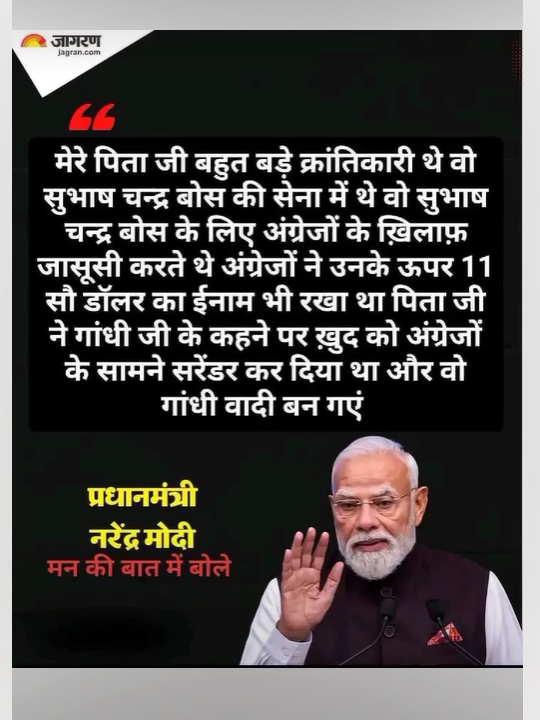
A fabricated graphic designed to look like a Dainik Jagran postcard is viral on social media. The viral post claims that Prime Minister Narendra Modi made a statement regarding his father, alleging that he was part of Netaji Subhash Chandra Bose's army and spied against the British. The post further claims that his father later surrendered on Mahatma Gandhi's advice and became a Gandhian. Research by the CyberPeace Research Wing has revealed that this claim is entirely fake and misleading. There is no record or evidence of PM Modi ever making such a statement, and the viral postcard has been digitally altered.
The Claim
An Instagram user shared the viral graphic claiming that PM Modi stated his father was associated with Netaji Subhash Chandra Bose's army, worked as a spy against the British, and later surrendered on Mahatma Gandhi's advice to become a follower of his ideology. https://www.instagram.com/reels/DZ7BAHdP5u , https://archive.ph/wip/7ajAK
Fact Check
A thorough Google keyword search was conducted using relevant terms, but no credible news reports or official sources were found to back up the viral claim.

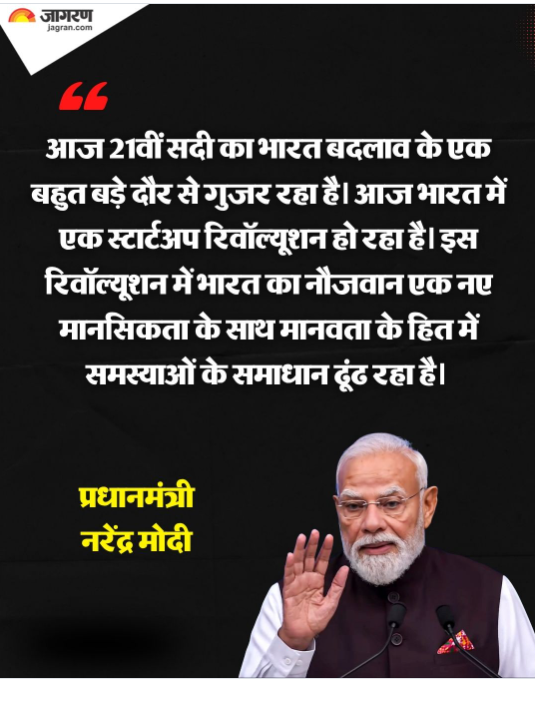
During the research, the original, authentic postcard published by Dainik Jagran was located. The original post actually quoted PM Modi speaking about India's startup ecosystem. Today, 21st-century India is going through a massive phase of transformation. A startup revolution is taking place in India today. In this revolution, the youth of India, with a fresh mindset, are finding solutions to problems for the welfare of humanity." https://www.instagram.com/p/DZkRUY2n2hi/
Conclusion
The research confirms that Prime Minister Narendra Modi never made any statement linking his father to Netaji Subhash Chandra Bose or Mahatma Gandhi's surrender advice. The viral image circulating on social media is morphed and edited to spread misinformation.

Related Blogs

Executive Summary
Amid the ongoing geopolitical tensions involving the US, Israel, and Iran, and reports of disruptions in the Strait of Hormuz affecting cargo ship movement and global crude oil prices, several posts on social media have made a viral claim. The posts allege that Indian cargo vessels are being allowed to pass through the Strait of Hormuz after payments to Iran were made in Chinese currency, the yuan. The claim has been widely circulated from certain social media accounts, suggesting a shift in India’s trade and payment arrangements. However, a fact-check by CyberPeace Research Wing has found the claim to be false.
Claim
A social media user “MEHF voice 2.0” shared a viral post (archived link), claiming that an Indian oil tanker secured passage through the Strait of Hormuz by making payments in Chinese yuan. The post further suggested that India had formed a new alignment with China, bypassing the US dollar system.

Fact Check
Due to US sanctions, Iran is excluded from the international banking network SWIFT, which prevents direct trade settlements in US dollars or euros. As a result, India and Iran conduct trade through a specially designed rupee–rial payment mechanism. According to a Ministry of Commerce and Industry release (based on a written reply in Parliament), India and Iran established this arrangement to facilitate bilateral trade using local currencies instead of the US dollar.

Further, information from the Indian Embassy in Tehran notes that rupee-based payments are processed through UCO Bank and Iranian banks with vostro accounts, enabling trade settlement outside sanctioned banking channels. IDBI Bank has also been part of efforts to expand rupee-based transactions with Iran.
The Ministry of External Affairs’ official fact-check handle has also debunked this claim, confirming that it is false.

Conclusion
The viral claim that Indian oil tankers are paying in Chinese yuan to pass through the Strait of Hormuz is false. India and Iran conduct trade settlements through a rupee–rial payment mechanism, not through the Chinese currency.

Executive Summary:
CVE 2024-3094 is a backdoor vulnerability recently found in Kali Linux installations that happened between March 26th to 29th. This vulnerability was found in XZ package version 5.6.0 to 5.6.1. It could allow the malicious actor to compromise SSHD authentication, and grant unauthorized access to the entire system remotely. The users who have installed or updated Kali Linux during the said time are advised to update their system to safeguard against this vulnerability.
The Dangerous Backdoor
The use of the malicious implant found in XZ Utils as a remote code execution tool makes it more dangerous, because of its ability to compromise the affected systems. Initially, researchers believed the vulnerability enabled an authentication bypass for the OpenSSH server (SSHD) process. However, further analysis revealed it is better characterized as a remote code execution (RCE) vulnerability.
The backdoor intercepts the RSA_public_decrypt function, verifies the host's signature using a fixed Ed448 key, and if successful, executes malicious code passed by the attacker via the system() function. This leaves no trace in SSHD logs and makes it difficult to detect the vulnerability.
Impacted Linux Distributions
The compromised versions of XZ Utils have been found in the following Linux distributions released in March 2024:
- Kali Linux (between March 26 and March 29)
- openSUSE Tumbleweed and openSUSE MicroOS (March 7 to March 28)
- Fedora 41, Fedora Rawhide, and Fedora Linux 40 beta
- Debian (testing, unstable, and experimental distributions only)
- Arch Linux container images (February 29 to March 29)
- Meanwhile, distributions such as Red Hat Enterprise Linux (RHEL), SUSE Linux Enterprise, openSUSE Leap, and Debian Stable are not believed to be affected.
How Did This Happen?
The malicious code appears to have been inserted by taking advantage of a typical control transfer vulnerability. The original maintainer of the XZ Libs project on GitHub handed over control of the repository to an account that had been contributing to various data compression-related projects for several years. It was at this point that the backdoor was implanted in the project code.
Fortunately, the Potential Disaster Was Averted
As per Igor Kuznetsov, head of Kaspersky's Global Research and Analysis Team (GReAT), the vulnerability CVE-2024-3094 is considered as the largest scale attack that has happened in the Linux ecosystem history. Because it targeted the primary remote management tool for Linux servers on the internet which is SSH servers.
As this vulnerability was detected in the testing and rolling distributions in the short period of time, where the latest software packages are used. This results to the minimum damage to the linux users and so far no case of CVE-2024-3094 being actively exploited have been detected.
Staying Safe
The U.S. Cybersecurity and Infrastructure Security Agency (CISA) advises that users who installed or updated the affected operating systems in March immediately roll back to XZ Utils 5.4.6 version and be on alert for any malicious activity. It is recommended to change the passwords in the case of a distribution where a weak version of XZ Utils has been installed.
The Yara rule has been released to detect any infected systems by CVE-2024-3094 Vulnerability.
Conclusion
The discovery of the XZ Utils backdoor provides a reminder to be vigilant in the open source software environment. This supply chain attack highlights the importance of strong security measures, elaborate code reviews, and regular distribution of security updates to provide shield against such vulnerabilities. Always staying informed and taking the necessary precautions, Linux users can mitigate the potential impact of this vulnerability to keep their systems safe.
References :
- https://thehackernews.com/2024/03/urgent-secret-backdoor-found-in-xz.html
- https://www.helpnetsecurity.com/2024/03/29/cve-2024-3094-linux-backdoor/
- https://www.kali.org/blog/about-the-xz-backdoor/
- https://www.kaspersky.com/blog/cve-2024-3094-vulnerability-backdoor/50873/
- https://www.rapid7.com/blog/post/2024/04/01/etr-backdoored-xz-utils-cve-2024-3094/
Introduction
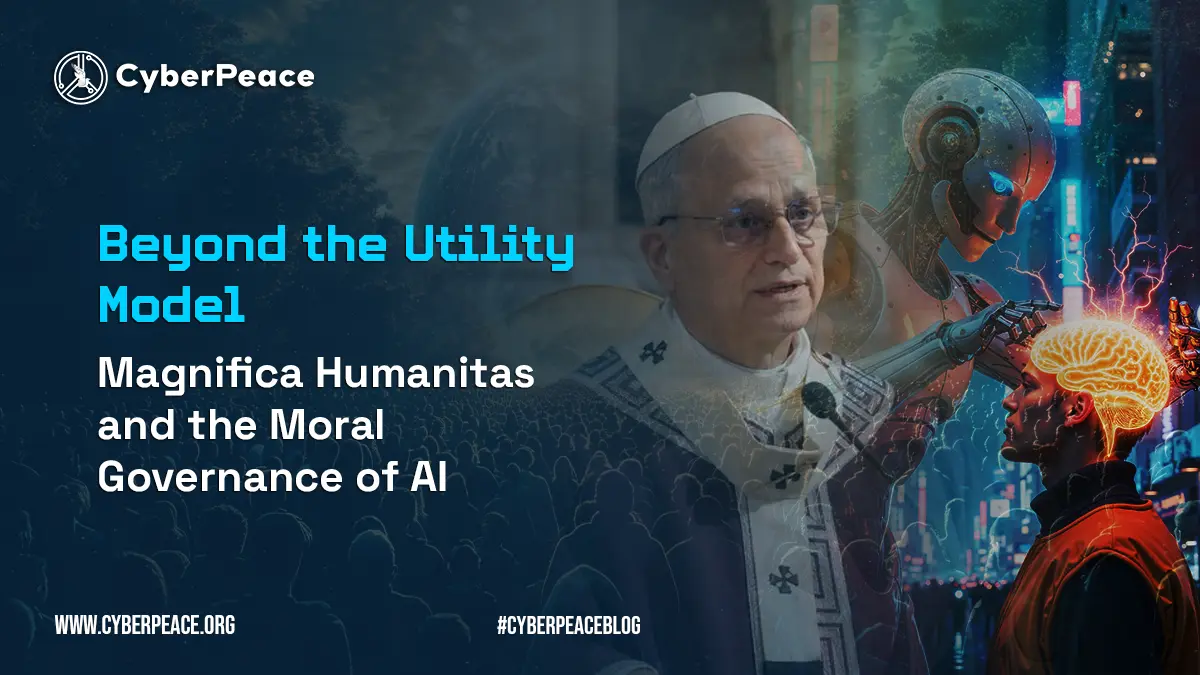
Two of the most influential voices offered strikingly divergent visions of humanity’s technological future in May 2026. On one side of the equation was Sam Altman, the CEO of OpenAI, who spoke of a future in which intelligence would be a "service like electricity or water," available on a metered basis and powered by massive AI infrastructure. On the other side was Leo XIV, the Pope of the Catholic Church, whose encyclical, Magnifica Humanitas, presented the Church's most substantial response to AI, presenting the technology not simply as a technical innovation but also as a crucial moral, social, and civilizational challenge.
The differences in their views run much deeper than merely those regarding control and development. At issue is a conflict in understanding intelligence, the purpose of technology, and the dignity of man. While Altman saw intelligence as an abundant economic factor, one that could be produced, distributed, and consumed, Leo XIV emphasized that intelligence is indissociable from the person and that we should be wary of turning human potential into mere merchandise. Their clash of visions can essentially be understood as two different answers to the question: What is a human being, and to whose service should technology be devoted?
Intelligence as Infrastructure
Altman implies that artificial intelligence will follow the trajectory of electricity in industrial society, where the utility became available everywhere as part of the bedrock of society. The ultimate goal is to generate abundance. Cognitive ability will become cheaper and more readily available until it is so inexpensive that it is built into everything.
From the perspective of the business, this is compelling. In many ways modern AI already has infrastructure-like properties. Programmers, businesses, governments, and even individuals are using intelligence as a commodity delivered by a centralized platform and API in a way similar to how previous generations would have used the electricity grid. Altman is essentially predicting that this trend will reach its ultimate form, where intelligence becomes a utility.
There are several assumptions inherent in this utility metaphor; however, utilities are never neutral technologies; they are all forms of governance, ownership, and control. It is not merely the resource being delivered that makes electricity grids, telephone systems, and water infrastructure powerful but the institutions that mediate access to those resources. In Altman's statement "people will buy it from us," there is a political question inherent: Who does the infrastructure of cognition belong to?
Altman himself is also concerned with these issues, often reiterating that this technology could lead to an unprecedented concentration of power and wealth. Yet this concern is a paradox, as truly democratized artificial intelligence does not appear possible without immense capital investment, colossal data centers, proprietary models, and a monopolization of talent. The path to making intelligence universally available appears to lie through unprecedented centralization.
The Vatican's Response: Beyond Technology
Magnifica Humanitas approaches this from a different perspective. It is not, fundamentally, a document on AI policy but on social philosophy, rooted in the Catholic tradition of social teaching. Just as Rerum Novarum, published in 1891, had explored the social implications of industrial capitalism, Leo XIV views AI as a new juncture in humankind's engagement with technology and power.
Two biblical images are recurring throughout the encyclical: Babel and Jerusalem. Babel, the archetype of technical ambition without purpose or moral intent, is an effort to reorder and recenter human society based on conformity, centralization, and the delusion of self-sufficiency. Jerusalem, rebuilt under Nehemiah, is an image of collective reconstruction based on participation and responsibility.
The symbolic weight is critical. Leo XIV is not arguing that technology in itself is inherently dangerous. He is, rather, suggesting that the tools of technology will inherently contain and perpetuate whatever values, incentives, and priorities of the architects and wielders of these technologies. The question is not therefore whether AI should exist, but rather whether it increases human flourishing or enhances systems of control.
This provides what is likely the most significant realization within the encyclical that AI and human intelligence are categories distinct in kind, not in degree. AI can simulate, calculate, and compute, but it can never possess awareness, ethical responsibility, embodiment, or meaningful relationships. As such, decisions impacting human life can no longer be deferred to algorithms in a manner that negates the human good.
The Problem of Power
The most evident clash between Altman's vision and Magnifica Humanitas lies in power dynamics.
The utility model of Altman places the assumption that intelligence can be centrally controlled and widely disseminated. However, the Vatican perceives major political consequences from the concentration of cognitive ability. According to the encyclical, this kind of concentration can lead to major political problems because small groups are given immense power over the economy, public debate, and democracy by possessing the necessary control over data, computation, and the network.
This idea is becoming more prominent in recent research. Experts like Kate Crawford, for instance, have described AI as 'a registry of power' in which systems build up hierarchies of social, political, and economic power. Digital colonialism scholars also show that the control of the network of intelligence under a few transnational corporations may diminish power that would otherwise reside with local authorities and democratic institutions.
The problem, seen from this point of view, does not simply address technology but sovereignty itself. If intelligence is provided as a metered service within private platforms, the access to knowledge, reason, and decision-making tools might rest with entities outside the public sphere, unconcerned with democracy.
The Vatican's solution relies on the principle of subsidiarity; decisions should be taken at the lowest possible levels, respecting the autonomy of individuals, communities, and local institutions. This principle directly contradicts the proposals that see cognitive infrastructure located within a few multinational organizations.
The Hidden Labour Behind AI
A particularly important segment of Magnifica Humanitas addresses the invisible labor of the AI economy.
While discourse on AI frequently conceptualizes it as an intangible or ethereal technology residing within "the cloud," the opposite is in fact the case. AI relies on the unseen labors of data annotators, content moderators, miners harvesting rare earth metals, construction workers creating data centers, and technicians repairing digital infrastructure. In many cases, these workers exist in marginal situations; investigations have revealed poor wages, minimal rights, and psychologically damaging working conditions, especially for content moderators and data annotators in the Global South. Critics contend that the AI of today exists on the backbone of an unacknowledged global workforce that is shielded from consumers of AI technology. In the encyclical, this idea of the AI economy is framed in terms of human dignity, the standard by which all progress, technological or otherwise, must be measured. Progress cannot be defined solely in terms of efficiency and productivity but must be defined by its consequences for workers, society, and human relationships. While the technology of AI may confer tremendous value to a few, it must not do so at the expense of the humanity of others. It gives a key critique of Altman’s utility model that the appeal of abundant intelligence often focuses on products while neglecting the social and material conditions in which it is produced.
A Clash of Anthropologies
The deepest philosophical disagreement of Altman's and Leo XIV's is over anthropology, i.e., who human beings actually are.
Altman’s view presumes an ability to quantify and allocate the human capacity for intelligence. The more intelligent the society, the better the society; and intelligence becomes the prime causal factor whose production must be maximized by the machine.
The Vatican rejects this fundamental principle. According to the argument of Magnifica Humanitas, human value is not located in intelligent productivity or efficiency or economic productivity. Dignity is non-conditional and cannot be reduced to measures of performance. One has dignity not because one can compute, produce, and optimize, but because one is a person.
The implications of this difference are vast. If intelligence is principally treated as an economic asset, then humans will constantly have to deal with being judged as being of greater or lesser use compared to the machine. If dignity is intrinsic, machines must remain instruments of the flourishing of the human, irrespective of machine efficiency. In sum, this is not a debate over machines. It is a debate over whether society is going to be defined according to an ideology of optimization or an ideology of humanity.
Conclusion
The juxtaposition of Sam Altman’s model of utility and Leo XIV’s idea of Magnifica Humanitas defines one of the key intellectual arguments of our times. Altman presents a vision of abundance, efficiency, and humanly impossible intellectual capacity. Leo XIV represents what happens when intelligence is divorced from the demands of ethics, democracy, and human dignity; when the demands they represent only contribute to its ultimate capacity to wound the needs it serves.
It is not whether we will build machines more and more intelligent; it is what politics and values will govern these machines. When intelligence becomes a service, whose interests will govern the machine, who will write the rules, and who will be the direct beneficiaries? When dignity is the source from which man and machine alike emerge, the service must not be judged on what the machine does best but on what it can do for man. The ultimate question is whether we will be able to maintain a view of ourselves that is larger than just our capacity to engineer.
References:
- Atlas of AI, Crawford, Kate. Atlas of AI: Power, Politics, and the Planetary Costs of Artificial Intelligence. New Haven: Yale University Press, 2021.
- Pope Leo XIV. Magnifica Humanitas: On Safeguarding the Human Person in the Time of Artificial Intelligence. Vatican City: Holy See, 2026.
- Pope Leo XIII. Rerum Novarum. Vatican City: Holy See, 1891.
- Pope John Paul II. Laborem Exercens. Vatican City: Holy See, 1981.
- Dicastery for the Doctrine of the Faith. Dignitas Infinita. Vatican City: Holy See, 2024.
- International Theological Commission. Quo Vadis, Humanitas? Thinking About Christian Anthropology in the Face of Some Scenarios on the Future of Humanity. Vatican City, 2026.
- Nick Lichtenberg. "Sam Altman Admits AI Is Killing the Labor-Capital Balance—and Says Nobody Knows What to Do About It." Fortune, 12 March 2026.
