#FactCheck- Old Ukraine War Video Falsely Shared as Iran Attack on Tel Aviv
Executive Summary
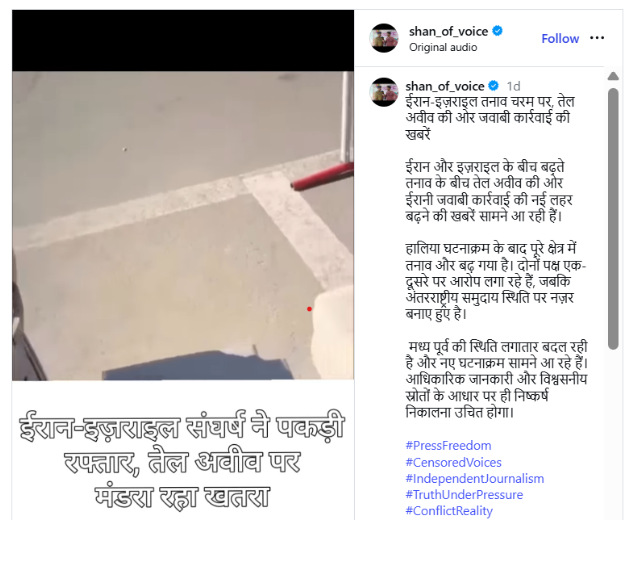
Amid renewed military tensions between Iran and Israel in West Asia, a video is widely circulating on social media showing a multi-storey building being struck, followed by a massive explosion and fire. Several users are sharing this clip with the claim that it shows a recent Iranian attack on Tel Aviv, Israel. However, CyberPeace Research Wing research found that the claim is misleading. The viral video has no connection to the current Iran–Israel conflict. It is actually from a Russian drone strike in Ukraine that took place in September 2025, and is now being falsely linked to the ongoing tensions in West Asia.
Claim
An Instagram user shared the viral video with the caption:“Iran–Israel tensions at peak, reports of retaliatory action towards Tel Aviv… New wave of Iranian response towards Tel Aviv amid escalating tensions between Iran and Israel. The situation in the region continues to intensify as both sides accuse each other, while the international community closely monitors developments. The Middle East situation is rapidly evolving and updates are emerging. It is important to rely only on official information and credible sources.”
https://www.instagram.com/shan_of_voice/reel/DZWRp8vqiM8
https://archive.ph/s26qV
Fact Check
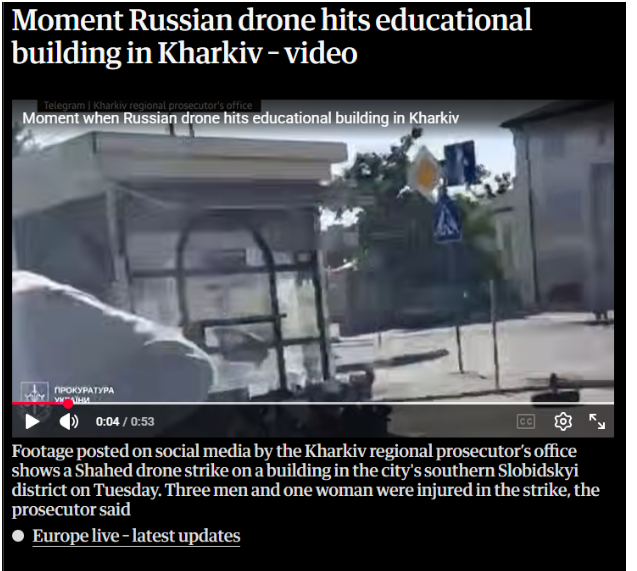
To verify the authenticity of the video, we extracted keyframes and conducted a Google Lens reverse image search. The same footage was found in a report published by The Guardian on 16 September 2025.
According to the report, the video shows a Russian drone strike on a building in Kharkiv, Ukraine, in which three men and one woman were injured.
Further verification through keyword search led us to the same footage on the official YouTube channel of Associated Press, published on 17 September 2025.
https://www.youtube.com/watch?v=cAke3aAhPxs

The Associated Press also confirmed that the video shows a Russian drone strike on a building in Kharkiv, Ukraine.
Conclusion
Our research found that the viral video has no connection to the ongoing Iran–Israel tensions or any attack on Tel Aviv. The footage is from a Russian drone strike in Kharkiv, Ukraine (September 2025), and is being misleadingly shared in the context of the West Asia conflict.
Related Blogs

.webp)
Introduction
Conversations surrounding the scourge of misinformation online typically focus on the risks to social order, political stability, economic safety and personal security. An oft-overlooked aspect of this phenomenon is the fact that it also takes a very real emotional and mental toll on people. Even as we grapple with the big picture questions about financial fraud or political rumors or inaccurate medical information online, we must also appreciate the fact that being exposed to misinformation and becoming aware of one’s own vulnerability are both significant sources of mental stress in today’s digital ecosystem.
Inaccurate information causes confusion and worry, which has negative consequences for mental health. Misinformation may also impair people's sense of well-being by undermining their trust in institutions, authority figures, and their own judgment. The constant bombardment of misinformation can lead to information overload, wherein people are unable to discriminate between legitimate sources and misleading content, resulting in mental exhaustion and a sense of being overwhelmed by the sheer volume of information available. Vulnerable groups such as children, the elderly, and those with pre-existing health conditions are more sensitive or susceptible to the negative effects of misinformation.
How Does Misinformation Endanger Mental Health?
Misinformation on social media platforms is a matter of public health because it has the potential to confuse people, lead to poor decision-making and result in cognitive dissonance, anxiety and unwanted behavioural changes.
Unconstrained misinformation can also lead to social disorder and the prevalence of negative emotions amongst larger numbers, ultimately causing a huge impact on society. Therefore, understanding the spread and diffusion characteristics of misinformation on Internet platforms is crucial.
The spread of misinformation can elicit different emotions of the public, and the emotions also change with the spread of misinformation. Factors such as user engagement, number of comments, and time of discussion all have an impact on the change of emotions in misinformation. Active users tend to make more comments, engage longer in discussions, and display more dominant negative emotions when triggered by misinformation. Understanding the evolution pattern of emotions triggered by misinformation is also important in view of the public’s emotional fluctuations under the influence of misinformation, and social media often magnifies the impact of emotions and makes emotions spread rapidly in social networks. For example, the sentiment of misinformation increases when there are sensitive topics such as political elections, viral trending topics, health-related information, communal and local information, information about natural disasters and more. Active misinformation on the Internet not only affects the public's psychology, mental health and behavior, but also has an impact on the stability of social order and the maintenance of social security.
Prebunking and Debunking To Build Mental Guards Against Misinformation
As the spread of misinformation and disinformation rises, so do the techniques aimed to tackle their spread. Prebunking or attitudinal inoculation is a technique for training individuals to recogniseand resist deceptive communications before they can take root. Prebunking is a psychological method for mitigating the effects of misinformation, strengthening resilience and creating cognitive defenses against future misinformation. Debunking provides individuals with accurate information to counter false claims and myths, correcting misconceptions and preventing the spread of misinformation. By presenting evidence-based refutations, debunking helps individuals distinguish fact from fiction.
What do health experts say about online misinformation?
“In the21st century, mental health is crucial due to the overwhelming amount of information available online. The COVID-19 pandemic-related misinformation was a prime example of this, with misinformation spreading online, leading to increased anxiety, panic buying, fear of leaving home, and mistrust in health measures. To protect our mental health, it is essential to cultivate a discerning mindset, question sources, and verify information before consumption. Fostering a supportive community that encourages open dialogue and fact-checking can help navigate the digital information landscape with confidence and emotional support. Prioritising self-care routines, mindfulness practices, and seeking professional guidance are also crucial for safeguarding mental health in the digital information era.”
In conversation with CyberPeace ~ Says Dubai-based psychologist, Aishwarya Menon, (BA,in Psychology and Criminology from the University of Westen Ontario, London and MA in Mental Health and Addictions (Humber College, University of Guelph),Toronto.
CyberPeace Policy Recommendations:
1) Countering misinformation is everyone's shared responsibility. To mitigate the negative effects of infodemics online, we must look at developing strong legal policies, creating and promoting awareness campaigns, relying on authenticated content on mass media, and increasing people's digital literacy.
2) Expert organisations actively verifying the information through various strategies including prebunking and debunking efforts are among those best placed to refute misinformation and direct users to evidence-based information sources. It is recommended that countermeasures for users on platforms be increased with evidence-based data or accurate information.
3) The role of social media platforms is crucial in the misinformation crisis, hence it is recommended that social media platforms actively counter the production of misinformation on their platforms. Local, national, and international efforts and additional research are required to implement the robust misinformation counterstrategies.
4) Netizens are advised or encouraged to follow official sources to check the reliability of any news or information. They must recognise the red flags by recognising the signs such as questionable facts, poorly written texts, surprising or upsetting news, fake social media accounts and fake websites designed to look like legitimate ones. Netizens are also encouraged to develop cognitive skills to discern fact and reality. Netizens are advised to approach information with a healthy dose of skepticism and curiosity.
Final Words:
It is crucial to protect mental health by escalating and disturbing the rise of misinformation incidents on various subjects, safeguarding our minds requires cognitive skills, building media literacy and verifying the information from trusted sources, prioritising mental health by self-care practices and staying connected with supportive authenticated networks. Promoting prebunking and debunking initiatives is necessary. Netizen scan protect themselves against the negative effects of misinformation and cultivate a resilient mindset in the digital information age.
References:
- https://www.hindawi.com/journals/scn/2021/7999760/
- https://www.ncbi.nlm.nih.gov/pmc/articles/PMC8502082/
.webp)
Introduction
In the intricate maze of our interconnected world, an unseen adversary conducts its operations with a stealth almost poetic in its sinister intent. This adversary — malware — has extended its tendrils into the digital sanctuaries of Mac users, long perceived as immune to such invasive threats. Our narrative today does not deal with the physical and tangible frontlines we are accustomed to; this is a modern tale of espionage, nestled in the zeros and ones of cyberspace.
The Mac platform, cradled within the fortifications of Apple's walled garden ecosystem, has stood as a beacon of resilience amidst the relentless onslaught of cyber threats. However, this sense of imperviousness has been shaken at its core, heralding a paradigm shift. A new threat lies in wait, bridging the gap between perceived security and uncomfortable vulnerability.
The seemingly invincible Mac OS X, long heralded for its robust security features and impervious resilience to virus attacks, faces an undercurrent of siege tactics from hackers driven by a relentless pursuit for control. This narrative is not about the front-and-centre warfare we see so often reported in media headlines. Instead, it veils itself within the actions of users as benign as the download of pirated software from the murky depths of warez websites.
The Incident
The casual act, born out of innocence or economic necessity, to sidestep the financial requisites of licensed software, has become the unwitting point of compromised security. Users find themselves on the battlefield, one that overshadows the significance of its physical counterpart with its capacity for surreptitious harm. The Mac's seeming invulnerability is its Achilles' heel, as the wariness against potential threats has been eroded by the myth of its impregnability.
The architecture of this silent assault is not one of brute force but of guile. Cyber marauders finesse their way through the defenses with a diversified arsenal; pirated content is but a smokescreen behind which trojans lie in ambush. The very appeal of free access to premium applications is turned against the user, opening a rift that permits these malevolent forces to ingress.
The trojans that permeate the defenses of the Mac ecosystem are architects of chaos. They surreptitiously enrol devices into armies of sorts – botnets which, unbeknownst to their hosts, become conduits for wider assaults on privacy and security. These machines, now soldiers in an unconsented war, are puppeteered to distribute further malware, carry out phishing tactics, and breach the sanctity of secure data.
The Trojan of Mac
A recent exposé by the renowned cybersecurity firm Kaspersky has shone a spotlight on this burgeoning threat. The meticulous investigation conducted in April of this year unveiled a nefarious campaign, engineered to exploit the complacency among Mac users. This operation facilitates the sale of proxy access, linking previously unassailable devices to the infrastructure of cybercriminal networks.
This revelation cannot be overstated in its importance. It illustrates with disturbing clarity the evolution and sophistication of modern malware campaigns. The threat landscape is not stagnant but ever-shifting, adapting with both cunning and opportunity.
Kaspersky's diligence in dissecting this threat detected nearly three dozen popular applications, and tools relied upon by individuals and businesses alike for a multitude of tasks. These apps, now weaponised, span a gamut of functionalities - image editing and enhancement, video compression, data recovery, and network scanning among them. Each one, once a benign asset to productivity, is twisted into a lurking danger, imbued with the power to betray its user.
The duplicity of the trojan is shrouded in mimicry; it disguises its malicious intent under the guise of 'WindowServer,' a legitimate system process intrinsic to the macOS. Its camouflage is reinforced by an innocuously named file, 'GoogleHelperUpdater.plist' — a moniker engineered to evade suspicion and blend seamlessly with benign processes affiliated with familiar applications.
Mode of Operation
Its mode of operation, insidious in its stealth, utilises the Transmission Control Protocol(TCP) and User Datagram Protocol(UDP) networking protocols. This modus operandi allows it to masquerade as a benign proxy. The full scope of its potential commands, however, eludes our grasp, a testament to the shadowy domain from which these threats emerge.
The reach of this trojan does not cease at the periphery of Mac's operating system; it harbours ambitions that transcend platforms. Windows and Android ecosystems, too, find themselves under the scrutiny of this burgeoning threat.
This chapter in the ongoing saga of cybersecurity is more than a cautionary tale; it is a clarion call for vigilance. The war being waged within the circuits and code of our devices underscores an inescapable truth: complacency is the ally of the cybercriminal.
Safety measures and best practices
It is imperative to safeguard the Mac system from harmful intruders, which are constantly evolving. Few measures can play a crucial role in protecting your data in your Mac systems.
- Refrain from Unlicensed Software - Refrain from accessing and downloading pirated software. Plenty of software serves as a decoy for malware which remains dormant till downloaded files are executed.
- Use Trusted Source: Downloading files from legitimate and trusted sources can significantly reduce the threat of any unsolicited files or malware making its way into your Mac system.
- Regular system updates: Regular updates to systems released by the company ensure the latest patches are installed in the system critical to combat and neutralize emerging threats.
- General Awareness: keeping abreast of the latest developments in cyberspace plays a crucial role in avoiding new and emerging threats. It is crucial to keep pace with trends and be well-informed about new threats and ways to combat them.
Conclusion
In conclusion, this silent conflict, though waged in whispers, echoes with repercussions that reverberate through every stratum of digital life. The cyber threats that dance in the shadows cast by our screens are not figments of paranoia, but very real specters hunting for vulnerabilities to exploit. Mac users, once confident in their platforms' defenses, must awaken to the new dawn of cybersecurity awareness.
The battlefield, while devoid of the visceral carnage of physical warfare, is replete with casualties of privacy and breaches of trust. The soldiers in this conflict are disguised as serviceable code, enacting their insidious agendas beneath a façade of normalcy. The victims eschew physical wounds for scars on their digital identities, enduring theft of information, and erosion of security.
As we course through the daunting terrain of digital life, it becomes imperative to heed the lessons of this unseen warfare. Shadows may lie unseen, but it is within their obscurity that the gravest dangers often lurk, a reminder to remain ever vigilant in the face of the invisible adversary.
References:

Introduction
In an era when misinformation spreads like wildfire across the digital landscape, the need for effective strategies to counteract these challenges has grown exponentially in a very short period. Prebunking and Debunking are two approaches for countering the growing spread of misinformation online. Prebunking empowers individuals by teaching them to discern between true and false information and acts as a protective layer that comes into play even before people encounter malicious content. Debunking is the correction of false or misleading claims after exposure, aiming to undo or reverse the effects of a particular piece of misinformation. Debunking includes methods such as fact-checking, algorithmic correction on a platform, social correction by an individual or group of online peers, or fact-checking reports by expert organisations or journalists. An integrated approach which involves both strategies can be effective in countering the rapid spread of misinformation online.
Brief Analysis of Prebunking
Prebunking is a proactive practice that seeks to rebut erroneous information before it spreads. The goal is to train people to critically analyse information and develop ‘cognitive immunity’ so that they are less likely to be misled when they do encounter misinformation.
The Prebunking approach, grounded in Inoculation theory, teaches people to recognise, analyse and avoid manipulation and misleading content so that they build resilience against the same. Inoculation theory, a social psychology framework, suggests that pre-emptively conferring psychological resistance against malicious persuasion attempts can reduce susceptibility to misinformation across cultures. As the term suggests, the MO is to help the mind in the present develop resistance to influence that it may encounter in the future. Just as medical vaccines or inoculations help the body build resistance to future infections by administering weakened doses of the harm agent, inoculation theory seeks to teach people fact from fiction through exposure to examples of weak, dichotomous arguments, manipulation tactics like emotionally charged language, case studies that draw parallels between truths and distortions, and so on. In showing people the difference, inoculation theory teaches them to be on the lookout for misinformation and manipulation even, or especially, when they least expect it.
The core difference between Prebunking and Debunking is that while the former is preventative and seeks to provide a broad-spectrum cover against misinformation, the latter is reactive and focuses on specific instances of misinformation. While Debunking is closely tied to fact-checking, Prebunking is tied to a wider range of specific interventions, some of which increase motivation to be vigilant against misinformation and others increase the ability to engage in vigilance with success.
There is much to be said in favour of the Prebunking approach because these interventions build the capacity to identify misinformation and recognise red flags However, their success in practice may vary. It might be difficult to scale up Prebunking efforts and ensure their reach to a larger audience. Sustainability is critical in ensuring that Prebunking measures maintain their impact over time. Continuous reinforcement and reminders may be required to ensure that individuals retain the skills and information they gained from the Prebunking training activities. Misinformation tactics and strategies are always evolving, so it is critical that Prebunking interventions are also flexible and agile and respond promptly to developing challenges. This may be easier said than done, but with new misinformation and cyber threats developing frequently, it is a challenge that has to be addressed for Prebunking to be a successful long-term solution.
Encouraging people to be actively cautious while interacting with information, acquire critical thinking abilities, and reject the effect of misinformation requires a significant behavioural change over a relatively short period of time. Overcoming ingrained habits and prejudices, and countering a natural reluctance to change is no mean feat. Developing a widespread culture of information literacy requires years of social conditioning and unlearning and may pose a significant challenge to the effectiveness of Prebunking interventions.
Brief Analysis of Debunking
Debunking is a technique for identifying and informing people that certain news items or information are incorrect or misleading. It seeks to lessen the impact of misinformation that has already spread. The most popular kind of Debunking occurs through collaboration between fact-checking organisations and social media businesses. Journalists or other fact-checkers discover inaccurate or misleading material, and social media platforms flag or label it. Debunking is an important strategy for curtailing the spread of misinformation and promoting accuracy in the digital information ecosystem.
Debunking interventions are crucial in combating misinformation. However, there are certain challenges associated with the same. Debunking misinformation entails critically verifying facts and promoting corrected information. However, this is difficult owing to the rising complexity of modern tools used to generate narratives that combine truth and untruth, views and facts. These advanced approaches, which include emotional spectrum elements, deepfakes, audiovisual material, and pervasive trolling, necessitate a sophisticated reaction at all levels: technological, organisational, and cultural.
Furthermore, It is impossible to debunk all misinformation at any given time, which effectively means that it is impossible to protect everyone at all times, which means that at least some innocent netizens will fall victim to manipulation despite our best efforts. Debunking is inherently reactive in nature, addressing misinformation after it has grown extensively. This reactionary method may be less successful than proactive strategies such as Prebunking from the perspective of total harm done. Misinformation producers operate swiftly and unexpectedly, making it difficult for fact-checkers to keep up with the rapid dissemination of erroneous or misleading information. Debunking may need continuous exposure to fact-check to prevent erroneous beliefs from forming, implying that a single Debunking may not be enough to rectify misinformation. Debunking requires time and resources, and it is not possible to disprove every piece of misinformation that circulates at any particular moment. This constraint may cause certain misinformation to go unchecked, perhaps leading to unexpected effects. The misinformation on social media can be quickly spread and may become viral faster than Debunking pieces or articles. This leads to a situation in which misinformation spreads like a virus, while the antidote to debunked facts struggles to catch up.
Prebunking vs Debunking: Comparative Analysis
Prebunking interventions seek to educate people to recognise and reject misinformation before they are exposed to actual manipulation. Prebunking offers tactics for critical examination, lessening the individuals' susceptibility to misinformation in a variety of contexts. On the other hand, Debunking interventions involve correcting specific false claims after they have been circulated. While Debunking can address individual instances of misinformation, its impact on reducing overall reliance on misinformation may be limited by the reactive nature of the approach.
.png)
CyberPeace Policy Recommendations for Tech/Social Media Platforms
With the rising threat of online misinformation, tech/social media platforms can adopt an integrated strategy that includes both Prebunking and Debunking initiatives to be deployed and supported on all platforms to empower users to recognise the manipulative messaging through Prebunking and be aware of the accuracy of misinformation through Debunking interventions.
- Gamified Inoculation: Tech/social media companies can encourage gamified inoculation campaigns, which is a competence-oriented approach to Prebunking misinformation. This can be effective in helping people immunise the receiver against subsequent exposures. It can empower people to build competencies to detect misinformation through gamified interventions.
- Promotion of Prebunking and Debunking Campaigns through Algorithm Mechanisms: Tech/social media platforms may promote and guarantee that algorithms prioritise the distribution of Prebunking materials to users, boosting educational content that strengthens resistance to misinformation. Platform operators should incorporate algorithms that prioritise the visibility of Debunking content in order to combat the spread of erroneous information and deliver proper corrections; this can eventually address and aid in Prebunking and Debunking methods to reach a bigger or targeted audience.
- User Empowerment to Counter Misinformation: Tech/social media platforms can design user-friendly interfaces that allow people to access Prebunking materials, quizzes, and instructional information to help them improve their critical thinking abilities. Furthermore, they can incorporate simple reporting tools for flagging misinformation, as well as links to fact-checking resources and corrections.
- Partnership with Fact-Checking/Expert Organizations: Tech/social media platforms can facilitate Prebunking and Debunking initiatives/campaigns by collaborating with fact-checking/expert organisations and promoting such initiatives at a larger scale and ultimately fighting misinformation with joint hands initiatives.
Conclusion
The threat of online misinformation is only growing with every passing day and so, deploying effective countermeasures is essential. Prebunking and Debunking are the two such interventions. To sum up: Prebunking interventions try to increase resilience to misinformation, proactively lowering susceptibility to erroneous or misleading information and addressing broader patterns of misinformation consumption, while Debunking is effective in correcting a particular piece of misinformation and having a targeted impact on belief in individual false claims. An integrated approach involving both the methods and joint initiatives by tech/social media platforms and expert organizations can ultimately help in fighting the rising tide of online misinformation and establishing a resilient online information landscape.
References
- https://mark-hurlstone.github.io/THKE.22.BJP.pdf
- https://futurefreespeech.org/wp-content/uploads/2024/01/Empowering-Audiences-Through-%E2%80%98Prebunking-Michael-Bang-Petersen-Background-Report_formatted.pdf
- https://newsreel.pte.hu/news/unprecedented_challenges_Debunking_disinformation
- https://misinforeview.hks.harvard.edu/article/global-vaccination-badnews/