
#FactCheck-Old Photo of Kareena Kapoor Khan Falsely Shared as Fresh Pregnancy Claim
Executive Summary
A photo of Bollywood actress Kareena Kapoor Khan is being widely shared on social media with the claim that she is pregnant again. In the viral image, Kareena appears with a visible baby bump, leading users to speculate about another pregnancy. However, research by the CyberPeace Research Wing found the claim to be misleading. The research revealed that the image is not recent and is actually from 2020, now being reshared with a false narrative.
Claim:
An Instagram user shared the viral image on April 18, 2026, and posted a caption jokingly suggesting that after Taimur and Jehangir, Kareena was expecting more children.

Fact Check:
To verify the claim, relevant keyword searches were conducted online, but no credible media report was found supporting the claim that Kareena Kapoor Khan is currently pregnant. A reverse search of the viral visual led to an older video uploaded on the YouTube channel Bol Bollywood on December 7, 2020, where the same image was used.

Further research also found a similar video report on the YouTube channel Bollywood Bluff, published on December 8, 2020, featuring the same visual and similar claims. These findings confirmed that the viral image is several years old and unrelated to any recent development.

Conclusion:
The claim that Kareena Kapoor Khan is pregnant again is misleading. The viral photo is not recent but an old image from 2020 that is being circulated with a false claim.

Related Blogs

Executive Summary
A video is being shared on social media with the claim that an Indian Air Force (IAF) MiG-29 fighter jet crashed while landing due to the pilot’s negligence. The claim further alleges that no casualties were reported in the incident and that the IAF is concealing the incident because it is losing fighter jets at a high rate. The video is being widely shared on social media.
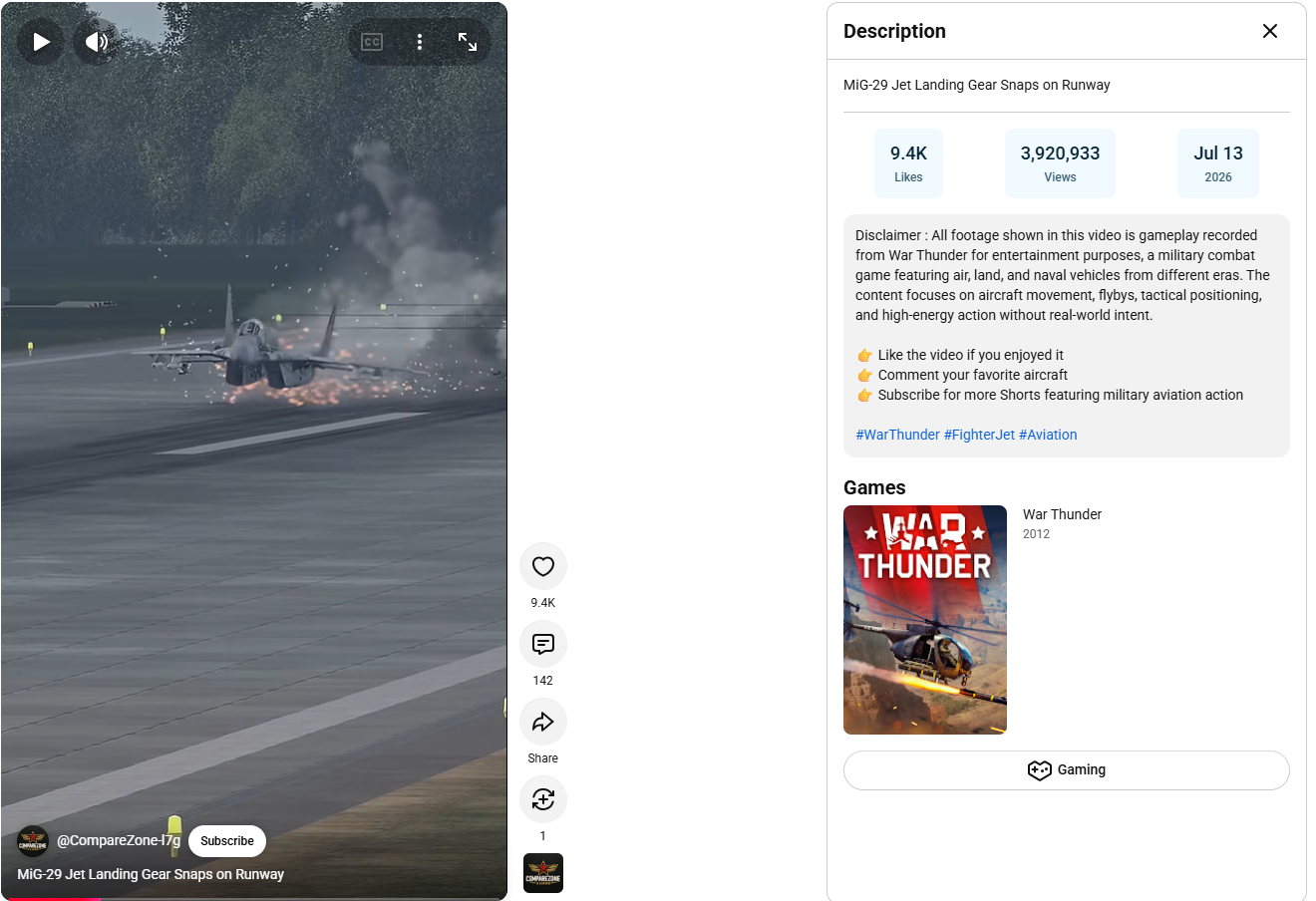
CyberPeace Research found the claim to be false. Our Research revealed that the video is not footage of an actual IAF MiG-29 crash, but gameplay footage from the video game War Thunder, which is being shared with a false and misleading claim.
Claim:
An Indian Air Force MiG-29 fighter jet crashed while landing, with pilot error being blamed for the incident. The post further claims that the IAF is trying to conceal the incident.
https://x.com/sheikh__khirad/status/2100447634599342114?s=20

Fact Check
To verify the claim, we conducted a Google search using relevant keywords. However, we did not find any credible media report supporting the claim. We also checked the official X account of the Indian Army, but found no post confirming the claim.
https://x.com/adgpi

As part of our further research, we conducted a reverse image search of keyframes from the video. During the search, we found a YouTube channel where similar visuals had been uploaded.

We found that the channel regularly posts gaming-related content. At the end of our research, we found the original version of the viral video on the YouTube channel. It was published on July 13, 2026. The video description also clearly states that the footage is gaming content and not a real-life incident.
https://www.youtube.com/shorts/dVu0eMztePo
Conclusion
Our research found that the video being shared with the claim that an IAF MiG-29 fighter jet crashed during landing does not depict a real incident. The video is actually gameplay footage from the video game War Thunder.Therefore, gaming footage is being falsely presented on social media as footage of an Indian Air Force MiG-29 crashing during landing. The incident shown in the video is not real.

Introduction
Global cybersecurity spending is expected to breach USD 210 billion in 2025, a ~10% increase from 2024 (Gartner). This is a result of an evolving and increasingly critical threat landscape enabled by factors such as the proliferation of IoT devices, the adoption of cloud networks, and the increasing size of the internet itself. Yet, breaches, misuse, and resistance persist. In 2025, global attack pressure rose ~21% Y-o-Y ( Q2 averages) (CheckPoint) and confirmed breaches climbed ~15%( Verizon DBIR). This means that rising investment in cybersecurity may not be yielding proportionate reductions in risk. But while mechanisms to strengthen technical defences and regulatory frameworks are constantly evolving, the social element of trust and how to embed it into cybersecurity systems remain largely overlooked.
Human Error and Digital Trust (Individual Trust)
Human error is consistently recognised as the weakest link in cybersecurity. While campaigns focusing on phishing prevention, urging password updates and using two-factor authentication (2FA) exist, relying solely on awareness measures to address human error in cyberspace is like putting a Band-Aid on a bullet wound. Rather, it needs to be examined through the lens of digital trust. As Chui (2022) notes, digital trust rests on security, dependability, integrity, and authenticity. These factors determine whether users comply with cybersecurity protocols. When people view rules as opaque, inconvenient, or imposed without accountability, they are more likely to cut corners, which creates vulnerabilities. Therefore, building digital trust means shifting from blaming people to design: embedding transparency, usability, and shared responsibility towards a culture of cybersecurity so that users are incentivised to make secure choices.
Organisational Trust and Insider Threats (Institutional Trust)
At the organisational level, compliance with cybersecurity protocols is significantly tied to whether employees trust employers/platforms to safeguard their data and treat them with integrity. Insider threats, stemming from both malicious and non-malicious actors, account for nearly 60% of all corporate breaches (Verizon DBIR 2024). A lack of trust in leadership may cause employees to feel disengaged or even act maliciously. Further, a 2022 study by Harvard Business Review finds that adhering to cybersecurity protocols adds to employee workload. When they are perceived as hindering productivity, employees are more likely to intentionally violate these protocols. The stress of working under surveillance systems that feel cumbersome or unreasonable, especially when working remotely, also reduces employee trust and, hence, compliance.
Trust, Inequality, and Vulnerability (Structural Trust)
Cyberspace encompasses a social system of its own since it involves patterned interactions and relationships between human beings. It also reproduces the social structures and resultant vulnerabilities of the physical world. As a result, different sections of society place varying levels of trust in digital systems. Women, rural, and marginalised groups often distrust existing digital security provisions more, and with reason. They are targeted disproportionately by cyber attackers, and yet are underprotected by systems, since these are designed prioritising urban/ male/ elite users. This leads to citizens adopting workarounds like password sharing for “safety” and disengaging from cyber safety discourse, as they find existing systems inaccessible or irrelevant to their realities. Cybersecurity governance that ignores these divides deepens exclusion and mistrust.
Laws and Compliances (Regulatory Trust)
Cybersecurity governance is operationalised in the form of laws, rules, and guidelines. However, these may often backfire due to inadequate design, reducing overall trust in governance mechanisms. For example, CERT-In’s mandate to report breaches within six hours of “noticing” it has been criticised as the steep timeframe being insufficient to generate an effective breach analysis report. Further, the multiplicity of regulatory frameworks in cross-border interactions can be costly and lead to compliance fatigue for organisations. Such factors can undermine organisational and user trust in the regulation’s ability to protect them from cyber attacks, fuelling a check-box-ticking culture for cybersecurity.
Conclusion
Cybersecurity is addressed primarily through code, firewall, and compliance today. But evidence suggests that technological and regulatory fixes, while essential, are insufficient to guarantee secure behaviour and resilient systems. Without trust in institutions, technologies, laws or each other, cybersecurity governance will remain a cat-and-mouse game. Building a trust-based architecture requires mechanisms to improve accountability, reliability, and transparency. It requires participatory designs of security systems and the recognition of unequal vulnerabilities. Thus, unless cybersecurity governance acknowledges that cyberspace is deeply social, investment may not be able to prevent the harms it seeks to curb.
References
- https://www.gartner.com/en/newsroom/press-releases/2025-07-29
- https://blog.checkpoint.com/research/global-cyber-attacks-surge-21-in-q2-2025
- https://www.verizon.com/business/resources/reports/2024-dbir-executive-summary.pdf
- https://www.verizon.com/business/resources/reports/2025-dbir-executive-summary.pdf
- https://insights2techinfo.com/wp-content/uploads/2023/08/Building-Digital-Trust-Challenges-and-Strategies-in-Cybersecurity.pdf
- https://www.coe.int/en/web/cyberviolence/cyberviolence-against-women
- https://www.upguard.com/blog/indias-6-hour-data-breach-reporting-rule

A report by MarketsandMarkets in 2024 showed that the global AI market size is estimated to grow from USD 214.6 billion in 2024 to USD 1,339.1 billion in 2030, at a CAGR of 35.7%. AI has become an enabler of productivity and innovation. A Forbes Advisor survey conducted in 2023 reported that 56% of businesses use AI to optimise their operations and drive efficiency. Further, 51% use AI for cybersecurity and fraud management, 47% employ AI-powered digital assistants to enhance productivity and 46% use AI to manage customer relationships.
AI has revolutionised business functions. According to a Forbes survey, 40% of businesses rely on AI for inventory management, 35% harness AI for content production and optimisation and 33% deploy AI-driven product recommendation systems for enhanced customer engagement. This blog addresses the opportunities and challenges posed by integrating AI into operational efficiency.
Artificial Intelligence and its resultant Operational Efficiency
AI has exemplary optimisation or efficiency capabilities and is widely used to do repetitive tasks. These tasks include payroll processing, data entry, inventory management, patient registration, invoicing, claims processing, and others. AI use has been incorporated into such tasks as it can uncover complex patterns using NLP, machine learning, and deep learning beyond human capabilities. It has also shown promise in improving the decision-making process for businesses in time-critical, high-pressure situations.
AI-driven efficiency is visible in industries such as the manufacturing industry for predictive maintenance, in the healthcare industry for streamlining diagnostics and in logistics for route optimisation. Some of the most common real-world examples of AI increasing operational efficiency are self-driving cars (Tesla), facial recognition (Apple Face ID), language translation (Google Translate), and medical diagnosis (IBM Watson Health)
Harnessing AI has advantages as it helps optimise the supply chain, extend product life cycles, and ultimately conserve resources and cut operational costs.
Policy Implications for AI Deployment
Some of the policy implications for development for AI deployment are as follows:
- Develop clear and adaptable regulatory frameworks for the ongoing and future developments in AI. The frameworks need to ensure that innovation is not hindered while managing the potential risks.
- As AI systems rely on high-quality data that is accessible and interoperable to function effectively and without proper data governance, these systems may produce results that are biased, inaccurate and unreliable. Therefore, it is necessary to ensure data privacy as it is essential to maintain trust and prevent harm to individuals and organisations.
- Policy developers need to focus on creating policies that upskill the workforce which complements AI development and therefore job displacement.
- To ensure cross-border applicability and efficiency of standardising AI policies, the policy-makers need to ensure that international cooperation is achieved when developing the policies.
Addressing Challenges and Risks
Some of the main challenges that emerge with the development of AI are algorithmic bias, cybersecurity threats and the dependence on exclusive AI solutions or where the company retains exclusive control over the source codes. Some policy approaches that can be taken to mitigate these challenges are:
- Having a robust accountability mechanism.
- Establishing identity and access management policies that have technical controls like authentication and authorisation mechanisms.
- Ensure that the learning data that AI systems use follows ethical considerations such as data privacy, fairness in decision-making, transparency, and the interpretability of AI models.
Conclusion
AI can contribute and provide opportunities to drive operational efficiency in businesses. It can be an optimiser for productivity and costs and foster innovation for different industries. But this power of AI comes with its own considerations and therefore, it must be balanced with proactive policies that address the challenges that emerge such as the need for data governance, algorithmic bias and risks associated with cybersecurity. A solution to overcome these challenges is establishing an adaptable regulatory framework, fostering workforce upskilling and promoting international collaborations. As businesses integrate AI into core functions, it becomes necessary to leverage its potential while safeguarding fairness, transparency, and trust. AI is not just an efficiency tool, it has become a stimulant for organisations operating in a rapidly evolving digital world.
References
- https://indianexpress.com/article/technology/artificial-intelligence/ai-indian-businesses-long-term-gain-operational-efficiency-9717072/
- https://www.marketsandmarkets.com/Market-Reports/artificial-intelligence-market-74851580.html
- https://www.forbes.com/councils/forbestechcouncil/2024/08/06/smart-automation-ais-impact-on-operational-efficiency/
- https://www.processexcellencenetwork.com/ai/articles/ai-operational-excellence
- https://www.leewayhertz.com/ai-for-operational-efficiency/
- https://www.forbes.com/councils/forbestechcouncil/2024/11/04/bringing-ai-to-the-enterprise-challenges-and-considerations/
