
#FactCheck-AI-Generated Video Falsely Attributed to Baba Ramdev, Claiming He Called for PM Modi’s Resignation
Executive Summary
A video of yoga guru Baba Ramdev is being shared on social media. The video is accompanied by the claim that Baba Ramdev said the following about Prime Minister Narendra Modi: “Modi ji should now respectfully step down. This is not a favourable time for him, and the coming period will be unfavourable for both the country and him.” In the viral video, he can also allegedly be heard saying, “People had hoped for change, but instead of change, destruction has begun.” A research done by the Research Wing of the CyberPeace found the claim accompanying the viral video to be false. The research revealed that the viral clip is AI-generated.
Claim:
A Facebook user shared the viral video on August 25, 2026, with the caption: **“Modi ji should now respectfully step down. This is not a favourable time for him, and the coming period will be unfavourable for both the country and him. People had hoped for change, but instead of change, destruction has begun.”**
The link to the post, its archive link, and a screenshot are provided below.

FactCheck:
To verify the authenticity of the viral claim, we searched Google using relevant keywords. During the search, we did not find any credible media report corroborating the claim. As part of the research, we also scanned the viral video using the AI detection tool HIVE Moderation. According to the tool’s analysis, there was a 99 per cent likelihood that the voice in the viral video was AI-generated.
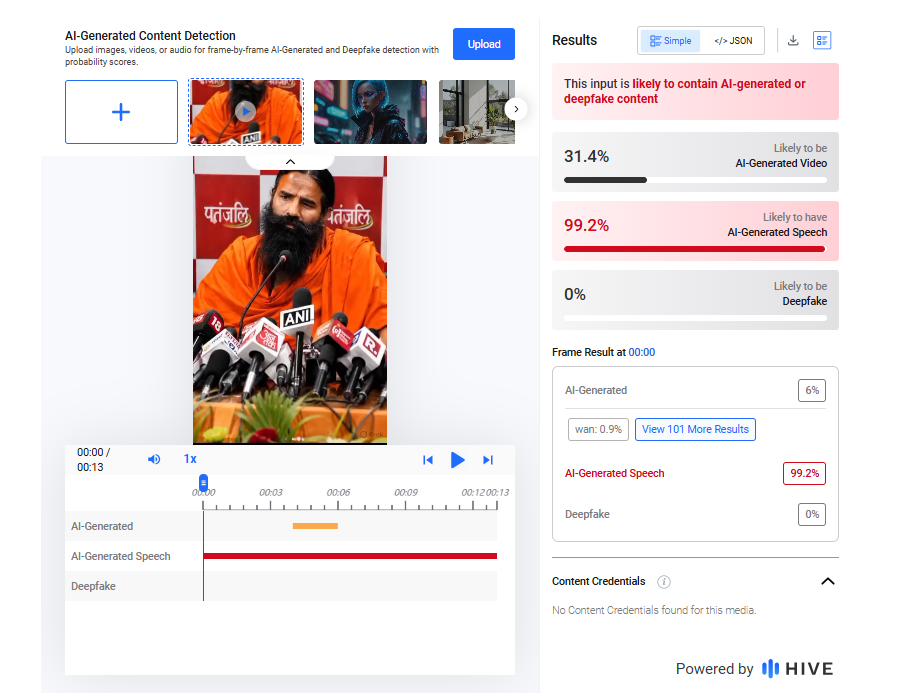
Additionally, we scanned the viral video using another AI detection tool, Detect AI. According to the tool’s analysis, there was a 71 per cent likelihood that the viral video was AI-generated.

Conclusion:
Our research found the claim accompanying the viral video to be false. The research revealed that the viral clip is AI-generated.

Related Blogs

Introduction
Microchips are the invisible foundation of the modern economy. From consumer electronics and automotive manufacturing to military defense and artificial intelligence, virtually every critical industry relies on semiconductor supply chains. Yet, despite their ubiquity, chip manufacturing remains one of the most complex and concentrated supply networks on the planet. This explainer breaks down the global semiconductor ecosystem: how chips are produced, where the primary vulnerabilities lie, and why control over silicon has become the defining geopolitical battleground of our time.
A Chip Crosses More Borders Than Most People Do
Chipmaking is a relay race across continents. Engineers design the layout, then factories carve it onto silicon wafers so precisely that a particle of dust can ruin a batch. A single chip may be designed in the United States, made in Taiwan on Dutch equipment, assembled in Malaysia or Vietnam, and soldered in China or India. Thus, the entire link in the chain is vulnerable, and the failure of one weak element will lead to the stoppage of the entire chain. The forecast for the industry in 2021 was complicated by pandemic-related constraints and record demand, resulting in the disruption of automakers’ production costs by $210 billion and the loss of 7.7 million vehicles, according to AlixPartners
The Geography of Silicon Power
Manufacturing clusters in East Asia: Taiwan is focused on advanced manufacturing, South Korea – on memory (Samsung, SK Hynix), Japan – on chemicals and equipment. South Korea is ready to double its DRAM production in 2026 by increasing it 5 times than 2025. China is seeking to reduce its dependence on imports, but it is not as far along in advanced manufacturing as many analysts believe. The US holds much of the underlying IP but manufactures a smaller share of it — TSMC's Arizona campus shows the shift, growing from $12 billion to over $165 billion, with a further $100 billion expansion announced in mid-2026 that could push the total to $265 billion, potentially the largest foreign direct investment in US history.
Foundry, Fabless, or Both?
The semiconductor industry runs on three primary business models:
- Fabless (Design-Only): Companies like NVIDIA, AMD, and Qualcomm focus exclusively on architecture, intellectual property, and circuit design. They outsource all physical fabrication to specialised manufacturers, which helps them stay agile.
- Pure-Play Foundries (Manufacturing-Only): Dedicated contract manufacturers, most prominently TSMC (Taiwan Semiconductor Manufacturing Company), take designs from fabless firms and produce the physical wafers. They invest billions annually in advanced lithography and don’t compete in product design.
- Integrated Device Manufacturers (IDMs): Legacy companies like Intel and Samsung manage the entire lifecycle, from designing and fabricating to packaging their own chips. However, maintaining both cutting-edge design and manufacturing capabilities has become more and more difficult, leading IDMs to adopt hybrid foundry strategies.
Advanced Packaging: The New Frontier
For decades, the primary driver of semiconductor performance was Moore’s Law: shrinking transistor dimensions on a single silicon die. But physical limitations are making traditional scaling prohibitively expensive, making the industry shift its focus to Advanced Packaging. Techniques like 2.5D and 3D stacking combine multiple chips with short, dense wiring, boosting speed and efficiency without shrinking transistors, which are crucial for AI hardware. TSMC's CoWoS platform is now considered as critical as fabrication itself, with demand regularly outpacing supply. Because packaging needs far less capital than a leading-edge fab, more countries are racing to build local packaging capacity.
Who Actually Runs This Industry
A few companies dominate the market. TSMC is the biggest contract manufacturer of chips, while Samsung is both a designer and a manufacturer. Intel is re-establishing its foundry business, while Nvidia has taken over the market for AI and graphics processing units. Qualcomm and MediaTek dominate the market for mobile phone chips, and AMD competes in the personal computer market. Finally, there is one tiny Dutch company, ASML, which has a monopoly on the most advanced lithography tools, called extreme ultraviolet, or EUV. Each such machine costs more than $15 billion, so there is no real competition for now. Broadcom, Micron, and SK Hynix are other important players, as they are major suppliers of memory chips for computers and cars, as well as AI chips.
Where Things Are Headed
AI remains central, pushing advanced packaging and high-bandwidth memory to the top of every strategy; SEMI projects 300mm memory equipment investment will exceed $50 billion in 2026. Trade policy now matters as much as technology. In January 2026, the U.S. imposed a 25 per cent tariff on advanced semiconductors and began applying case-by-case reviews to previously near-automatic rejections of requests for Chinese firms to buy state-of-the-art chips for use in artificial intelligence computers. The U.S. is incentivizing Taiwanese manufacturers to make semiconductors in America while South Korea, Japan, and the European Union have made efforts to encourage investment in their own display technology. According to an article from Bloomberg published in July 2026, new fabrication plants face a danger of being delayed for years due to a shortage of skilled workers, resulting in billions of dollars wasted on investments.
Conclusion
Ultimately, semiconductors represent the ultimate convergence of technology, commerce, and geopolitics. A single speck of silicon now carries the weight of global GDP, national security, and the future of artificial intelligence. As trade barriers rise and supply chains re-align, control over these micro-foundations will decide which economies lead and which get left behind. The next decade will be won by mastering advanced packaging, talent management, and forging strategic alliances.
References
AlixPartners. "Semiconductor Shortages to Cost the Auto Industry Billions." September 2021
TSMC. "TSMC Arizona." Company overview
World Semiconductor Trade Statistics (WSTS). "Global Semiconductor Market Surges Beyond $1.5T 2026."

A Foray into the Digital Labyrinth
In our digital age, the silhouette of truth is often obfuscated by a fog of technological prowess and cunning deception. With each passing moment, the digital expanse sprawls wider, and within it, synthetic media, known most infamously as 'deepfakes', emerge like phantoms from the machine. These adept forgeries, melding authenticity with fabrication, represent a new frontier in the malleable narrative of understood reality. Grappling with the specter of such virtual deceit, social media behemoths Facebook and YouTube have embarked on a prodigious quest. Their mission? To formulate robust bulwarks around the sanctity of fact and fiction, all the while fostering seamless communication across channels that billions consider an inextricable part of their daily lives.
In an exploration of this digital fortress besieged by illusion, we unpeel the layers of strategy that Facebook and YouTube have unfurled in their bid to stymie the proliferation of these insidious technical marvels. Though each platform approaches the issue through markedly different prisms, a shared undercurrent of necessity and urgency harmonizes their efforts.
The Detailing of Facebook's Strategic
Facebook's encampment against these modern-day chimaeras teems with algorithmic sentinels and human overseers alike—a union of steel and soul. The company’s layer upon layer of sophisticated artificial intelligence is designed to scrupulously survey, identify, and flag potential deepfake content with a precision that borders on the prophetic. Employing advanced AI systems, Facebook endeavours to preempt the chaos sown by manipulated media by detecting even the slightest signs of digital tampering.
However, in an expression of profound acumen, Facebook also serves reminder of AI's fallibility by entwining human discernment into its fabric. Each flagged video wages its battle for existence within the realm of these custodians of reality—individuals entrusted with the hefty responsibility of parsing truth from technologically enabled fiction.
Facebook does not rest on the laurels of established defense mechanisms. The platform is in a perpetual state of flux, with policies and AI models adapting to the serpentine nature of the digital threat landscape. By fostering its cyclical metamorphosis, Facebook not only sharpens its detection tools but also weaves a more resilient protective web, one capable of absorbing the shockwaves of an evolving battlefield.
YouTube’s Overture of Transparency and the Exposition of AI
Turning to the amphitheatre of YouTube, the stage is set for an overt commitment to candour. Against the stark backdrop of deepfake dilemmas, YouTube demands the unveiling of the strings that guide the puppets, insisting on full disclosure whenever AI's invisible hands sculpt the content that engages its diverse viewership.
YouTube's doctrine is straightforward: creators must lift the curtains and reveal any artificial manipulation's role behind the scenes. With clarity as its vanguard, this requirement is not just procedural but an ethical invocation to showcase veracity—a beacon to guide viewers through the murky waters of potential deceit.
The iron fist within the velvet glove of YouTube's policy manifests through a graded punitive protocol. Should a creator falter in disclosing the machine's influence, repercussions follow, ensuring that the ecosystem remains vigilant against hidden manipulation.
But YouTube's policy is one that distinguishes between malevolence and benign use. Artistic endeavours, satirical commentary, and other legitimate expositions are spared the policy's wrath, provided they adhere to the overarching principle of transparency.
The Symbiosis of Technology and Policy in a Morphing Domain
YouTube's commitment to refining its coordination between human insight and computerized examination is unwavering. As AI's role in both the generation and moderation of content deepens, YouTube—which, like a skilled cartographer, must redraw its policies increasingly—traverses this ever-mutating landscape with a proactive stance.
In a Comparative Light: Tracing the Convergence of Giants
Although Facebook and YouTube choreograph their steps to different rhythms, together they compose an intricate dance aimed at nurturing trust and authenticity. Facebook leans into the proactive might of their AI algorithms, reinforced by updates and human interjection, while YouTube wields the virtue of transparency as its sword, cutting through masquerades and empowering its users to partake in storylines that are continually rewritten.
Together on the Stage of Our Digital Epoch
The sum of Facebook and YouTube's policies is integral to the pastiche of our digital experience, a multifarious quilt shielding the sanctum of factuality from the interloping specters of deception. As humanity treads the line between the veracious and the fantastic, these platforms stand as vigilant sentinels, guiding us in our pursuit of an old-age treasure within our novel digital bazaar—the treasure of truth. In this labyrinthine quest, it is not merely about unmasking deceivers but nurturing a wisdom that appreciates the shimmering possibilities—and inherent risks—of our evolving connection with the machine.
Conclusion
The struggle against deepfakes is a complex, many-headed challenge that will necessitate a united front spanning technologists, lawmakers, and the public. In this digital epoch, where the veneer of authenticity is perilously thin, the valiant endeavours of these tech goliaths serve as a lighthouse in a storm-tossed sea. These efforts echo the importance of evergreen vigilance in discerning truth from artfully crafted deception.
References
- https://about.fb.com/news/2020/01/enforcing-against-manipulated-media/
- https://indianexpress.com/article/technology/artificial-intelligence/google-sheds-light-on-how-its-fighting-deep-fakes-and-ai-generated-misinformation-in-india-9047211/
- https://techcrunch.com/2023/11/14/youtube-adapts-its-policies-for-the-coming-surge-of-ai-videos/
- https://www.trendmicro.com/vinfo/us/security/news/cybercrime-and-digital-threats/youtube-twitter-hunt-down-deepfakes
Executive Summary
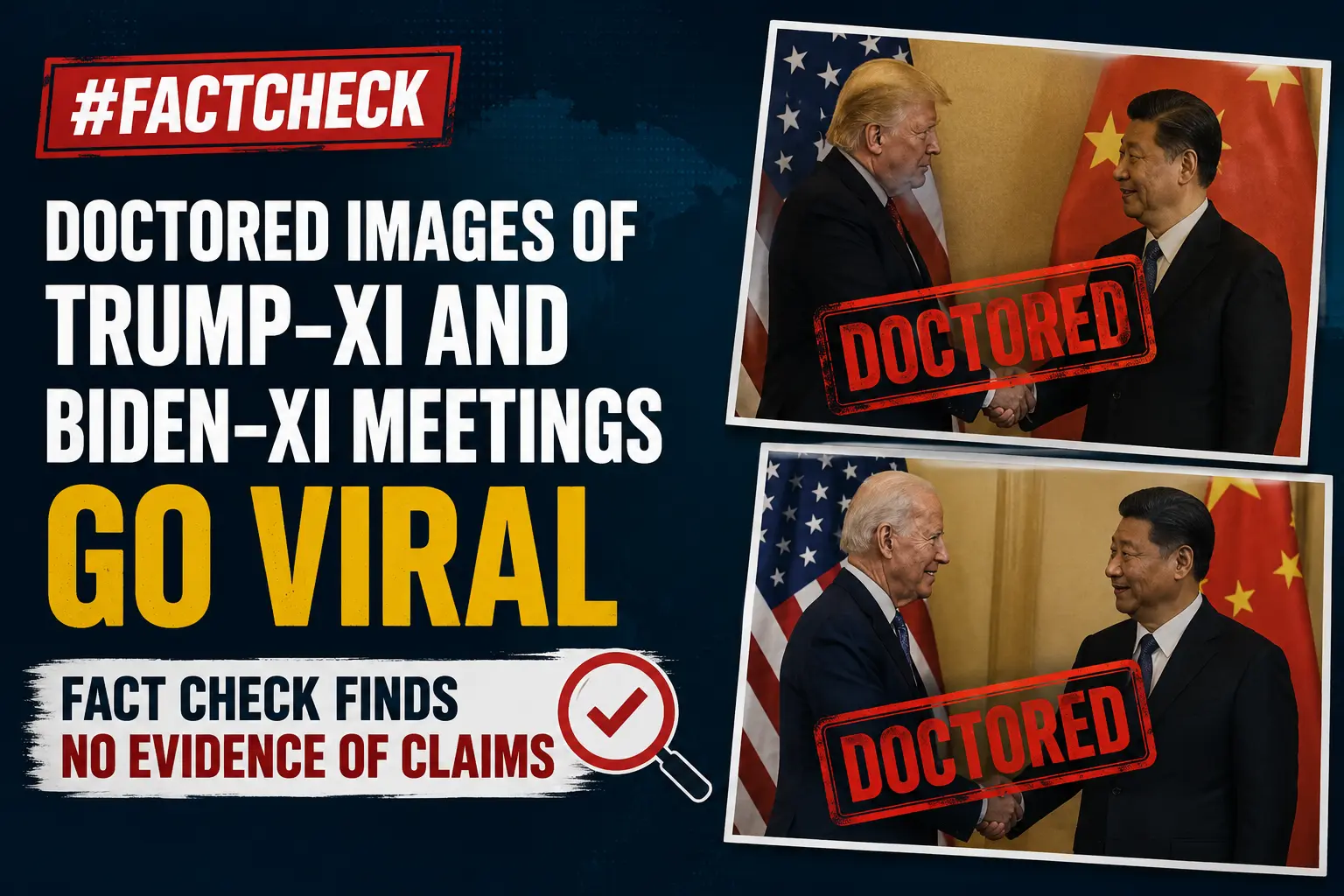
Following the recent meeting between US President Donald Trump and Chinese President Xi Jinping, two images began circulating widely on social media. One image showed Trump shaking hands with Xi, while another purportedly showed former US President Joe Biden turning his back on the Chinese leader during a previous meeting. The viral posts claimed that Trump showed respect to Xi Jinping, whereas Biden had allegedly insulted him. However, an research found that the image involving Biden was digitally altered and that no such moment appeared in authentic video footage. At the same time, another image showing Trump bowing before Xi Jinping also went viral across multiple social media platforms. This image, too, was found to be manipulated and misleading. Research by the CyberPeace Research Wing confirmed that both viral visuals had been doctored and were being shared with false claims.
Claim
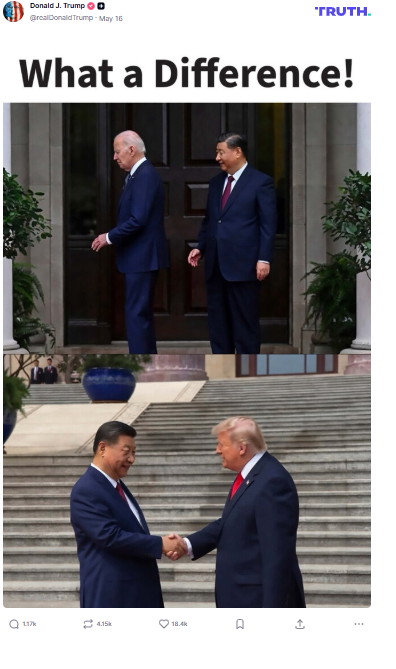
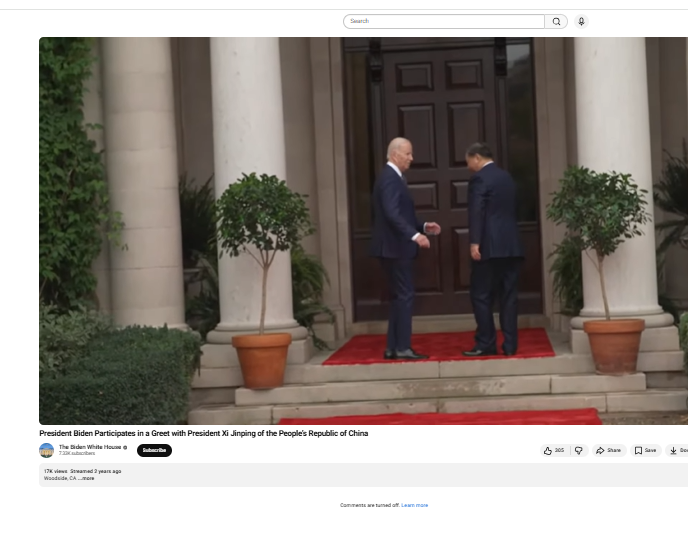
The viral post juxtaposes two images. The first photograph, dated May 14, shows Donald Trump and Xi Jinping shaking hands at the beginning of a landmark summit in Beijing. The second image allegedly depicts Joe Biden turning away from Xi during their 2023 meeting near San Francisco.
- https://web.archive.org/web/20260519173701/https://truthsocial.com/@realDonaldTrump/116585350109647241/embed
- https://truthsocial.com/@realDonaldTrump/116585350109647241/embed
Fact Check
The side-by-side comparison surfaced amid years of criticism by Donald Trump targeting Joe Biden’s age and mental fitness. Trump shared the image after his China visit, which included high-level discussions on trade and the Middle East conflict, along with a temple tour and tea meeting with Xi Jinping. Meanwhile, another manipulated image spread rapidly online, falsely portraying Trump bowing while greeting Xi Jinping. The image circulated widely in several languages, accompanied by captions attacking Trump
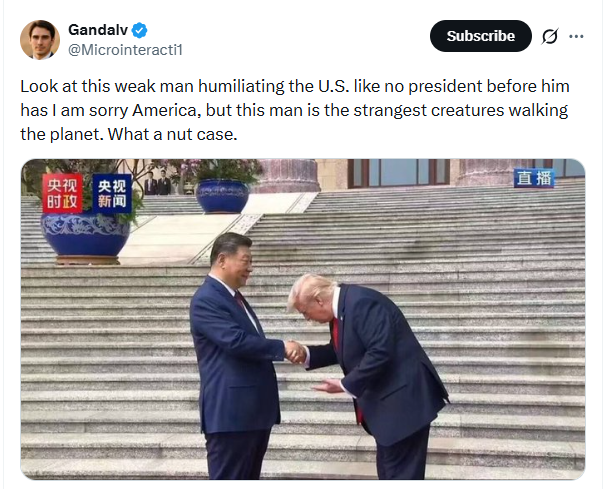
However, a review of the The White House livestream on YouTube showed that Joe Biden greeted Xi Jinping immediately after he stepped out of his vehicle and shook hands with him before both leaders walked inside together. At no point in the footage did Biden turn his back or look away from Xi.
Further examination also revealed inconsistencies in the manipulated Trump image. A subtle crease visible near the side pocket of Trump’s suit jacket in authentic footage was missing in the viral version, indicating that the image had been digitally edited.
Conclusion
The research found that both viral images were digitally manipulated and shared with misleading narratives. Neither Joe Biden ignored Xi Jinping during their 2023 meeting, nor did authentic footage show Donald Trump bowing before the Chinese president.
