
#FactCheck - Bangladesh video falsely shared as BSF arresting an infiltrator at Bengal border
Executive Summary
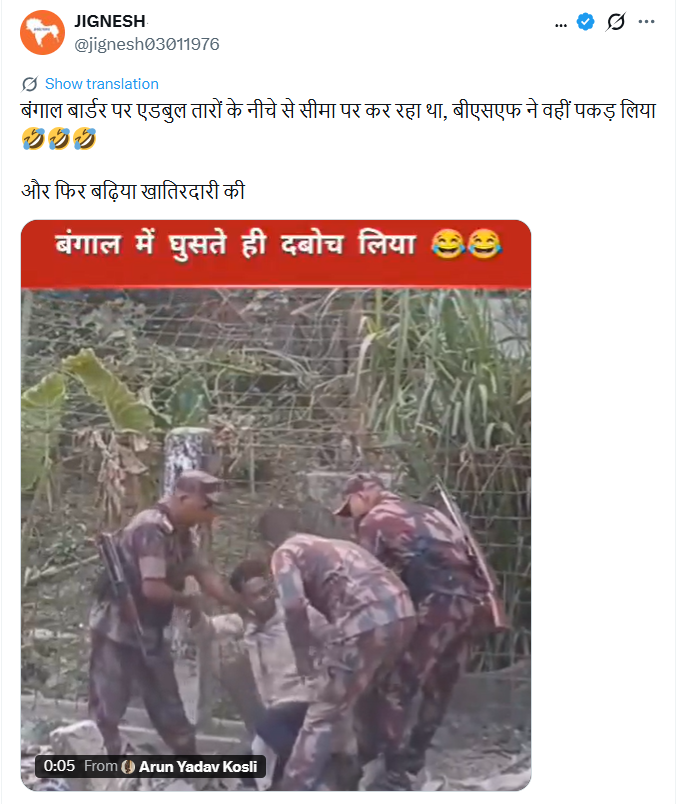
A video showing security personnel overpowering a man is being widely shared on social media with the claim that it shows the Border Security Force (BSF) arresting an infiltrator attempting to cross the India-Bangladesh border in West Bengal. However, research by CyberPeace Research Wing found that the claim is false. The viral video is from Bangladesh and is unrelated to India or the BSF.
Claim
An X user shared the viral video claiming: “He was crossing the Bengal border from beneath the barbed fencing when the BSF caught him on the spot.”
The post was circulated as an incident from the India-Bangladesh border in West Bengal.
Fact Check
To verify the claim, we extracted keyframes from the viral video and conducted a reverse image search. During the research, we found the same video posted on 21 March 2026 by an X handle named “Niru Nahar.”
According to the caption of that post, the video showed Bangladesh Border Guards arresting BNP leader Mizan, also known as “Baba Mizan,” near the border.

Further research led us to a Facebook post uploaded on 22 March 2026 by Bangladeshi news platform Jono Pulse. The post identified the detained individual as “Juel,” an alleged drug trafficker from Chapainawabganj, and stated that he had been arrested by the Border Guard Bangladesh (BGB).
Chapainawabganj is located in Bangladesh, confirming that the video is unrelated to West Bengal or the BSF.

Conclusion
The viral claim is misleading. The video does not show the BSF arresting an infiltrator at the Bengal border. It is actually from Bangladesh and depicts a separate incident involving Border Guard Bangladesh personnel.

Related Blogs

The evolution of technology has presented both profound benefits and considerable challenges. It has benefited us with global interconnectivity, optimisation of the workforce, faster and solution-oriented approach, but at the same time increases risks of cybercrimes and the misuse of technology via online theft, fraud, and abuse. As the reliance on technology increases, it makes the users vulnerable to cyberattacks.
One way to address this nuisance is to set global standards and initiate measures for cooperation by integrating the efforts of international institutions such as UN bodies and others. The United Nations Interregional Crime and Justice Research Institute, which combats cybercrime and promotes the responsible use of technology, is making waves in these issues.
Understanding the Scope of the Problem
Crowdstrike had estimated the cybersecurity market at $207.77 billion in 2024 and expected it to reach $376.55 billion by 2029 and continue growing at a CAGR of 12.63% during the forecast period. In October of 2024, Forbes predicted that the cost of cyber attacks on the global economy would be over $10.5 trillion.
The developments in technology have provided cybercriminals with more sophisticated means to commit cybercrimes. These include cybercrimes like data breaches, which are increasingly common, such as phishing attacks, ransomware, social engineering, and IoT attacks. Their impact is evident across various domains, including economic and social spheres. The victims of cybercrimes can often suffer from stress, anxiety, fear of being victimised again, a lack of trust and social polarisation/stigmatisation.
UNICRI’s Strategic Approach
UNICRI actively combats cybercrimes and technology misuse, focusing on cybersecurity, organized crime in cyberspace, and terrorists' internet use. Since 2020, it has monitored social media misuse, analysed tools to debunk misinformation and balanced security with human rights.
The key focus areas of UNICRI’s strategic approach include cybersecurity in robotics, critical infrastructure, and SCADA systems, digital forensics, child online protection and addressing online profiling and discrimination. It further supports LEAs (judges, prosecutors, and investigators) by providing them with specialised training. Its strategies to counter cybercrime and tech misuse include capacity-building exercises for law enforcement, developing international legal frameworks, and fostering public-private collaborations.
Key Initiatives under UNICRI Strategic Programme Framework of 2023-2026
The key initiatives under UNICRI set out the strategic priority areas that will guide its work. It includes:
- Prevent and Counter Violent Extremism: By addressing the drivers of radicalisation, gender-based discrimination, and leveraging sports for prevention.
- Combat Organised Crime: Via tackling illicit financial flows, counterfeiting, and supply chain crimes while promoting asset recovery.
- Promotion of Emerging Technology Governance: Encouraging responsible AI use, mitigating cybercrime risks, and fostering digital inclusivity.
- Rule of Law and Justice Access: Enhancing justice systems for women and vulnerable populations while advancing criminal law education.
- CBRN Risk Mitigation: Leveraging expert networks and whole-of-society strategies to address chemical, biological, radiological, and nuclear risks.
The Challenges and Opportunities: CyberPeace Takeaways
The challenges that affect the regulation of cybercrimes are most often caused due to jurisdictional barriers, the lack of resources, and the rapid pace of technological change. This is due to the cross-border nature of cybercrimes and as many nations lack the expertise or infrastructure to address sophisticated cyber threats. The regulatory or legislative frameworks often get outpaced by technology developments, including quantum computing, deepfakes, or blockchain misuse. Due to this, these crimes are often unpunished.
The opportunities that have been developing for innovation in cybercrime prevention, include AI and machine learning tools to detect cybercrimes, enhanced international cooperation that can strengthen the collective defence mechanisms, like multi-stakeholder approaches. Capacity Building initiatives for continuous training and education help LEAs and judicial systems adapt to emerging threats, is a continuous effort that requires participation from all sectors, be it public or private.
Conclusion
Due to cybercrimes and the threats they induce on individuals, communities, and global security, the proactive approach by UNICRI of combining international cooperation, capacity-building and innovative strategies is pivotal in combating these challenges. By addressing the challenges of organised crime in cyberspace, child online protection, and emerging technology governance, UNICRI exemplifies the power of strategic engagement. While jurisdictional barriers and resource limitations persist, the opportunities in AI, global collaboration, and education offer a path forward. With the evolution of technology, our defences must also be dynamic and ever evolving, and UNICRI’s efforts are essential to building a safer, more inclusive digital future for all.
References
- https://unicri.it/special_topics/securing_cyberspace
- https://www.forbes.com/sites/bernardmarr/2023/10/11/the-10-biggest-cyber-security-trends-in-2024-everyone-must-be-ready-for-now/

Introduction
We consume news from various sources such as news channels, social media platforms and the Internet etc. In the age of the Internet and social media, the concern of misinformation has become a common issue as there is widespread misinformation or fake news on the Internet and social media platforms.
Misinformation on social media platforms
The wide availability of user-provided content on online social media platforms facilitates the spread of misinformation. With the vast population on social media platforms, the information gets viral and spreads all over the internet. It has become a serious concern as such misinformation, including rumours, morphed images, unverified information, fake news, and planted stories, spread easily on the internet, leading to severe consequences such as public riots, lynching, communal tensions, misconception about facts, defamation etc.
Platform-centric measures to mitigate the spread of misinformation
- Google introduced the ‘About this result’ feature’. This allows the users to help with better understand the search results and websites at a glance.
- During the covid-19 pandemic, there were huge cases of misinformation being shared. Google, in April 2020, invested $6.5 million in funding to fact-checkers and non-profits fighting misinformation around the world, including a check on information related to coronavirus or on issues related to the treatment, prevention, and transmission of Covid-19.
- YouTube also have its Medical Misinformation Policy which prevents the spread of information or content which is in contravention of the World Health Organization (WHO) or local health authorities.
- At the time of the Covid-19 pandemic, major social media platforms such as Facebook and Instagram have started showing awareness pop-ups which connected people to information directly from the WHO and regional authorities.
- WhatsApp has a limit on the number of times a WhatsApp message can be forwarded to prevent the spread of fake news. And also shows on top of the message that it is forwarded many times. WhatsApp has also partnered with fact-checking organisations to make sure to have access to accurate information.
- On Instagram as well, when content has been rated as false or partly false, Instagram either removes it or reduces its distribution by reducing its visibility in Feeds.
Fight Against Misinformation
Misinformation is rampant all across the world, and the same needs to be addressed at the earliest. Multiple developed nations have synergised with tech bases companies to address this issue, and with the increasing penetration of social media and the internet, this remains a global issue. Big tech companies such as Meta and Google have undertaken various initiatives globally to address this issue. Google has taken up the initiative to address this issue in India and, in collaboration with Civil Society Organisations, multiple avenues for mass-scale awareness and upskilling campaigns have been piloted to make an impact on the ground.
How to prevent the spread of misinformation?
Conclusion
In the digital media space, there is a widespread of misinformative content and information. Platforms like Google and other social media platforms have taken proactive steps to prevent the spread of misinformation. Users should also act responsibly while sharing any information. Hence creating a safe digital environment for everyone.

A video of Bollywood actor and Kolkata Knight Riders (KKR) owner Shah Rukh Khan is going viral on social media. The video claims that Shah Rukh Khan is reacting to opposition against Bangladeshi bowler Mustafizur Rahman playing for KKR and is allegedly calling industrialist Gautam Adani a “traitor,” while appealing to stop Hindu–Muslim politics.
Research by the CyberPeace Foundation found that the voice heard in the video is not Shah Rukh Khan’s but is AI-generated. Shah Rukh Khan has not made any official statement regarding Mustafizur Rahman’s removal from KKR. The claim made in the video concerning industrialist Gautam Adani is also completely misleading and baseless.
Claim
In the viral video, Shah Rukh Khan is allegedly heard saying: “People barking about Mustafizur Rahman playing for KKR should stop it. Adani is earning money by betraying the country by supplying electricity from India to Bangladesh. Leave Hindu–Muslim politics and raise your voice against traitors like Adani for the welfare of the country. Mustafizur Rahman will continue to play for the team.”
The post link, archive link, and screenshots can be seen below:
- Archive link: https://archive.is/XsQXp
- Facebook reel link: https://www.facebook.com/reel/1220246633365097

Research
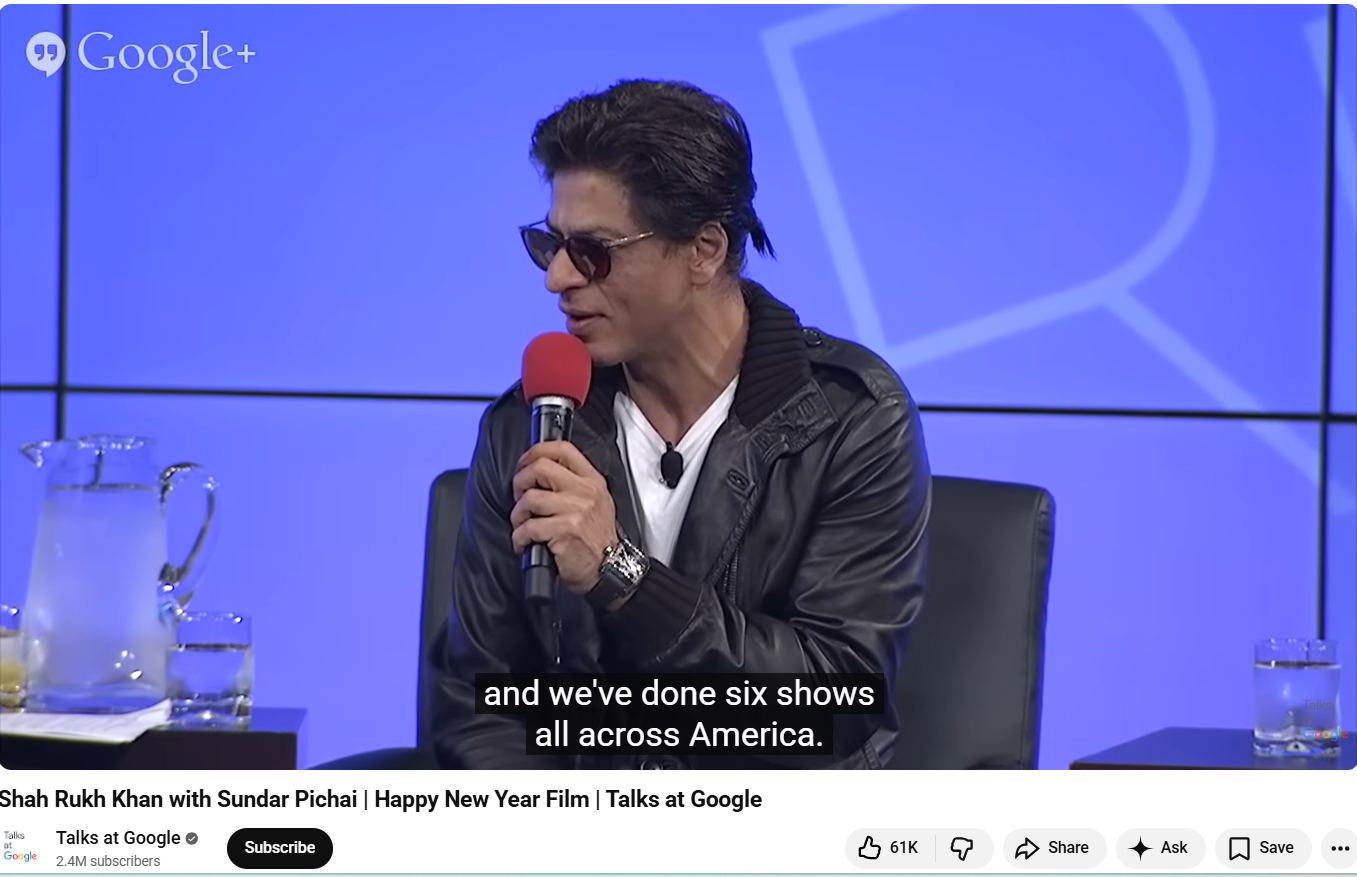
We examined the key frames of Shah Rukh Khan’s viral video using Google Lens. During this process, we found the original video on the official YouTube channel Talks at Google, which was uploaded on 2 October 2014.
In this video, Shah Rukh Khan is seen wearing the same outfit as in the viral clip. He is seen responding to questions from Google CEO Sundar Pichai. The YouTube video description mentions that Shah Rukh Khan participated in a fireside chat held at the Googleplex, where he answered Pichai’s questions and also promoted his upcoming film “Happy New Year.”
The link to the video is given : https://www.youtube.com/watch?v=H_8UBv5bZo0
Upon closely analyzing the viral video of Shah Rukh Khan, we noticed a clear mismatch between his voice and lip movements (lip sync). Such inconsistencies usually appear when the original video or its audio has been tampered with.
We then examined the audio present in the video using the AI detection tool Aurigin. According to the tool’s results, the audio in the viral video was found to be approximately 99 percent AI-generated.
Conclusion
Our research confirmed that the voice heard in the video is not Shah Rukh Khan’s but is AI-generated. Shah Rukh Khan has not made any official comment regarding Mustafizur Rahman’s removal from KKR. Additionally, the claims made in the video about industrialist Gautam Adani are completely misleading and baseless.
