
#FactCheck : Old Video of Birds Misleadingly Linked to Iran’s Attack on Israel Goes Viral
Executive Summary
Amid the ongoing hostilities between Israel and Iran, a video is rapidly going viral on social media with Hindi and Urdu captions. The clip shows several vehicles on a road while a large number of black birds can be seen circling in the sky. Users are sharing the video with the claim that it shows thousands of crows hovering over Tel Aviv after an Iranian attack. Some have even described it as a sign of a major impending event.
However, an research by the CyberPeace found the claim to be misleading. The viral video is old and has no connection to the ongoing conflict between Iran and Israel.

Fact Check
To verify the claim, a keyframe from the video was reverse searched on Yandex. This led to the same video being shared on Reddit on June 13, 2024, where it was described as footage from the US state of Texas. Further searches using the keywords “Crows in Texas” revealed that the same video had been shared on Facebook in April and June 2024. These posts also claimed that the visuals were captured near a supermarket in Texas, where a large number of crows were seening.


While the exact location of the video cannot be independently confirmed, the available evidence clearly establishes that the footage predates the current conflict and is unrelated to any recent events involving Iran or Israel.
Conclusion
The viral video showing a flock of birds in the sky is not linked to any Iranian attack on Israel. It has been available online since 2024 and is being falsely shared in the context of the ongoing conflict.

Related Blogs
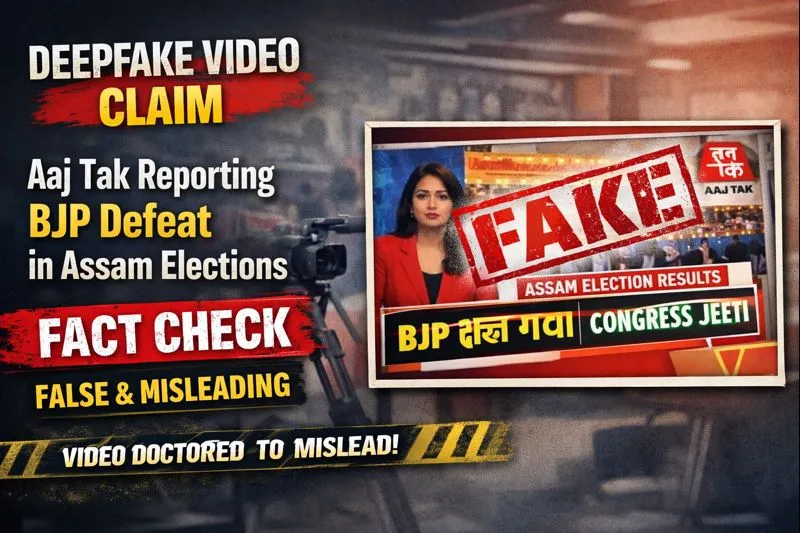
Assembly elections are due to be held in Assam later this year, with polling likely in April or May. Ahead of the elections, a video claiming to be an Aaj Tak news bulletin is being widely circulated on social media.
In the viral video, Aaj Tak anchor Rajiv Dhoundiyal is allegedly seen stating that a leaked intelligence report has issued a warning for the ruling Bharatiya Janata Party (BJP) in Assam. The clip claims that according to this purported report, the BJP may suffer significant losses in the upcoming Assembly elections. Several social media users sharing the video have also claimed that the alleged intelligence report signals the possible removal of Assam Chief Minister Himanta Biswa Sarma from office.
However, an investigation by the Cyber Peace Foundation found the viral claim to be false. Our probe clearly established that no leaked intelligence report related to the Assam Assembly elections exists.
Further, Aaj Tak has neither published nor broadcast any such report on its official television channel, website, or social media platforms. The investigation also revealed that the viral video itself is not authentic and has been created using deepfake technology.
Claim
On social media platform Facebook, a user shared the viral video claiming that the BJP has been pushed on the back foot following organisational changes in the Congress—appointing Priyanka Gandhi Vadra as chairperson of the election screening committee and Gaurav Gogoi as the Assam Pradesh Congress Committee president. The post further claims that an Intelligence Bureau report predicts that the current Assam government will not return to power.
(Link to the post, archive link, and screenshots are available.)
FactCheck:
To verify the claim, we first searched for reports related to any alleged leaked intelligence assessment concerning the Assam Assembly elections using relevant keywords. However, no credible or reliable reports supporting the claim were found. We then reviewed Aaj Tak’s official website, social media pages, and YouTube channel. Our examination confirmed that no such news bulletin has been published or broadcast by the network on any of its official platforms.
- https://www.facebook.com/aajtak/?locale=hi_IN
- https://www.instagram.com/aajtak/
- https://x.com/aajtak
- https://www.youtube.com/channel/UCt4t-jeY85JegMlZ-E5UWtA
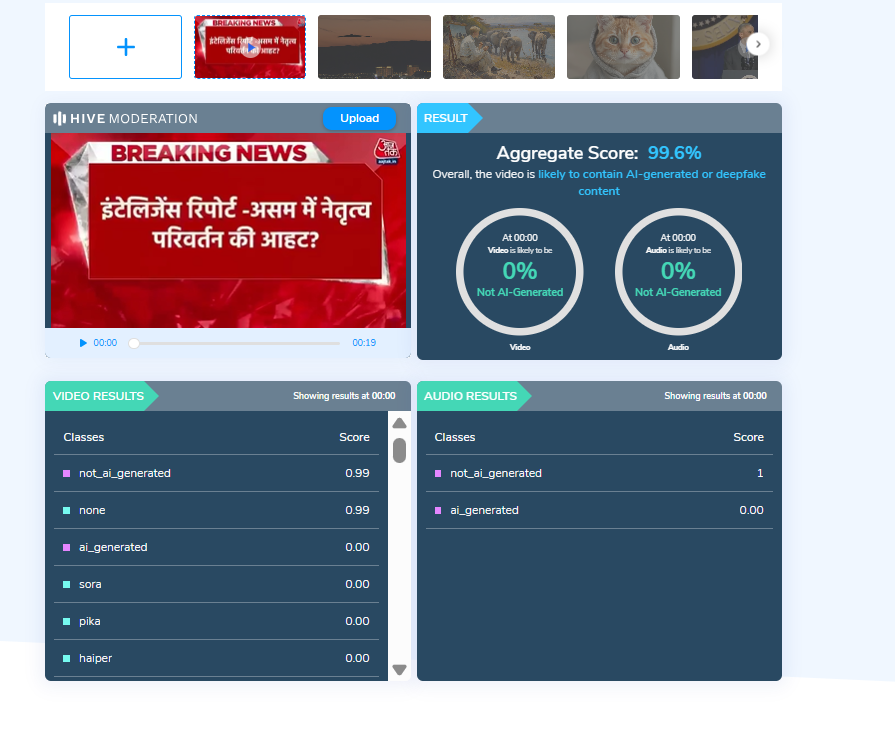
To further verify the authenticity of the video, its audio was scanned using the deepfake voice detection tool HIVE Moderation.
The analysis revealed that the voice heard in the video is 99 per cent AI-generated, clearly indicating that the audio is not genuine and has been artificially created using artificial intelligence.
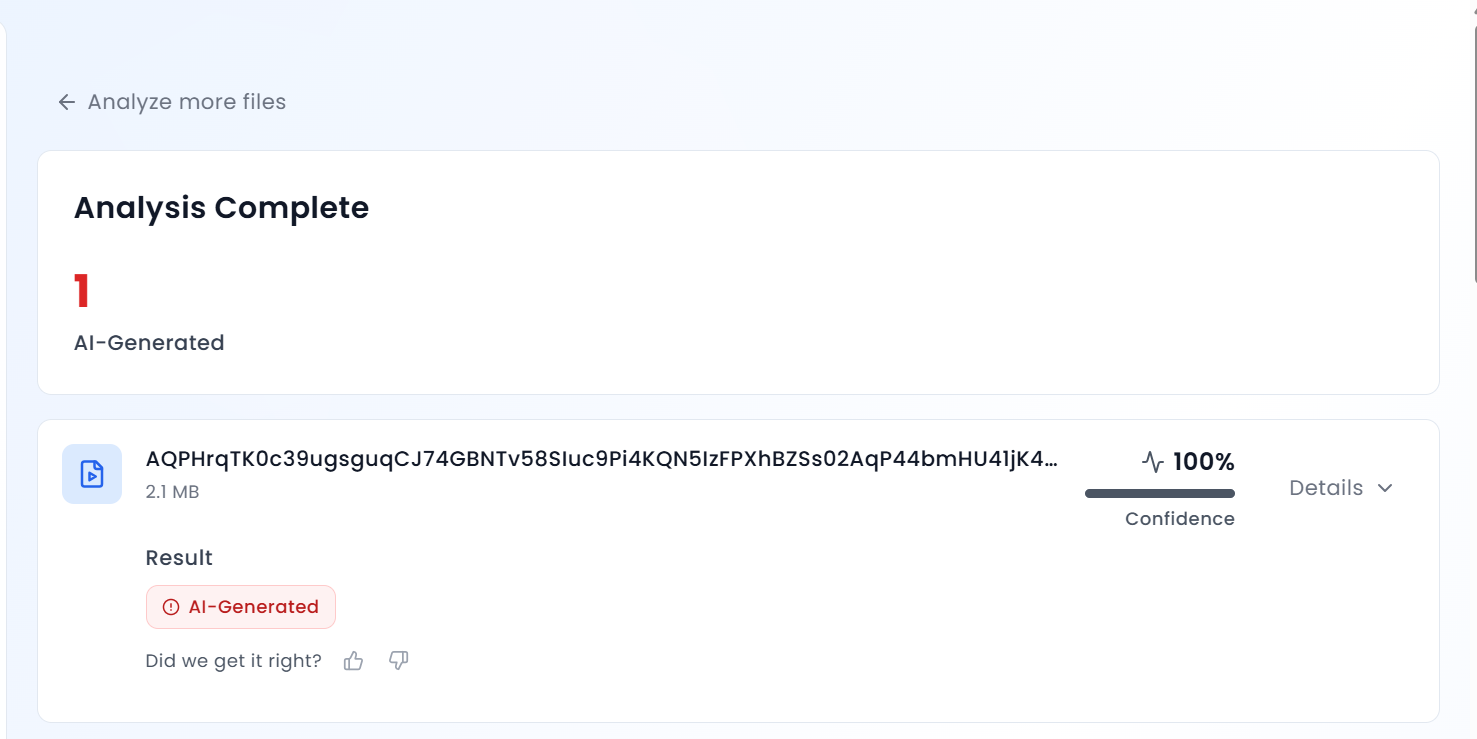
Additionally, the video was analysed using another AI detection tool, Aurigin AI, which also identified the viral clip as AI-generated.
Conclusion:
The investigation clearly establishes that there is no leaked intelligence report predicting BJP’s defeat in the Assam Assembly elections. Aaj Tak has not published or broadcast any such content on its official platforms. The video circulating on social media is not authentic and has been created using deepfake technology to mislead viewers.

Data localisation refers to restrictions in the data flow by limiting the physical storage and processing of data within a given jurisdiction’s boundaries.
An obvious benefit contributing to the importance of data localisation is the privacy benefits it offers. In addition to this, data localisation also has the potential to safeguard sensitive data and decrease the probability of cyber-attacks. In India, data localisation has become a key issue in the last decade due to the increase in the discourse for data privacy.
The Legal Framework in India
India passed the Digital Personal Data Protection Act of 2023 which directs the data fiduciaries (collectors and processors of digital personal data) to store the data of Indian citizens within India. This push for data localisation aligns with India’s position to enhance privacy, national security and regulatory control. It further requires data fiduciaries to adhere to the principles of data minimisation, purposeful limitation and consent of the data principles. Further, Section 17 of the Act prohibits the transfer of sensitive personal data to foreign jurisdictions unless they meet satisfactory privacy protection standards.
The Reserve Bank of India, via a circular for Payments Data Regulation in 2018, has mandated that all payment data be stored in India, though it can be processed abroad. It requires the telecom sector to ensure local storage and local processing of subscriber information. It further prohibits the transferring of subscribers’ account information overseas.
MeitY’s Information Technology (Intermediary Guidelines and Digital Media Ethics Code) Rules, 2021, emphasise data localisation, specifically when it involves government or critical data. The main idea behind this is that data related to Indian citizens or government activities should remain accessible to Indian law enforcement agencies and is not subject to external jurisdiction.
Common Misinformation about Data Localisation and its Impact
Misconceptions fuel misinformation and influence public perception and policy debates. A common misconception is that all data must be stored in India. It should be noted that non-critical and non-sensitive data are not subject to localisation, and can be cleared for cross-border transfers under specific circumstances.
Another misconception is that data localisation alone ensures complete security. A robust cybersecurity approach, infrastructure and capabilities are what guarantee security and this holds true regardless of the location of where the data is stored.
The notion that small businesses and startups will suffer the most is untrue. While data localisation policies may lead to increased costs, they foster innovation in the domestic infrastructure and services. This potentially fuels development and innovation in these small businesses and startups. Claims that data localisation will stifle global business are unfounded.
Proper regulations for data transfers can help balance data flows, enabling international trade while ensuring data sovereignty.
Real Impact of Data Localisation
Data localisation impacts several domains and has both positive and negative outcomes.
- It can be a driver for investment in local data centres and infrastructure, thereby inducing employment generation and boosting the domestic economy. And in contrast, the compliance costs may rise especially for MNCs that need to maintain multiple data storage systems.
- It can expedite the growth of local technology ecosystems while encouraging innovation in cloud computing and data storage solutions. On the other hand, small businesses might face struggles to afford the required infrastructure updates and upgrades.
- Law enforcement agencies will be able to gain access to data more swiftly while avoiding lengthy processes such as the Mutual Legal Assistance Treaties (MLATs). However, it should be noted that storing data locally does not automatically ensure that they are immune from attacks and breaches.
- A balance between sovereignty and global partnerships is a challenge that emerges with data localisation. International Trade Relationships are vulnerable to data localisations where countries favour a free data flow. This can hamper foreign collaborations with companies that rely on global data systems.
CyberPeace Outlook
It is important to clear misinformation about data localisation, some strategies that can be undertaken are:
- Launching public awareness campaigns to educate the stakeholders about the real requirements and the benefits of data localisation. Misinformation about data restrictions and security guarantees should be tackled fairly quickly.
- A balanced approach that promotes local economic development while at the same time allowing for the necessary cross-border data flows and creating a flexible and friendly business environment is important.
- India should work on international frameworks to streamline the process of data-sharing with other nations. This would protect national interests while making global cooperation easier.
Conclusion
Data localisation in India presents a valuable opportunity to enhance privacy, bolster national security, and stimulate economic growth through local infrastructure investment. Yet, addressing common misconceptions is crucial; the belief that all data must be stored domestically or that localisation alone ensures security is misleading.
It’s vital to pair local data storage with robust cybersecurity measures and foster international cooperation. Supporting small businesses, which may face challenges due to localisation requirements, is equally important. By addressing misinformation, promoting flexible regulations, and working towards global data-sharing frameworks, India can effectively manage the complexities of data localisation, safeguarding national interests while encouraging innovation and economic development.
References
- https://www.thehindu.com/sci-tech/technology/are-data-localisation-requirements-necessary-and-proportionate/article66131957.ece
- https://carnegieendowment.org/research/2021/04/how-would-data-localization-benefit-india?lang=en
- https://www.rbi.org.in/commonperson/English/Scripts/FAQs.aspx?Id=2995
- https://www.meity.gov.in/writereaddata/files/Information%20Technology%20%28Intermediary%20Guidelines%20and%20Digital%20Media%20Ethics%20Code%29%20Rules%2C%202021%20%28updated%2006.04.2023%29-.pdf

Introduction
The pervasive issue of misinformation in India is a multifaceted challenge with profound implications for democratic processes, public awareness, and social harmony. The Election Commission of India (ECI) has taken measures to counter misinformation during the 2024 elections. ECI has launched campaigns to educate people and urge them to verify election-related content and share responsibly on social media. In response to the proliferation of fake news and misinformation online, the ECI has introduced initiatives such as ‘Myth vs. Reality’ and 'VerifyBeforeYouAmplify' to clear the air around fake news being spread on social media. EC measures aim to ensure that the spread of misinformation is curbed, especially during election time, when voters consume a lot of information from social media. It is of the utmost importance that voters take in facts and reliable information and avoid any manipulative or fake information that can negatively impact the election process.
EC Collaboration with Tech Platforms
In this new age of technology, the Internet and social media continue to witness a surge in the spread of misinformation, disinformation, synthetic media content, and deepfake videos. This has rightly raised serious concerns. The responsible use of social media is instrumental in maintaining the accuracy of information and curbing misinformation incidents.
The ECI has collaborated with Google to empower the citizenry by making it easy to find critical voting information on Google Search and YouTube. In this way, Google supports the 2024 Indian General Election by providing high-quality information to voters, safeguarding platforms from abuse, and helping people navigate AI-generated content. The company connects voters to helpful information through product features that show data from trusted organisations across its portfolio. YouTube showcases election information panels, including how to register to vote, how to vote, and candidate information. YouTube's recommendation system prominently features content from authority sources on the homepage, in search results, and in the "Up Next" panel. YouTube highlights high-quality content from authoritative news sources during key moments through its Top News and Breaking News shelves, as well as the news watch page.
Google has also implemented strict policies and restrictions regarding who can run election-related advertising campaigns on its platforms. They require all advertisers who wish to run election ads to undergo an identity verification process, provide a pre-certificate issued by the ECI or anyone authorised by the ECI for each election ad they want to run where necessary, and have in-ad disclosures that clearly show who paid for the ad. Additionally, they have long-standing ad policies that prohibit ads from promoting demonstrably false claims that could undermine trust or participation in elections.
CyberPeace Countering Misinformation
CyberPeace Foundation, a leading organisation in the field of cybersecurity works to promote digital peace for all. CyberPeace is working on the wider ecosystem to counter misinformation and develop a safer and more responsible Internet. CyberPeace has collaborated with Google.org to run a pan-India awareness-building program and comprehensive multilingual digital resource hub with content available in up to 15 Indian languages to empower over 40 million netizens in building resilience against misinformation and practising responsible online behaviour. This step is crucial in creating a strong foundation for a trustworthy Internet and secure digital landscape.
Myth vs Reality Register by ECI
The Election Commission of India (ECI) has launched the 'Myth vs Reality Register' to combat misinformation and ensure the integrity of the electoral process during the general elections 2024. The 'Myth vs Reality Register' can be accessed through the Election Commission's official website (https://mythvsreality.eci.gov.in/). All stakeholders are urged to verify and corroborate any dubious information they receive through any channel with the information provided in the register. The register provides a one-stop platform for credible and authenticated election-related information, with the factual matrix regularly updated to include the latest busted fakes and fresh FAQs. The ECI has identified misinformation as one of the challenges, along with money, muscle, and Model Code of Conduct violations, for electoral integrity. The platform can be used to verify information, prevent the spread of misinformation, debunk myths, and stay informed about key issues during the General Elections 2024.
The ECI has taken proactive steps to combat the challenge of misinformation which could cripple the democratic process. EC has issued directives urging vigilance and responsibility from all stakeholders, including political parties, to verify information before amplifying it. The EC has also urged responsible behaviour on social media platforms and discourse that inspires unity rather than division. The commission has stated that originators of false information will face severe consequences, and nodal officers across states will remove unlawful content. Parties are encouraged to engage in issue-based campaigning and refrain from disseminating unverified or misleading advertisements.
Conclusion
The steps taken by the ECI have been designed to empower citizens and help them affirm the accuracy and authenticity of content before amplifying it. All citizens must be well-educated about the entire election process in India. This includes information on how the electoral rolls are made, how candidates are monitored, a complete database of candidates and candidate backgrounds, party manifestos, etc. For informed decision-making, active reading and seeking information from authentic sources is imperative. The partnership between government agencies, tech platforms and civil societies helps develop strategies to counter the widespread misinformation and promote online safety in general, and electoral integrity in particular.
References
- https://pib.gov.in/PressReleaseIframePage.aspx?PRID=2016941#:~:text=To%20combat%20the%20spread%20of,the%20ongoing%20General%20Elections%202024
- https://www.business-standard.com/elections/lok-sabha-election/ls-elections-2024-ec-uses-social-media-to-nudge-electors-to-vote-124040700429_1.html
- https://blog.google/intl/en-in/company-news/outreach-initiatives/supporting-the-2024-indian-general-election/
- https://blog.google/intl/en-in/partnering-indias-success-in-a-new-digital-paradigm/
