
#FactCheck -Old Image from Iraq Falsely Linked to Alleged Attack on Iran’s Water Treatment Plant
Executive Summary:
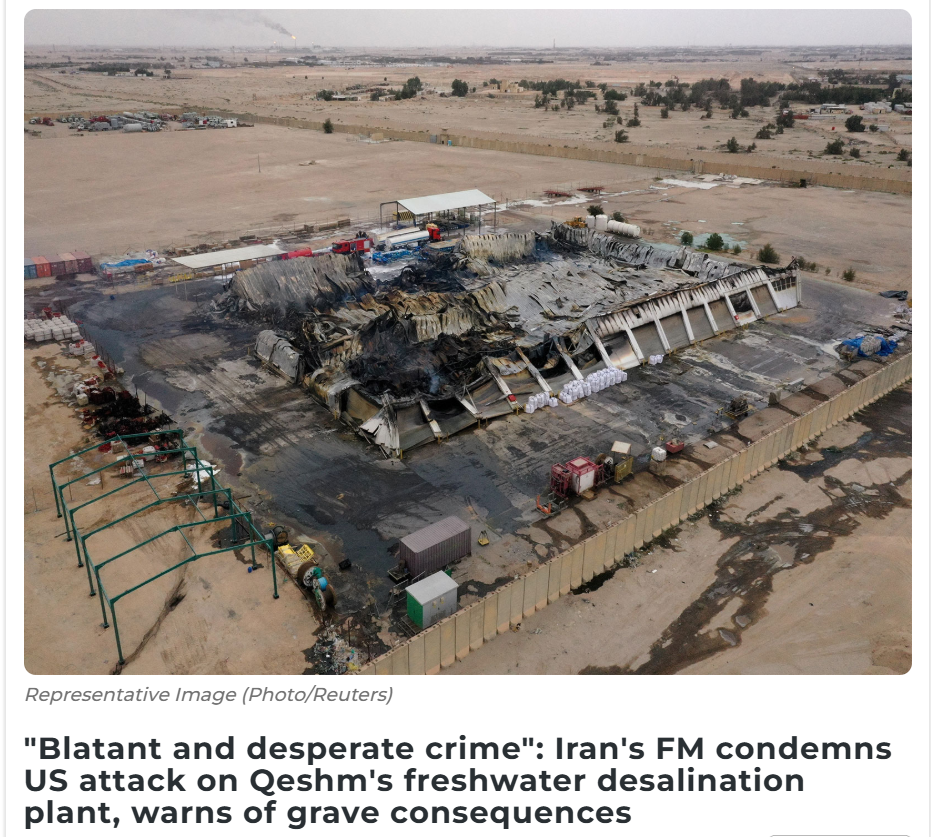
Amid the ongoing tensions and conflict involving the United States, Israel, and Iran, an image of a heavily damaged industrial facility is circulating widely on social media. Several users are sharing the picture claiming that it shows an Iranian water treatment or desalination plant destroyed in a US–Israel attack. Some media reports have also used the same image while reporting on the alleged attack on a freshwater desalination plant in Iran.
However, a research by the CyberPeace found that the claim is misleading. The viral image is not from Iran. It actually shows the aftermath of a drone attack on a warehouse belonging to a US company in Basra, Iraq.
Claim
X user “Shashank Shekhar Jha” shared the image on March 8, 2026, claiming that a freshwater desalination plant in Qeshm, Iran, had been destroyed.
Fact check
To verify the claim, we conducted a reverse image search using Google Lens. During the search, we found a report published on March 7, 2026, on the website of Asian News International (ANI). The report stated that Iran’s Foreign Minister Seyed Abbas Araghchi condemned a US attack on a freshwater desalination plant on Qeshm Island, calling it a “blatant and desperate crime.”
The report used the same viral image; however, the caption clearly mentioned that it was a representational image credited to Reuters.
https://www.aninews.in/news/world/middle-east/blatant-and-desperate-crime-irans-fm-condemns-us-attack-on-qeshms-freshwater-desalination-plant-warns-of-grave-consequences20260307212645/
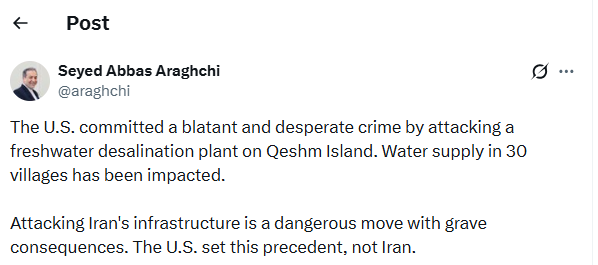
To further confirm the claim, we checked the official X account of Seyed Abbas Araghchi. In a post on March 7, he condemned the alleged attack on the desalination plant in Qeshm and stated that the strike had disrupted water supply to around 30 villages. However, the post did not include any image of the incident.
Conclusion
The viral image being shared as evidence of a US–Israel attack on Iran’s water treatment plant is misleading. The photo actually shows the aftermath of a drone strike on a warehouse belonging to a US company in Basra, Iraq, and has been wrongly linked to the situation in Iran.

Related Blogs

Introduction
MGM Resorts, which is an international company, has suffered an ongoing cyberattack which led to the shutdown of a number of its computer systems, including its website, in response to a cybersecurity issue. MGM Resorts International is in touch with external cybersecurity experts to resolve the issue since it has affected its entire Computer systems. MGM is a larger entity and operates thousands of hotel rooms across Las Vegas and the United States. MGM Resorts shared about the incident and posted that MGM recently identified a cybersecurity issue affecting some of the Company's systems. Promptly after detecting the issue, they quickly began an investigation with assistance from leading external cybersecurity experts. MGM has notified law enforcement and took prompt action to protect systems and data, including putting down certain systems. MGM further stated that the investigation is ongoing.
The issue
Basic operations such as the online reservation and booking system MGM have been affected and shut down due to the cybersecurity issue faced by a lot of visitors. Since earlier times, casino security has been the state of the art as they were very vulnerable to attacks by robbers and con artists. This is what we have also seen in a lot of movies. In today's time, con artists and robbers are now strengthened by cyber tactics. This is exactly what was seen in the case of the MGM attack.
MGM Resorts is home to best-in-class amenities and facilities for guests, but with the increase in tourist traction, the vulnerabilities and the scope of cyber attacks have also increased. This is also because of open wifis in the establishments and the transition of casinos to e-casinos, thus causing a major shift towards digital and technology-based intervention for better customer experience and streamlining a lot of operations.
How real is the threat?
As reported by MGM Resorts, the following systems were impacted in the cyber security attack:
- Slots Machines: The slot machines placed in the casino suddenly went offline and displayed an error message for the players. Some players who were already using the slot machines lost their bets and were unable to withdraw their winnings.
- Room Keys: Some of the guests reported that the room keys became unresponsive, and in some cases, the replacement keys were also inactive for some time, causing massive chaos at the reception.
- Booking Status: All the bookings in today's time are made online; this was one of the worst-hit segments of the cyber attacks. Most of the bookings made automatically were put on hold, and the confirmations could be made only from the hotel reception, thus causing massive cancelling of the bookings and both the hotel and customers losing out on money.
- MGM App: The official app of MGM Resorts was completely down, thus causing a situation of confusion and panic among the guests. The users also received notifications to speak to different customer care executives, but some of the numbers were unattentive and seemed to be operated by bad actors.
- Data breach: The main focus of the cyber attack was dedicated to committing a data breach. The attack led to the breach of personal data of most of the users registered on the app or on the system of MGM Resorts.
Conclusion
The cyber attack on the tourism industry is a major and growing concern for the industry and its customers. Seeing the volatility of the data and the regular inflow of personal information this makes the hotel's cyber security system a vulnerable choice for bad actors. The cyber attack was no less than a fire sale, where in all the segments of the services offered were impacted. Similar attacks were reported by MGM in 2019 and 2020, and subsequently, the safety measures were also deployed, but the bad actors have hit the resorts chain owners again, in such cases the most paramount defence is having a safe and regularly updated firewall, upskilling of staff for IT issues and attacks, active reporting and investigation mechanisms for assisting the LEAs. In the times of rising cyberattacks, one needs to be critical of their data management and digital footprints. The sooner we adopt safe, secure and resilient cyber hygiene practices, the safer our future will be.
References:
https://www.bleepingcomputer.com/news/security/mgm-resorts-shuts-down-it-systems-after-cyberattack/
https://www.cnbc.com/2023/09/12/mgm-resorts-cybersecurity-incident-forces-system-outage.html

Executive Summary:
A manipulated image showing someone making an offensive gesture towards Prime Minister Narendra Modi is circulating on social media. However, the original photo does not display any such behavior towards the Prime Minister. The CyberPeace Research Team conducted an analysis and found that the genuine image was published in a Hindustan Times article in May 2019, where no rude gesture was visible. A comparison of the viral and authentic images clearly shows the manipulation. Moreover, The Hitavada also published the same image in 2019. Further investigation revealed that ABPLive also had the image.

Claims:
A picture showing an individual making a derogatory gesture towards Prime Minister Narendra Modi is being widely shared across social media platforms.


Fact Check:
Upon receiving the news, we immediately ran a reverse search of the image and found an article by Hindustan Times, where a similar photo was posted but there was no sign of such obscene gestures shown towards PM Modi.

ABP Live and The Hitavada also have the same image published on their website in May 2019.


Comparing both the viral photo and the photo found on official news websites, we found that almost everything resembles each other except the derogatory sign claimed in the viral image.

With this, we have found that someone took the original image, published in May 2019, and edited it with a disrespectful hand gesture, and which has recently gone viral across social media and has no connection with reality.
Conclusion:
In conclusion, a manipulated picture circulating online showing someone making a rude gesture towards Prime Minister Narendra Modi has been debunked by the Cyberpeace Research team. The viral image is just an edited version of the original image published in 2019. This demonstrates the need for all social media users to check/ verify the information and facts before sharing, to prevent the spread of fake content. Hence the viral image is fake and Misleading.
- Claim: A picture shows someone making a rude gesture towards Prime Minister Narendra Modi
- Claimed on: X, Instagram
- Fact Check: Fake & Misleading

Introduction
India currently faces a crucial moment because its digital system experiences rapid growth while cyber criminals take advantage of this development to increase their fraudulent activities. The Department of Telecommunications (DoT) has implemented a new regulatory requirement that mandates all messaging and communication platforms to use SIM-binding technology as their primary security measure. The new rule, which starts on 1st March 2026, requires WhatsApp, Telegram, Signal and other similar applications to operate only when users have their registered SIM card present in their device. The telecom identifier restriction aims to prevent unauthorised access, but it creates significant privacy concerns, together with issues of proportionality and platform governance.
Understanding the SIM-Binding Directive
SIM-binding establishes direct links between communication platform accounts and the SIM cards used for registration. The application will stop working when users take out their SIM card, turn it off, or get a new SIM card. Users must re-authenticate their sessions through the main device because web-based sessions, including WhatsApp Web, will automatically log out after six hours of use.
The Telecommunications Act, 2023 and Telecom Cyber Security Rules serve as the base legal authority for this directive. The regulation requires Telecommunication Identity User Entities (TIUEs), which identify users through mobile numbers, to maintain service access based on verified telecommunications credentials.
Rationale: Addressing Cyber Fraud and Misuse
The policy exists because cyber fraud activities have reached a point where they require a more powerful response. Authorities have stated that messaging applications maintain their operational capacity even after users remove their SIM cards, which allows international scammers to use Indian phone numbers for their fraudulent activities. SIM-binding aims to:
- Restore traceability by linking active accounts to verified SIM-based identities.
- Reduce remote access abuse, which includes both account takeovers and impersonation scams.
- Stop fraudulent activities that require physical device access through the creation of permanent sessions.
- Build a system of accountability that extends throughout the telecommunications industry.
The government introduced this measure as an appropriate solution to deal with systemic vulnerabilities because reported cyber fraud losses in 2024 reached more than ₹22,800 crore.
Security with Responsibility
The system requires digital trust to be established through secure identity verification systems, which include official systems for verification and operational systems that enable governmental agencies to work together.
CyberPeace principles require security measures to maintain three essential conditions, which are:
- They must respond to existing dangers
- Their execution process must be open to public observation
- They need to protect user rights, which include their right to privacy and personal independence
- They must provide equal access while safeguarding against negative impacts on at-risk user groups.
Industry Response and Governance Challenges
The directive has received diverse responses from people who work in different fields. Some platforms are testing SIM presence verification features for their upcoming changes, according to reports, while industry groups representing major technology companies have raised legal issues. They argue that the mandate may exceed the regulatory scope of the DoT and potentially conflict with constitutional protections. The existing tension demonstrates how governments face difficulties because they must protect national security while managing international platform operations and legal systems. The situation requires multiple stakeholders to work together because governments, industry, and civil society need to design policies through their collective input.
Policy Insights and Recommendations
The successful balanced execution of this initiative depends on these two essential elements:
- Clear Implementation Guidelines: Organizations need to establish detailed technical standards together with compliance frameworks, which must be followed during their implementation process across various platforms.
- Privacy Safeguards: The telecom service provider must implement strong data protection measures that protect customer data from unauthorised access through SIM-binding technology.
- User Awareness and Transparency: Users should receive information about SIM-binding effects on their access rights, together with security controls, which will help them build trust and provide informed consent.
- Flexibility for Edge Cases: Provisions should exist for legitimate use cases such as device changes, international travel, and accessibility needs.
- Global Interoperability Dialogue: India should engage with global stakeholders to ensure that such measures do not fragment the digital ecosystem.
Conclusion
The SIM-binding directive establishes India’s defence against cyber threats by solving a specific problem that exists in digital identity verification. The system establishes CyberPeace as its fundamental base through its shift from reactive cybersecurity practices toward preventive digital governance methods.
The system will achieve its desired results only if it effectively manages the three elements of security protection, privacy maintenance, and user convenience. SIM-binding and similar policies require ongoing assessment because their implementation affects both national security and the fundamental principles of trustworthiness, inclusiveness, and ethical digital governance.
References
- https://www.opindia.com/2026/02/sim-binding-to-be-implemented-from-1st-march-what-it-means-and-how-it-will-impact-users/
- https://www.ndtv.com/india-news/sim-binding-rule-set-to-change-how-whatsapp-telegram-work-in-india-from-march-1-11148903#:~:text=Under%20the%20new%20framework%2C%20messaging,is%20re%2Dinserted%20and%20authenticated.
- https://timesofindia.indiatimes.com/technology/tech-news/telecom-departments-sim-binding-rule-to-come-into-effect-from-tomorrow-march-1-what-is-sim-binding-how-it-works-and-what-it-means-for-whatsapp-users/articleshow/128879561.cms
- https://www.deccanherald.com/technology/whatsapp-begins-testing-sim-binding-in-india-3913963
