
#FactCheck - AI-Generated Image Falsely Shared as Bees Attacking Shankaracharya Swami Avimukteshwaranand Saraswati
Executive Summary
During the Gau Raksha Yatra of Shankaracharya Swami Avimukteshwaranand Saraswati, bees reportedly attacked a discourse event in Rohania area of Varanasi, Uttar Pradesh. Following the incident, a picture has gone viral on social media showing bees attacking Swami Avimukteshwaranand Saraswati. Several users are sharing the image as genuine while targeting the Shankaracharya online. CyberPeace Research Wing investigated the viral image and found it to be fake. Our research revealed that the picture was created using Artificial Intelligence (AI). While it is true that a bee attack occurred during Swami Avimukteshwaranand Saraswati’s discourse program, the viral image itself is fabricated.
Claim
A Facebook user named “Sanjay Chaudhary” shared the viral image on May 15, 2026, with the caption: “Prakritik kop ka bhajan bana Shukracharya Umashankar alias Avimukteshwaranand… This Kaalnemi was delivering false sermons in Rohania, Varanasi in the name of religion… The bees from a nearby hive did not like it and collectively attacked, creating chaos. Even insects and nature no longer like the opposition’s politics disguised as Sanatan Dharma. Calling Yogi Ji Aurangzeb, Akbar and butcher is not acceptable even to nature and insects.”
Post link and archive link are given below:
- https://www.facebook.com/sanjaychaudhary073/posts/pfbid02kgts8igKDwgctz3MamECMGoGfQR5aWPTdsDgLeux3pD9jwP7ADfgNpoPfHvMb9Zul
- https://perma.cc/E6SE-BAXZ

Fact-Check
To verify the viral claim, we used Google Open Search tools and found reports related to the incident on the YouTube channel of News18 UP Uttarakhand. A report published on May 13, 2026 stated that bees attacked the discourse event during Swami Avimukteshwaranand’s Gau Raksha Yatra in Rohania, Varanasi. The incident created panic at the venue, forcing the Swami to end his discourse midway. The channel also uploaded a YouTube Shorts video related to the incident.

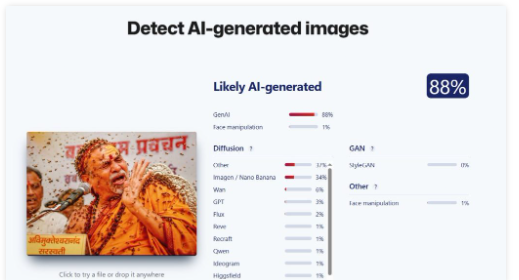
As part of the research, we further analyzed the viral image using AI detection tools. First, we used the tool “Sight Engine,” which indicated an 88 percent probability that the image was AI-generated.
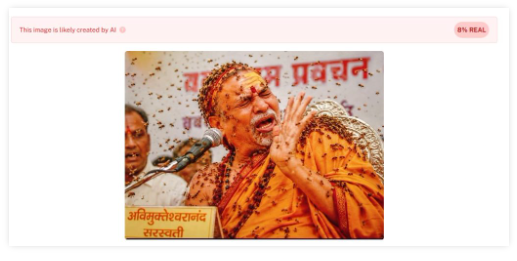
We then examined the image using another AI detection tool called “Undetectable,” which also suggested that the photo was likely created using AI.
Conclusion
Our research found that the viral image is AI-generated. The picture was created using artificial intelligence tools. While bees did attack during Swami Avimukteshwaranand Saraswati’s Gau Raksha Yatra on May 13, 2026, the viral image circulating on social media is fictional and not real.

Related Blogs

Introduction
Google’s search engine is widely known for its ability to tailor its search results based on user activity, enhancing the relevance of search outcomes. Recently, Google introduced the ‘Try Without Personalisation’ feature. This feature allows users to view results independent of their prior activity. This change marks a significant shift in platform experiences, offering users more control over their search experience while addressing privacy concerns.
However, even in this non-personalised mode, certain contextual factors including location, language, and device type, continue to influence results. This essentially provides the search with a baseline level of relevance. This feature carries significant policy implications, particularly in the areas of privacy, consumer rights, and market competition.
Understanding the Feature
When users engage with this option of non-personalised search, it will no longer show them helpful individual results that are personalisation-dependent and will instead provide unbiased search results. Essentially,this feature provides users with neutral (non-personalised) search results by bypassing their data.
This feature allows the following changes:
- Disables the user’s ability to find past searches in Autofill/Autocomplete.
- Does not pause or delete stored activity within a user’s Google account. Users, because of this feature, will be able to pause or delete stored activity through data and privacy controls.
- The feature doesn't delete or disable app/website preferences like language or search settings are some of the unaffected preferences.
- It also does not disable or delete the material that users save.
- When a user is signed in, they can ‘turn off the personalisation’ by clicking on the search option at the end of the webpage. These changes, offered by the feature, in functionality, have significant implications for privacy, competition, and user trust.
Policy Implications: An Analysis
This feature aligns with global privacy frameworks such as the GDPR in the EU and the DPDP Act in India. By adhering to principles like data minimisation and user consent, it offers users control over their data and the choice to enable or disable personalisation, thereby enhancing user autonomy and trust.
However, there is a trade-off between user expectations for relevance and the impartiality of non-personalised results. Additionally, the introduction of such features may align with emerging regulations on data usage, transparency, and consent. Policymakers play a crucial role in encouraging innovations like these while ensuring they safeguard user rights and maintain a competitive market.
Conclusion and Future Outlook
Google's 'Try Without Personalisation' feature represents a pivotal moment for innovation by balancing user privacy with search functionality. By aligning with global privacy frameworks such as the GDPR and the DPDP Act, it empowers users to control their data while navigating the complex interplay between relevance and neutrality. However, its success hinges on overcoming technical hurdles, fostering user understanding, and addressing competitive and regulatory scrutiny. As digital platforms increasingly prioritise transparency, such features could redefine user expectations and regulatory standards in the evolving tech ecosystem.
References

Introduction
In todays time, we can access any information in seconds and from the comfort of our homes or offices. The internet and its applications have been substantial in creating an ease of access to information, but the biggest question which still remains unanswered is Which information is legit and which one is fake? As netizens, we must be critical of what information we access and how.
Influence of Bad actors
The bad actors are one of the biggest threats to our cyberspace as they make the online world full of fear and activities which directly impact the users financial or emotional status by exploitaing their vulnerabilities and attacking them using social engineering. One such issue is website spoofing. In website spoofing, the bad actors try and create a website similar to the original website of any reputed brand. The similarity is so uncanny that the first time or occasional website users find it very difficult to find the difference between the two websites. This is basically an attempt to access sensitive information, such as personal and financial information, and in some cases, to spread malware into the users system to facilitate other forms of cybercrimes. Such websites will have very lucrative offers or deals, making it easier for people to fall prey to such phoney websites In turn, the bad actors can gain sensitive information right from the users without even calling or messaging them.
The Incident
A Noida based senior citizen couple was aggreved by using their dishwasher, and to get it fixed, they looked for the customer care number on their web browser. The couple came across a customer care number- 1800258821 for IFB, a electronics company. As they dialed the number and got in touch with the fake customer care representative, who, upon hearing the couple’s issue, directed them to a supposedly senior official of the company. The senior official spoke to the lady, despite of the call dropping few times, he was admant on staying in touch with the lady, once he had established the trust factor, he asked the lady to download an app which he potrayed to be an app to register complaints and carry out quick actions. The fake senior offical asked the lady to share her location and also asked her to grant few access permissions to the application along with a four digit OTP which looked harmless. He further asked the kady to make a transaction of Rs 10 as part of the complaint processing fee. Till this moment, the couple was under the impression that their complaimt had been registred and the issue with their dishwasher would be rectified soon.
The couple later at night recieved a message from their bank, informing them that Rs 2.25 lakh had been debited from their joint bank account, the following morning, they saw yet another text message informing them of a debit of Rs 5.99 lakh again from their account. The couple immediatly understood that they had become victims to cyber fraud. The couple immediatly launched a complaint on the cyber fraud helpline 1930 and their respective bank. A FIR has been registerd in the Noida Cyber Cell.
How can senior citizens prevent such frauds?
Senior citizens can be particularly vulnerable to cyber frauds due to their lack of familiarity with technology and potential cognitive decline. Here are some safeguards that can help protect them from cyber frauds:
- Educate seniors on common cyber frauds: It’s important to educate seniors about the most common types of cyber frauds, such as phishing, smishing, vishing, and scams targeting seniors.
- Use strong passwords: Encourage seniors to use strong and unique passwords for their online accounts and to change them regularly.
- Beware of suspicious emails and messages: Teach seniors to be wary of suspicious emails and messages that ask for personal or financial information, even if they appear to be from legitimate sources.
- Verify before clicking: Encourage seniors to verify the legitimacy of links before clicking on them, especially in emails or messages.
- Keep software updated: Ensure seniors keep their software, including antivirus and operating system, up to date.
- Avoid public Wi-Fi: Discourage seniors from using public Wi-Fi for sensitive transactions, such as online banking or shopping.
- Check financial statements: Encourage seniors to regularly check their bank and credit card statements for any suspicious transactions.
- Secure devices: Help seniors secure their devices with antivirus and anti-malware software and ensure that their devices are password protected.
- Use trusted sources: Encourage seniors to use trusted sources when making online purchases or providing personal information online.
- Seek help: Advise seniors to seek help if they suspect they have fallen victim to a cyber fraud. They should contact their bank, credit card company or report the fraud to relevant authorities. Calling 1930 should be the first and primary step.
Conclusion
The cyberspace is new space for people of all generations, the older population is a little more vulnerble in this space as they have not used gadgets or internet for most f theur lives, and now they are dependent upon the devices and application for their convinience, but they still do not understand the technology and its dark side. As netizens, we are responsible for safeguarding the youth and the older population to create a wholesome, safe, secured and sustainable cyberecosystem. Its time to put the youth’s understanding of tech and the life experience of the older poplaution in synergy to create SoPs and best practices for erradicating such cyber frauds from our cyberspace. CyberPeace Foundation has created a CyberPeace Helpline number for victims where they will be given timely assitance for resolving their issues; the victims can reach out the helpline on +91 95700 00066 and thay can also mail their issues on helpline@cyberpeace.net.
Pretext
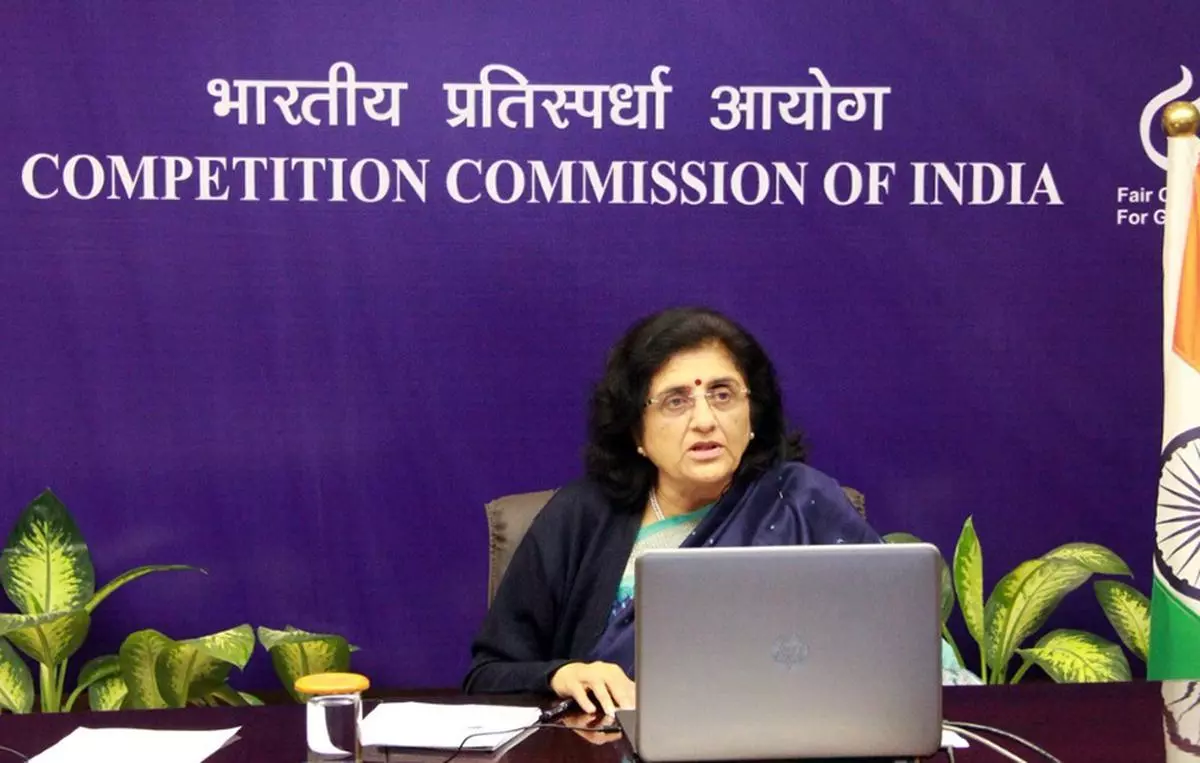
On 20th October 2022, the Competition Commission of India (CCI) imposed a penalty of Rs. 1,337.76 crores on Google for abusing its dominant position in multiple markets in the Android Mobile device ecosystem, apart from issuing cease and desist orders. The CCI also directed Google to modify its conduct within a defined timeline. Smart mobile devices need an operating system (OS) to run applications (apps) and programs. Android is one such mobile operating system that Google acquired in 2005. In the instant matter, the CCI examined various practices of Google w.r.t. licensing of this Android mobile operating system and various proprietary mobile applications of Google (e.g., Play Store, Google Search, Google Chrome, YouTube, etc.).
The Issue
Google was found to be misusing its dominant position in the tech market, and the same was the reason behind the penalty. Google argued about the competitive constraints being faced from Apple. In relation to understanding the extent of competition between Google’s Android ecosystem and Apple’s iOS ecosystem, the CCI noted the differences in the two business models, which affect the underlying incentives of business decisions. Apple’s business is primarily based on a vertically integrated smart device ecosystem that focuses on the sale of high-end smart devices with state-of-the-art software components. In contrast, Google’s business was found to be driven by the ultimate intent of increasing users on its platforms so that they interact with its revenue-earning service, i.e., online searches, which directly affects the sale of online advertising services by Google. It was seen that google had created a dominant position among the android phone manufacturers as they were made to have a set of google apps preinstalled in the device to increase the user’s dependency on google services. The CCI felt that Google had created a dominant position to which they replied that the same operations are done by Apple as well, to which the commission responded that apple is a phone and app manufacturer and they have Apple-owned apps in Apple devices only, but Google here in had made a pseudo mandate for android manufactures to have the google apps pre-installed which is, in turn, a possible way of disrupting the market equilibrium and violative of market practices. The CCI imposed a penalty of Rs. 1,337.76 for abusing its dominant position in multiple markets in India, CCI delineated the following five relevant markets in the present matter –
- The market for licensable OS for smart mobile devices in India
- The market for app store for Android smart mobile OS in India
- The market for general web search services in India
- The market for non-OS specific mobile web browsers in India
- The market for online video hosting platforms (OVHP) in India.
Supreme Courts Opinion
In October 2022, the Competition Commission of India (CCI) ruled that Google, owned by Alphabet Inc, exploited its dominant position in Android and told it to remove restrictions on device makers, including those related to the pre-installation of apps and ensuring exclusivity of its search. Google lost a challenge in the Supreme Court to block the directives, as the learned court refused to put a stay on the imposed penalty, further giving seven days to comply. The Supreme Court has said a lower tribunal—where Google first challenged the Android directives—can continue to hear the company’s appeal and must rule by March 31.
Counterpoint Research estimates that about 97% of 600 million smartphones in India run on Android. Apple has just a 3% share. Hoping to block the implementation of the CCI directives, Google challenged the CCI order in the Supreme Court by warning it could stall the growth of the Android ecosystem. It also said it would be forced to alter arrangements with more than 1,100 device manufacturers and thousands of app developers if the directives kick in. Google has been concerned about India’s decision as the steps are seen as more sweeping than those imposed in the European Commission’s 2018 ruling. There it was fined for putting in place what the Commission called unlawful restrictions on Android mobile device makers. Google is still challenging the record $4.3 billion fine in that case. In Europe, Google made changes later, including letting Android device users pick their default search engine, and said device makers would be able to license the Google mobile application suite separately from the Google Search App or the Chrome browser.
Conclusion
As the world goes deeper into cyberspace, the big tech companies have more control over the industry and the markets, but the same should not turn into anarchy in the global markets. The Tech giants need to be made aware that compliance is the utmost duty for all companies, and enforcement of the law of the land will be maintained no matter what. Earlier India lacked policies and legislation to govern cyberspace, but in the recent proactive stance by the govt, a lot of new bills have been tabled, one of them being the Intermediary Rules 2021, which has laid down the obligations nand duties of the companies by setting up an intermediary in the country. Such bills coupled with such crucial judgments on tech giants will act as a test and barrier for other tech companies who try to flaunt the rules and avoid compliance.
