
#FactCheck - AI-Generated Image Falsely Linked to Mira–Bhayandar Bridge
Executive Summary
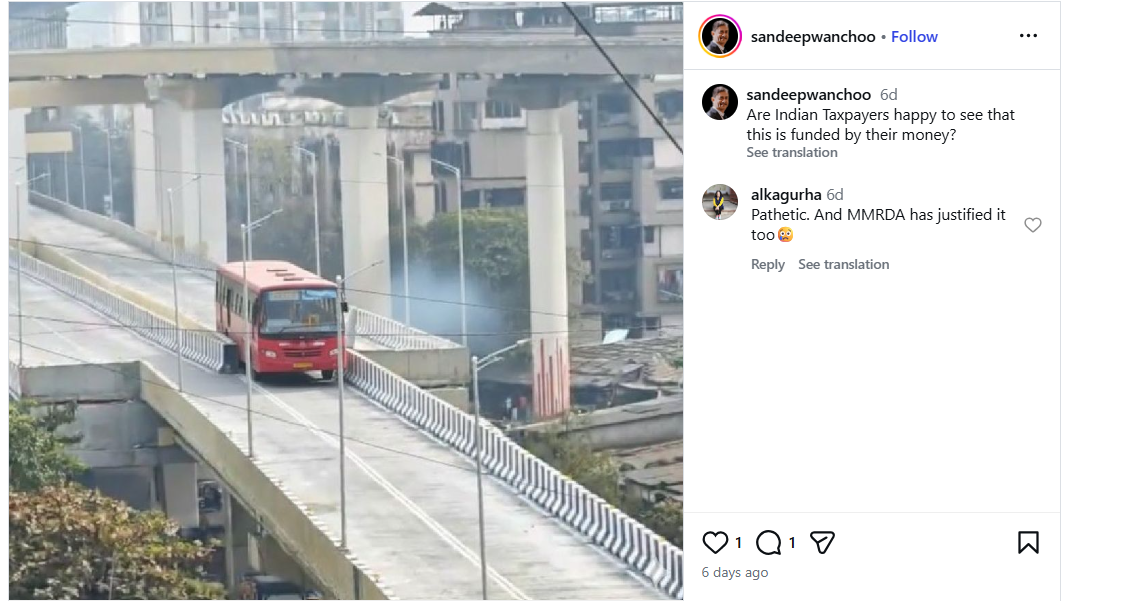
Mumbai’s Mira–Bhayandar bridge has recently been in the news due to its unusual design. In this context, a photograph is going viral on social media showing a bus seemingly stuck on the bridge. Some users are also sharing the image while claiming that it is from Sonpur subdivision in Bihar. However, an research by the CyberPeace has found that the viral image is not real. The bridge shown in the image is indeed the Mira–Bhayandar bridge, which is under discussion because its design causes it to suddenly narrow from four lanes to two lanes. That said, the bridge is not yet operational, and the viral image showing a bus stuck on it has been created using Artificial Intelligence (AI).
Claim
An Instagram user shared the viral image on January 29, 2026, with the caption:“Are Indian taxpayers happy to see that this is funded by their money?” The link, archive link, and screenshot of the post can be seen below.
Fact Check:
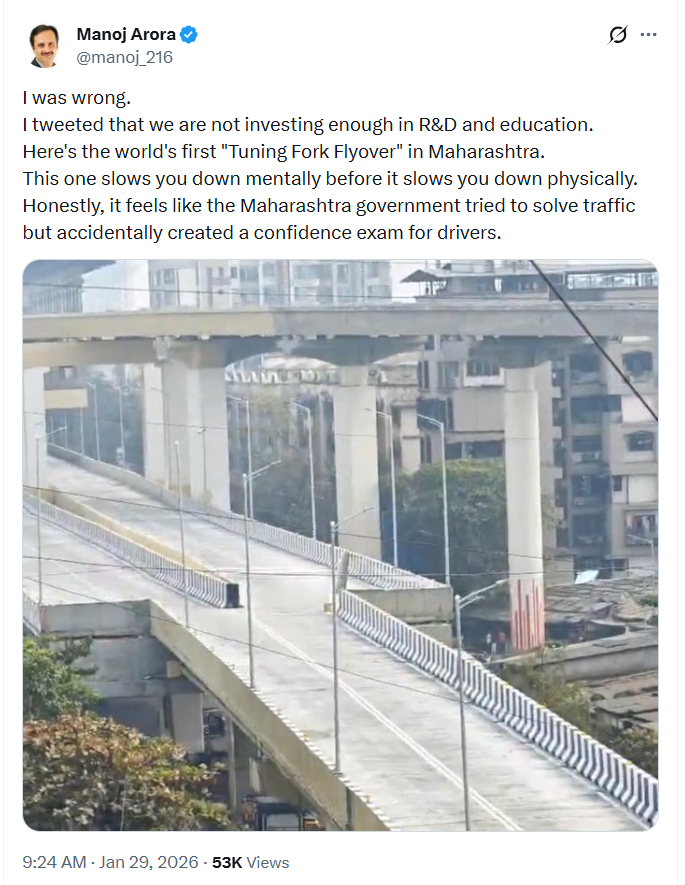
To verify the claim, we first conducted a Google Lens reverse image search. This led us to a post shared by X (formerly Twitter) user Manoj Arora on January 29. While the bridge structure in that image matches the viral photo, no bus is visible in the original post.This raised suspicion that the viral image had been digitally manipulated.
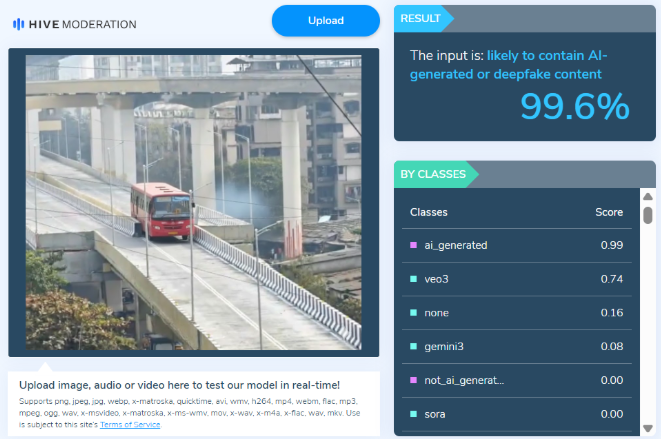
We then ran the viral image through the AI detection tool Hive Moderation, which flagged it as over 99% likely to be AI-generated
Conclusion
The CyberPeace research confirms that while the Mira–Bhayandar bridge is real and has been in the news due to its design, the viral image showing a bus stuck on the bridge has been created using AI tools. Therefore, the image circulating on social media is misleading.

Related Blogs
Introduction: Reasons Why These Amendments Have Been Suggested.
The suggested changes in the Information Technology (Intermediary Guidelines and Digital Media Ethics Code) Rules, 2021, are the much-needed regulatory reaction to the blistering emergence of synthetic information and deepfakes. These reforms are due to the pressing necessity to govern risks within the digital ecosystem as opposed to regular reformation.
The Emergence of the Digital Menace
Generative AI tools have also facilitated the generation of very realistic images, videos, audio, and text in recent years. Such artificial media have been abused to portray people in situations they are not in or in statements they have never said. The market size is expected to have a compound annual growth rate(CAGR) from 2025 to 2031 of 37.57%, resulting in a market volume of US$400.00 bn by 2031. Therefore, tight regulatory controls are necessary to curb a high prevalence of harm in the Indian digital world.
The Gap in Law and Institution
None of the IT Rules, 2021, clearly addressed synthetic content. Although the Information Technology Act, 2000 dealt with identity theft, impersonation and violation of privacy, the intermediaries were not explicitly obligated on artificial media. This left a loophole in enforcement, particularly since AI-generated content might get around the old system of moderation. These amendments bring India closer to the international standards, including the EU AI Act, which requires transparency and labelling of AI-driven content. India addresses such requirements and adapts to local constitutional and digital ecosystem needs.
II. Explanation of the Amendments
The amendments of 2025 present five alternative changes in the current IT Rules framework, which address various areas of synthetic media regulation.
A. Definitional Clarification: Synthetic Generation of Information Introduction.
Rule 2(1)(wa) Amendment:
The amendments provide an all-inclusive definition of what is meant by “synthetically generated information” as information, which is created, or produced, changed or distorted with the use of a computer resource, in a way that such information can reasonably be perceived to be genuine. This definition is intentionally broad and is not limited to deepfakes in the strict sense but to any artificial media that has gone through algorithmic manipulation in order to have a semblance of authenticity.
Expansion of Legal Scope:
Rule 2(1A) also makes it clear that any mention of information in the context of unlawful acts, namely, including categories listed in Rule 3(1)(b), Rule 3(1)(d), Rule 4(2), and Rule 4(4), should be understood to mean synthetically generated information. This is a pivotal interpretative protection that does not allow intermediaries to purport that synthetic versions of illegal material are not under the control of the regulation since they are algorithmic creations and not descriptions of what actually occurred.
B. Safe Harbour Protection and Content Removal Requirements
Amendment, rule 3(1)(b)- Safe Harbour Clarification:
The amendments add a certain proviso to the Rule (3) (1)(b) that explains a deletion or facilitation of access of synthetically produced information (or any information falling within specified categories) which the intermediaries have made in good faith as part of reasonable endeavours or at the receipt of a complaint shall not be considered a breach of the Section 79(2) (a) or (b) of the Information Technology Act, 2000. This coverage is relevant especially since it insures the intermediaries against liability in situations where they censor the synthetic contents in advance of a court ruling or governmental warnings.
C. Labelling and Metadata Requirements that are mandatory on Intermediaries that enable the creation of synthetic content
The amendments establish a new framework of due diligence in Rule 3(3) on the case of intermediaries that offer tools to generate, modify, or alter the synthetically generated information. Two fundamental requirements are laid down.
- The generated information must be prominently labelled or embedded with a permanent, unique metadata or identifier. The label or metadata must be:
- Visibly displayed or made audible in a prominent manner on or within that synthetically generated information.
- It should cover at least 10% of the surface of the visual display or, in the case of audio content, during the initial 10% of its duration.
- It can be used to immediately identify that such information is synthetically generated information which has been created, generated, modified, or altered using the computer resource of the intermediary.
- The intermediary in clause (a) shall not enable modification, suppression or removal of such label, permanent unique metadata or identifier, by whatever name called.
D. Important Social Media Intermediaries- Pre-Publication Checking Responsibilities
The amendments present a three-step verification mechanism, under Rule 4(1A), to Significant Social Media Intermediaries (SSMIs), which enables displaying, uploading or publishing on its computer resource before such display, uploading, or publication has to follow three steps.
Step 1- User Declaration: It should compel the users to indicate whether the materials they are posting are synthetically created. This puts the first burden on users.
Step 2-Technical Verification: To ensure that the user is truly valid, the SSMIs need to provide reasonable technical means, such as automated tools or other applications. This duty is contextual and would be based on the nature, format and source of content. It does not allow intermediaries to escape when it is known that not every type of content can be verified using the same standards.
Step 3- Prominent Labelling: In case the synthetic origin is verified by user declaration or technical verification, SSMIs should have a notice or label that is prominently displayed to be seen by users before publication.
The amendments provide a better system of accountability and set that intermediaries will be found to have failed due diligence in a case where it is established that they either knowingly permitted, encouraged or otherwise failed to act on synthetically produced information in contravention of these requirements. This brings in an aspect of knowledge, and intermediaries cannot use accidental errors as an excuse for non-compliance.
An explanation clause makes it clear that SSMIs should also make reasonable and proportionate technical measures to check user declarations and keep no synthetic content published without adequate declaration or labelling. This eliminates confusion on the role of the intermediaries with respect to making declarations.
III. Attributes of The Amendment Framework
- Precision in Balancing Innovation and Accountability.
The amendments have commendably balanced two extreme regulatory postures by neither prohibiting nor allowing the synthetic media to run out of control. It has recognised the legitimate use of synthetic media creation in entertainment, education, research and artistic expression by adopting a transparent and traceable mandate that preserves innovation while ensuring accountability.
- Overt Acceptance of the Intermediary Liability and Reverse Onus of Knowledge
Rule 4(1A) gives a highly significant deeming rule; in cases where the intermediary permits or refrains from acting with respect to the synthetic content knowing that the rules are violated, it will be considered as having failed to comply with the due diligence provisions. This description closes any loopholes in unscrupulous supervision where intermediaries can be able to argue that they did so. Standard of scienter promotes material investment in the detection devices and censor mechanisms that have been in place to offer security to the platforms that have sound systems, albeit the fact that the tools fail to capture violations at times.
- Clarity Through Definition and Interpretive Guidance
The cautious definition of the term “synthetically generated information” and the guidance that is provided in Rule 2(1A) is an admirable attempt to solve confusion in the previous regulatory framework. Instead of having to go through conflicting case law or regulatory direction, the amendments give specific definitional limits. The purposefully broad formulation (artificially or algorithmically created, generated, modified or altered) makes sure that the framework is not avoided by semantic games over what is considered to be a real synthetic content versus a slight algorithmic alteration.
- Insurance of non-accountability but encourages preventative moderation
The safe harbour clarification of the Rule 3(1)(b) amendment clearly safeguards the intermediaries who voluntarily dismiss the synthetic content without a court order or government notification. It is an important incentive scheme that prompts platforms to implement sound self-regulation measures. In the absence of such protection, platforms may also make rational decisions to stay in a passive stance of compliance, only deleting content under the pressure of an external authority, thus making them more effective in keeping users safe against dangerous synthetic media.
IV. Conclusion
The Information Technology (Intermediary Guidelines and Digital Media Ethics Code) Rules 2025 suggest a structured, transparent, and accountable execution of curbing the rising predicaments of synthetic media and deepfakes. The amendments deal with the regulatory and interpretative gaps that have always existed in determining what should be considered as synthetically generated information, the intermediary liabilities and the mandatory labelling and metadata requirement. Safe-harbour protection will encourage the moderation proactively, and a scienter-based liability rule will not permit the intermediaries to escape liability when they are aware of the non-compliance but tolerate such non-compliance. The idea to introduce pre-publication verification of Significant Social Media Intermediaries adds the responsibility to users and due diligence to the platform. Overall, the amendments provide a reasonable balance between innovation and regulation, make the process more open with its proper definitions, promote responsible conduct on the platform and transform India and the new standards in the sphere of synthetic media regulation. They collaborate to enhance the verisimilitude, defence of the users, and visibility of the systems of the digital ecosystem of India.
V. References
2. https://www.statista.com/outlook/tmo/artificial-intelligence/generative-ai/worldwide
Executive Summary
A video circulating on social media claims that Chief of Defence Staff Anil Chauhan described US leaders as “toothless rulers” and said that US President Donald Trump cannot disobey Israeli Prime Minister Benjamin Netanyahu. The clip is being widely shared as a recent statement. However, research by the CyberPeace Research Wing found the claim to be misleading. A review of the full interview revealed that Chauhan was speaking about the need for India to prepare for the next phase of ‘Operation Sindoor’. He emphasised that the armed forces must move beyond past operations and gear up for future challenges.
Claim
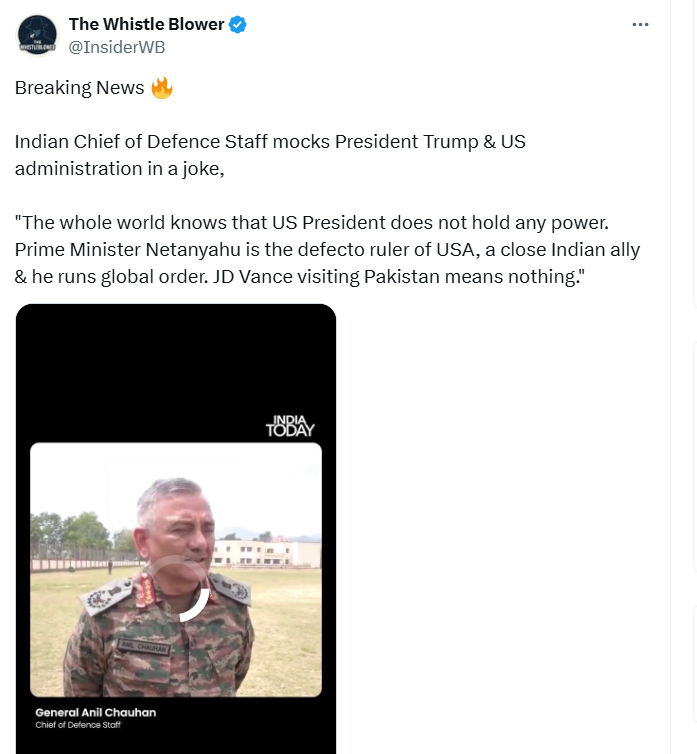
Social media users have shared the video claiming that CDS Anil Chauhan referred to US leaders as “toothless rulers” and stated that Donald Trump cannot act against the wishes of Benjamin Netanyahu.
- Link: https://x.com/InsiderWB/status/2046263000928330130
- Archive: https://archive.ph/j8CeL
Fact Check
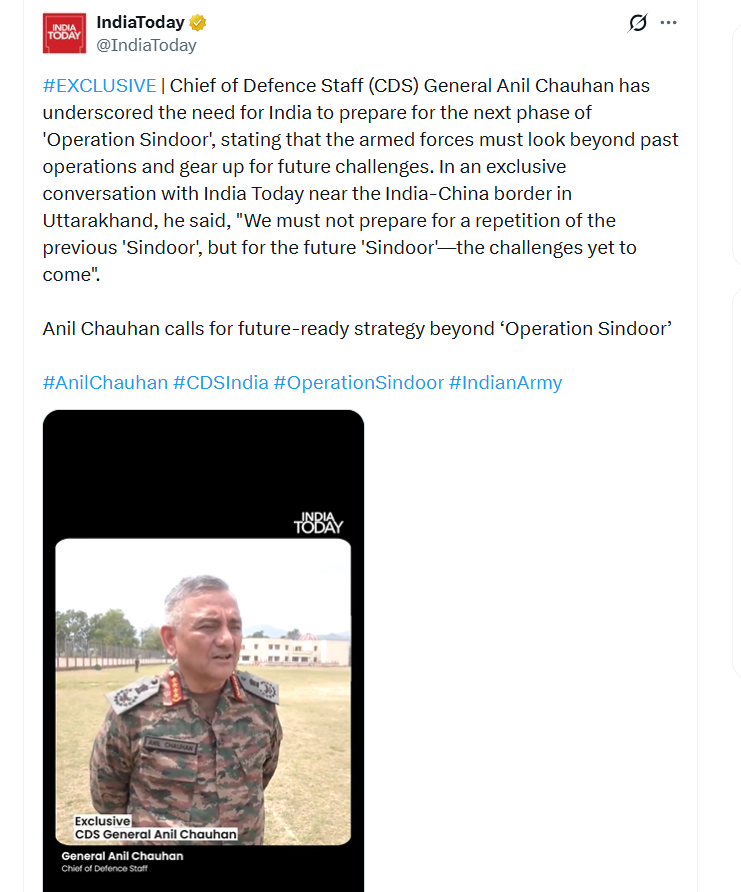
A detailed keyword search using terms such as “CDS Anil Chauhan, Donald Trump, JD Vance, Pakistan” did not yield any credible reports or verified statements supporting the viral claim. A reverse image search of keyframes from the clip traced it back to a post shared by India Today on April 18, 2026, where the same visuals and setting were used.
https://x.com/IndiaToday/status/2045531069647327240
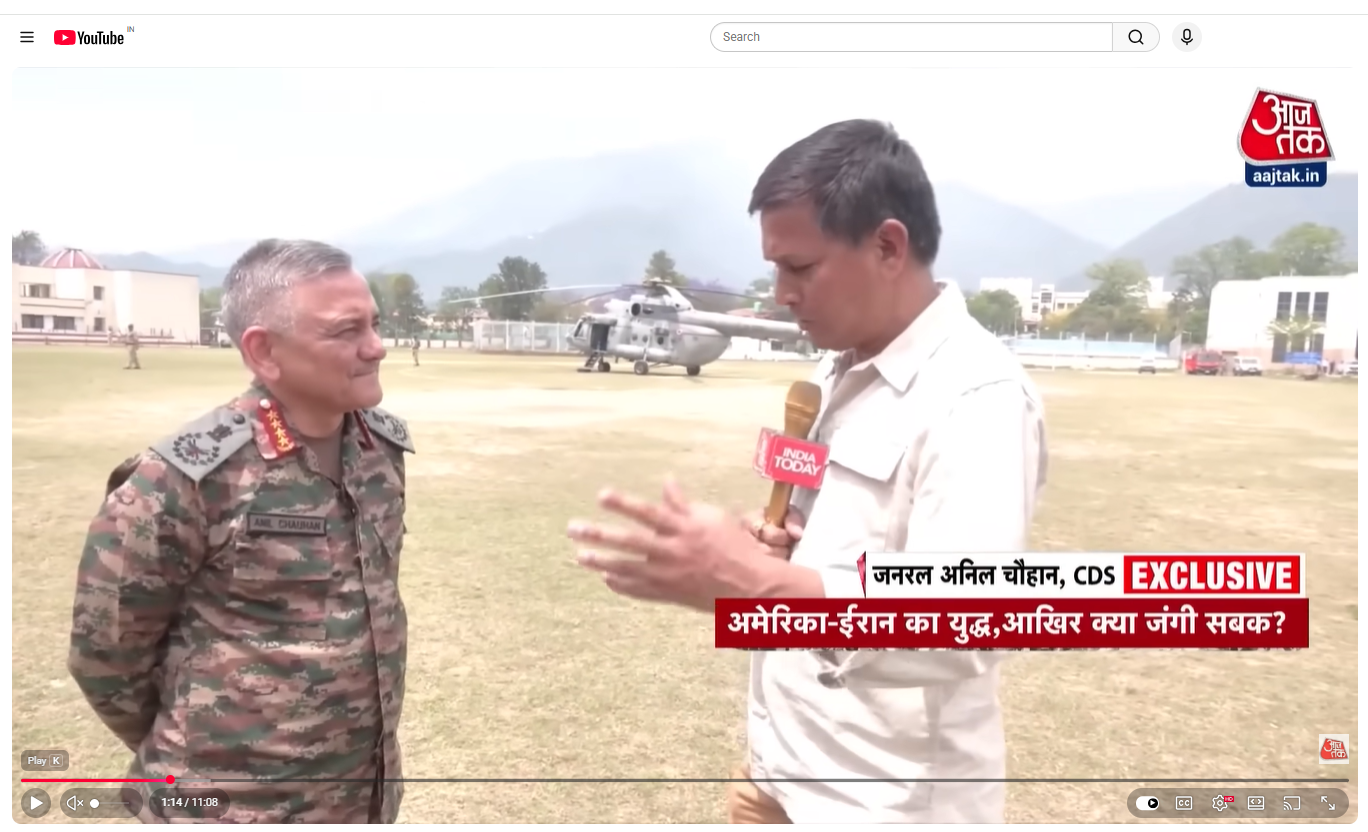
In the original interview, Chauhan focused on military preparedness and the future course of ‘Operation Sindoor’. He did not make any remarks about US leadership, Donald Trump, or Benjamin Netanyahu. The complete version of the interaction, also aired on Aaj Tak, was reviewed in full and similarly contains no such controversial or political statements.
Conclusion
The viral claim is misleading. The video has been edited or taken out of context to falsely attribute remarks to CDS Anil Chauhan that he never made. In reality, his statements were limited to India’s military preparedness and did not include any comments on US or Israeli leadership.

Executive Summary
A video is being shared on social media with the claim that a thief in Indore, Madhya Pradesh, performed dangerous stunts to evade the police. In the viral video, several police personnel can be seen chasing a man. The man appears to dodge vehicles on the road to escape the police and then climbs onto the roof of a moving bus. He later jumps from the bus and climbs onto a roadside hoarding. The video is being shared with the claim that a clever thief gave the police a tough time in Indore. Research by CyberPeace Research Wing found that the video is AI-generated and is being shared with a misleading claim.
Claim:
A high-voltage, filmy-style chase between police and a clever thief took place in a busy market in Indore. The police later surrounded the accused and detained him. Archive of the post can be seen here. Similar posts can be seen here and here.
https://www.facebook.com/reel/1356598853312128

Fact Check:
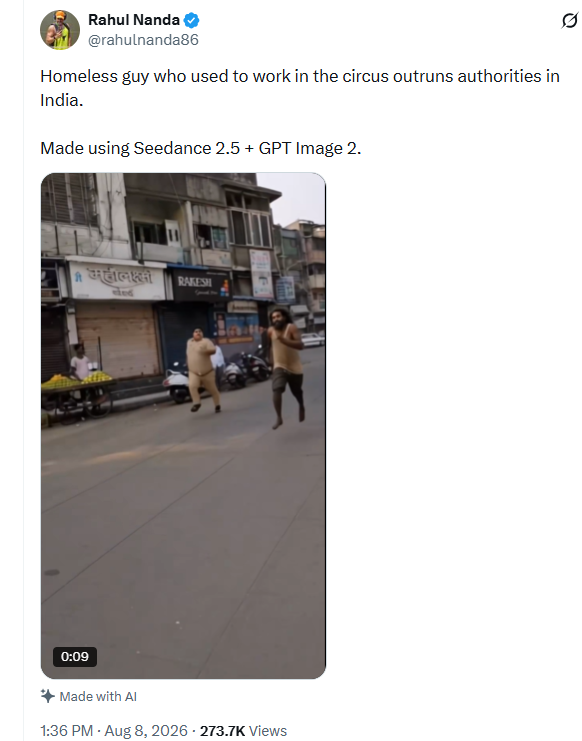
To verify the claim, we conducted a reverse image search of keyframes from the viral video using Google Lens. During the search, we found the same video posted on August 8 on the X account of a user named Rahul Nanda. The post stated that the video had been created using AI.
https://x.com/rahulnanda86/status/2086001127762657614
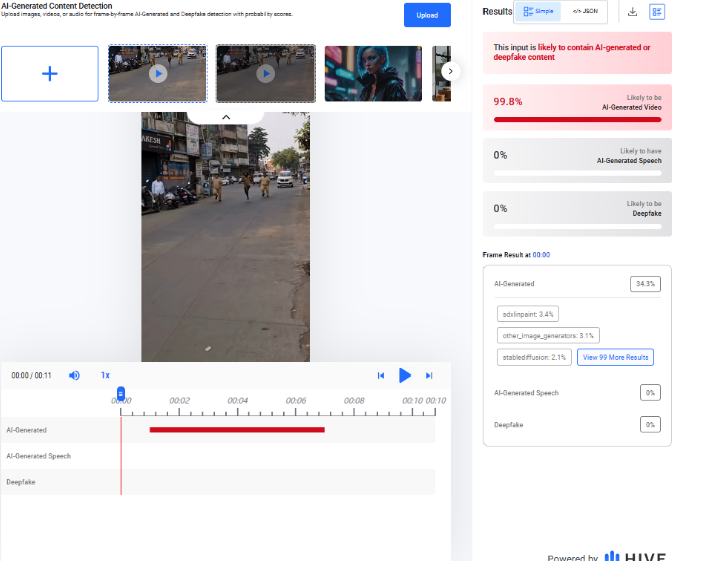
We then analysed the viral video using the AI detection tool Hive Moderation. The tool gave the video a 99.8 per cent score for being potentially AI-generated.
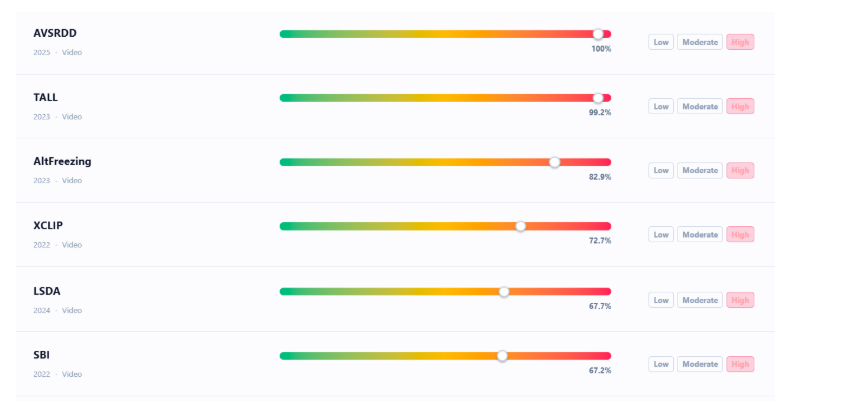
As part of the research, we also checked the video using another AI detection tool, Deepfake-O-Meter. Six different detectors on the tool indicated a high probability that the video was AI-generated.
Conclusion
The evidence gathered during our research establishes that the viral video claiming to show a thief evading police in Indore is AI-generated. Therefore, the claim is misleading.
