
#FactCheck- Old 2019 Video Falsely Shared as Iran Seizing US Ship in Hormuz
Executive Summary:
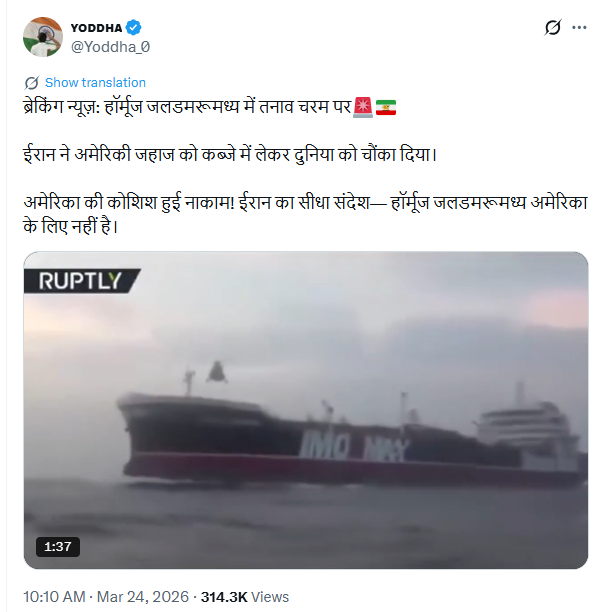
Amid the ongoing tensions in West Asia, a video is being widely circulated on social media with the claim that Iran has seized a US ship in the Strait of Hormuz. However, a research by the CyberPeace found that the claim is false. The video is from 2019 and is unrelated to the current situation. It actually shows Iran’s Islamic Revolutionary Guard Corps (IRGC) seizing a British-flagged tanker, Stena Impero. The ongoing conflict involving the United States, Israel and Iran since late February has raised concerns over global energy supply. The Strait of Hormuz, located between Iran and Oman, is a key route for global oil and maritime trade. Rising tensions in the region have impacted this route, although Iran has stated that it has not been completely closed.
Claim:
Users on X (formerly Twitter) are sharing the video as breaking news, claiming that Iran has captured a US ship in the Strait of Hormuz. The posts suggest that the move is a direct warning to the United States.
Fact Check:
To verify the claim, we extracted keyframes from the viral video and conducted a reverse image search. This led us to the same video posted on the X handle of Iran’s Press TV on July 20, 2019.
Link:
- https://x.com/PressTV/status/1152597789362262016?s=20
- https://x.com/PressTV/status/1152597789362262016?s=20

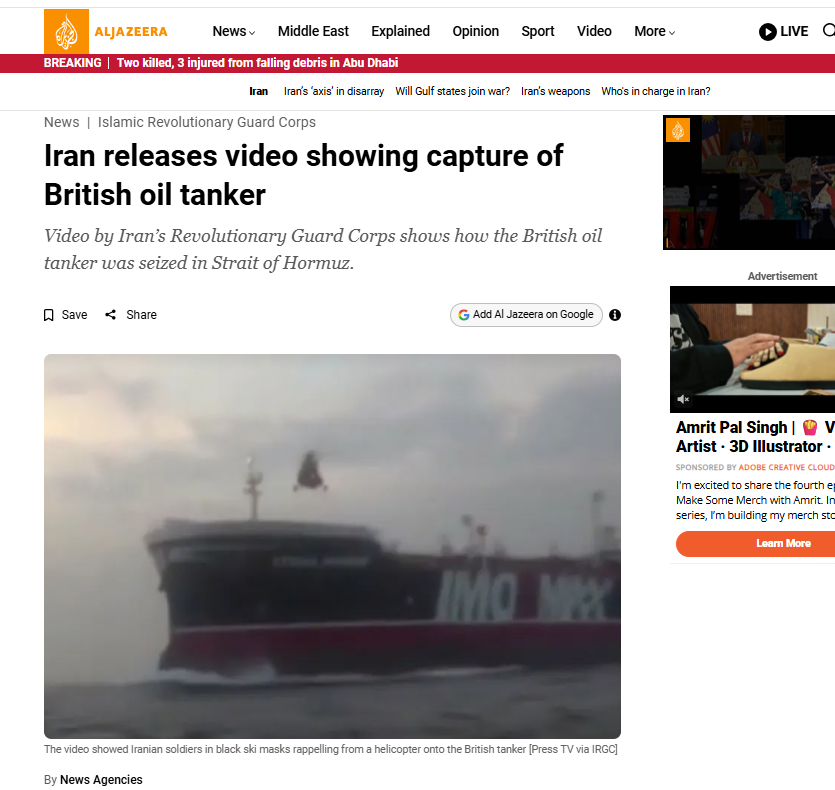
The caption of the post stated that the footage showed the moment when IRGC forces seized the British oil tanker Stena Impero in the Strait of Hormuz. Further, we found a July 2019 report by Al Jazeera that included visuals matching the viral video. According to the report, Iran’s IRGC had intercepted the British-flagged tanker on July 19, 2019, after which the footage was released.
https://www.aljazeera.com/news/2019/7/20/iran-releases-video-showing-capture-of-british-oil-tanker
Conclusion:
The viral claim is misleading. The video is not recent and does not show Iran capturing a US ship. It is from 2019 and depicts the seizure of the British tanker Stena Impero by Iran’s IRGC.

Related Blogs

Executive Summary
Belgian Prime Minister Bart De Wever is on an official visit to India. During the visit, he met Prime Minister Narendra Modi. Meanwhile, a video of his speech is going viral on social media. In his speech, Bart De Wever can be heard saying to PM Modi, “Chocolate is excellent for diplomacy, but not for diplomatic travel.” The video is being shared with the claim that Belgian Prime Minister Bart De Wever took a jibe at Prime Minister Narendra Modi’s diplomacy by referring to “chocolate diplomacy.” A research done by the CyberPeace Research Wing found that Belgian Prime Minister Bart De Wever had brought an unusual and thoughtful gift for Prime Minister Narendra Modi. It was a miniature replica of Delhi’s iconic India Gate, made entirely from Belgian chocolate. However, the chocolate replica melted during the journey to India. Referring to the incident, Bart De Wever made the remark in a humorous manner, saying that the chocolate gift could not withstand the journey. The video is now being shared by users with a misleading claim.
Claim:
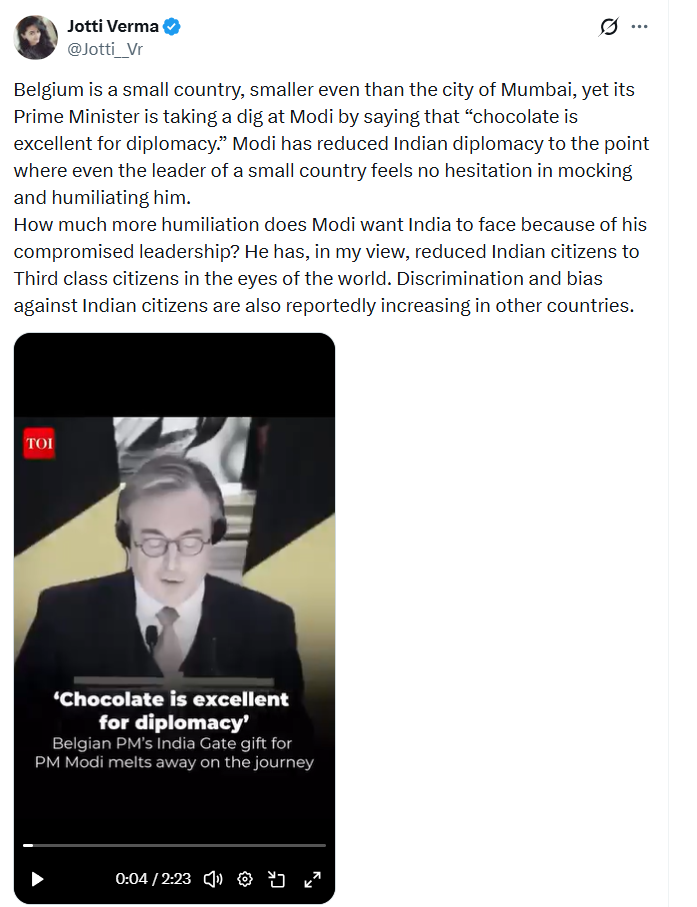
X user Jyoti Verma wrote, “Belgium is a small country, smaller than the city of Mumbai, yet its Prime Minister is taking a jibe at Modi by saying that ‘chocolate is a very good thing for diplomacy.’ Modi has brought the level of Indian diplomacy down so much that even the leader of a small country does not hesitate to mock and belittle him. How much more humiliation does Modi want India to face because of his weak leadership? In my view, he has turned Indian citizens into ‘third-class’ citizens in the eyes of the world. There are also reports that discrimination and bias against Indian citizens are increasing in other countries.”
https://x.com/Jotti__Vr/status/2096154750425424086?s=20
Fact Check
During the research of the claim, a search using relevant keywords led us to the full video of the Belgian Prime Minister posted on ANI’s official X handle. In the video, Bart De Wever can be seen mentioning the chocolate replica of India Gate during a joint press conference with Prime Minister Narendra Modi.
https://x.com/ANI/status/2095426762243281060?s=20
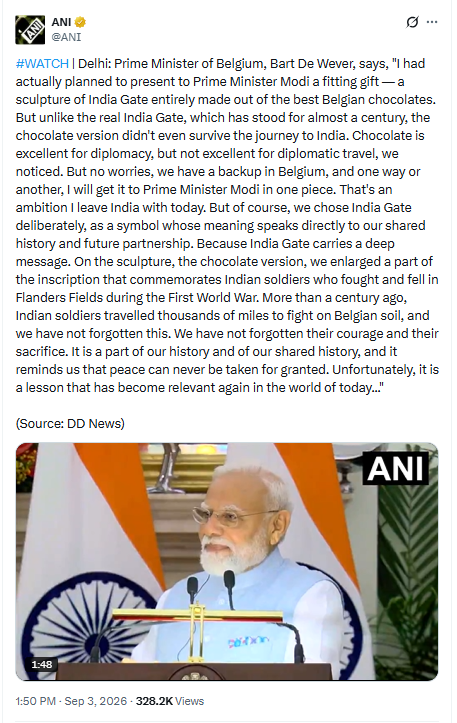
As part of the research, we found a report published on the Times of India website on September 4, 2026. According to the report, Belgian Prime Minister Bart De Wever arrived in India carrying a unique and special gift for Prime Minister Narendra Modi. It was a miniature replica of Delhi’s iconic India Gate, made entirely of Belgian chocolate. However, there was one problem—the chocolate replica melted during the journey to India. During a joint press conference with Prime Minister Modi in New Delhi on September 3, De Wever shared the anecdote in a light-hearted manner. He said he had planned to gift Modi a replica of India Gate made from “the finest Belgian chocolate.” However, unlike the real India Gate, which has stood for nearly a century, the chocolate replica did not survive the journey intact. De Wever jokingly remarked, “Chocolate is great for diplomacy, but not for diplomatic travel.”

Conclusion:
Our research found that the viral claim is misleading. Belgian Prime Minister Bart De Wever did indeed bring a miniature replica of India Gate made entirely of Belgian chocolate as a gift for Prime Minister Narendra Modi. However, the claim that the replica “melted during the journey” needs context. De Wever mentioned the incident humorously during his joint press conference with PM Modi, explaining that the chocolate replica did not survive the journey intact. Therefore, the viral post is based on a genuine incident but may present the context in a misleading manner.
.webp)
Introduction
The rise of unreliable social media newsgroups on online platforms has significantly altered the way people consume and interact with news, contributing to the spread of misinformation and leading to sources of unverified and misleading content. Unlike traditional news outlets that adhere to journalistic standards, these newsgroups often lack proper fact-checking and editorial oversight, leading to the rapid dissemination of false or distorted information. Social media transformed individuals into active content creators. Social media newsgroups (SMNs) are social media platforms used as sources of news and information. According to a survey by the Pew Research Center (July-August 2024), 54% of U.S. adults now rely on social media for news. This rise in SMNs has raised concerns over the integrity of online news and undermines trust in legitimate news sources. Social media users are advised to consume information and news from authentic sources or channels available on social media platforms.
The Growing Issue of Misinformation in Social Media Newsgroups
Social media newsgroups have become both a source of vital information and a conduit for misinformation. While these platforms allow rapid news sharing and facilitate political and social campaigns, they also pose significant risks of unverified information. Misleading information, often driven by algorithms designed to maximise user engagement, proliferates in these spaces. This has led to increasing challenges, as SMNs cater to diverse communities with varying political affiliations, gender demographics, and interests. This sometimes results in the creation of echo chambers where information is not critically assessed, amplifying the confirmation bias and enabling the unchecked spread of misinformation. A prominent example is the false narratives surrounding COVID-19 vaccines that spread across SMNs, contributing to widespread vaccine hesitancy and public health risks.
Understanding the Susceptibility of Online Newsgroups to Misinformation
Several factors make social media newsgroups particularly susceptible to misinformation. Some of the factors are listed below:
- The lack of robust fact-checking mechanisms in social media news groups can lead to false narratives which can spread easily.
- The lack of expertise from admins of online newsgroups, who are often regular users without journalism knowledge, can result in the spreading of inaccurate information. Their primary goal of increasing engagement may overshadow concerns about accuracy and credibility.
- The anonymity of users exacerbates the problem of misinformation. It allows users to share unverified or misleading content without accountability.
- The viral nature of social media also leads to the vast spread of misinformation to audiences instantly, often outpacing efforts to correct it.
- Unlike traditional media outlets, online newsgroups often lack formal fact-checking processes. This absence allows misinformation to circulate without verification, making it easier for inaccuracies to go unchallenged.
- The sheer volume of user engagement in the form of posts has created the struggle to moderate content effectively imposing significant challenges.
- Social Media Platforms have algorithms designed to enhance user engagement and inadvertently amplify sensational or emotionally charged content, which is more likely to be false.
Consequences of Misinformation in Newsgroups
The societal impacts of misinformation in SMNs are profound. Political polarisation can fuel one-sided views and create deep divides in democratic societies. Health risks emerge when false information spreads about critical issues, such as the anti-vaccine movements or misinformation related to public health crises. Misinformation has dire long-term implications and has the potential to destabilise governments and erode trust in media, in both traditional and social media leading to undermining democracy. If unaddressed, the consequences could continue to ripple through society, perpetuating false narratives that shape public opinion.
Steps to Mitigate Misinformation in Social Media Newsgroups
- Educating users in social media literacy education can empower critical assessment of the information encountered, reducing the spread of false narratives.
- Introducing stricter platform policies, including penalties for deliberately sharing misinformation, may act as a deterrent against sharing unverified information.
- Collaborative fact-checking initiatives with involvement from social media platforms, independent journalists, and expert organisations can provide a unified front against the spread of false information.
- From a policy perspective, a holistic approach that combines platform responsibility with user education and governmental and industry oversight is essential to curbing the spread of misinformation in social media newsgroups.
Conclusion
The emergence of Social media newsgroups has revolutionised the dissemination of information. This rapid spread of misinformation poses a significant challenge to the integrity of news in the digital age. It gets further amplified by algorithmic echo chambers unchecked user engagement and profound societal implications. A multi-faceted approach is required to tackle these issues, combining stringent platform policies, AI-driven moderation, and collaborative fact-checking initiatives. User empowerment concerning media literacy is an important factor in promoting critical thinking and building cognitive defences. By adopting these measures, we can better navigate the complexities of consuming news from social media newsgroups and preserve the reliability of online information. Furthermore, users need to consume news from authoritative sources available on social media platforms.
References

Executive Summary:
Viral pictures featuring US Secret Service agents smiling while protecting former President Donald Trump during a planned attempt to kill him in Pittsburgh have been clarified as photoshopped pictures. The pictures making the rounds on social media were produced by AI-manipulated tools. The original image shows no smiling agents found on several websites. The event happened with Thomas Mathew Crooks firing bullets at Trump at an event in Butler, PA on July 13, 2024. During the incident one was deceased and two were critically injured. The Secret Service stopped the shooter, and circulating photos in which smiles were faked have stirred up suspicion. The verification of the face-manipulated image was debunked by the CyberPeace Research Team.

Claims:
Viral photos allegedly show United States Secret Service agents smiling while rushing to protect former President Donald Trump during an attempted assassination in Pittsburgh, Pennsylvania.


Fact Check:
Upon receiving the posts, we searched for any credible source that supports the claim made, we found several articles and images of the incident but in those the images were different.

This image was published by CNN news media, in this image we can see the US Secret Service protecting Donald Trump but not smiling. We then checked for AI Manipulation in the image using the AI Image Detection tool, True Media.


We then checked with another AI Image detection tool named, contentatscale AI image detection, which also found it to be AI Manipulated.

Comparison of both photos:

Hence, upon lack of credible sources and detection of AI Manipulation concluded that the image is fake and misleading.
Conclusion:
The viral photos claiming to show Secret Service agents smiling when protecting former President Donald Trump during an assassination attempt have been proven to be digitally manipulated. The original image found on CNN Media shows no agents smiling. The spread of these altered photos resulted in misinformation. The CyberPeace Research Team's investigation and comparison of the original and manipulated images confirm that the viral claims are false.
- Claim: Viral photos allegedly show United States Secret Service agents smiling while rushing to protect former President Donald Trump during an attempted assassination in Pittsburgh, Pennsylvania.
- Claimed on: X, Thread
- Fact Check: Fake & Misleading

