
#FactCheck- Viral video does not show Iran targeting a Pakistani tanker in Strait of Hormuz
Executive Summary
Amid the ongoing tensions involving the United States, Israel, and Iran, a video of a cargo ship engulfed in flames is being widely shared across social media platforms. The clip shows a vessel burning intensely at sea, with users claiming that Iran targeted the ship with a drone for attempting to cross the Strait of Hormuz without permission. Some users have also claimed that the destroyed vessel was a Pakistani-flagged oil tanker hit by Iranian missiles. However, research by CyberPeace found the claim to be false. Our verification also reveals that the viral video is being misrepresented.
Claim
Social media users, including an X (formerly Twitter) account named “IranDefenceForce,” shared the video claiming that Iran targeted an oil tanker in the Strait of Hormuz for allegedly violating restrictions.

Fact Check
A keyword-based news search led us to multiple credible reports mentioning a statement by Iran’s Foreign Minister Abbas Araghchi. According to reports, Iran had allowed ships from “friendly countries” including India, China, Russia, Iraq, and Pakistan to pass through the Strait of Hormuz.
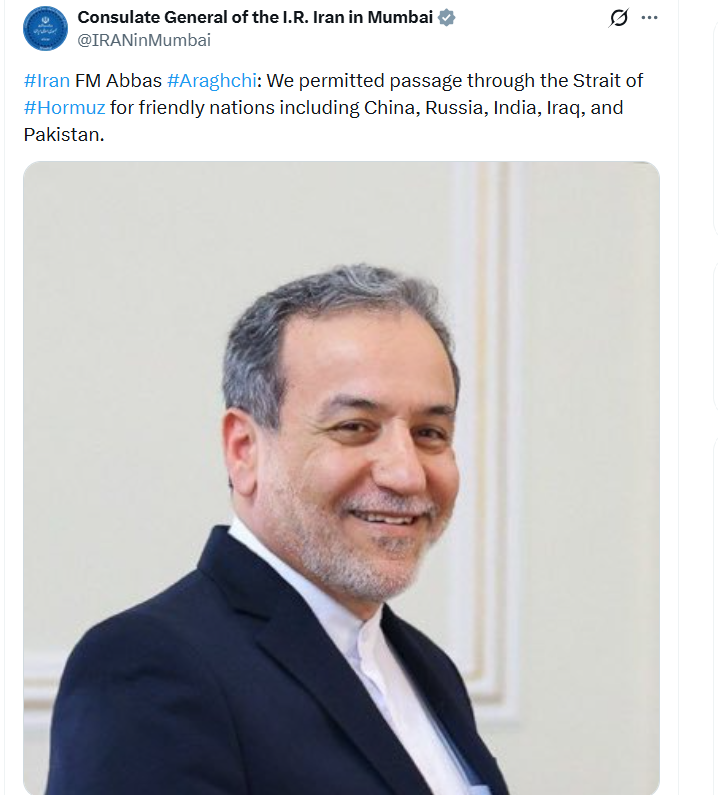
A March 26, 2026 report by The Hindu stated that Araghchi also emphasized Iran’s assertion of sovereignty over the strategic waterway connecting the Persian Gulf and the Gulf of Oman. The same statement was also shared via the official X handle of the Iranian Consulate in Mumbai. During a frame-by-frame analysis of the viral video, we noticed the word “SAFEEN” written on a part of the ship. Using this clue, we conducted a targeted news search and found a report by Reuters dated March 4, 2026.

According to the report, a Malta-flagged container ship named Safeen Prestige was damaged in an attack while heading toward the Strait of Hormuz. Shipping sources cited in the report stated that the vessel was struck around 1109 GMT while sailing eastward, approximately two nautical miles north of Oman. The ship had reportedly departed from Sharjah Port in the United Arab Emirates but was damaged before reaching its destination. Its last known location was in the Persian Gulf. Additionally, earlier this month, another cargo vessel named Mayuri Naree was also attacked near Iran’s Qeshm Island. As per Reuters, an explosion caused a fire in the engine room, after which 20 crew members were rescued by the Omani navy, while three remained missing.
Conclusion
The viral video does not show Iran targeting a Pakistani oil tanker for violating restrictions in the Strait of Hormuz. In reality, the clip features the Malta-flagged container ship Safeen Prestige, which was damaged in an unidentified attack in the Persian Gulf. The claim being circulated on social media is misleading.

Related Blogs

Introduction
As the world seemingly shrinks under the vast, ever-stretching canopy of the internet, the channels through which information flows are becoming increasingly enigmatic and tangled. In the digital world, the gulf between fact and fabrication narrows dramatically, with the veracity of information too often lost in the flood. Amidst the torrents of data, platforms like YouTube, a veritable Goliath in the video streaming sphere, are finding themselves at the forefront of a critical battle against the dark forces of fake news and disinformation—a war that is waged with the intensity of any historical conflict over truth and influence.
It is in this volatile theatre that Google's video behemoth, YouTube, under the scrutiny of the global eye, announces its strategic campaign to shield against the onslaught of misinformation. With India, the world's most populous democracy, on the cusp of its monumental general elections, the stakes could hardly be higher. YouTube's involvement thus evolves beyond corporate social responsibility—it becomes a crusade for the integrity of information, a paladin for the democratic process, and a protector of the public’s right to factual reporting.
The Campaign
The campaign envisioned by YouTube India's vanguard is multifaceted and robust, aimed at rooting out the insidious tendrils of fake news where they lie. At the heart of this mission are two pivotal strategies that form the backbone of YouTube's defense. Firstly, a rigorous misinformation policy, which heralds as a bastion against content designed with duplicitous intent. YouTube Indian Head Ishan Chatterjee elucidates, 'Our misinformation policies clearly state that if the content has been technically manipulated with the intent to deceive a user and there's a danger of real-world harm...we will act against that content.' It is an exhortation of YouTube's commitment to a culture of truth and an acknowledgement of the platform's influence and responsibility. This process, however, is more complex than it appears; it is tangled in socio-political nuances and demands an uncompromising vigilance to identify and dispel falsehoods.
Yet, this is merely the foundation upon which YouTube’s strategy rests. The second prong of their stratagem is even more ambitious—intending not only to eradicate the chaff of misinformation but also to till the soil with the seeds of verifiable, authoritative news content. This is an initiative to resuscitate the public's faith in digital information sources. By allying with credible news publishers and fostering a symbiosis with independent journalists, YouTube has taken up the mantle of an institution that not just police content, but cultivates it, transforming the barren desert of online falsehoods into an oasis of enlightenment.
News on YouTube is symbiotic with the larger consciousness of its users, driving content consumption and engaging millions who seek out current affairs, investigative reports, and in-depth analysis on the platform. The democratisation of news, once the hallowed ground of traditional broadcast and print media, now finds its theatre online. Chatterjee insightfully notes the ascending trend of news story engagement on YouTube Shorts and Connected TV (CTV)—two emergent platforms that have revolutionised content delivery and consumption. CTV, in particular, has skyrocketed in popularity within the past five years, boasting over 58 million viewers in India consuming YouTube content from the comfort of their living rooms as of June 2023, per analytics.
This phenomenon is acutely observed by YouTube's Director and Global Head of Responsibility, Tim Katz, who delineates a portrait of the Indian market's distinctive hunger for live content, particularly news, on CTV. Katz's observations carry an air of fascination, 'The other two things that have been exciting to see are that we've seen a lot of growth, particularly during sensitive moments, with large news stories occurring certainly during an election cycle, and we just see very large growth from many of our authoritative partners.'
The Implications of the Campaign
The tapestry of YouTube's news ecosystem is a rich mosaic of diversity, including independent journalists, broadcasters, legacy print publications, and digital-first media organisations. Katz underscores the gravity of nurturing such a broad and dynamic news environment on the platform, a gesture of YouTube's commitment to a holistic information landscape.
An illuminating report from the Google News Initiative, forged in cooperation with Kantar, reiterates the dominance of video as the consummate medium for news consumption across a spectrum of languages and formats in India. It paints a picture of a nation of insatiable news consumers, with nearly every second Indian language internet user engaging with news content, a substantial proportion hailing from urban locales. Of particular resonance is hyperlocal news, which plucks the chords of local interests and concerns, touching the lives of seven out of ten citizens.
Moreover, the economic impetus behind YouTube’s role in the media firmament is brought to light in the Oxford Economics Impact Report, revealing a staggering 70% of Indian media and music companies with a YouTube presence acknowledge the platform as a crucial revenue stream.
Conclusion
Poised upon the sharp edge of an electric election season—a season that will no doubt be drenched in a spectrum of information, both fact and fable—YouTube's convictions stand as a beacon of reliability. Their initiative is more than a method—it's a philosophy, a dedication to purifying the information sphere. In the digital epoch, where the battle lines for truth are drawn in bytes and bandwidth, YouTube’s rallying cry for responsibility, its vow to safeguard democratic ideals, and its unyielding commitment to illuminating the corridors of knowledge are more than strategies; they are pillars on which a well-informed, engaged, and enlightened citizenry can lean.
Reference
.webp)
Introduction
The unprecedented rise of social media, challenges with regional languages, and the heavy use of messaging apps like WhatsApp have all led to an increase in misinformation in India. False stories spread quickly and can cause significant harm, like political propaganda and health-related mis/misinformation. Programs that teach people how to use social media responsibly and attempt to check facts are essential, but they do not always connect with people deeply. Reading stories, attending lectures, and using tools that check facts are standard passive learning methods used in traditional media literacy programs.
Adding game-like features to non-game settings is called "gamification," it could be a new and interesting way to answer this question. Gamification involves engaging people by making them active players instead of just passive consumers of information. Research shows that interactive learning improves interest, thinking skills, and memory. People can learn to recognise fake news safely by turning fact-checking into a game before encountering it in real life. A study by Roozenbeek and van der Linden (2019) showed that playing misinformation games can significantly enhance people's capacity to recognise and avoid false information.
Several misinformation-related games have been successfully implemented worldwide:
- The Bad News Game – This browser-based game by Cambridge University lets players step into the shoes of a fake news creator, teaching them how misinformation is crafted and spread (Roozenbeek & van der Linden, 2019).
- Factitious – A quiz game where users swipe left or right to decide whether a news headline is real or fake (Guess et al., 2020).
- Go Viral! – A game designed to inoculate people against COVID-19 misinformation by simulating the tactics used by fake news peddlers (van der Linden et al., 2020).
For programs to effectively combat misinformation in India, they must consider factors such as the responsible use of smartphones, evolving language trends, and common misinformation patterns in the country. Here are some key aspects to keep in mind:
- Vernacular Languages
There should be games in Hindi, Tamil, Bengali, Telugu, and other major languages since that is how rumours spread in different areas and diverse cultural contexts. AI voice conversation and translation can help reduce literacy differences. Research shows that people are more likely to engage with and trust information in their native language (Pennycook & Rand, 2019).
- Games Based on WhatsApp
Interactive tests and chatbot-powered games can educate consumers directly within the app they use most frequently since WhatsApp is a significant hub for false information. A game with a WhatsApp-like interface where players may feel like they are in real life, having to decide whether to avoid, check the facts of, or forward messages that are going viral could be helpful in India.
- Detecting False Information
As part of a mobile-friendly game, players can pretend to be reporters or fact-checkers and have to prove stories that are going viral. They can do the same with real-life tools like reverse picture searches or reliable websites that check facts. Research shows that doing interactive tasks to find fake news makes people more aware of it over time (Lewandowsky et al., 2017).
- Reward-Based Participation
Participation could be increased by providing rewards for finishing misleading challenges, such as badges, diplomas, or even incentives on mobile data. This might be easier to do if there are relationships with phone companies. Reward-based learning has made people more interested and motivated in digital literacy classes (Deterding et al., 2011).
- Universities and Schools
Educational institutions can help people spot false information by adding game-like elements to their lessons. Hamari et al. (2014) say that students are more likely to join and remember what they learn when there are competitive and interactive parts to the learning. Misinformation games can be used in media studies classes at schools and universities by using models to teach students how to check sources, spot bias, and understand the psychological tricks that misinformation campaigns use.
What Artificial Intelligence Can Do for Gamification
Artificial intelligence can tailor learning experiences to each player in false games. AI-powered misinformation detection bots could lead participants through situations tailored to their learning level, ensuring they are consistently challenged. Recent natural language processing (NLP) developments enable AI to identify nuanced misinformation patterns and adjust gameplay accordingly (Zellers et al., 2019). This could be especially helpful in India, where fake news is spread differently depending on the language and area.
Possible Opportunities
Augmented reality (AR) scavenger hunts for misinformation, interactive misinformation events, and educational misinformation tournaments are all examples of games that help fight misinformation. India can help millions, especially young people, think critically and combat the spread of false information by making media literacy fun and interesting. Using Artificial Intelligence (AI) in gamified treatments for misinformation could be a fascinating area of study in the future. AI-powered bots could mimic real-time cases of misinformation and give quick feedback, which would help students learn more.
Problems and Moral Consequences
While gaming is an interesting way to fight false information, it also comes with some problems that you should think about:
- Ethical Concerns: Games that try to imitate how fake news spreads must ensure players do not learn how to spread false information by accident.
- Scalability: Although worldwide misinformation initiatives exist, developing and expanding localised versions for India's varied language and cultural contexts provide significant challenges.
- Assessing Impact: There is a necessity for rigorous research approaches to evaluate the efficacy of gamified treatments in altering misinformation-related behaviours, keeping cultural and socio-economic contexts in the picture.
Conclusion
A gamified approach can serve as an effective tool in India's fight against misinformation. By integrating game elements into digital literacy programs, it can encourage critical thinking and help people recognize misinformation more effectively. The goal is to scale these efforts, collaborate with educators, and leverage India's rapidly evolving technology to make fact-checking a regular practice rather than an occasional concern.
As technology and misinformation evolve, so must the strategies to counter them. A coordinated and multifaceted approach, one that involves active participation from netizens, strict platform guidelines, fact-checking initiatives, and support from expert organizations that proactively prebunk and debunk misinformation can be a strong way forward.
References
- Deterding, S., Dixon, D., Khaled, R., & Nacke, L. (2011). From game design elements to gamefulness: defining "gamification". Proceedings of the 15th International Academic MindTrek Conference.
- Guess, A., Nagler, J., & Tucker, J. (2020). Less than you think: Prevalence and predictors of fake news dissemination on Facebook. Science Advances.
- Hamari, J., Koivisto, J., & Sarsa, H. (2014). Does gamification work?—A literature review of empirical studies on gamification. Proceedings of the 47th Hawaii International Conference on System Sciences.
- Lewandowsky, S., Ecker, U. K., & Cook, J. (2017). Beyond misinformation: Understanding and coping with the “post-truth” era. Journal of Applied Research in Memory and Cognition.
- Pennycook, G., & Rand, D. G. (2019). Fighting misinformation on social media using “accuracy prompts”. Nature Human Behaviour.
- Roozenbeek, J., & van der Linden, S. (2019). The fake news game: actively inoculating against the risk of misinformation. Journal of Risk Research.
- van der Linden, S., Roozenbeek, J., Compton, J. (2020). Inoculating against fake news about COVID-19. Frontiers in Psychology.
- Zellers, R., Holtzman, A., Rashkin, H., Bisk, Y., Farhadi, A., Roesner, F., & Choi, Y. (2019). Defending against neural fake news. Advances in Neural Information Processing Systems.

Introduction
In India, the population of girls and adolescents is 253 million, as per the UNICEF report, and the sex ratio at birth is 929 per 1000 male children as of 2023. Cyberspace has massively influenced the daily aspects of our lives, and hence the safety aspect of cyberspace cannot be ignored any more. The social media platforms play a massive role in information dissemination and sharing. The data trail created by the use of such platforms is often used by cyber criminals to target innocent girls and children.
On Ground Stats
Of the six million crimes police in India recorded between 1 January and 31 December last year, 428,278 cases involved crimes against women. It’s a rise of 26.35% over six years – from 338,954 cases in 2016. A majority of the cases in 2021, the report said, were of kidnappings and abduction, rapes, domestic violence, dowry deaths and assaults. Also, 107 women were attacked with acid, 1,580 women were trafficked, 15 girls were sold, and 2,668 were victims of cybercrimes. With more than 56,000 cases, the northern state of Uttar Pradesh, which is India’s most populous with 240 million people, once again topped the list. Rajasthan followed it with 40,738 cases and Maharashtra with 39,526 cases. This shows the root of the problem and how deep this menace goes in our society. With various campaigns and initiatives by Government and the CSO, awareness is on the rise, but still, we need a robust prevention mechanism to address this issue critically.
Influence of Social Media Platforms
Social media platforms such as Facebook, Instagram and Twitter were created to bring people closer by eliminating geographical boundaries, which is strengthened by the massive internet connectivity network across the globe. Throughout 2022, on average, there are about 470.1 million active social media users in India on a monthly basis, with an annual growth rate of 4.2 % in 2021-22. This represents about 33.4 % of the total population. These social media users, on average, spend about 2.6 hours on social media, and each, on average, has accounts on 8.6 platforms.
The bad actors have also upskilled themselves and are now using these social platforms to commit cybercrimes. Some of these crimes against girls and women include – Impersonation, Identity theft, Cyberstalking, Cyber-Enabled human trafficking and many more. These crimes are on the rise post-pandemic, and instances of people using fake IDs to lure young girls into their traps are being reported daily. One such instance is when Imran Mansoori created an Instagram account in the name of Rahul Gujjar, username: rahul_gujjar_9010. Using social engineering and scoping out the vulnerabilities, he trapped a minor girl in a relationship & took her to a hotel in Moradabad. The hotel manager raised the suspicion of seeing a different ID & called the Police, Imran was then arrested. But many such crimes go unreported, and it is essential for all stakeholders to create a safeguard regarding girls’ and women’s safety.
Legal Remedies at our disposal
The Indian Legal system has been evolving with time towards the online safety of girls and women. The National Commission for Protection of Child Rights (NCPCR) and the National Commission for Women (NCW) have worked tirelessly to safeguard girls and women to create a wholesome, safe, secure environment. The Information Technology Act governs cyberspace and its associated rights and duties. The following provisions of the IT Act are focused towards safeguarding the rights –
- Violation of privacy – Section 66E
- Obscene material – Section 67
- Pornography & sexually explicit act – Section 67A
- Child pornography – Section 67B
- Intermediaries due diligence rules – Section 79
Apart from these provisions, acts like POCSO, IPC, and CrPC, draft the Digital Personal Data Protection Bill, Intermediary Guidelines on Social Media and Online Gaming and telecommunications bill.
Conclusion
The likelihood of becoming a victim of cybercrime is always growing due to increased traffic in the virtual world, which is especially true for women who are frequently viewed as easy targets. The types of cyber crimes that target women have grown, and the trend has not stopped in India. Cyber flaming, cyber eve-teasing, cyber flirting, and internet cheating are some new-generation crimes that are worth mentioning here. In India, women tend to be reluctant to speak up about issues out of concern that doing so might damage their reputations permanently. Without being fully aware of the dangers of the internet, women grow more susceptible the more time they spend online. Women should be more alert to protect themselves from targeted online attacks.
