#FactCheck- Doctored Audio in News18 Video Fuels False ‘Operation Sindoor’ Claim
Executive Summary
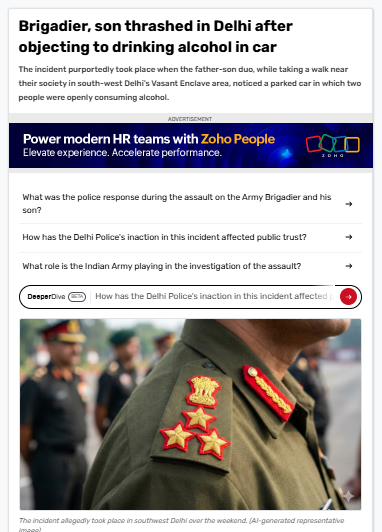
A video clip bearing the logo of News18 is being widely shared on social media with the claim that a serving Indian Army brigadier and his son were attacked in Delhi by an RSS-supporting mob for criticising the government over “Operation Sindoor.” The clip features an anchor allegedly explaining the motive behind the assault. However, research by the CyberPeace Research Wing found the claim to be false. The viral video has been digitally manipulated, with its audio altered to include misleading information.
Claim
An X user (@Mohammad776157) shared a video clip from Network18 on April 13, claiming that a serving Indian Army brigadier and his son were attacked in Delhi by an RSS-supporting mob for criticising the government over “Operation Sindoor.”
- https://x.com/Mohammad776157/status/2043691737609347166?s=20
- https://archive.ph/5EpbJ
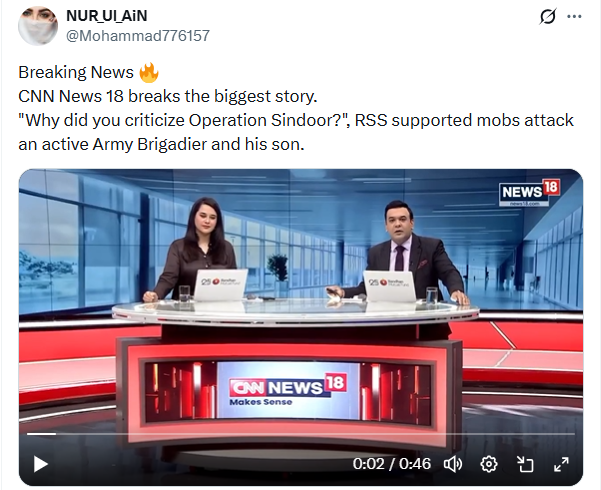
To verify the claim, we extracted multiple keyframes from the viral video using the InVid tool and conducted reverse image searches via Google Lens. The same clip was found circulating across several social media platforms with similar claims.
- https://www.facebook.com/reel/2397972117364665
- https://www.instagram.com/reels/DXE4FFdjcnq/
- https://archive.ph/hjG3b
- https://archive.ph/9IkTY
Fact Check
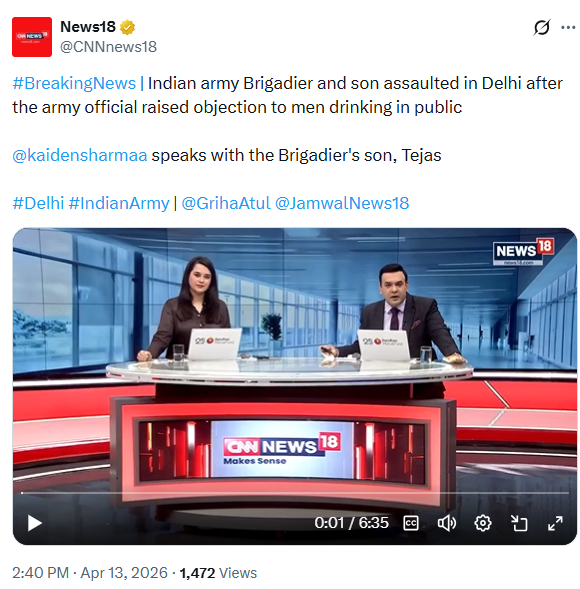
Since the video carried the News18 logo, we examined the outlet’s official social media handles. We found the original video on its X account, where the visuals matched the viral clip. However, a detailed analysis of the original footage showed that the anchor never stated that the brigadier and his son were attacked for criticising the government over “Operation Sindoor.”
In the authentic version, the anchor reported that the assault took place in Delhi’s Vasant Enclave after the brigadier objected to two individuals consuming alcohol inside a car parked outside his residence. This clearly indicates that the audio in the viral clip was tampered with to insert a false narrative.
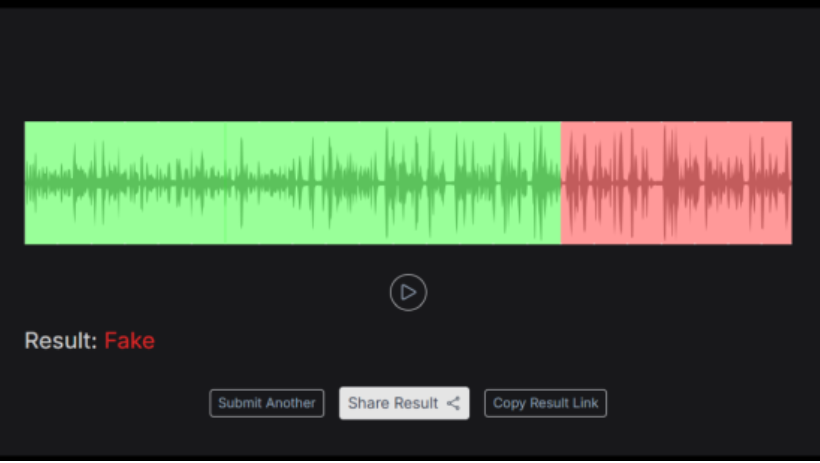
For further verification, we extracted the audio segment from the viral clip and analysed it using Resemble AI. The tool indicated that the portion describing the motive behind the attack had been digitally manipulated.
Conclusion
The viral claim is false. The video has been altered by modifying its audio to mislead viewers. In reality, the assault was not related to “Operation Sindoor” but occurred after the brigadier objected to public drinking near his residence.
Related Blogs

Introduction
The Ministry of Electronics and Information Technology (MEITy) released the Draft Information Technology (Intermediary Guidelines and Digital Media Ethics Code) Second Amendment Rules, 2026 on March 30, 2026, inviting public comments with a response window closing on April 14. This is a limited 15-day period for public input on proposed rules that will have major constitutional impacts. The brevity and timing of this opportunity demonstrate debatable commitment to stakeholder engagement and meaningful consultation by the drafting agency.
While MEITY describes the proposed amendments as "clarificatory and procedural nature," an analysis shows they will have substantive effects. Collectively, the amended language changes significantly how online speech will be regulated in India by providing the executive with more concentrated regulatory authority, limiting the required transparency of content enforcement, mandating greater retention of data without proportionality-based safeguards, and placing excessive compliance burden on intermediaries. Each of these changes has consequences beyond just changes in process and together, these changes collectively raise substantial concerns regarding compliance with Articles 14, 19, and 21 of the Constitution of India.
The Constitutional Baseline: Shreya Singhal and the Limits of Intermediary Liability
India’s Supreme Court decision in Shreya Singhal v Union of India (2015) 5 SCC 1 provides the foundation for intermediary liability, wherein the Court read down Section 79(3)(b) of the IT Act, 2000, holding that intermediaries are required to act upon receiving actual knowledge only through a court order or a valid notification by the appropriate government authority. The Supreme Court’s decision intended to provide a constitutional protection to intermediaries from being subjected to informal, unverified executive pressure to take down content by requiring that any such order be subject to some level of legal objective credibility or threshold.
Rule 3(4) of the proposed amendments places that balance under significant strain. By requiring intermediaries to comply with advisories, directions, standard operating procedures, codes of practice, and guidelines issued by the Ministry — and tying non-compliance to the loss of safe harbour — the draft effectively lowers the constitutional threshold that Shreya Singhal was designed to maintain. Compliance obligations now potentially arise from instruments that carry no judicial sanction and no mandatory public disclosure.
Rule 3(4): Delegated Legislation or Executive Overreach
The rule-making power conferred on the Central Government under Section 87 of the IT Act is limited to carrying out the provisions of the Act. It does not authorise the creation of new substantive obligations. This principle has been consistently affirmed in Indian Express Newspapers v. Union of India (1985) 1 SCC 641 and Confederation of Ex-Servicemen Associations v. Union of India (2006) 8 SCC 399, where the Court held that delegated legislation must remain within the four corners of the parent statute.
Rule 3(4) tests those limits. It converts executive advisories into binding compliance instruments without a clear statutory foundation in either Section 79 or Section 87. Although the proposed rule requires that such instruments specify their legal basis, there is no requirement that they be published or made publicly accessible. This creates a framework in which legality risks becoming circular — instruments claimed to be lawful solely by reference to a provision that does not clearly authorise them, shielded from scrutiny by their own opacity. Justice Chandurkar’s judgment in Kunal Kamra v. Union of India identified precisely this defect in the Fact Check Unit amendment. Rule 3(4) replicates the structural problem in a broader form.
Compliance Pressure and the Logic of Over-Censorship
The practical consequence of Rule 3(4) lies not only in its legality but in how it reshapes incentive structures for platforms. An intermediary facing the permanent threat of safe harbour loss will not wait to assess the legal merit of each advisory. The rational calculation is to comply early, broadly, and without friction. Lawful content — particularly satire, political commentary, and journalism — becomes vulnerable not because it is unlawful, but because it presents regulatory risk.
This dynamic was visible on 18 March 2026, when stand-up comedian Pulkit Mani (@hunnywhoisfunny) found his satirical Instagram reel being restricted across India. The video had accumulated over 16.5 million views. Users encountered a notice citing Section 79(3)(b) of the IT Act. No reasons were publicly provided. No prior hearing was offered. The same night, several political parody and satire accounts were withheld on X.
Data Retention, Privacy, and the Proportionality Test
The amendments to Rules 3(1)(g) and 3(1)(h) extend data retention obligations by making them additional to requirements under any other law. The existing 180-day floor for retained user data — covering removed content, registration information, and associated records — becomes a minimum rather than a ceiling. No maximum is specified, and no proportionality requirement accompanies the extension.
This raises direct concerns under Article 21 as interpreted in Justice K.S. Puttaswamy v. Union of India (2017) 10 SCC 1, which held that any state intrusion into privacy must satisfy the triple test of legality, necessity, and proportionality. Undefined retention periods, with no statutory ceiling and no requirement of purpose limitation, risk failing all three. The longer user data is held, including metadata, device information, and records of removed content, the greater the exposure to surveillance, unauthorised access, and use beyond the original justification.
Circumventing Judicial Scrutiny Through Procedural Redesign
The Bombay High Court, in its August 2021 order, stayed provisions of the IT Rules’ oversight mechanism as prima facie violative of Article 19(1)(a). The Madras High Court in T.M. Krishna v. Union of India affirmed that stay, cautioning that government-controlled media oversight risked undermining press independence. Both matters remain pending before the Delhi High Court.
The amendments to Rules 8(1) and 14 restructure the same oversight machinery through a modified procedural design. By extending the Inter-Departmental Committee’s jurisdiction to cover “matters” referred by the Ministry with no requirement of a complainant, no defined subject matter, and no guaranteed prior hearing, the proposed rules effectively reconstitute what courts found constitutionally suspect. Individual users posting news and current affairs content are now brought within reach of blocking mechanisms originally designed for institutional publishers.
Conclusion
As seen above, the Draft IT Rules 2026 are unable to meet the constitutional and judicial requirements to regulate free speech. What the proposed amendments construct is a durable system in which platforms self-censor under liability pressure, data is retained without proportionate justification, and content oversight expands through procedural adjustment rather than parliamentary legislation. Regulation of the digital public sphere is both legitimate and necessary. But it must be anchored in law, not in the quiet authority of executive advisories. The law must ultimately remain anchored in constitutional values, guided by the enduring principles of justice, equity, and good conscience.
The comment period closes on 14 April 2026.
Submissions may be sent to itrules.consultation@meity.gov.in.
References
- https://www.meity.gov.in/static/uploads/2026/03/30591fc6e322dcbcc9dae84a0f02e9e7.pdf
- https://www.meity.gov.in/static/uploads/2026/03/a71a21d35c107f2e528363d3eb17646a.pdf
- https://www.meity.gov.in/static/uploads/2026/02/550681ab908f8afb135b0ad42816a1c9.pdf
- https://neopolitico.com/india/government-blocks-viral-satirical-reel-impersonating-pm-modi-raising-fresh-questions-on-free-speech-and-digital-regulation/
- https://internetfreedom.in/sound-the-alarm-iffs-first-read-on-meitys-draft-it-rules-second-amendment-2026/

Introduction
India is seeing a major change due to the introduction of Artificial Intelligence (AI) across all sectors of government, business, and the digital economy with regard to areas such as governance, healthcare, finance, and the infrastructure. The large scale and rapid pace of AI implementation are expected to lead to efficiency gains, innovations in products and services, and to drive economic growth; however, the growth of AI also creates many serious concerns regarding ethics, legality, and societal ramifications. Issues such as algorithmic bias in the use of algorithms by AI, a lack of transparency in decision-making algorithms, data protection risks resulting from AI employments, and unclear frameworks for determining accountability for AI-related action; bring issues of how we will govern AI in a responsible manner to the forefront of public policy discourse.
India wants to become an AI superpower and leader in technology on the world stage. As such, India has a dual responsibility to fuel innovation without discounting democratic ideals, human rights, and public trust. UNESCO's AI Readiness Assessment Methodology (RAM) is a global tool for AI governance, created to provide concrete policy guidance on how to make ethical AI a reality. The India AI RAM Report is set to be formally released by UNESCO during the India AI Impact Summit 2026, taking place in New Delhi, as a major milestone in India's developing AI governance journey.
What is UNESCO’s AI Readiness Assessment Methodology (RAM)?
UNESCO has created a simple yet effective tool, called the AI Readiness Assessment Methodology (RAM), that can assist governments in determining how well they are prepared to develop, deploy and manage Artificial Intelligence ethically, responsibly and trustworthily. RAM provides a framework for diagnosing and self-assessing the state of a country’s ability to govern AI on the basis of evidence-based decision making rather than serving as a regulatory framework or ranking system.
The most important goal of RAM is to assess a country’s overall state of readiness to govern AI based on four dimensions: institutionally, legally, socially and technologically. In doing so, RAM examines how institutions function, their maturity level and the extent to which various policies align with one another; thereby giving governments an overview of strengths, weaknesses and priorities for reform.
Unlike other frameworks, RAM does not prescribe any one-size-fits-all solutions; instead, it uses a context sensitive approach when implementing the concepts of AI governance due to differing national realities, developmental priorities and social/economic conditions. Using the ethical principles established by UNESCO, RAM converts these principles into practical actions that can guide countries in their transition from abstract commitments to concrete strategies for governing AI.
Key Dimensions Assessed Under RAM
UNESCO's AI Readiness Assessment Methodology (RAM) is a tool used to assess a country's readiness to implement ethical Artificial Intelligence through five interconnected dimensions. These include: the legal and regulatory dimension (which looks at the laws, rules, and safeguards that are currently in place related to AI), the social and cultural dimension (which looks at whether the public is aware of AI, whether it trusts AI, whether AI is an inclusive experience for all people who use AI and whether AI has affected society in various ways), and the economic dimension (which looks at innovation, participation from industry, and readiness of the market for AI).
Also included in the framework/functionality of the RAM are: scientific and educational dimension (which examines a country’s capacity to conduct serious scientific research, including research activities that prepare persons to be employable in AI jobs); and technological and infrastructure dimension (which examines the availability of data, digital infrastructure, and computing capabilities for AI projects in a country).
All five of these dimensions consider the entirety of the scope of an AI readiness evaluation to ensure that AI Governance is more than just a technical issue; rather, it is a condition of a country’s capacity to generate laws, create policy and maintain social equality in relation to all forms of Artificial Intelligence.
Methodology and Nationwide Consultative Process
RAM takes both qualitative and quantitative characteristics together to create an overall understanding of how ready any nation is for AI capabilities. It is designed with flexibility so nations can define their assessments with respect to their own institutional capabilities and development agenda.
Normally, RAM is implemented by an independent expert who is assisted by a national team consisting of various stakeholders. With respect to the RAM process used in India, it was conducted as a national consultation where representatives from across all sectors of society (government, private sector, academia, civil society, and young people) participated in the assessment's creation. This consultation process made sure there were many different viewpoints present, which increased the legitimacy of the assessment results and how relevant they are in each country. The consultation process also yields policy recommendations based on real life governing situations or challenges that are specific to different sectors.
Institutional Partnerships Behind India’s RAM
The India RAM Initiative was developed by the UNESCO South Asia Regional Office (as a partner of IndiaAI Mission and the Indian Ministry of Electronics and Information Technology) and implemented by Ikigai Law with the help of The Patrick J. McGovern Foundation. This demonstrated the need for and importance of partnership in developing governance frameworks for Artificial Intelligence (AI). The result of the RAM process is a collaborative effort that includes evidence-based international norm-setting capabilities from around the world; government policies under the guidance of national political leadership; independent legal-technical implementation; input from civil society; all with the goal of empowering (increasing) India's ability to establish and implement both a consistent (i.e., coherent) and comprehensive (i.e., inclusive) AI Governance Framework.
Significance of the India AI RAM Report and Its Launch
The India AI RAM Report provides a complete initial assessment of India’s AI ecosystem and includes key insights into AI readiness, governance strengths/weaknesses, and potential opportunities across multiple sectors. It identifies priority areas to promote a responsible and trustworthy AI ecosystem in India.
The report will be officially released during the India AI Impact Summit (February 16, 2026 at Bharat Mandapam, New Delhi) where Mr. Abhishek Venkateswaran (National Project Officer-Social and Human Sciences at UNESCO South Asia) offered additional insight into the consultative process and the overall importance of this launch on India's future AI policy path.
Policy Relevance and the Road Ahead
The RAM Framework gives the government a structure and roadmap for developing and implementing AI Governance. In doing this, RAM reinforces the alignment of IndiaAI Mission, which includes safety and trust in AI as one of the pillars. However, the results from this Assessment will not automatically translate to reforming institutions, issuing guidelines specific to sectors, or developing a mechanism for continued evaluation. Implementation will require strong and sustained commitment from political leaders, as well as the commitment of institutions involved in the reforms made possible by RAM's implementation.
Conclusion
UNESCO has developed an AI Readiness Assessment Methodology (AI-RAM) that can greatly advance the way India approaches governance with respect to artificial intelligence (AI). By focusing on "readiness" (doing what needs to be done), "responsibility" (being or having good moral principles) and "inclusivity" (including everyone), the AI-RAM will enable India to become an active participant in discussions around ethical use of AI at a global level. India is now positioned to take on a leadership role in the world by adopting this methodology, which provides a platform for establishing global standards for AI development. The real benefit of the AI-RAM will come from policy measures that will ensure future AI development in India is 'human-centered', 'trustworthy' and 'aligns with democratic values'.
References
- https://icaire.org/files/UNESCORam-en.pdf
- https://www.pib.gov.in/PressReleasePage.aspx?PRID=2134492®=3&lang=2
- https://www.facebook.com/unesconewdelhi/videos/unesco-is-set-to-launch-the-india-ai-readiness-assessment-methodology-ram-report/25955631820699516/
- https://www.unesco.org/ethics-ai/en/ram
- https://www.hindustantimes.com/india-news/unesco-meity-launch-exercise-to-assess-india-s-ai-readiness-101749188341803.html#
- https://www.manoramayearbook.in/current-affairs/india/2025/06/09/unesco-ai-readiness-assessment-methodology-ram.html

Executive Summary
Amid reports of a two-week ceasefire announced on April 8, 2026, between the United States and Iran, a video showing a sudden explosion inside a building has gone viral on social media. The clip shows a fire brigade vehicle stationed outside a structure, with people entering the premises moments before a blast occurs. Social media users are sharing the video with claims that Iran carried out an attack on Israeli Defence Minister Yoav Gallant, alleging that the building shown is linked to Israel’s defence ministry.
However, a research by CyberPeace has found the claim to be false. The viral video is not recent and has no connection to Israel or any ongoing conflict.
Claim
A Facebook user shared the video on April 3, 2026, claiming that Iran had attacked Israeli Defence Minister Yoav Gallant and severely damaged a building associated with him.

Fact Check
To verify the claim, we extracted keyframes from the viral video and conducted a reverse image search. This led us to the same video posted on an X account named Fernanda Melchionna on December 31, 2025.

According to the available information, the video is from Santana do Livramento, where a major fire broke out in a supermarket. Further keyword searches led us to a report published on December 31, 2025, by the Brazilian news website GZH (gaúcha zh clicrbs). The report stated that a fire had erupted in a supermarket in Santana do Livramento, and firefighters had reached the spot to control the blaze. During the operation, an explosion occurred, leaving around 17 people injured. The injured were later taken to a hospital.

We also found the same video uploaded on the YouTube channel Terra Brasil on January 1, 2026, further confirming its origin and timeline.

Conclusion
The viral claim is false and misleading. The explosion video being shared as an attack on Israeli Defence Minister Yoav Gallant is unrelated to the ongoing Middle East situation. The footage is actually from December 2025 and shows an incident in Brazil, where a fire in a supermarket led to an explosion during firefighting operations. There is no evidence to suggest any such attack took place in Israel. The video has been taken out of context and circulated with a fabricated narrative to mislead users and exploit geopolitical tensions.