
#FactCheck - Unmasking the Deception: The Truth Behind the Fake 84-Day Recharge Offer in Celebration of BJP Government Formation in 2024
Executive Summary:
The internet has become a hub for fraudsters, and a new fraudulent scheme has been circulating, stating a free 84-day recharge of ₹719 given by the Honourable Prime Minister Narendra Modi in celebration of the BJP Government formation in 2024. This is yet another scam that uses tricks to lure the users, for instance by fake questionnaires, fake promises and the use of the Honourable Prime Minister Narendra Modi’s image to give a fake impression of legitimacy. The following blog post analyzes the scam and offers recommendations on how to recognize similar frauds and avoid them.
False Claim:
A viral link trending on various social media platforms states that Narendra Modi, the Honourable Prime Minister of India, is giving a free 84-day free recharge worth ₹719 to all users in India and this is an Election Bonus in celebration of the BJP government formation in 2024. The claim insists the users are required to click on the link (https://offerraj.in/Congress2024-Recharge/id=9jMiaeN1) and complete a questionnaire to get the offer.
The Deceptive Scheme:
- Mobile-Only Access: The malicious link (https://offerraj.in/Congress2024-Recharge/id=9jMiaeN1) is designed to open only on mobile devices; this makes it easier for more people to be affected.
- Multiple Redirects: After clicking the link, the users are led through a sequence of other links in order to conceal the actual source of the deception, and probably a try of making it difficult to track the notorious activity.
- Fake Comments & Images: First, the landing page contains a banner with the photo of India’s Honourable Prime-Minister Narendra Modi which gives the site’s visitors the impression of the official source. Also, fake comments can be made for the same reason, stating that the author has received a free recharge and supporting the so-called initiative.
- Fake Prize Notifications: For instance, after responding to the questions in the questionnaire, users may be presented with messages such as ‘Congratulations, you have won a free recharge’; this further creates an impression of a genuine offer.
- Social Sharing Requirement: To collect the so-called ‘prize’, the users are requested to share the link in the WhatsApp or other social networks, thus contributing to the spread of the scam.
Analyzing the Fraudulent Campaign:
- No Official Announcement: The internet and other social platforms are the only places where such an offer has been mentioned, and there is no official announcement from the Government or any other authorized body.
- Multiple Redirects: After clicking the link, users are taken through multiple redirects to obfuscating the source of the deception and to trace the malicious activity.
- Suspicious Domain and Hosting: The campaign is hosted on a third-party domain (offerraj.in) instead of any official government website, raising suspicion about its authenticity.
- Personal Data Collection: The questionnaire prompts users to provide personal information, which legitimate Government initiatives would not typically request through unofficial channels.
- Insecure HTTP Link: The link provided is an insecure HTTP link, whereas legitimate government websites employ secure HTTPS encryption.
Domain Analysis:
The actual url is hosted on a third party domain instead of the official website of the BJP or any Government website. This is the common way to deceive users into falling for a Phishing scam. Whois information reveals that the domain has been registered recently i.e on 28-03-2023 and the domain is registered with godaddy.com and state is from Rajasthan, India. Cybercriminals used Cloudflare technology to mask the actual IP address of the fraudulent website.

- Domain Name: offerraj.in
- Registry Domain ID: D9483D0EB38264263958C9609D2DCEA70-IN
- Registrar WHOIS Server:
- Registrar URL: www.godaddy.com
- Updated Date: 2024-05-03T07:30:03Z
- Creation Date: 2023-03-28T04:33:12Z
- Registry Expiry Date: 2026-03-28T04:33:12Z
- Registrar: GoDaddy.com, LLC
- Registrar IANA ID: 146
- Registrant State/Province: Rajasthan
- Registrant Country: IN
- Name Server: johnathan.ns.cloudflare.com
- Name Server: braelyn.ns.cloudflare.com


Similar offer surfing with different links: Several similar kind of offers through various links such as https://offerintro.com/BJP2024-Recharge/id=QYntPBDU, https://mahaloot2.xyz, https://mahaloot3.xyz, https://pmoffer4.online, are available in the social media. All these links are analysed and validated to be malicious or phishing links.
CyberPeace Advisory and Best Practices:
- Stay Informed: Be aware of potential scams and rely on official government channels for verified information.
- Verify Website Security: Do not click on links that have the ‘http’ at the beginning and focus on sites that have encryption (‘https’).
- Protect Personal Information: Be careful when there is any request to send some type of personal information, especially if it is done through informal companies.
- Report Suspicious Activity: When you notice that you have been scammed or a certain activity is fraudulent, ensure to report the incidents to the necessary authorities and the platforms to prevent others from being scammed.
Conclusion:
The claim of 84 day free recharge worth ₹719 to all users in India as an “Election Bonus” is false and similar kinds of various links are consistently surfing through the internet. The deceptive practices employed in these kinds of links are insecure and it has multiple redirects to false promises which highlights the need for heightened awareness and caution among internet users. In this digital world, it is important to stay informed, verify the authenticity of resources to protect personal information. Individuals can safeguard themselves against such fraudulent schemes and contribute to a safer online environment.

Related Blogs

Introduction
In today’s cybersecurity landscape, ransomware has emerged as one of the most significant and rapidly growing cyber threats. What began as attacks carried out by individual hackers has evolved into a highly organised criminal enterprise, with groups operating through structured business models and global networks. The emergence of The Gentlemen ransomware group reflects this transformation, demonstrating how modern threat actors can quickly expand their operations and target organisations across multiple sectors. Their rise highlights the increasing sophistication of ransomware campaigns and the growing challenges faced by organisations in defending against them. The attribution of the group's administrator to an identified individual in Izhevsk, Russia, provides a valuable lens through which to examine three interconnected developments: the maturation of ransomware-as-a-service (RaaS) business models, the inherent operational security (OPSEC) weaknesses that emerge over the course of cybercriminal careers, and the geopolitical environments that enable such actors to operate with relative impunity. Together, these dynamics illustrate the industrialisation of modern cybercrime.
The Industrialisation of Ransomware-as-a-Service
The remarkable rapid rise of The Gentlemen is impossible without discussing the maturation of ransomware-as-a-service (RaaS). RaaS systems utilize network intrusion experts as affiliates who conduct networks intrusions and secure access in exchange for a cut of the total ransoms paid, while a core group builds and maintains the ransomware framework itself. Although Reveton, one of the earliest Raas providers, can be credited with bringing early iterations of RaaS to fruition in 2012, the potential scale was truly evident in the mid-2020s. By 2025 it was estimated that there were over 100 active ransomware gangs operating; this proliferation is the direct result of the franchise-like system, which has lowered the barriers to entry for cybercrime.
The marketplace surrounding RaaS is intensely competitive, and this is clearly exemplified in the business structure of The Gentlemen: while many of the top ransomware groups provide an 80/20 profit share (with the majority of the profit going to the affiliates), The Gentlemen has an exceptionally profitable 90/10 split (affiliates keep 90% of the profit share) for affiliates, likely to draw experienced operators away from their rivals given recent decreases in victim willingness to pay and corresponding increases in the incentives RaaS platforms are required to offer.
The operational efficiency of the group is representative of a successful enterprise. They attack vulnerable internet-facing VPNs and firewalls and generally complete the network encryption within a matter of hours, leaving defenders with very little time to respond, as confirmed by Check Point Software, a renowned cybersecurity vendor.
Additionally, PRODAFT reports that the administrator of The Gentlemen, known by the alias Zeta88 (previously known as Hastalamuerte), directly provides affiliates with SSL VPN credentials, often obtained through brutal force attacks or their own private leaked databases, indicating an unusually high level of vertical integration for RaaS groups.
AI as a Force Multiplier in Ransomware Development
A particularly significant aspect of the Hastalamuerte case is PRODAFT's finding that the administrator employs artificial intelligence to develop and maintain ransomware, support associated tooling, and assist post-exploitation operations. This reflects a broader trend observed across the 2025–2026 threat landscape, where AI has increasingly lowered the capability threshold for participation in organised cybercrime. Researchers have documented its role in automating stages of intrusion, accelerating malware development cycles, and simplifying the maintenance of malicious infrastructure. These capabilities have been leveraged by both nation-state actors and criminal enterprises.
The trajectory of Hastalamuerte is especially illustrative. Cybersecurity Forum posts during 2019-2020 depict a hacker who is fairly novice at fundamental penetration testing procedures. A subsequent emergence as the operator of a top-tier ransomware-as-a-service operation indicates that AI-assisted development may be responsible for dramatically reducing the skill level and time necessary to create a successful criminal enterprise in cyberspace. The evolution of these tools should make the route from novice forum user to accomplished ransomware operator more attainable for a wider array of perpetrators in the future.
The OPSEC Paradox: How Cybercriminals Leave a Trail
The attribution of Hastalamuerte's identity by researchers from Intel 471, Flashpoint, and Constella Intelligence demonstrates the effectiveness of modern open-source and commercial intelligence methodologies. A forum registration traceable to an IP address from Izhevsk, Russia linked a Protonmail address, which linked to an Apple account, a GitHub profile, a Telegram handle, a Russian phone number, and finally to a 36 year old marketing professional named Alexander Andreevich Yapaev who was also living in Izhevsk. Investigators did not use an advanced capability in their attribution, but rather a simple OPSEC mistake of consistently reusing credentials. Every username and email address and every phone number creates a linkage between disparate data points, eventually building into a real-world persona.
It has also come out in the forum discussion that while training for a penetration testing course in 2020, Hastalamuerte displayed the kind of inexperience that a novice would display in traceable, recorded fashion to intelligence databases. It's an example of a broader rule about attribution; attacker mistakes provide the most value. With Russians the lack of apparent consequences may contribute to a lack of need to maintain tight OPSEC from the start.
The Russian Safe Haven: Conditional Impunity and Its Limits
Yapaev's base in Izhevsk is emblematic of the geostrategic situation that has allowed Russian cybercriminality to prosper. Security researchers routinely label Russia's policy as one of "controlled impunity," where the cybercriminality directed at foreign entities is ignored or implicitly condoned, while that directed at Russian interests will prompt a law enforcement response. This constitutes what has been called a "managed market" rather than an "unconditional sanctuary," where many of the named defendants could and likely will continue their illegal enterprise with little fear of reprisal, provided that they do not threaten the interests of the Russian state and do not attempt to move their operations outside of Russian control.
Yet this protection is neither absolute nor permanent. In May 2024, the transnational Operation Endgame campaign highlighted the growing global appetite for damaging the cybercrime ecosystem rooted in Russia. Russian authorities did indeed pursue and seize some assets and operators, but arrests seem largely confined to the lower-rung facilitators of these attacks (hosting providers and payment services), and it seems higher-end ransomware operators continue to evade scrutiny. Selective enforcement thus further bolsters the perception that protection is accorded according to strategic value, not legal standards. For operators such as Hastalamuerte, who possess no publicly documented intelligence connections, growing attribution capabilities, and sustained international pressure may gradually erode the security traditionally associated with operating from within Russia.
Attribution as a Deterrence Instrument
The public identification of Alexander Andreevich Yapaev as Hastalamuerte/Zeta88 shows the continued struggle with the utility of attribution in situations where immediate prosecution is not feasible. Its utility is far more extensive than simply an ability to make an arrest. Functionally, public naming forces a perpetrator into an open evidentiary space and can lead to alterations in their operational habits and effectiveness. Strategically, attribution provides future leverage for sanctions, indictments, financial restrictions, or extradition if the target can leave their safe haven country. The logic behind US rewards programs (paying up to $10 million for the capture and conviction of ransomware operators) relies on this principle. The analytical insight provided by the case cannot be understated either. Hastalamuerte's trajectory from a relative amateur forum participant on Nulled and Raidforums in 2019 to leading a significant ransomware operation by 2026 offers an invaluable look into the career progression of a cyber criminal. It confirms one of the lessons learned through deterrence and attribution: pseudonymity is not everlasting, and many years of OPSEC failures can be pieced together to establish a real-world identity.
Conclusion
The Gentlemen incident is emblematic of the three broad themes that currently characterise cyber warfare: ransomware-as-a-service through innovative competition, common OPSEC failures that enable attribution, and a new, conditional regime of protection for Russian cybercriminals. The obvious defense lesson: increasing attack surfaces require stronger identity, behavioural monitoring, and intelligence capacities. The policy lesson: effective attribution is still an essential tool for comprehension, deterrence, and disruption in an increasingly industrialised environment of criminals supporting each other's operations in ransomware-as-a-service.
References
- https://krebsonsecurity.com/2026/06/who-runs-the-ransomware-group-the-gentlemen/
- https://www.recordedfuture.com/
- https://www.vectra.ai/topics/ransomware-as-a-service
- https://www.trmlabs.com/es/resources/blog/new-disruption-opportunities-in-the-evolving-ransomware-ecosystem

Introduction
For years, Indian companies could get away with vague privacy promises. That window closed on 13 November 2025, when the government notified the Digital Personal Data Protection Rules, giving teeth to the broad principles Parliament had passed back in 2023 under the DPDP Act. The Rules turned soft commitments into specific, auditable duties, and a lot of organisations are only now realising how much that actually changes.
Start with Section 8(4). It requires every Data Fiduciary to put "appropriate technical and organisational measures" in place. Most readers skim past "organisational" and focus on the technical half, but that's a mistake, because the word is doing real work. It's asking for defined roles, written policies, staff training, and someone actually watching whether any of it holds up over time, not just firewalls and encryption keys. Section 8(5) goes further, demanding reasonable security safeguards against breaches, and Rule 6 spells out exactly what that phrase means in practice: encrypt data at rest and in transit, restrict access on a need to know basis, require multi factor authentication, log and monitor activity, run regular vulnerability checks, bind your data processors contractually to the same standard, and keep relevant logs for at least a year.
Then there's Rule 7, and this is where the clock starts running. Once a Data Fiduciary becomes aware of a breach, the Data Protection Board must be told without delay, and a full report has to follow within 72 hours covering what happened, when, why, what's being done about it, and confirmation that affected individuals were notified. Unlike GDPR, there's no minimum severity threshold here. A breach affecting ten people triggers the same obligation as one affecting ten million. And CERT-In's existing six hour reporting window under its 2022 Directions still applies separately, which means a serious incident can trigger two overlapping regulatory clocks running side by side.
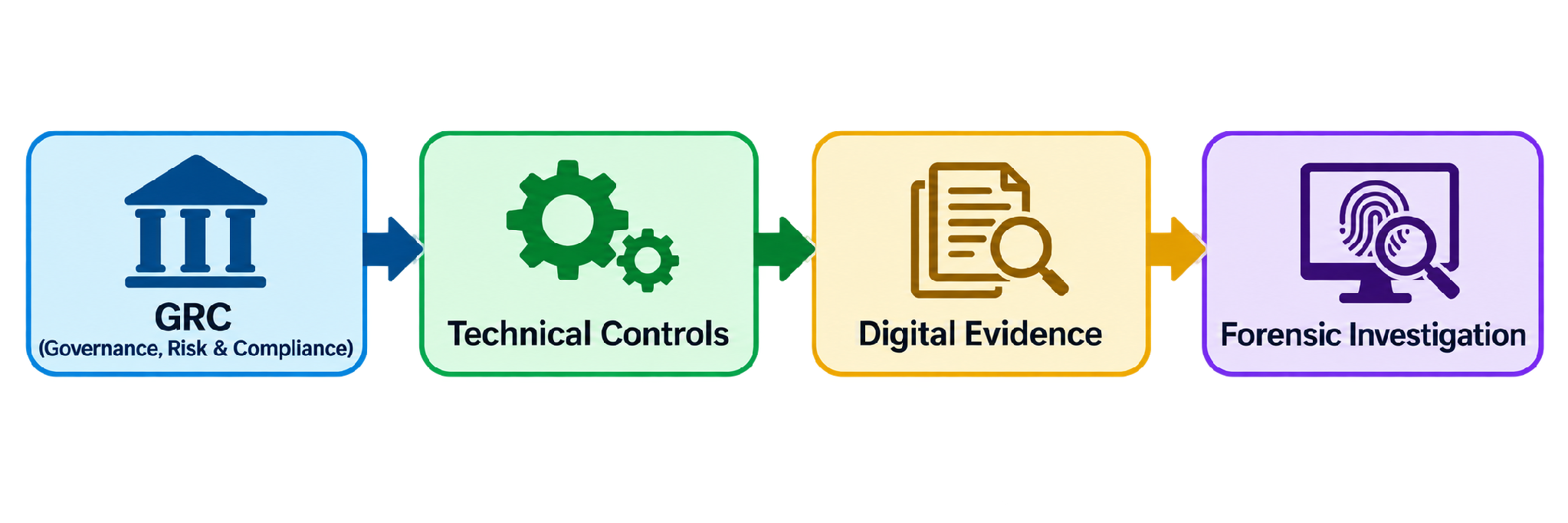
Put all of this together and a pattern emerges. The law assumes an organisation already knows what it's protecting, has actually protected it, kept usable records the whole way through, and can explain clearly what happened the moment something breaks. That coordination job belongs to Governance, Risk and Compliance, or GRC for short. GRC decides who's accountable, which risks actually matter, which controls address them, and how anyone checks whether compliance is real rather than assumed. Skip that structure and security work tends to splinter into a pile of disconnected tasks nobody truly owns.
GRC gives a legal duty somewhere to live. Forensic readiness is what lets an organisation prove, months or years later, that the duty was actually being met.
The Role of Governance, Risk and Compliance
On paper, most cybersecurity programmes look fine. There's an incident response plan somewhere, access control rules exist, logging is "in place," and someone has a title that says they're responsible for security. None of that gets tested until something actually breaks. A phishing compromise, a ransomware infection, a leaked database, a hijacked admin account, whatever the trigger, the questions that follow are always the same, and they're not comfortable ones. What happened, exactly, and when did it start? Which systems, which data, were actually touched? Were the controls the organisation claims to run genuinely functioning at that moment, or just described in a slide deck somewhere? And can anyone produce records solid enough to answer those questions with confidence rather than a shrug?
This is the exact seam where GRC and digital forensics meet. GRC lays out what's expected, who's responsible, and what evidence a control should be generating in the background. Digital forensics is the craft of taking whatever technical traces actually exist and turning them into an account of events that will hold up to scrutiny. Passing an audit was never really the point. Being able to stand in front of a regulator, mid incident, and show that the processes described on paper were real, active, and generating trustworthy evidence, that's the actual bar.
Why Compliance Alone Falls Short
Compliance, in the narrow sense, just means meeting whatever legal, contractual, or internal requirement applies. But a policy sitting in a document repository proves nothing about what actually happens on a Tuesday afternoon when someone requests admin access. A written incident response plan says nothing about whether the team can actually execute it under real pressure, at 2am, with a ransomware note on every screen. A logging policy is close to worthless if the logs it promises were switched off somewhere along the way, or overwritten, or scattered across systems that were never synchronised to the same clock.
NIST's Cybersecurity Framework 2.0 essentially built this concern into its core structure, placing "Govern" alongside Identify, Protect, Detect, Respond, and Recover as one of five equal functions rather than background paperwork sitting off to the side. India's own regulatory posture pushes in the same direction. CERT-In's 2022 Directions require certain incidents to be reported within six hours of discovery, and its guidance for government entities leans heavily on documented incident handling and disciplined evidence practices. The underlying message from both is identical: figure out, before anything goes wrong, whether the evidence you'll eventually need is actually going to exist when someone asks for it.
Where GRC and Forensics Actually Connect
A good GRC programme spells out what's supposed to happen. Forensic readiness is what lets you later prove what actually did.
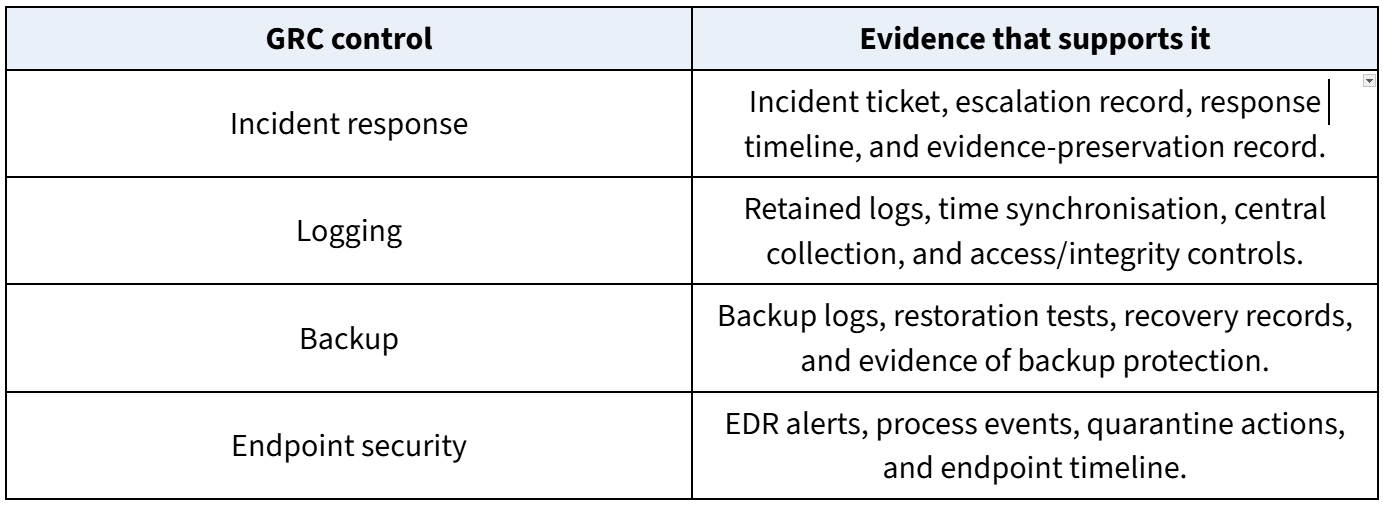
Access control is a useful example here. On the GRC side, an organisation might require least privilege access, multi factor authentication, periodic reviews of who holds privileged accounts, and prompt removal of access once someone leaves or changes roles. On the forensic side, none of that means anything without the underlying records that let investigators actually test it, authentication logs, MFA usage history, privilege change records, and account activity trails. The table below lines up a few common GRC controls against the specific evidence needed to show they were genuinely operating.
A Practical Scenario: After a Ransomware Incident
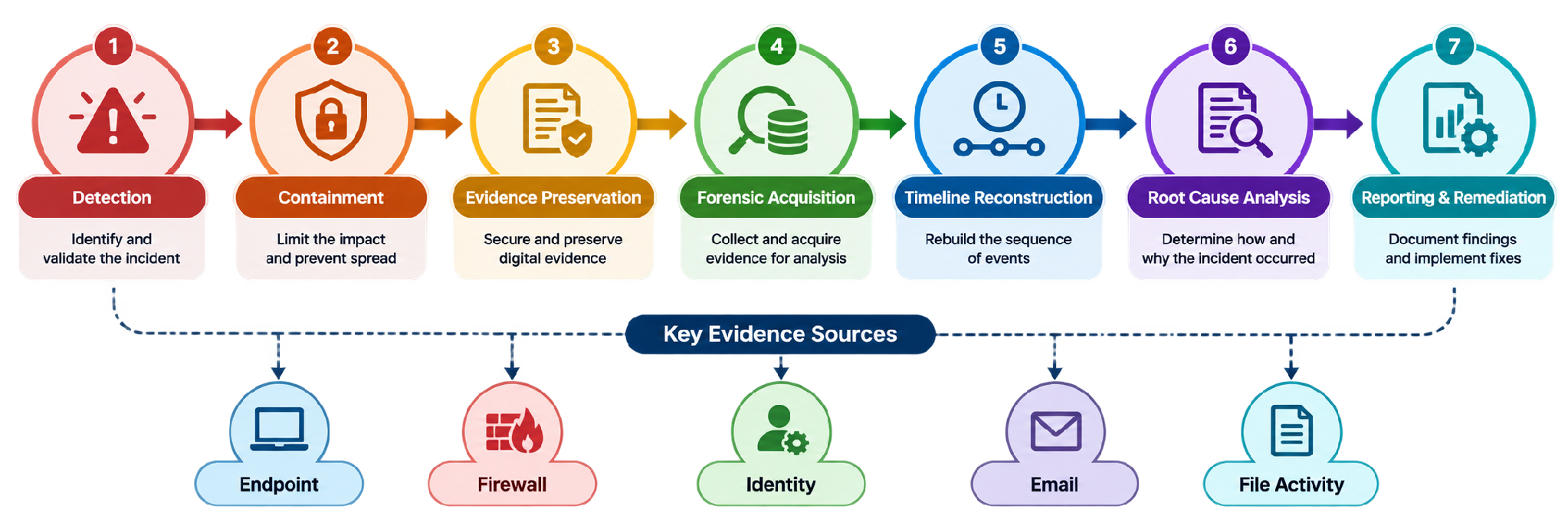
Picture a mid-sized company waking up to find half its file servers encrypted. There's an incident response plan somewhere in the shared drive, technically, but nobody's actually run through it in over a year. The security team isolates the obviously compromised endpoint and starts escalating. Now the forensic side of the house has to reconstruct what happened, working backward through endpoint telemetry, authentication logs, firewall events, email traffic, and file activity, hunting for the original point of entry, how the attacker escalated privileges, how they moved sideways through the network, what data they actually touched, and finally how the ransomware got deployed.
This is where the quality of everything collected beforehand suddenly matters a great deal. If server clocks were never properly synchronised, the timeline investigators build might not line up cleanly enough to trust. If logs only ever lived locally on individual machines rather than being pulled centrally, some of them are probably gone by now. If nobody ever bothered logging administrator actions, there are going to be real, unexplained gaps in the story. And if whatever evidence does exist wasn't collected the right way, its integrity can be challenged later, sometimes fatally, in a legal or regulatory proceeding. CERT-In actually ran a programme on exactly this in July 2026, "Inside the Breach," covering system artefacts, investigative technique, and chain of custody requirements, precisely because this is where real investigations tend to succeed or quietly fall apart.
Building a Forensic Ready GRC Programme
For an organisation starting more or less from scratch, forensic readiness doesn't need to be bolted on as some separate initiative. It can be built straight into the GRC programme that already exists. Start by identifying the systems, applications, cloud services, and privileged accounts that actually matter. Map the real risks and regulatory requirements onto the controls meant to address them. Then get specific about what evidence each control should be generating, and how that evidence gets protected and kept over time. Time synchronisation, centralised logging, tightly controlled access to security records, and clear ownership of preservation, escalation, and investigation all need to exist well before an incident, not be improvised during one. And none of it means much until it's actually been tested, through tabletop exercises and simulated incidents rather than assumed to work because it's written down somewhere. NIST SP 800-61 Revision 3 frames incident response as one continuous loop of preparation, detection, response, recovery, and improvement, rather than a series of separate boxes to check.
There's one question worth asking of every important control an organisation runs: could you actually prove this was working at the moment an incident happened? If the honest answer is no, what you have is a compliance process on paper, and a forensic readiness gap sitting quietly underneath it.
Conclusion
Cyber readiness was never really about how many policies sit in a binder or how many boxes get ticked in an audit. It shows up, or doesn't, in the hours right after something breaks, when an organisation has to move fast, preserve evidence that can actually stand up to scrutiny, explain clearly what happened, and prove that governance and technical controls were genuinely working together rather than just coexisting on paper. GRC sets the direction, the accountability, the risk priorities, and the compliance expectations. Digital forensics does the work of preserving and interpreting the technical evidence once something actually happens. Forensic readiness sits in between the two, making sure they're actually talking to each other long before an incident forces the conversation. The practical task for most organisations comes down to something simple to say, if not always simple to build: design controls that hold up under real incident response, not just an auditor's checklist. The strongest compliance posture was never the one with the thickest binder. It's the one that can back every document up with evidence, on the day it actually matters.
References
- Digital Personal Data Protection Act, 2023, Sections 8(4), 8(5), 8(6). https://www.meity.gov.in/writereaddata/files/Digital%20Personal%20Data%20Protection%20Act%202023.pdf
- Digital Personal Data Protection Rules, 2025, Rules 6 and 7, notified 13 November 2025. https://www.meity.gov.in
- National Institute of Standards and Technology, The NIST Cybersecurity Framework (CSF) 2.0, CSWP 29, 2024. https://csrc.nist.gov/pubs/cswp/29/the-nist-cybersecurity-framework-csf-20/final
- Indian Computer Emergency Response Team (CERT-In), Directions under Section 70B of the Information Technology Act, 2000, dated 28 April 2022. https://www.cert-in.org.in/Directions70B.jsp
- Indian Computer Emergency Response Team (CERT-In), Guidelines on Information Security Practices for Government Entities. https://www.cert-in.org.in/Downloader?fileName=CIPS-2026-0014.pdf&pageid=5&type=2
- National Institute of Standards and Technology, SP 800-86: Guide to Integrating Forensic Techniques into Incident Response, 2006. https://csrc.nist.gov/pubs/sp/800/86/final
- International Organization for Standardization, ISO/IEC 27037:2012, Guidelines for identification, collection, acquisition and preservation of digital evidence. CERT-In, "Inside the Breach: Advanced Cyber Forensics & Incident Investigation," 31 July 2026. https://www.cert-in.org.in/s2cMainServlet?pageid=PRSTNVIEW03&reCode=CIWS-2026-3569
- National Institute of Standards and Technology, SP 800-61 Rev. 3: Incident Response Recommendations and Considerations for Cybersecurity Risk Management, 2025. https://csrc.nist.gov/pubs/sp/800/61/r3/final
- Matters.ai, "DPDP Breach Notification: 72-Hour Rule & ₹200 Cr Penalty." https://www.matters.ai/article/dpdp-breach-notification MediaNama, "Data Breach Reporting Timeline of DPDP Rules 2025 Explained." https://www.medianama.com/2025/11/223-data-breach-reporting-timeline-of-dpdp-rules-2025-explained/

Introduction
The Digital Personal Data Protection (DPDP) Act, of 2023, introduces a framework for the protection of personal data in India. Data fiduciaries are the entity that essentially determines the purpose and means of processing of personal data. The small-scale industries also fall within the ambit of the term. Startups/Small companies and Micro, Small, and Medium Enterprises (MSMEs) while determining the purpose of processing of personal data in the capacity of ‘data fiduciary’ are also required to comply with the DPDP Act provisions. The obligations set for the data fiduciary will apply to them unilaterally, though compliance with this Act and can be challenging due to resource constraints and limited expertise in data protection.
DPDP Act, 2023 Section 17(3) gives power to the Central Government to exempt Startups from being obligated to comply with the Act, taking into account the volume and nature of personal data processed. It is the nation's first standalone law on data protection and privacy, which sets forth strict rules on how data fiduciaries can collect and process personal data, focusing on consent-based mechanisms and personal data protection. Small-scale industries are given more time to comply with the DPDP Act. The detailed provisions to be notified in further rulemaking called ‘DPDP rules’.
Obligations on Data Fiduciary under the DPDP Act, 2023
The DPDP Act focuses on processing digital personal data in a manner that recognizes both the right of individuals to protect their personal data and the need to process such personal data for lawful purposes and for matters connected therewith or incidental thereto. Hence, small-scale industries also need to comply with provisions aimed at protecting digital personal data.
The key requirements to be considered:
- Data Processing Principles: Ensuring that data processing is done lawfully, fairly, and transparently. Further, the collection and processing of personal data is only for specific, clear, and legitimate purposes and only the data necessary for the stated purpose. Ensuring that the data is accurate and up to date is also necessary. An important part is that the data is not retained longer than necessary and appropriate security measures are taken to protect the said data.
- Consent Management: Clear and informed consent should be obtained from individuals before collecting their personal data. Further, individuals have the option to withdraw their consent easily.
- Rights of Data Principals: Data principals (individuals) whose data is being collected have the right to Information, the right to correction and erasure of data, the right to grievance redressa, Right to nominate.the right to access, correct, and delete their personal data. Data fiduciaries need to be mindful of mechanisms to handle requests from data principals regarding their concerns.
- Data Breach Notifications: Data fiduciaries are required to notify the data protection board and the affected individuals in case a data breach has occurred.
- Appropriate technical and organisational measures: A Data Fiduciary shall implement appropriate technical and organisational measures to ensure effective observance of the provisions of this Act and the rules made thereunder.Cross-border Data Transfers: Compliance with regulations in relation to the transfer of personal data outside of India should be ensured.
Challenges for Small Scale Industries for the DPDP Act Compliance
While small-scale industries have high aims for their organisational growth and now in the digital age they also need to place reliance on online security measures and handling of personal data, with the DPDP act in the picture it becomes an obligation to consider and comply with. As small-scale industries including MSMEs, they might face certain challenges in fulfilling these obligations but digital data protection measures will also boost the competitive market and customer growth in their business. Bringing reforms in methods aimed at better data governance in today's digital era is significant.
One of the major challenges for small-scale industries could be ensuring a skilled workforce that understands and educates internal stakeholders about the DPDP Act compliances. This could undoubtedly become an additional burden.
Further, the limited resources can make the implementation of data protection, which is oftentimes complex for a layperson in the case of a small-scale industry, difficult to implement. Limitations in resources are often financial or human resources.
Cybersecurity, cyber awareness, and protection from cyber threats need some form of expertise, which is lacking in small enterprises. The outsourcing of such expertise is a decision that is sometimes taken too late, and some form of harm can take place between the periods by which an incident can occur.
Investment in the core business or enterprise many times doesn't include technology other than the basic requirements to run the business, nor towards ensuring that the data is secure and all compliances are met. However, in the fast-moving digital world, all industries need to be mindful of their efforts to protect personal data and proper data governance.
Recommendations
To ensure the proper and effective personal data handling practices as per the provisions of the act, the small companies/startups need to work backend and frontend and ensure that they take adequate measures to comply with the act. While such industries have been given more time to ensure compliance, there are some suggestions for them to be compliant with the new law.
Small companies can ensure compliance with the DPDP Act by implementing robust data protection policies, investing in and providing employee training on data privacy, using age-verification mechanisms, and adopting privacy-by-design principles. Conduct a gap analysis to identify areas where current practices fall short of DPDP Act requirements. Regular audits, secure data storage solutions, and transparent communication with users about data practices are also essential. Use cost-effective tools and technologies for data protection and management.
Conclusion
Small-scale industries must take proactive steps to align with the DPDP Act, 2023 provisions. By understanding the requirements, leveraging external expertise, and adopting best practices, small-scale industries can ensure compliance and protect personal data effectively. In the long run, complying with the new law would lead to greater trust and better business for the enterprises, resulting in a larger revenue share for them.
References
- https://pib.gov.in/PressReleaseIframePage.aspx?PRID=1959161
- https://www.financialexpress.com/business/digital-transformation-dpdp-act-managing-data-protection-compliance-in-businesses-3305293/
- https://economictimes.indiatimes.com/tech/technology/big-tech-coalition-seeks-12-18-month-extension-to-comply-with-indias-dpdp-act/articleshow/104726843.cms?from=mdr
