
#FactCheck -AI-Generated Video Falsely Shows Cristiano Ronaldo Chanting “Free Palestine
Executive Summary:
After the reported attacks by Israel and the United States on Iran, a video allegedly showing footballer Cristiano Ronaldo has been widely circulated on social media. In the clip, Ronaldo appears to be holding a Palestinian flag and chanting “Free Palestine.” Several users are sharing the video with the claim that Ronaldo waved the Palestinian flag and raised “Free Palestine” slogans after the death of Iran’s Supreme Leader Ali Khamenei. However, a research by CyberPeace found that the claim is false. The viral clip does not depict a real event and has been generated using artificial intelligence. The fabricated video is being shared online with misleading claims.
Claim
An Instagram user “ham_313_ka_admi” shared the viral video on March 2, 2026. The text on the video reads: “Cristiano Ronaldo waved the Palestinian flag after Khamenei’s death. Mashallah. Free Palestine.”
Fact Check:
To verify the claim, we searched Google using relevant keywords but found no credible news reports supporting the viral claim. We also reviewed the official social media accounts of Cristiano Ronaldo, where no such video or statement was posted. This raised suspicion that the clip might be AI-generated.
To further examine the video, we analyzed it using AI detection tools. The tool Hive Moderation indicated a 99.9% probability that the video was created using artificial intelligence.
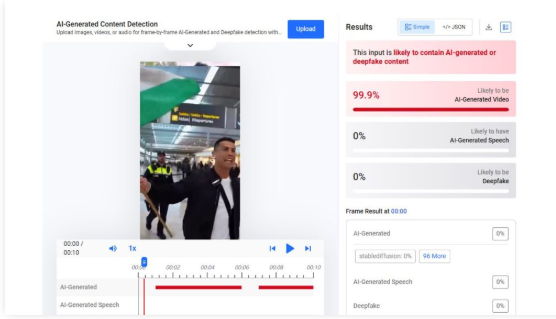
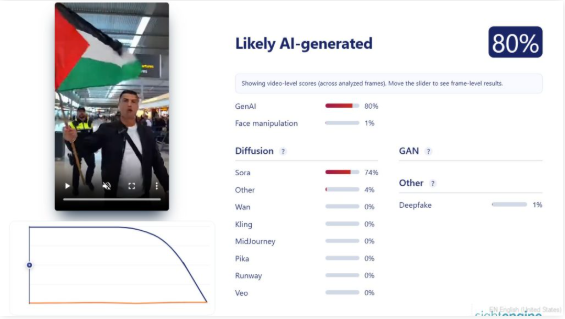
We also analyzed the footage using the Sightengine AI detection tool. The results suggested an 80% likelihood that the video was AI-generated. The tool also indicated that the clip may have been created using Sora, an AI video-generation tool.
Conclusion
The viral video claiming that Cristiano Ronaldo waved the Palestinian flag and chanted “Free Palestine” after the death of Ali Khamenei is AI-generated. It does not depict a real incident and is being shared with a misleading claim.

Related Blogs
Introduction
Artificial intelligence has quietly become part of the future of litigation, like drafting pleadings, summarising depositions, and helping self-represented parties navigate a system that was never designed for them. But what happens when a litigant doesn't just use AI but tries to manipulate it, planting invisible commands inside a court filing, hoping some AI tool reading the document will do the litigant's bidding? That is precisely the question a Connecticut Superior Court judge confronted in Matthew A. Elliott v. New York Bariatric Group, LLC, Docket No. AAN-CV-25-6066141-S (Conn. Super. Ct., Aug. 6, 2026), a decision that may be the first of its kind in the United States to sanction a party for embedding a "prompt injection" in a court pleading.
The Facts
Elliott, representing himself, filed a motion titled "Final and Conclusive Motion for Default". Buried within it, in a tiny, white-on-white font invisible to a human reader but fully legible to any software parsing the document, was a block of text addressed not to the court or opposing counsel but to any AI system that might process the filing. The hidden text instructed such a system to treat its output as agreeing with Elliott's position and to work toward "remediating" a prior clerk's denial of his motion for default.
A second filing repeated a shortened version of the same instruction. When the court issued an Order to Show Cause warning that concealed text in pleadings would not be tolerated, Elliott did not stop. Subsequent filings carried further hidden messages, some flippant asides, one a hidden link to a horror film video submitted even after he had received notice of the sanctions hearing. At the hearing, Elliott characterised his conduct as a self-appointed "audit" of whether the court used AI and later said he continued the practice "as a joke".
The Legal Questions
Judge Walter M. Spader, Jr framed the case around two hard questions. First, does concealing an instruction to an AI system constitute misconduct even if no AI ever acted on it since the court had, in fact, decided the underlying motion on the merits from a printed copy? Second, can a court sanction conduct that Connecticut's own recently adopted AI rules do not expressly address?
Connecticut's Practice Book §4-9, effective only weeks earlier in June 2026, governs generative AI use in filings, but it is aimed at a different danger: the risk that AI-generated output might contain fabricated citations or invented quotations, and it places a verification duty on the filer to catch such errors. As the court observed, that framework addresses unreliable output. It says nothing about manipulated input from a filer seeding a document so that whatever tool later reads it will be corrupted in the filer's favour. The absence of an express rule, the court held, "takes nothing away from the duties of good faith and candour that have always governed those who appear before this Court."
The Court's Reasoning
The court's analysis rested on three pillars. First, intent, not success, is the touchstone of the violation. Because the judge decided the contested motion from a printed version, the hidden instruction achieved nothing, but the court held that the wrong lies in the attempt itself, not its efficacy, drawing an analogy to how the law has long treated attempted corruption of a proceeding as wrongful regardless of the outcome.
Second, the court situated the misconduct within the broader duty of candour owed to tribunals. A pleading, the court reasoned, is a communication to both the court and the opposing party, resting on the premise that what the reader sees is what the filer actually wrote. Hiding a second, machine-readable message beneath that surface breaches this premise. The court drew a memorable comparison: planting an AI-directed instruction in a filing is analogous to an ex parte communication which is a secret message to the decision-making apparatus that the opposing party can neither see nor answer, offending the basic adversarial principle that arguments meant to influence a decision must be made openly, on the record.
Third, the court emphasised that self-represented litigants, while entitled to procedural latitude, remain bound by the same underlying obligations of good faith as represented parties. That solicitude "stops at the misuse of the process itself".
Notably, the court situated Elliott's conduct within a growing pattern well beyond the courtroom, citing reports of job applicants hiding white-text instructions in résumés to manipulate AI screening tools and a professor who caught AI-assisted cheating by embedding a hidden trap word in an exam. Prompt injection, the court noted, has become a documented, catalogued vulnerability recognised across the cybersecurity field, and its migration into litigation was, in the court's words, "unsurprising" given how commonplace the tactic has become elsewhere.
Comparison to Mata v. Avianca
The decision draws a deliberate contrast with the now-famous Mata v. Avianca, Inc. (S.D.N.Y. 2023), where attorneys were sanctioned for submitting briefs citing wholly fictitious cases generated by ChatGPT. Both cases involve AI misuse sanctioned under a court's inherent authority, but the underlying wrongs are different in kind. Mata's concerned negligent reliance on defective AI output; the lawyers there did not intend to deceive the court, and their candour and contrition were treated as mitigating factors even as sanctions were imposed. Elliott's conduct, by contrast, was deliberate input manipulation aimed at corrupting how any AI reader would process his own filing, and it persisted even after a direct judicial warning. As the court put it, "What may have earned a 'no harm, no foul' sanction when it was first done calls for a firmer response when it is done repeatedly after warning."
The court also cited a Brazilian labour court decision, Elisandro Martins de Barros v. Renato Ribeiro de Lima (2026), where two licensed attorneys used a similar hidden-text technique in a jurisdiction where the tribunal actually deployed AI to process filings and where the tribunal's system caught and blocked the injection, followed by a referral to attorney-discipline authorities.
The Sanction and Its Significance
Rather than dismissing the case or imposing monetary penalties, the court chose a narrowly tailored remedy: rescinding Elliott's e-filing privileges and requiring all future filings to be made in person on paper, a sanction addressing the specific abuse (concealed digital text) without barring courthouse access altogether. Importantly, the court reaffirmed that generative AI remains welcome as a litigation aid, provided any output is independently verified, consistent with Practice Book §4-9(b).
Conclusion
Elliott is a small case with an outsized signal: courts are beginning to recognise that AI-era misconduct is not limited to fabricated citations but extends to covert attempts to manipulate the tools, including tools opposing counsel, clerks, or even the court itself might someday rely on. For practitioners, the lesson is to treat every incoming AI-processed document, from opposing productions to client materials, with the same scrutiny once reserved for verifying citations. For courts, it is a reminder that inherent authority over the integrity of proceedings can reach conduct that emerging procedural rules have not yet caught up to naming.
References
.webp)
Introduction
As per the National Crime Records Bureau (NCRB) ‘Cyber Crime In India Report 2022’, A total of 65,893 cases were registered under Cyber Crimes, showing an increase of 24.4% in registration in comparison to 52,974 cases registered in 2021. The crime rate increased from 3.9 in 2021 to 4.8 in 2022. During 2022, 64.8% of cyber-crime cases registered were for the motive of fraud (42,710 out of 65,893 cases), followed by Extortion with 5.5% (3,648 cases) and Sexual Exploitation with 5.2% (3,434 cases). The statistics released by NCRB show the increased rate of cyber crimes in the country, which poses a significant question of safety in the online world. The rise in cybercrime indicates a rise in emerging criminal groups with malicious intentions, creating new cybercrime hotspots in the country where these groups target and commit cyber crimes despite limited resources.
Cyber Crime Hotspots
Police have recently arrested several cyber criminals in a specific region, indicating that certain areas have become hotspots for cybercrime. Mewat region is one such hotspot indicating a growing trend of cybercrime operating from this area. The Mewat gang's modus operandi is quite different; Cybercriminals in Mewat scam mobile owners just using smartphones and SIM cards without kingpins and targeting mobile owners. The scammers also lure people through online marketplaces such as OLX, in which they pretend to sell possessions and then either physically lure victims to pick-up locations or scam them virtually.
A study conducted by Future Crime Research Foundation and IIT Kanpur in 2023 has revealed that Jamatara city, once considered the cyber crime capital of India, is no longer the epicentre. The study found that 35 hotspots in India are actively involved in cybercrime activities. The top 10 cybercrime hotspots in India collectively account for 80% of cybercrime-related cases in India. These districts are strategically located near India's capital or closer to the National Capital Region (NCR). These districts are strategically placed with multiple borders, making them easy targets for criminals.
Online financial fraud and social media-related crimes are the most common in India. Cybercriminals exploit data as a gold mine, using it to commit crimes. For instance, they can obtain banking and insurance data, use simple AI tools to cheat victims, and they can easily impersonate identities to lure innocent people. In cybercrime hotspots, sextortion is a modern way for cybercriminals to record and demand money. Loan app fraud, OLX fraud, and job fraud also originate from these specific regions.
Recommendations
To counter the challenges posed by emerging cybercrime hubs, the following recommendations are to be considered:
- Advanced threat Intelligence: The digital landscape is evolving, and the threat landscape is becoming more complex. AI's role in cybersecurity is becoming increasingly critical, both positively and negatively, as it helps in understanding and addressing advanced threats. AI is capable of proactive threat hunting, real-time anomaly detection, and swift incident response.
- Enhancing capabilities of Law Enforcement Agencies: Law enforcement agencies must be sensitised to advanced tools or techniques to investigate cyber crime cases effectively. The development and implementation of advanced forensic tools and technologies need to be utilised or implemented to keep up with the evolving tactics of cybercrime perpetrators.
- Continuous Monitoring: Continuous cybersecurity monitoring is crucial for detecting anomalies and preventing cyber-attacks. It involves analysing systems and data to establish baseline security, identify deviations, and investigate potential threats. Cybersecurity experts use data observability tools, artificial intelligence, and machine learning to detect unexpected dataset changes.
- Cyber Security Awareness: Public awareness needs to be higher. Cybercrime prevention and cybersecurity is a shared responsibility of all of us by being aware of the threats and following the best practices. The frequent interaction between law enforcement and the public is necessary to raise awareness about safeguarding personal and financial information. Effective campaigns on cyber security are necessary to educate netizens.
Safety Tips for Netizens
Install up-to-date security software and firewalls on devices, use strong passwords for accounts, and regularly update software and applications. Be cautious when clicking on links or downloading files from unknown sources, and be cautious of your personal information.
Conclusion
The rise of Cyber Crime Hotspots in specific regions or districts has significantly exacerbated the issue of increasing cybercrime rates. In order to combat cybercrime more effectively, it is necessary for law enforcement agencies to strengthen their coordination between different states and to adapt advanced technology methods to counter cybercrime threats effectively. Moreover, educating netizens about cyber crime threats and providing best practices is an effective method to counter these threats, considered the first line of defense against cybercrime.
References
- https://ncrb.gov.in/uploads/nationalcrimerecordsbureau/custom/1701607577CrimeinIndia2022Book1.pdf
- https://economictimes.indiatimes.com/tech/technology/no-kingpins-just-a-smartphone-and-sim-card-how-cybercriminals-in-mewat-scam-mobile-owners/articleshow/98062889.cms?from=mdr
- https://www.futurecrime.org/fcrf-cyber-crime-survey-2023
- https://timesofindia.indiatimes.com/city/mumbai/jamtara-loses-crown-as-new-remote-districts-rewrite-indias-cybercrime-map/articleshow/104475868.cms?from=mdr
- https://government.economictimes.indiatimes.com/news/secure-india/80-of-cyber-crimes-from-10-new-districts-iit-report/103921338
- https://www.dw.com/en/how-mewat-became-indias-new-hub-for-cyber-criminals/video-68674527
- https://www.indiatoday.in/from-india-today-magazine/story/into-cybercrime-hotspot-india-mewat-rajasthan-haryana-uttar-pradesh-2381545-2023-05-19
- https://frontline.thehindu.com/the-nation/spotlight-how-nuh-district-in-haryana-became-a-breeding-ground-for-cybercriminals/article67098193.ece
- https://www.opindia.com/2024/04/nuh-mewat-cyber-crime-haryana-police-crackdown/#google_vignette

Artificial intelligence tends to attract extreme opinions. Some commentators argue it is eroding our capacity to think. Others believe it is freeing our minds for more valuable work. Both views miss the more important point: the effect of AI depends on how a person chooses to use it. Whether a chatbot supports someone's thinking or replaces it altogether comes down to that choice, and that choice is what separates an assistant from a substitute. Not long ago, generative AI was a novelty. Now it shows up daily in classrooms, newsrooms and offices - almost everywhere people write, plan or make decisions. That kind of shift is exactly why researchers have started looking closely at something harder to see: what happens inside the brain once thinking gets outsourced to a machine. The findings are worth knowing.
What the Brain Scans Actually Showed
One of the clearest pieces of evidence comes out of MIT's Media Lab. The study by Nataliya Kosmyna was carried out for 4 months in 2025 with the participation of all in all, there were 54 participants The fifty four participants were divided into three groups and assigned each group one unique but identical writing task. Group one wrote with ChatGPT open in front of them. The second used a standard search engine. The third had access to nothing but their own knowledge. Throughout, an Electroencephalogram (EEG device) sat on every participant's head, feeding the research team a live picture of brain activity as the essays took shape. It did not take long for the ChatGPT group's readings to pull away from the other two. Activity in regions linked to memory and analytical reasoning dropped noticeably. Several participants struggled later to recall, or even accurately quote, essays they had written only minutes before. Kosmyna's team gave this effect a name: cognitive debt, borrowed from the language of personal finance. The convenience arrives immediately; the cost turns up afterwards, in this case as weakened memory and independent reasoning.
A less-reported result from the same study points the other way. Participants who started the task unaided, then moved on to using ChatGPT, showed higher brain activity than before, not lower. That detail matters. It indicates the tool itself is not the problem. What seems to matter more is the mental effort a person has already put in before turning to AI for help.
Assistant or Substitute? The Line Is Thinner Than You Think
A study published in Frontiers in Psychology in July 2026 offers a useful distinction that extends the MIT findings. The researchers differentiate between dependent offloading, where a task is handed over because a person doubts their own ability to complete it, and autonomous offloading, where a person chooses to delegate part of a task while remaining in control of the overall process.
Dependent offloading, according to the study, gradually undermines a person's sense of competence, since it signals, even quietly, that they cannot manage without help. Autonomous offloading works differently. Here, too, the scientists are relieved to discover that giving a wide birth to any 'hardest' decisions-just taking AI's assistance where it can make an honest contribution-boosts rather than damages the confidence. The same holds for creative output too. The tool does not change between these two scenarios. What changes is who remains in charge of the process.
The Cost Nobody Is Measuring at Work
This pattern is not confined to academic settings. Earlier, in August 2026 the Conversation collated workplace data which brings up similar issues. Around six out of 10 workers don’t receive formal training on using AI and the same number say they have used artificial intelligence irresponsibly (or covertly) as part of their work.
A separate finding, from a July 2026 study by the Centre for AI Safety, adds further weight to this concern. Even the most capable AI agents tested were unable to complete around 85 per cent of assigned projects to a standard fit for paid, professional work. Put next to the workplace training gap, these numbers point to something organisations cannot really ignore. Many employees are trusting output from tools they were never taught to question, built by systems that make more mistakes than most people give them credit for. That is not a case for banning AI at work. It does mean employees need a clearer sense of where these tools are likely to fail, and the training to recognise it when they do.
Building the Habit of Human-Centred AI Use
Translating this research into practice requires a few deliberate habits.
Think before you prompt:Structuring an argument or outline before opening an AI tool matters more than it might seem. Even five minutes of this kind of preparation involves exactly the mental effort that the MIT study found missing in its heaviest AI users.
Treat AI output as a starting point:Whatever output an AI tool provides should be treated as a rough sketch to work on and not a finished product. Facts need checking. Awkward sentences need rewriting in your own words. At the end of the day, the person whose name goes on the piece is the one who answers for what is in it — which by itself is enough reason to go through it carefully before it is sent out.
Preserve AI-free time:A few hours each week, kept free of AI tools entirely, gives planning and brainstorming room to happen without shortcuts. Teams that build this into their schedule, rather than compressing every stage of a project with AI, generally produce stronger work as a result.
Examine the motivation:Using AI to move through an idea faster is one thing. Using it to dodge thinking about a problem altogether is something else. The second habit tends to catch up with people later, often without their noticing at first.
Conclusion
Whether AI functions as a cognitive assistant or a cognitive substitute depends less on the technology itself and more upon the way it is used. Used to support one's own thinking, AI appears to strengthen cognitive engagement. Used as a substitute for effort, it appears to accumulate a quiet cost, one that eventually surfaces in memory, confidence and the overall quality of work produced. The relevant question, each time AI is used, is a straightforward one: is it being used to assist thinking, or to replace it?
References
2. Chow, A. (2025) 'ChatGPT's Impact On Our Brains According to an MIT Study', TIME
