
#FactCheck - AI‑Manipulated Audio Used to Falsely Claim Trump Warned India Over Russia Ties
A video circulating widely on social media claims to show former US President Donald Trump issuing a threat to India over its relationship with Russia. In the clip, Trump is allegedly heard warning New Delhi that if it does not cut bilateral ties with Moscow, the United States would “treat India the same way Pakistan did during the May war.”
The reference to the “May war” appears to point to the India-Pakistan military escalation in May 2025, which followed the Pahalgam terror attack and India’s retaliatory strikes under Operation Sindoor targeting terror infrastructure.
However, research done by the Cyber Peace Foundation has found that the video is misleading and digitally manipulated.
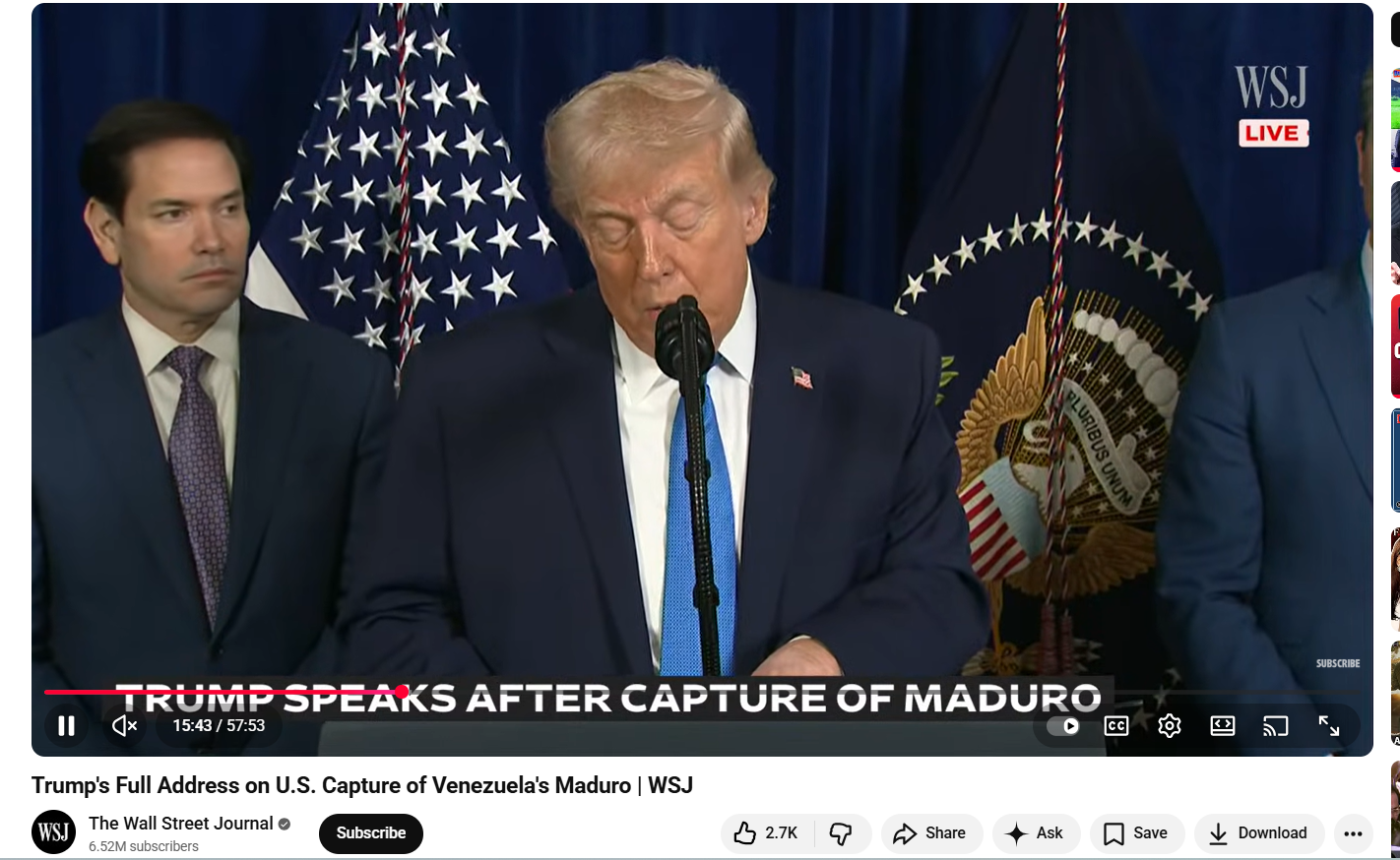
The visuals used in the viral clip are genuine and were taken from a press briefing addressed by Donald Trump on January 3, 2026. However, the audio track accompanying the video has been fabricated and falsely superimposed to
misrepresent his remarks. In the original address, Trump was speaking about a US-led military operation in Caracas that reportedly resulted in the capture of Venezuelan President Nicolás Maduro and his wife. He made no reference to India, Russia, or any geopolitical warning involving New Delhi.
Claim:
On January 10, an X (formerly Twitter) user, Niki Chiri (@cutehunmee), shared a video claiming it showed Donald Trump threatening India over its ties with Russia.
In the clip, Trump is purportedly heard stating that unless India severed its relationship with Moscow, the United States would respond in a manner similar to Pakistan’s actions during the May conflict.
The post quickly gained traction, with several users amplifying the claim. Iink,archive link and screenshot
Research:
To verify the authenticity of the video, the Cyber Peace Foundation conducted a reverse image and video analysis. A Google Lens search led investigators to a longer version of the same footage uploaded on the official YouTube channel of The Wall Street Journal, a prominent US-based news outlet.
A comparison confirmed that both videos shared identical visuals, background elements, and camera angles, establishing that the viral clip was sourced from the same press address.
A review of the full speech, however, showed that Trump did not issue any warning to India, nor did he mention Russia or the May conflict. His remarks were strictly focused on developments in Venezuela.
This confirmed that the viral video had been digitally altered. Here is the link to the original video, along with a screenshot:
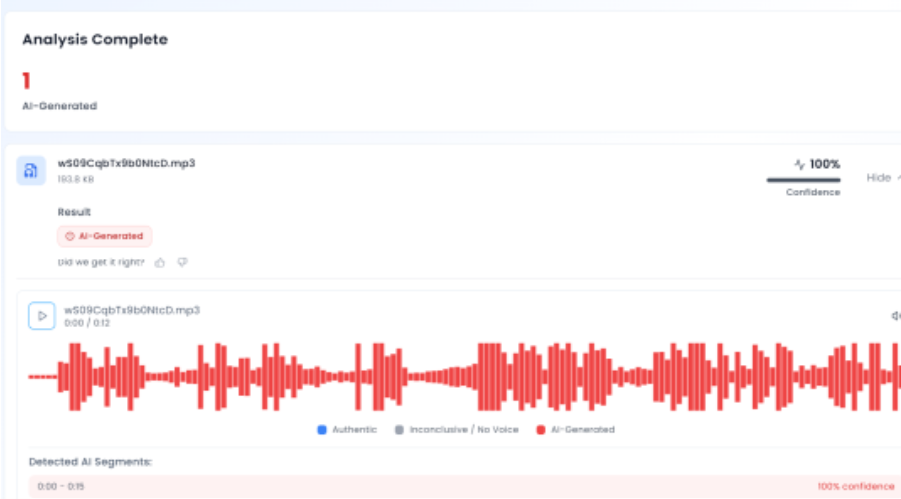
In the next phase of the research, the audio track from the viral clip was extracted and analysed using the AI-based voice detection tool Aurigin. The results indicated a high likelihood that the voice in the video was artificially generated, further confirming that the audio did not originate from Trump’s original speech. A screenshot of the result is provided below.
Conclusion
The claim that a video shows Donald Trump threatening India over its ties with Russia is false. The Cyber Peace Foundation found that while the visuals were taken from a real press address, the audio was fabricated and overlaid to falsely attribute threatening statements to Trump. The manipulated video was circulated online to mislead viewers and spread disinformation.

Related Blogs

Executive Summary
A video is being shared on social media showing a multi-storey building located beside what appears to be a river. A road runs alongside the building, with visible erosion and large cracks. A crowd of people can be seen standing near the edge of the road close to the building. Suddenly, the front portion of the building collapses into the water, followed moments later by the rear section tilting and falling into the river. As the building collapses, people are seen running in panic. The video is being shared with the claim that it shows a real incident in which a multi-storey building collapsed like a house of cards due to heavy rainfall, a swollen river, and severe erosion that also caused part of the road to cave in. CyberPeace Research Wing’s research found the viral claim to be false. Our research revealed that the video is not real. It was generated using Artificial Intelligence (AI) and is being circulated with a false claim.
Claim
An Instagram user shared the viral video on July 15, 2026, claiming that it shows a multi-storey building collapsing into a swollen river due to heavy rainfall and strong water currents, while part of the adjacent road also collapsed because of a landslide.
https://www.instagram.com/reel/DazTcrBCBrI/?utm_source=ig_web_button_share_sheet

Fact Check
To verify the claim, we extracted several keyframes from the viral video and conducted a reverse image search using Google Lens. During the research, we found no credible news reports, authentic videos, or reliable sources related to the incident. However, we found the same video uploaded on a YouTube Shorts channel named @mohammedalmekhlafiht1555. The channel's cover image describes the creator as an "AI & Automation Engineer." In addition, the descriptions of videos uploaded on the channel explicitly mention "Made With AI."
https://youtube.com/shorts/zFotETyAz8E?si=b6wj_eAG-nj7U1HE


We also carried out a detailed visual analysis of the footage. During the collapse, the front portion of the building falls into the water almost as a single block without breaking apart, which is highly unrealistic. After a brief pause, the rear section tilts and also falls almost intact onto the first section, without disintegrating despite the massive impact. The behaviour of people in the video also appears unnatural. Some individuals are seen running with their hands raised, while others inexplicably move toward the collapsing building and even jump into the water. Workers repairing the damaged road appear completely unaffected by the nearby collapse. In a real structural failure of this magnitude, buildings typically break apart into multiple sections, generating debris, dust, and strong shockwaves that would significantly affect nearby people.

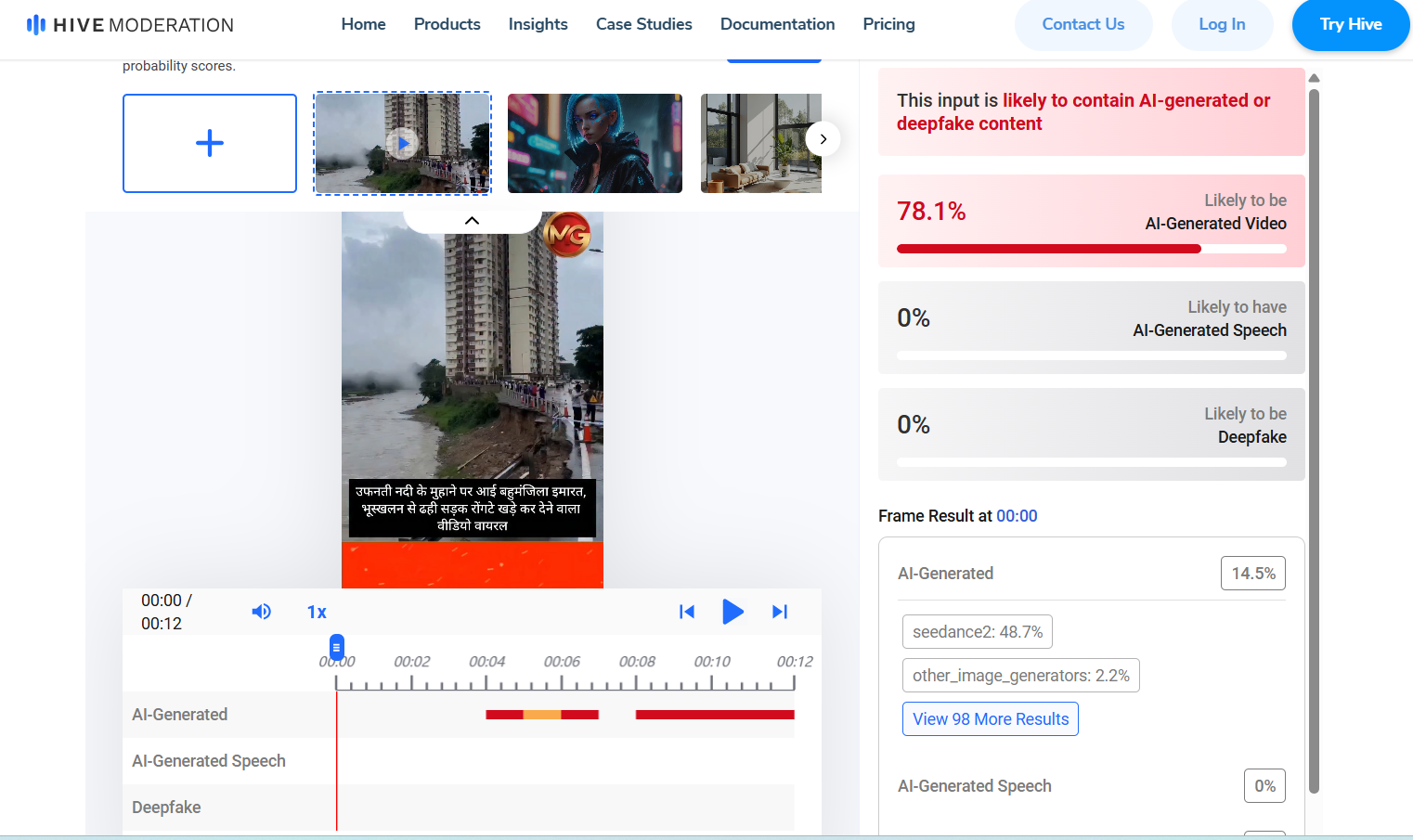
In the next stage of our research, we analysed the video using the AI detection tool Hive Moderation, which indicated a 78.1% probability that the video was AI-generated.
For additional verification, we also examined the video using AI or Not, which concluded that the footage has a 96% probability of being AI-generated.

Finally, we analysed the video using Wasit.AI, which also indicated a 75% probability that the video had been created using Artificial Intelligence.

Conclusion
Our research found that the viral video does not depict a real incident. It was generated using Artificial Intelligence and is being shared on social media with a false and misleading claim that it shows a multi-storey building collapsing into a river due to heavy rainfall and erosion.

Introduction
As the sun rises on the Indian subcontinent, a nation teeters on the precipice of a democratic exercise of colossal magnitude. The Lok Sabha elections, a quadrennial event that mobilises the will of over a billion souls, is not just a testament to the robustness of India's democratic fabric but also a crucible where the veracity of information is put to the sternest of tests. In this context, the World Economic Forum's 'Global Risks Report 2024' emerges as a harbinger of a disconcerting trend: the spectre of misinformation and disinformation that threatens to distort the electoral landscape.
The report, a carefully crafted document that shares the insights of 1,490 experts from the interests of academia, government, business and civil society, paints a tableau of the global risks that loom large over the next decade. These risks, spawned by the churning cauldron of rapid technological change, economic uncertainty, a warming planet, and simmering conflict, are not just abstract threats but tangible realities that could shape the future of nations.
India’s Electoral Malice
India, as it strides towards the general elections scheduled in the spring of 2024, finds itself in the vortex of this hailstorm. The WEF survey positions India at the zenith of vulnerability to disinformation and misinformation, a dubious distinction that underscores the challenges facing the world's largest democracy. The report depicts misinformation and disinformation as the chimaeras of false information—whether inadvertent or deliberate—that are dispersed through the arteries of media networks, skewing public opinion towards a pervasive distrust in facts and authority. This encompasses a panoply of deceptive content: fabricated, false, manipulated and imposter.
The United States, the European Union, and the United Kingdom too, are ensnared in this web of varying degrees of misinformation. South Africa, another nation on the cusp of its own electoral journey, is ranked 22nd, a reflection of the global reach of this phenomenon. The findings, derived from a survey conducted over the autumnal weeks of September to October 2023, reveal a world grappling with the shadowy forces of untruth.
Global Scenario
The report prognosticates that as close to three billion individuals across diverse economies—Bangladesh, India, Indonesia, Mexico, Pakistan, the United Kingdom, and the United States—prepare to exercise their electoral rights, the rampant use of misinformation and disinformation, and the tools that propagate them, could erode the legitimacy of the governments they elect. The repercussions could be dire, ranging from violent protests and hate crimes to civil confrontation and terrorism.
Beyond the electoral arena, the fabric of reality itself is at risk of becoming increasingly polarised, seeping into the public discourse on issues as varied as public health and social justice. As the bedrock of truth is undermined, the spectre of domestic propaganda and censorship looms large, potentially empowering governments to wield control over information based on their own interpretation of 'truth.'
The report further warns that disinformation will become increasingly personalised and targeted, honing in on specific groups such as minority communities and disseminating through more opaque messaging platforms like WhatsApp or WeChat. This tailored approach to deception signifies a new frontier in the battle against misinformation.
In a world where societal polarisation and economic downturn are seen as central risks in an interconnected 'risks network,' misinformation and disinformation have ascended rapidly to the top of the threat hierarchy. The report's respondents—two-thirds of them—cite extreme weather, AI-generated misinformation and disinformation, and societal and/or political polarisation as the most pressing global risks, followed closely by the 'cost-of-living crisis,' 'cyberattacks,' and 'economic downturn.'
Current Situation
In this unprecedented year for elections, the spectre of false information looms as one of the major threats to the global populace, according to the experts surveyed for the WEF's 2024 Global Risk Report. The report offers a nuanced analysis of the degrees to which misinformation and disinformation are perceived as problems for a selection of countries over the next two years, based on a ranking of 34 economic, environmental, geopolitical, societal, and technological risks.
India, the land of ancient wisdom and modern innovation, stands at the crossroads where the risk of disinformation and misinformation is ranked highest. Out of all the risks, these twin scourges were most frequently selected as the number one risk for the country by the experts, eclipsing infectious diseases, illicit economic activity, inequality, and labor shortages. The South Asian nation's next general election, set to unfurl between April and May 2024, will be a litmus test for its 1.4 billion people.
The spectre of fake news is not a novel adversary for India. The 2019 election was rife with misinformation, with reports of political parties weaponising platforms like WhatsApp and Facebook to spread incendiary messages, stoking fears that online vitriol could spill over into real-world violence. The COVID-19 pandemic further exacerbated the issue, with misinformation once again proliferating through WhatsApp.
Other countries facing a high risk of the impacts of misinformation and disinformation include El Salvador, Saudi Arabia, Pakistan, Romania, Ireland, Czechia, the United States, Sierra Leone, France, and Finland, all of which consider the threat to be one of the top six most dangerous risks out of 34 in the coming two years. In the United Kingdom, misinformation/disinformation is ranked 11th among perceived threats.
The WEF analysts conclude that the presence of misinformation and disinformation in these electoral processes could seriously destabilise the real and perceived legitimacy of newly elected governments, risking political unrest, violence, and terrorism, and a longer-term erosion of democratic processes.
The 'Global Risks Report 2024' of the World Economic Forum ranks India first in facing the highest risk of misinformation and disinformation in the world at a time when it faces general elections this year. The report, released in early January with the 19th edition of its Global Risks Report and Global Risk Perception Survey, claims to reveal the varying degrees to which misinformation and disinformation are rated as problems for a selection of analyzed countries in the next two years, based on a ranking of 34 economic, environmental, geopolitical, societal, and technological risks.
Some governments and platforms aiming to protect free speech and civil liberties may fail to act effectively to curb falsified information and harmful content, making the definition of 'truth' increasingly contentious across societies. State and non-state actors alike may leverage false information to widen fractures in societal views, erode public confidence in political institutions, and threaten national cohesion and coherence.
Trust in specific leaders will confer trust in information, and the authority of these actors—from conspiracy theorists, including politicians, and extremist groups to influencers and business leaders—could be amplified as they become arbiters of truth.
False information could not only be used as a source of societal disruption but also of control by domestic actors in pursuit of political agendas. The erosion of political checks and balances and the growth in tools that spread and control information could amplify the efficacy of domestic disinformation over the next two years.
Global internet freedom is already in decline, and access to more comprehensive sets of information has dropped in numerous countries. The implication: Falls in press freedoms in recent years and a related lack of strong investigative media are significant vulnerabilities set to grow.
Advisory
Here are specific best practices for citizens to help prevent the spread of misinformation during electoral processes:
- Verify Information:Double-check the accuracy of information before sharing it. Use reliable sources and fact-checking websites to verify claims.
- Cross-Check Multiple Sources:Consult multiple reputable news sources to ensure that the information is consistent across different platforms.
- Be Wary of Social Media:Social media platforms are susceptible to misinformation. Be cautious about sharing or believing information solely based on social media posts.
- Check Dates and Context:Ensure that information is current and consider the context in which it is presented. Misinformation often thrives when details are taken out of context.
- Promote Media Literacy:Educate yourself and others on media literacy to discern reliable sources from unreliable ones. Be skeptical of sensational headlines and clickbait.
- Report False Information:Report instances of misinformation to the platform hosting the content and encourage others to do the same. Utilise fact-checking organisations or tools to report and debunk false information.
- Critical Thinking:Foster critical thinking skills among your community members. Encourage them to question information and think critically before accepting or sharing it.
- Share Official Information:Share official statements and information from reputable sources, such as government election commissions, to ensure accuracy.
- Avoid Echo Chambers:Engage with diverse sources of information to avoid being in an 'echo chamber' where misinformation can thrive.
- Be Responsible in Sharing:Before sharing information, consider the potential impact it may have. Refrain from sharing unverified or sensational content that can contribute to misinformation.
- Promote Open Dialogue:Open discussions should be promoted amongst their community about the significance of factual information and the dangers of misinformation.
- Stay Calm and Informed:During critical periods, such as election days, stay calm and rely on official sources for updates. Avoid spreading unverified information that can contribute to panic or confusion.
- Support Media Literacy Programs:Media Literacy Programs in schools should be promoted to provide individuals with essential skills to sail through the information sea properly.
Conclusion
Preventing misinformation requires a collective effort from individuals, communities, and platforms. By adopting these best practices, citizens can play a vital role in reducing the impact of misinformation during electoral processes.
References:
- https://thewire.in/media/survey-finds-false-information-risk-highest-in-india
- https://thesouthfirst.com/pti/india-faces-highest-risk-of-disinformation-in-general-elections-world-economic-forum/
Introduction
Agentic AI systems are autonomous systems that can plan, make decisions, and take actions by interacting with external tools and environments. But they shift the nature of risk by blurring the lines among input, decision, and execution. A conventional model generates an output and stops. An agent takes input, makes plans, invokes tools, updates its state and repeats the cycle. This creates a system where decisions are continuously revised through interaction with external tools and environments, rather than being fixed at the point of input.
This means the attack surface expands in size and becomes more dynamic. Instead of remaining confined to components as in traditional computational systems, they spread in layers and can continue to grow through time. To understand this shift, the system can be analysed through functional layers such as inputs, memory, reasoning, and execution, while recognising that risk does not remain isolated within these layers but emerges through their interaction.
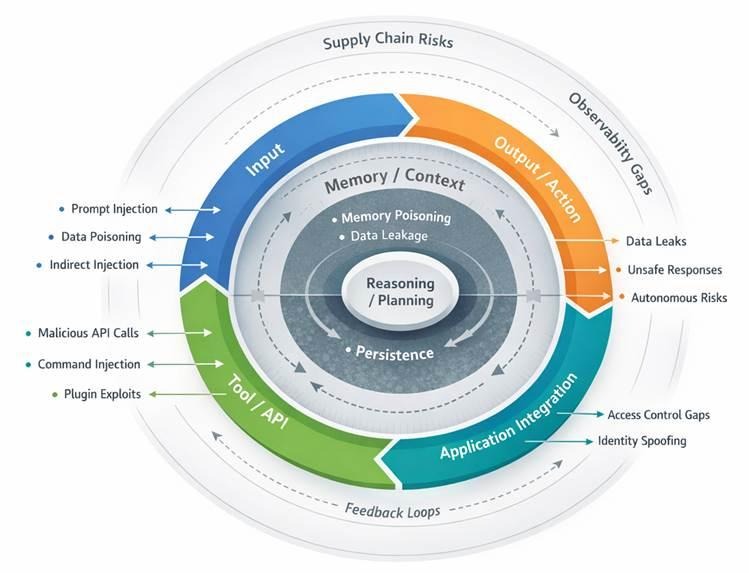
Agentic AI Attack Surface
A layered view of how risks emerge across input, memory, reasoning, execution, and system integration, including feedback loops and cross-system dependencies that amplify vulnerabilities.
Input Layer: Where Untrusted Data Becomes Control
The entry point of an agent is no longer one prompt. The documents, APIs, files, system logs and the outputs of other agents can now be considered input. This diversity is significant due to the fact that every source of input carries its own trust assumptions, and in the majority of cases, they are weak.
The most obvious threat is prompt injection, where inputs are treated as instructions rather than data. Since inputs are treated as instructions, a virus, a malicious webpage, or a document can contain instructions that override system goals without necessarily being detected as something harmful.
Indirect prompt injection extends this risk beyond direct user interaction. Instead of targeting the interface, attackers compromise the retrieval process by embedding malicious instructions within external data sources. When the agent retrieves and processes the data, it treats the embedded content as legitimate input. As a result, the attack is executed through normal reasoning processes, allowing the system to act on untrusted data without recognising the manipulation.
Data poisoning also occurs at runtime. In contrast to classical poisoning (where training data is manipulated), runtime poisoning distorts the agent’s perception of its environment as it runs. This can change decisions without causing apparent failures.
Obfuscation introduces another indirect attacker vector. Encoded instructions or complicated forms may bypass human review but remain readable to the model. This creates asymmetry whereby the system knows more about the attack than those operating it. Once compromised at this layer, the agent implements compromised instructions which affect downstream operations.
Context and Memory: Persistence of Influence
Agentic systems depend on memory to operate efficiently. They often retain context across sessions and frequently store information between sessions.
This introduces a different type of risk: persistence. Through memory poisoning, attackers can insert false or adversarial information into sorted context, which then influences future decisions. Unlike prompt injection, which is often limited to a single interaction, this effect carries forward. Over time, the agent begins to operate on a distorted internal state, shaping decisions in ways that may not be immediately visible.
Another issue is cross-session leakage. Information in a particular context may be replayed in a different context when memory is being shared or there is insufficient memory separation. This is specifically dangerous in those systems that combine retrieval and long-term storage. The context management in itself becomes a weakness. Agents are required to make decisions on what to retain and what to discard. This is susceptible to attackers who can flood the context or manipulate what is still visible and indirectly affect reasoning.
The underlying problem is structural. Memory turns data into a state. Once state is corrupted, the system cannot easily distinguish valid knowledge from adversarial influence.
The issue is structural. Memory converts temporary data into a persistent state. Once this state is weakened, the system cannot reliably separate valid information from adversarial influence, making recovery significantly more difficult.
Reasoning and Planning: Manipulating Intent Without Breaking Logic
The reasoning layer is where agentic AI stands apart from traditional systems. The model no longer reacts to inputs alone. It actively breaks down objectives, analyses alternatives, and ranks actions.
At the reasoning stage, the nature of risk shifts. The concern is no longer limited to injecting instructions, but to influencing how decisions are made. One example is goal manipulation, where the agent subtly reinterprets its objective and produces outcomes that are technically correct but strategically harmful. Reasoning hijacking operates within intermediate steps, altering how constraints are evaluated or how trade-offs are prioritised. The system may remain internally consistent, which makes such deviations difficult to detect.
Tool selection becomes a critical control point. Agents decide which tools to use and when, so influencing these choices can redirect execution without directly accessing the tools themselves. Hallucinations also take on a different role here. In static systems, they remain errors. In agentic systems, they can trigger actions. A perceived need or incorrect judgement can translate into real-world consequences.
This layer introduces probabilistic failure. The system is not fully weakened, but it is nudged towards decisions that appear reasonable yet are incorrect. The risk lies in how those decisions are justified.
Tool and Execution: When Decisions Gain Reach
Once an agent begins interacting with tools, its behaviour extends beyond the model into external systems. APIs, databases, and services become part of the execution path.
One key risk is the use of unauthorised tools. When agents operate with broad permissions, any manipulation of the upstream can be converted into real-world actions. This makes access control a central security concern. Command injection also takes a different form here. The agent generates commands based on its reasoning, so if that reasoning is compromised, the resulting actions may still appear valid despite being harmful.
External tool outputs introduce another risk. If these systems return corrupted or misleading data, the agent may accept it without verification and incorporate it into its decisions. It is also becoming increasingly reliant on third-part tools and plugins adds to this exposure. If these components are compromised, they can affect behaviour without directly attacking the core system, creating a supply-side risk.
At this stage, the agent effectively operates as an insider. It holds legitimate credentials and interacts with systems in expected ways, making misuse harder to identify.
Application and Integration: System-Level Exposure
Agentic systems rarely operate in isolation. They are embedded in larger environments, interacting with identity systems, business logic, and operational workflows.
Access control becomes a major vulnerability. Agents tend to operate across multiple systems with various permission models, creating irregularities that can be exploited. Risks also arise from identity and delegation. In case an agent is operating on behalf of a user, then any vulnerabilities in authentication or session management can allow attackers to assume that authority.
Workflow execution amplifies these risks. Agents can initiate multi-step processes such as transactions, updates, or approvals. Manipulating a single step can change the result of the entire workflow. As integrations increase, so do the number of interaction points, making cumulative risk harder to track.
At this layer, failures are not isolated. They propagate into business operations, making consequences harder to contain.
Output and Action: Where Failures Become Visible
The output layer is where failures become visible, though they rarely originate there.
Data leakage has been a key concern. Agents may disclose information they are allowed to access, especially when tasks boundaries are not clearly defined. Misinformation and unsafe outputs are also important, particularly when outputs directly influence actions or decisions.
Generated code and commands introduce execution risk. If outputs are used without validation, errors or manipulations can have system-level effects. The shift towards autonomous action increases this risk, as small upstream deviations can lead to significant consequences without human intervention. This layer reflects symptoms rather than root causes. Addressing it alone does not reduce the underlying risk.
Beyond Layers: The Missing Dimension
A layered view helps, but it does not capture the full picture. Agentic systems are defined by continuous interaction across layers.
The key missing dimension is the runtime loop. Inputs shape reasoning, reasoning drives action, and actions feed back into both reasoning and memory. These cycles create feedback loops, where small manipulations may escalate over time. This also reduces observability. With multiple interacting components, it becomes difficult to trace cause and effect or identify where failures originate.
Supply chain dependencies add another layer of risk. Models, datasets, APIs, and plugins each introduce their own points of failure. A compromise at any of these points can propagate across the system. The attack surface also includes governance. Weak supervision, unclear responsibility, or excessive autonomy increase overall risk. Human control is not external to the system; it is part of its security.
Conclusion: Structuring the Attack Surface
Agentic AI expands the attack surface beyond traditional systems. It is both recursive and stateful. Risk does not just accumulate across layers; it moves and changes as the system operates.
Any useful representation must go beyond a linear stack. It should capture feedback loops, persistent state, and cross-layer dependencies that characterise the way these systems actually behave. The system is not a pipeline but a cycle. That is where both its capability and its risk emerge.
