
#FactCheck - Viral Video of Army Chief Upendra Dwivedi ‘Admitting’ India Betrayed Iran Is a Deepfake
Executive Summary
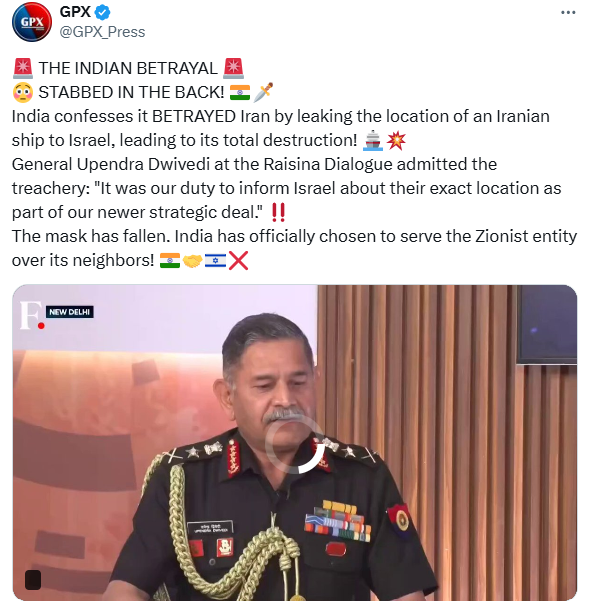
A 57-second video featuring India’s Chief of Army Staff Upendra Dwivedi is widely circulating on social media. The clip is being shared with the claim that the Army chief admitted India had “betrayed” Iran by providing the location of an Iranian naval ship to Israel, allegedly leading to its destruction The video is spreading amid heightened tensions in West Asia involving United States, Israel, and Iran. According to posts sharing the claim, the Iranian naval vessel IRIS Dena, which had participated in a naval event in Visakhapatnam and was returning to Iran with around 130 personnel onboard, was torpedoed by a US submarine near the southern coast of Sri Lanka on March 4 while sailing in the Indian Ocean.
In the viral clip, the speaker—presented as the Indian Army chief—appears to say that India informed Israel about the exact location of the Iranian ship after it left Indian waters, describing Israel as a strategic ally and suggesting that the attack occurred in international waters. The clip also claims that India had no direct involvement in the alleged joint US-Israel torpedo strike.
However, research conducted by the CyberPeace found the claim to be false. Our research shows that the video does not contain a genuine statement from Army Chief Upendra Dwivedi and is in fact a manipulated clip.
Claim
On X (formerly Twitter), a page named GPX (@GPX_Press) shared the video on March 9 with the caption: “India confesses it BETRAYED Iran by leaking the location of an Iranian ship to Israel, leading to its total destruction!”
Fact Check
During the verification process, researchers noticed a ticker in the viral video reading “Raisina Dialogue 2026 × Firstpost.” Using this clue, we conducted a keyword search on YouTube and located a video uploaded by Firstpost on March 7 titled “India’s Army Chief Speaks on Op Sindoor, Pakistan and Future of Warfare | Raisina Dialogue 2026.”
In the 21-minute interview, Army Chief Upendra Dwivedi is seen speaking with strategic affairs expert Harsh V. Pant. According to the video description, the discussion focuses on lessons from Operation Sindoor and the evolving nature of modern warfare.

The viral clip appears to be taken from this interview. However, throughout the conversation, Dwivedi does not mention any conflict involving the United States, Israel, and Iran, nor does he refer to the sinking of an Iranian naval ship in the Indian Ocean. This indicates that the circulating clip has been edited and misrepresented to create a misleading narrative.
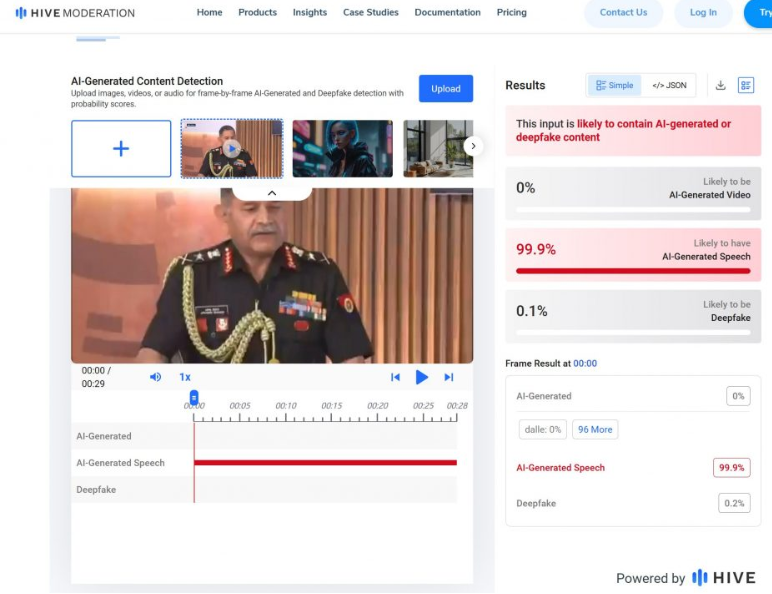
For additional verification, the viral video was analyzed using the AI detection tool Hive Moderation. The results suggested a 99.9% probability that the speech in the clip was generated using AI, indicating manipulation of the original footage.
Conclusion
The research makes it clear that the viral video does not reflect an authentic statement by India’s Army Chief Upendra Dwivedi. The clip has been altered and the audio appears to be AI-generated. In other words, the circulating video is a deepfake being shared with a misleading claim.

Related Blogs

Executive Summary:
The viral image in the social media which depicts fake injuries on the face of the MP(Member of Parliament, Lok Sabha) Kangana Ranaut alleged to have been beaten by a CISF officer at the Chandigarh airport. The reverse search of the viral image taken back to 2006, was part of an anti-mosquito commercial and does not feature the MP, Kangana Ranaut. The findings contradict the claim that the photos are evidence of injuries resulting from the incident involving the MP, Kangana Ranaut. It is always important to verify the truthfulness of visual content before sharing it, to prevent misinformation.

Claims:
The images circulating on social media platforms claiming the injuries on the MP, Kangana Ranaut’s face were because of an assault incident by a female CISF officer at Chandigarh airport. This claim hinted that the photos are evidence of the physical quarrel and resulting injuries suffered by the MP, Kangana Ranaut.


Fact Check:
When we received the posts, we reverse-searched the image and found another photo that looked similar to the viral one. We could verify through the earring in the viral image with the new image.

The reverse image search revealed that the photo was originally uploaded in 2006 and is unrelated to the MP, Kangana Ranaut. It depicts a model in an advertisement for an anti-mosquito spray campaign.
We can validate this from the earrings in the photo after the comparison between the two photos.

Hence, we can confirm that the viral image of the injury mark of the MP, Kangana Ranaut has been debunked as fake and misleading, instead it has been cropped out from the original photo to misrepresent the context.
Conclusion:
Therefore, the viral photos on social media which claimed to be the results of injuries on the MP, Kangana Ranaut’s face after being assaulted allegedly by a CISF officer at the airport in Chandigarh were fake. Detailed analysis of the pictures provided the fact that the pictures have no connection with Ranaut; the picture was a 2006 anti-mosquito spray advertisement; therefore, the allegations that show these images as that of Ranaut’s injury are fake and misleading.
- Claim: photos circulating on social media claiming to show injuries on the MP, Kangana Ranaut's face following an assault incident by a female CISF officer at Chandigarh airport.
- Claimed on: X (Formerly known as Twitter), thread, Facebook
- Fact Check: Fake & Misleading

Executive Summary
A video is being widely shared on social media claiming to show a Saudi Arabian F-15 fighter jet carrying out an airstrike on Sanaa International Airport in Yemen's capital. The footage shows several aircraft parked at what appears to be an airport before explosions erupt, followed by flames, thick smoke and people running in panic. The CyberPeace Research Wing found that the viral claim is false. Our research revealed that the circulating video is AI-generated and does not depict the actual airstrike. While it is true that Saudi Arabia carried out an airstrike at Sanaa International Airport, the viral footage is unrelated to that incident and is being shared with a misleading claim.
Claim
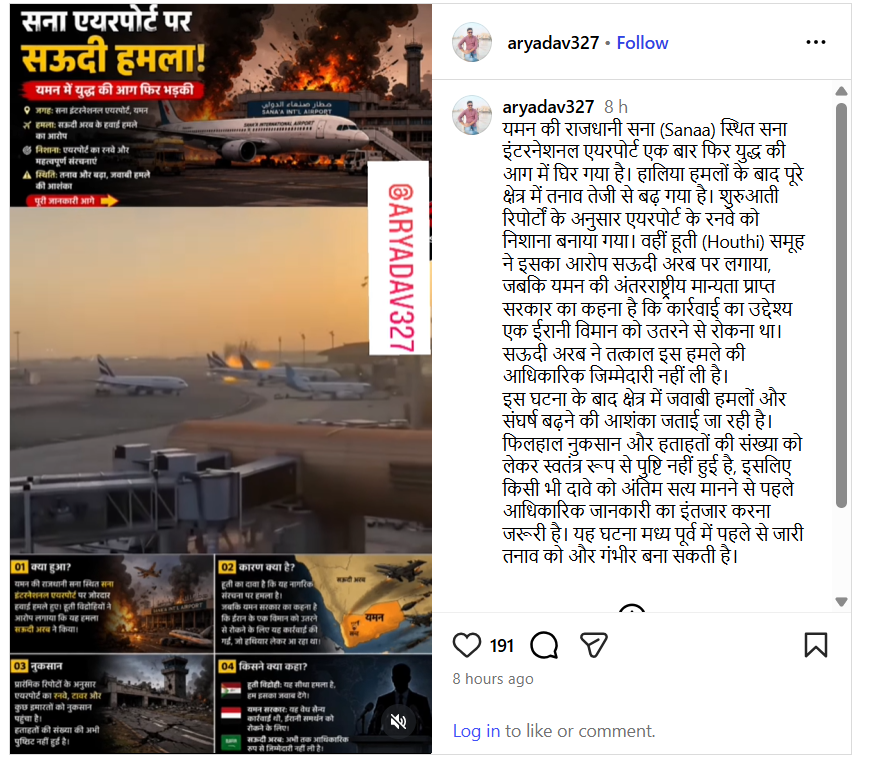
An Instagram post shared on July 15, 2026, claims that Saudi Arabia's F-15 fighter jets bombed Sanaa International Airport in Yemen. The post can be viewed here:
https://www.instagram.com/reel/DayBwufzn2N/?utm_source=ig_web_button_share_sheet
Fact Check
To verify the claim, we searched using relevant keywords but found no credible news reports or authentic footage matching the viral video. However, we found verified footage of the actual Saudi airstrike on The New York Post's YouTube channel. A comparison showed that the genuine footage is entirely different from the viral clip in terms of visuals, sequence and overall content.
https://www.instagram.com/reel/DawHCM_s_fn/?utm_source=ig_web_button_share_sheet

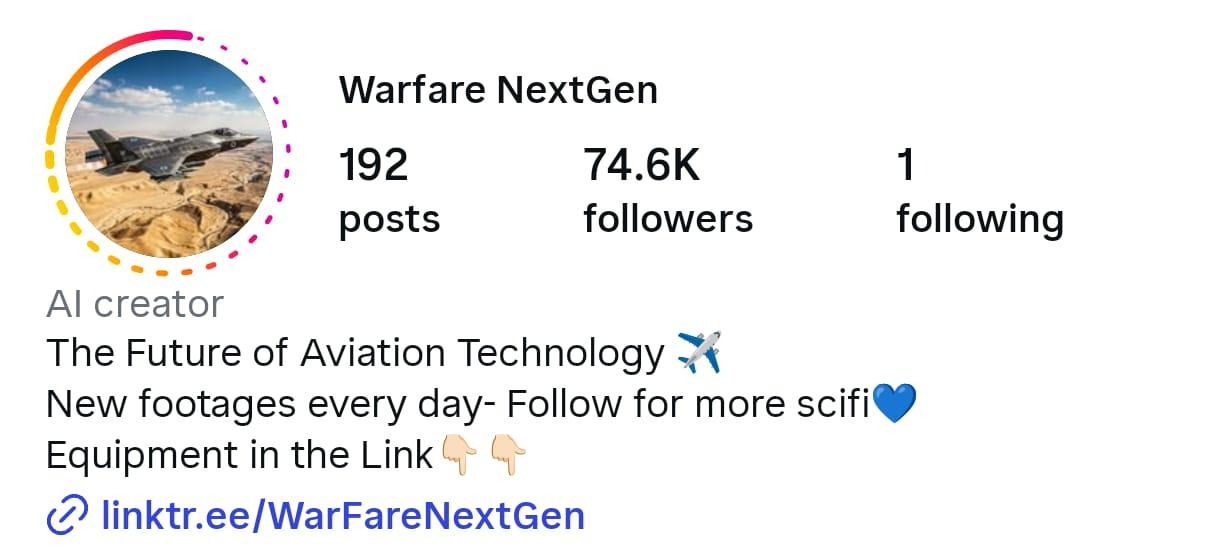
During our research, we also found the same viral video on an Instagram account named "warfarenextgen", which regularly publishes AI-generated war-related videos
We further examined the video using multiple AI detection tools: Hive Moderation assessed the video as 99.9% likely to be AI-generated.

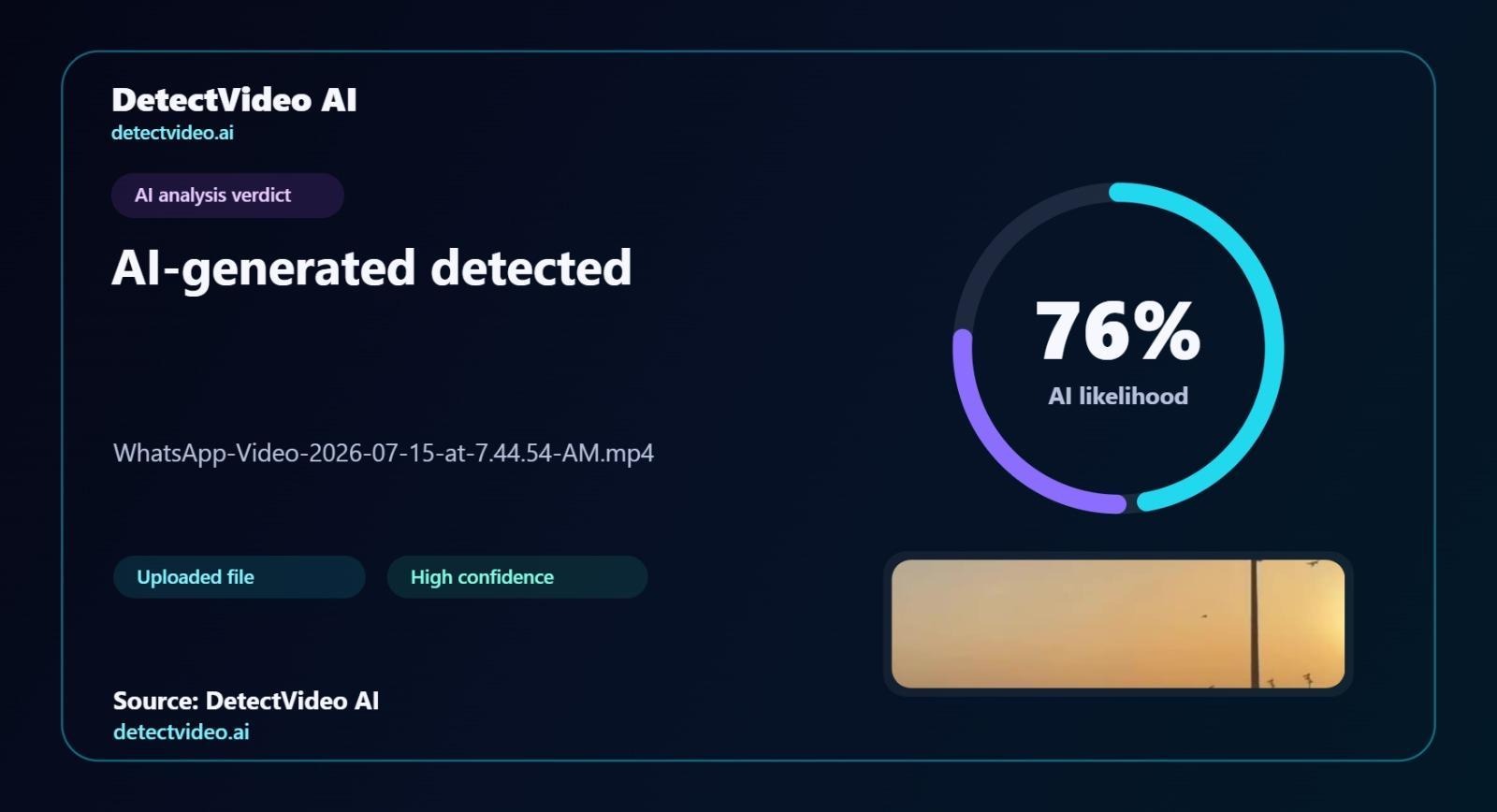
DetectVideo AI found a 76% probability that the video was AI-generated.
Sightengine also concluded that the video was approximately 99% likely to be AI-generated.

Conclusion
Our research found that Saudi Arabia did carry out an airstrike on Sanaa International Airport to prevent an Iranian aircraft carrying a Houthi delegation from landing. However, the viral video does not show that attack. It is an AI-generated video that is being falsely circulated as footage of the real incident, making the viral claim misleading.

Introduction
Phishing as a Service (PhaaS) platform 'LabHost' has been a significant player in cybercrime targeting North American banks, particularly financial institutes in Canada. LabHost offers turnkey phishing kits, infrastructure for hosting pages, email content generation, and campaign overview services to cybercriminals in exchange for a monthly subscription. The platform's popularity surged after introducing custom phishing kits for Canadian banks in the first half of 2023.Fortra reports that LabHost has overtaken Frappo, cybercriminals' previous favorite PhaaS platform, and is now the primary driving force behind most phishing attacks targeting Canadian bank customers.
In the digital realm, where the barriers to entry for nefarious activities are crumbling, and the tools of the trade are being packaged and sold with the same customer service one might expect from a legitimate software company. This is the world of Phishing-as-a-Service (PhaaS), and at the forefront of this ominous trend is LabHost, a platform that has been instrumental in escalating attacks on North American banks, with a particular focus on Canadian financial institutions.
LabHost is not a newcomer to the cybercrime scene, but its ascent to infamy was catalyzed by the introduction of custom phishing kits tailored for Canadian banks in the first half of 2023. The platform operates on a subscription model, offering turnkey solutions that include phishing kits, infrastructure for hosting malicious pages, email content generation, and campaign overview services. For a monthly fee, cybercriminals are handed the keys to a kingdom of deception and theft.
Emergence of Labhost
The rise of LabHost has been meticulously chronicled by various cyber security firms which reports that LabHost has dethroned the previously favored PhaaS platform, Frappo. LabHost has become the primary driving force behind the majority of phishing attacks targeting customers of Canadian banks. Despite suffering a disruptive outage in early October 2023, LabHost has rebounded with vigor, orchestrating several hundreds of attacks per month.
Their investigation into LabHost's operations reveals a tiered membership system: Standard, Premium, and World, with monthly fees of $179, $249, and $300, respectively. Each tier offers an escalating scope of targets, from Canadian banks to 70 institutions worldwide, excluding North America. The phishing templates provided by LabHost are not limited to financial entities; they also encompass online services like Spotify, postal delivery services like DHL, and regional telecommunication service providers.
LabRat
The true ingenuity of LabHost lies in its integration with 'LabRat,' a real-time phishing management tool that enables cybercriminals to monitor and control an active phishing attack. This tool is a linchpin in man-in-the-middle style attacks, designed to capture two-factor authentication codes, validate credentials, and bypass additional security measures. In essence, LabRat is the puppeteer's strings, allowing the phisher to manipulate the attack with precision and evade the safeguards that are the bulwarks of our digital fortresses.
LabSend
In the aftermath of its October disruption, LabHost unveiled 'LabSend,' an SMS spamming tool that embeds links to LabHost phishing pages in text messages. This tool orchestrates a symphony of automated smishing campaigns, randomizing portions of text messages to slip past the vigilant eyes of spam detection systems. Once the SMS lure is cast, LabSend responds to victims with customizable message templates, a Machiavellian touch to an already insidious scheme.
The Proliferation of PhaaS
The proliferation of PhaaS platforms like LabHost, 'Greatness,' and 'RobinBanks' has democratized cybercrime, lowering the threshold for entry and enabling even the most unskilled hackers to launch sophisticated attacks. These platforms are the catalysts for an exponential increase in the pool of threat actors, thereby magnifying the impact of cybersecurity on a global scale.
The ease with which these services can be accessed and utilized belies the complexity and skill traditionally required to execute successful phishing campaigns. Stephanie Carruthers, who leads an IBM X-Force phishing research project, notes that crafting a single phishing email can consume upwards of 16 hours, not accounting for the time and resources needed to establish the infrastructure for sending the email and harvesting credentials.
PhaaS platforms like LabHost have commoditized this process, offering a buffet of malevolent tools that can be customized and deployed with a few clicks. The implications are stark: the security measures that businesses and individuals have come to rely on, such as multi-factor authentication (MFA), are no longer impenetrable. PhaaS platforms have engineered ways to circumvent these defenses, rendering them vulnerable to exploitation.
Emerging Cyber Defense
In the face of this escalating threat, a multi-faceted defense strategy is imperative. Cybersecurity solutions like SpamTitan employ advanced AI and machine learning to identify and block phishing threats, while end-user training platforms like SafeTitan provide ongoing education to help individuals recognize and respond to phishing attempts. However, with phishing kits now capable of bypassing MFA,it is clear that more robust solutions, such as phishing-resistant MFA based on FIDO/WebAuthn authentication or Public Key Infrastructure (PKI), are necessary to thwart these advanced attacks.
Conclusion
The emergence of PhaaS platforms represents a significant shift in the landscape of cybercrime, one that requires a vigilant and sophisticated response. As we navigate this treacherous terrain, it is incumbent upon us to fortify our defenses, educate our users, and remain ever-watchful of the evolving tactics of cyber adversaries.
References
- https://www-bleepingcomputer-com.cdn.ampproject.org/c/s/www.bleepingcomputer.com/news/security/labhost-cybercrime-service-lets-anyone-phish-canadian-bank-users/amp/
- https://www.techtimes.com/articles/302130/20240228/phishing-platform-labhost-allows-cybercriminals-target-banks-canada.htm
- https://www.spamtitan.com/blog/phishing-as-a-service-threat/
- https://timesofindia.indiatimes.com/gadgets-news/five-government-provided-botnet-and-malware-cleaning-tools/articleshow/107951686.cms
