
#FactCheck -Viral video falsely linked to Operation Sindoor and India–Pakistan conflict claims
Executive Summary
A video from Prime Minister Narendra Modi’s visit to Norway is being widely shared on social media with the false claim that he avoided a question related to alleged Indian aircraft losses during the India–Pakistan conflict and “Operation Sindoor”. However, a fact-check by CyberPeace Research Wing found the claim to be false.The video shows a recent incident from 18 May in Oslo during a joint press appearance between Prime Minister Narendra Modi and Norwegian Prime Minister Jonas Gahr Støre.
The clip being circulated online shows journalist Helle Lyng asking PM Modi a question, but there is no reference to any India–Pakistan conflict or aircraft losses in her question.
Claim:
A post shared on X (formerly Twitter) on 19 May 2026 claims: “Fear of questions on historic defeat in Operation Sindoor and Pakistan’s great victory in Marka e Haq: Modi flees in Norway without taking journalists’ questions.”
The post, along with archived links and screenshots, has been circulated to support the misleading narrative.

Fact Check
A review of journalist Helle Lyng’s official social media account shows the original video posted by her on 18 May. In the video, she can be heard asking:
“Prime Minister Modi, why don’t you take some questions from the freest press in the world?” In her caption, she stated that she did not expect PM Modi to take her question and highlighted press freedom rankings, noting Norway’s position at the top and India’s at 157th. She also emphasized that questioning cooperating governments is part of journalistic responsibility.
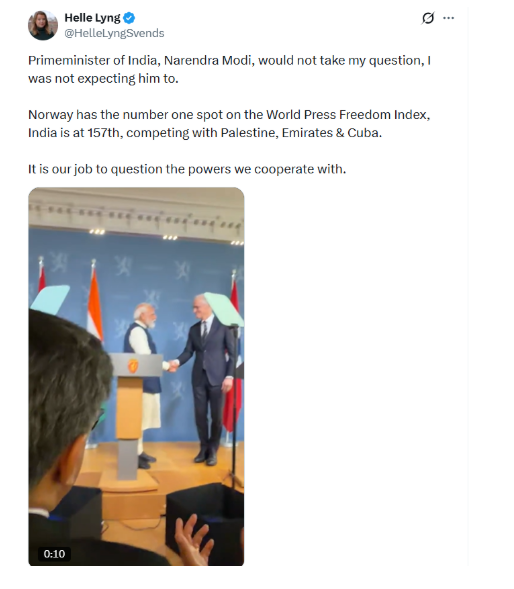
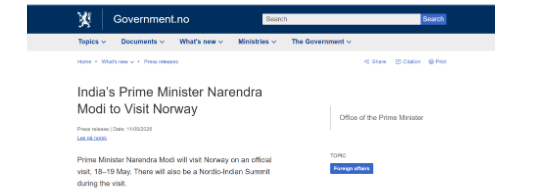
Further verification of the full press event published on the official Government of Norway portal shows no question related to alleged downed aircraft or military losses.
Additional reporting by Al Jazeera also confirms that a Norwegian journalist questioned PM Modi in Oslo about why he does not engage in open media briefings.

Conclusion:
The video is being shared with a misleading claim. It is a recent clip from 18 May in Oslo, and the journalist’s question was about press freedom—not about Operation Sindoor or any India–Pakistan conflict-related aircraft losses.

Related Blogs

Introduction
Human Trafficking has been a significant concern and threat to society for a very long time. The aspects of our physical safety also have been influenced by human traffickers and the modus operandi they have adopted and deployed over the years. We are always cautious of younger children in regard to trafficking whenever we go out to crowded or unknown places. This concern and threat have also migrated to cyberspace and now pose new and different tangents of threats. These crimes are committed using technology and are further substantiated by different cybercrimes.
What is Cyber-Enabled Human Trafficking?
Cyber-enabled human trafficking is the new evolution of human trafficking in the digital age. Bad actors lure the victims via the internet and use social engineering to exploit their vulnerabilities to get them into their traps. In today's time, crime is often substantiated in lieu of fake job offers and a better lifestyle in new and major metropolitan cities. Now this crime has gone beyond the geographical boundaries of our nation, and often the victims end up in remote locations in the Middle East or South East Asia.
Cybercrime Hubs in Myanmar
The reports have indicated that a lot of trafficked victims are taken down to various cybercrime hubs in Myanmar. The victims are often lured on the pretext of job offers overseas, which pay handsomely. The victims make their way into the foreign nation but are then cornered by the bad actors and are segregated and taken into different hubs. The victims are often school graduates and seek basic jobs for their earnings. The victims are taken into Cybercrime hubs which Chinese syndicate criminals allegedly run.The victims are kept in tough conditions, beaten up, and held captive in remote jungles. Once the victim has lost hope, the criminals train them to commit cyber frauds like phishing. The victims are given scripts and mobile numbers to commit cybercrimes. The victims are given targets to ensure their survival, and due to the dark and threatening conditions, the victims just give up on the demands just to remain alive. Some of the victims make their way back home as well, but that is after 6-7 years of such constant torture and abuse to commit cybercrimes. The majority of such survivors face trouble seeking legal assistance as the criminals are almost impossible to track, thus making redressal for crimes and rehabilitation for survivors tough.
How to stay safe?
The criminals in such acts often target the vulnerable sector of the population, these people generally hail from tier 3 towns and rural areas. These victims aspire for a better life and earning opportunities, and due to less education and minimal awareness, they fail to see the traps set by the victims. The population at large can deploy the following measures and safe practices to avoid such horrific threats-
- Avoid Stranger interaction: Avoid interacting with strangers on any online platform or portal. Social media sites are the most used platforms by bad actors to make contact with potential victims.
- Do not Share: Avoid sharing any personal information with anyone online, and avoid filling out third-party surveys/forms seeking personal information.
- Check, Check and Recheck: Always be on alert for threats and always check and cross-check any link or platform you use or access.
- Too good to be true: If something feels like Too good to be true, it probably is and hence avoid falling for attractive job offers and work-from-home opportunities on social media platforms.
- Know your helplines: One should know the helpline numbers to make sure to exercise the reporting duty and also encourage your family members to report in case of any threat or issue.
- Raise Awareness: It is the duty of all netizens to raise awareness in society to arm more people against cybercrimes and fraud.
Conclusion
The name of cybercriminals is spreading all across the ecosystems, and now the technology is being deployed by such bad actors to even substantiate physical crimes. We need to be on alert and remain aware of such crimes and the modus Operandi of cyber criminals. Awareness and education are our best weapons to combat the threats and issues of cyber-enabled human trafficking, as the criminals feed on our vulnerabilities, lets eradicate them for once and for all and work towards creating a wholesome safe cyber ecosystem for all.https://www.scmp.com/week-asia/politics/article/3228543/inside-chinese-run-crime-hubs-myanmar-are-conning-world-we-can-kill-you-here

Introduction
As our experiments with Generative Artificial Intelligence (AI) continue, companies and individuals look for new ways to incorporate and capitalise on it. This also includes big tech companies betting on their potential through investments. This process also sheds light on how such innovations are being carried out, used, and affect other stakeholders. Google’s AI overview feature has raised concerns from various website publishers and regulators. Recently, Chegg, a US-based tech education company that provides online resources for high school and college students, has filed a lawsuit against Google alleging abuse of monopoly over the searching mechanism.
Legal Background
Google’s AI Overview/Search Generative Experience (SGE) is a feature that incorporates AI into its standard search tool and helps summarise search results. This is then presented at the top, over the other published websites, when one looks for the search result. Although the sources of the information present are linked, they are half-covered, and it is ambiguous to tell which claims made by the AI come from which link. This creates an additional step for the searcher as, to find out the latter, their user interface requires the searcher to click on a drop-down box. Individual publishers and companies like Chegg have argued that such summaries deter their potential traffic and lead to losses as they continue to bid higher for advertisement services that Google offers, only to have their target audience discouraged from visiting their websites. What is unique about the lawsuit that has been filed by Chegg, is that it is based on anti-trust law rather than copyright law, which it has dealt with previously. In August 2024, a US Federal Judge had ruled that Google had an illegal monopoly over internet search and search text advertising markets, and by November, the US Department of Justice (DOJ) filed its proposed remedy. Some of them were giving advertisers and publishers more control of their data flowing through Google’s products, opening Google’s search index to the rest of the market, and imposing public oversight over Google’s AI investments. Currently, the DOJ has emphasised its stand on dismantling the search monopoly through structural separations, i.e., divesting Google of Chrome. The company is slated to defend itself before the DC District Court Judge Amit Mehta starting April 20, 2025.
CyberPeace Insights
As per a report by Statista (Global market share of leading search engines 2015-2025), Google, as the market leader, held a search traffic share of around 89.62 per cent. It is also stated that its advertising services account for the majority of its revenue, which amounted to a total of 305.63 billion U.S. dollars in 2023. The inclusion of the AI feature is undoubtedly changing how we search for things online. Benefits for users include an immediate, convenient scan of general information pertaining to the looked-up subject, but it may also raise concerns on the part of the website publishers and their loss of ad revenue owing to fewer impressions/clicks. Even though links (sources) are mentioned, they are usually buried. Such a searching mechanism questions the incentive on both ends- the user to explore various viewpoints, as people are now satisfied with the first few results that pop up, and the incentive for a creator/publisher to create new content as well as generate an income out of it. There might be a shift to more passive consumption rather than an active one, where one looks up/or is genuinely searching for information.
Conclusion
AI might make life more convenient, but in this case, it might also take away from small businesses, their finances, and the results of their hard work. It is also necessary for regulators, publishers, and users to continue asking such critical questions to keep the accountability of big tech giants in check, whilst not compromising their creations and publications.
References
- https://www.washingtonpost.com/technology/2024/05/13/google-ai-search-io-sge/
- https://www.theverge.com/news/619051/chegg-google-ai-overviews-monopoly
- https://economictimes.indiatimes.com/tech/technology/google-leans-further-into-ai-generated-overviews-for-its-search-engine/articleshow/118742139.cms?from=mdr
- https://www.nytimes.com/2024/12/03/technology/google-search-antitrust-judge.html
- https://www.odinhalvorson.com/monopoly-and-misuse-googles-strategic-ai-narrative/
- https://cio.economictimes.indiatimes.com/news/artificial-intelligence/google-leans-further-into-ai-generated-overviews-for-its-search-engine/118748621
- https://www.techpolicy.press/the-elephant-in-the-room-in-the-google-search-case-generative-ai/
- https://www.karooya.com/blog/proposed-remedies-break-googles-monopoly-antitrust/
- https://getellipsis.com/blog/googles-monopoly-and-the-hidden-brake-on-ai-innovation/
- https://www.statista.com/statistics/266249/advertising-revenue-of-google/#:~:text=Google:%20annual%20advertising%20revenue%202001,local%20products%20are%20more%20preferred.
- https://www.statista.com/statistics/1381664/worldwide-all-devices-market-share-of-search-engines/
- https://www.techpolicy.press/doj-sets-record-straight-of-whats-needed-to-dismantle-googles-search-monopoly/

Executive Summary
A video is being shared on social media showing a young calf running behind a milk truck on a road. A large image of a white cow is printed on the back of the truck. The calf appears to mistake the image for its real mother and tries to reach its udders. The video is being widely shared online with emotional captions. Research by the CyberPeace Research Wing found the viral claim to be false. Our research revealed that the viral video is AI-generated.
Claim:
An Instagram user shared the viral video with the caption: “A helpless calf was so hungry that it mistook the cow shown in the poster for its mother and tried to drink milk from her. This heartwarming video of innocence is rapidly going viral on social media.
https://www.instagram.com/reels/Dc5Gh-1DUl7/

Fact Check
To verify the viral claim, we conducted a Google search using relevant keywords but found no credible media reports supporting the claim. In the next step of our research, we extracted keyframes from the video and performed a reverse image search on Google. This led us to the same video on an account named ‘realishai’. Our research found that the account creates and shares AI-generated videos.”
https://www.instagram.com/realishai/

We also found several other AI-generated videos similar to the viral clip on the same account.

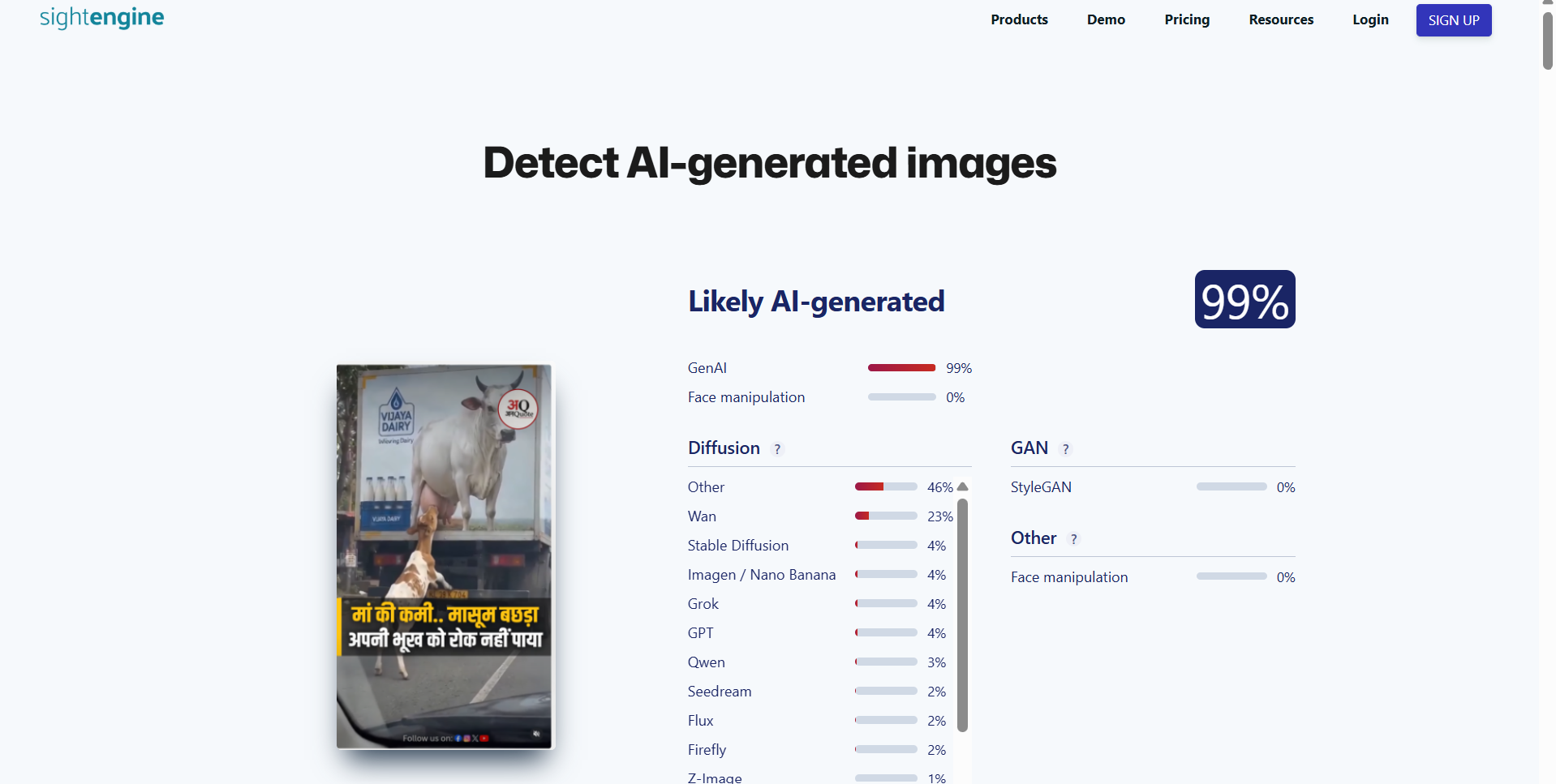
In the next step of our research, we scanned the viral video using the AI detection tool Sightengine. According to the results, the viral video is 99 per cent AI-generated.
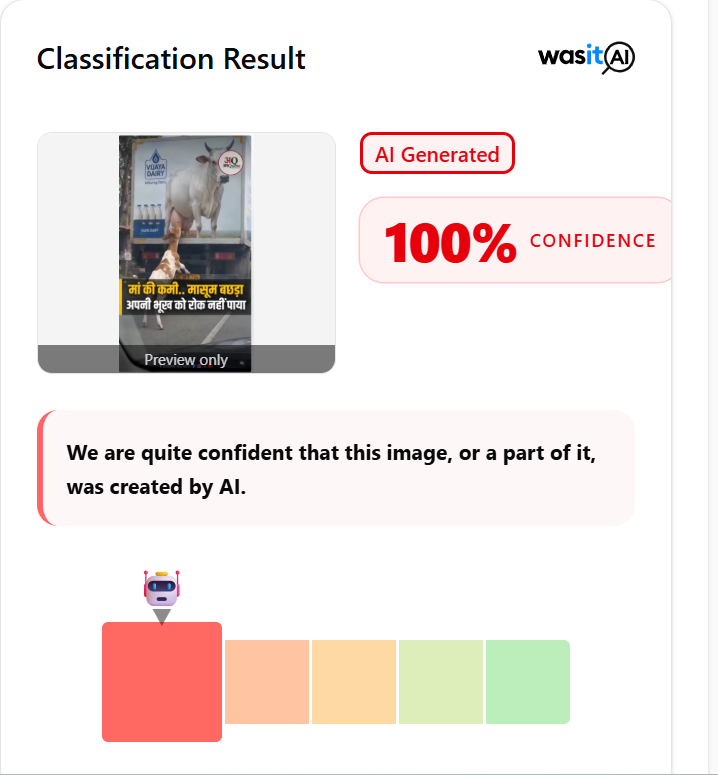
In the next step of our research, we scanned the viral video using the AI detection tool Wasit AI. According to the results, the viral video is AI-generated.
Conclusion
Our research found the viral claim to be false. The research established that the viral video is AI-generated and does not depict a real incident.
