
#FactCheck-No Evidence India Returned Iranian Oil After Trump-Modi Call
Executive Summary
A claim circulating on social media alleges that India refused to unload crude oil from two Iranian tankers following a call between US President Donald Trump and Prime Minister Narendra Modi, after the US announced fresh restrictions on Iranian oil exports. However, research by the CyberPeace Research Wing found the claim to be misleading. The probe revealed that two supertankers carrying Iranian crude are currently anchored off India’s western and eastern coasts. No credible evidence or reports suggest that India refused to unload the cargo or sent the vessels back.
Claim
A user on X claimed that India returned 2 million barrels of Iranian crude oil after a phone call from Donald Trump. According to the post, India had already paid for the oil and the tanker was en route, but following the call with Narendra Modi, authorities refused to unload the shipment and sent the tanker back to Iran.
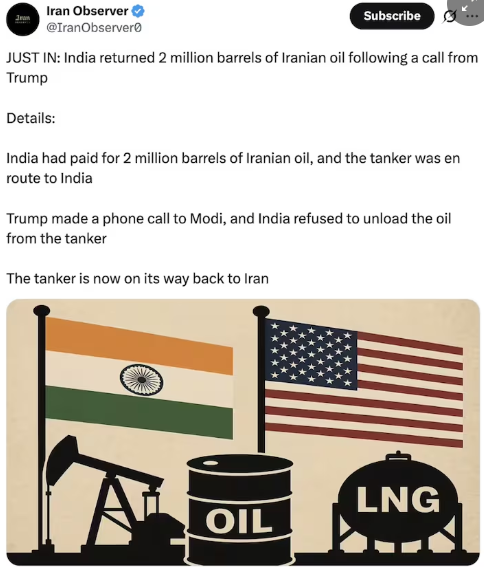
Fact Check
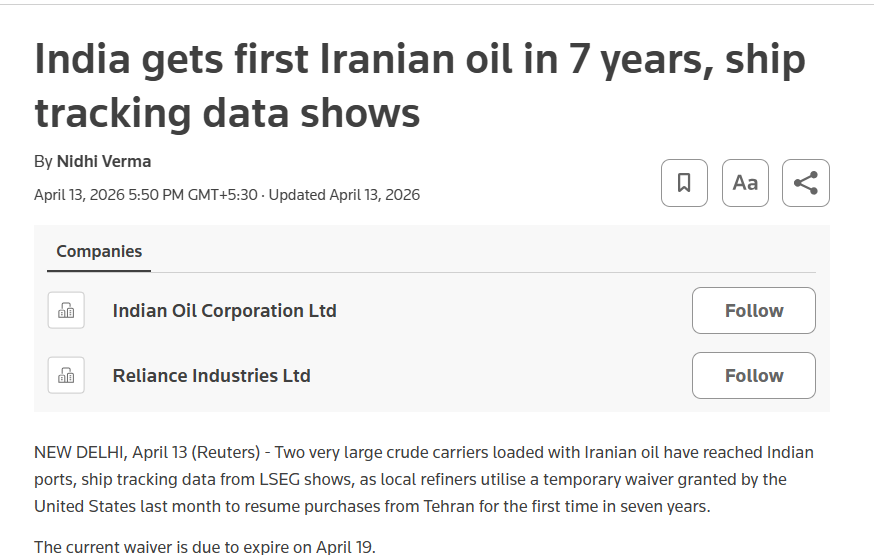
No credible national or international media reports were found to support the claim that India refused to accept Iranian oil or returned the tankers. Given the global scrutiny on oil shipments amid tensions in West Asia, any such development would have drawn widespread coverage. According to Reuters, two large crude carriers loaded with Iranian oil reached Indian ports on April 13. The Iran-flagged Felicity arrived near Sikka port in Gujarat, while the Curacao-flagged Jaya reached Paradip port in Odisha. The report noted that this marked the first purchase of Iranian oil by Indian refiners since 2019.
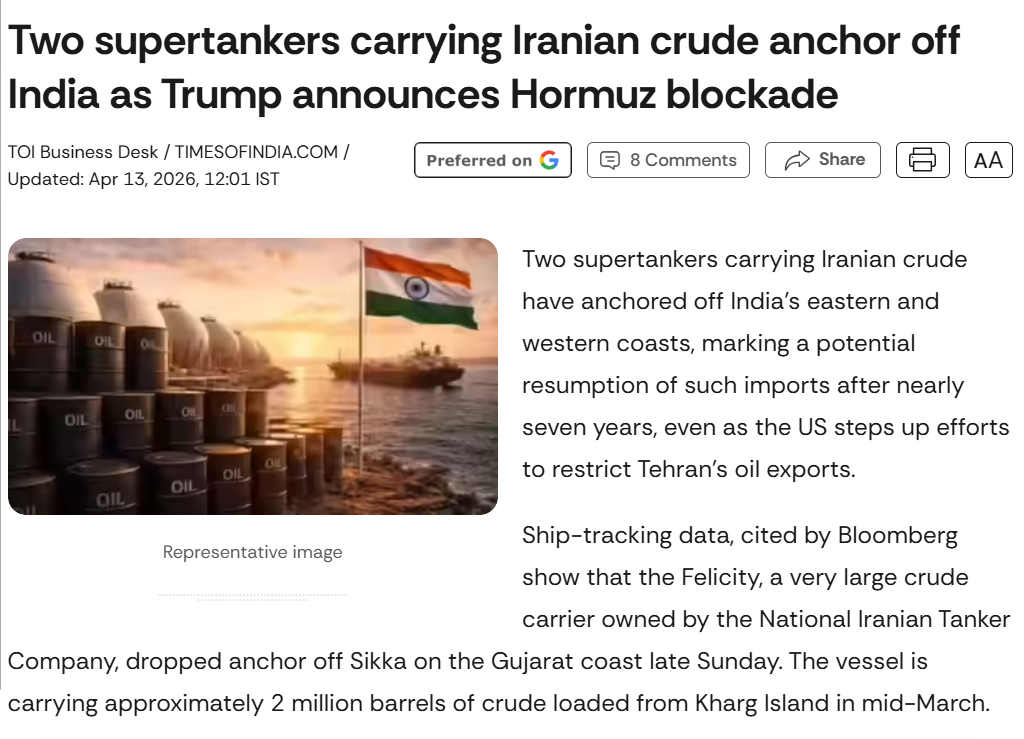
Further, The Times of India reported that Felicity, owned by the National Iranian Tanker Company, anchored off Sikka on April 12 carrying around 2 million barrels of crude loaded from Kharg Island in mid-March. The second tanker, Jaya, also anchored near Paradip around the same time, having departed with a similar volume of crude in late February. While the buyers of these cargoes have not been officially disclosed, Paradip port is primarily used by Indian Oil Corporation, while Sikka port is used by Reliance Industries and Bharat Petroleum Corporation.
Conclusion
The viral claim is false and misleading. Available evidence shows that the Iranian oil tankers are stationed near Indian ports, and there is no confirmation that India refused to unload the cargo or sent the vessels back.

Related Blogs

Executive Summary
The viral video, in which south actor Allu Arjun is seen supporting the Congress Party's campaign for the upcoming Lok Sabha Election, suggests that he has joined Congress Party. Over the course of an investigation, the CyberPeace Research Team uncovered that the video is a close up of Allu Arjun marching as the Grand Marshal of the 2022 India Day parade in New York to celebrate India’s 75th Independence Day. Reverse image searches, Allu Arjun's official YouTube channel, the news coverage, and stock images websites are also proofs of this fact. Thus, it has been firmly established that the claim that Allu Arjun is in a Congress Party's campaign is fabricated and misleading

Claims:
The viral video alleges that the south actor Allu Arjun is using his popularity and star status as a way of campaigning for the Congress party during the 2024 upcoming Lok Sabha elections.


Fact Check:
Initially, after hearing the news, we conducted a quick search using keywords to relate it to actor Allu Arjun joining the Congress Party but came across nothing related to this. However, we found a video by SoSouth posted on Feb 20, 2022, of Allu Arjun’s Father-in-law Kancharla Chandrasekhar Reddy joining congress and quitting former chief minister K Chandrasekhar Rao's party.

Next, we segmented the video into keyframes, and then reverse searched one of the images which led us to the Federation of Indian Association website. It says that the picture is from the 2022 India Parade. The picture looks similar to the viral video, and we can compare the two to help us determine if they are from the same event.

Taking a cue from this, we again performed a keyword search using “India Day Parade 2022”. We found a video uploaded on the official Allu Arjun YouTube channel, and it’s the same video that has been shared on Social Media in recent times with different context. The caption of the original video reads, “Icon Star Allu Arjun as Grand Marshal @ 40th India Day Parade in New York | Highlights | #IndiaAt75”

The Reverse Image search results in some more evidence of the real fact, we found the image on Shutterstock, the description of the photo reads, “NYC India Day Parade, New York, NY, United States - 21 Aug 2022 Parade Grand Marshall Actor Allu Arjun is seen on a float during the annual Indian Day Parade on Madison Avenue in New York City on August 21, 2022.”

With this, we concluded that the Claim made in the viral video of Allu Arjun supporting the Lok Sabha Election campaign 2024 is baseless and false.
Conclusion:
The viral video circulating on social media has been put out of context. The clip, which depicts Allu Arjun's participation in the Indian Day parade in 2022, is not related to the ongoing election campaigns for any Political Party.
Hence, the assertion that Allu Arjun is campaigning for the Congress party is false and misleading.
- Claim: A video, which has gone viral, says that actor Allu Arjun is rallying for the Congress party.
- Claimed on: X (Formerly known as Twitter) and YouTube
- Fact Check: Fake & Misleading

Executive Summary:
In the digital world, people are becoming targets more and more of online scams, which rely on deception. One of the ways the social media is being used for the elections in recent time, is the "BJP - Election Bonus" offer that promises a cash prize of Rs. 5000 or more, through some easy questionnaire. This article provides the details of this swindle and reveals its deceptive tricks as well as gives a set of recommendations on how to protect yourself from such online fraud, especially during the upcoming elections.
False Claim:
The "BJP - Election Bonus" campaign boasts that by taking a few clicks of the mouse, users will get a cash prize. This scheme is nothing but a fake association with the Bharatiya Janata Party (BJP)’s Government and Prime Minister Shri Narendra Modi and therefore, it uses the images and brands of both of them to give the scheme an impression of legitimacy. The imposters are taking advantage of the public's trust for the Government and the widespread desire for remuneration to ensnare the unaware victims, specifically before the upcoming Lok Sabha elections.

The Deceptive Scheme:
- Tempting Social Media Offer: The fraud begins with an attractive link on the social media platforms. The scammers say that the proposal is related to the Bharatiya Janata Party (BJP) with the caption of “The official party has prepared many gifts for their supporters.” accompanied by an image of the Prime Minister Shri Narendra Modi.
- Luring with Money: The offer promises to give Rs.5,000 or more. This is aimed at drawing in people specifically during election campaigns; and people’s desire for financial gain.
- Tricking with Questions: When the link is clicked, the person is brought to the page with the simple questions. The purpose of these questions is to make people feel safe and believe that they have been selected for an actual government’s program.
- The Open-the-Box Trap: Finally, the questions are answered and the last instruction is to open-the-box for the prize. However, this is just a tactic for them to make you curious about the reward.
- Fake Reward and Spreading the Scam: Upon opening the box, the recipient will be greeted with the text of Rs. 5000. However, this is not true; it is just a way to make them share the link on WhatsApp, helping the scammers to reach more victims.
The fraudsters use political party names and the Prime Minister's name to increase the plausibility of it, although there is no real connection. They employ the people's desire for monetary help, and also the time of the elections, making them susceptible to their tricks.
Analytical Breakdown:
- The campaign is a cleverly-created scheme to lure people by misusing the trust they have in the Government. By using BJP's branding and the Prime Minister's photo, fraudsters aim to make their misleading offer look credible. Fake reviews and cash reward are the two main components of the scheme that are intended to lure users into getting involved, and the end result of this is the path of deception.
- Through sharing the link over WhatsApp, users become unaware accomplices that are simply assisting the scammers to reach an even bigger audience and hence their popularity, especially with the elections around the corner.
- On top of this, the time of committing this fraud is very disturbing, as the election is just round the corner. Scammers do this in the context of the political turmoil and the spread of unconfirmed rumors and speculation about the upcoming elections in the same way they did earlier. The fraudsters are using this strategy to take advantage of the political affiliations by linking their scam to the Political party and their Leaderships.
- We have also cross-checked and as of now there is no well established and credible source or any official notification that has confirmed such an offer advertised by the Party.
- Domain Analysis: The campaign is hosted on a third party domain, which is different from the official website, thus creating doubts. Whois information reveals that the domain has been registered not long ago. The domain was registered on 29th march 2024, just a few days back.

- Domain Name: PSURVEY[.]CYOU
- Registry Domain ID: D443702580-CNIC
- Registrar WHOIS Server: whois.hkdns.hk
- Registrar URL: http://www.hkdns.hk
- Updated Date: 2024-03-29T16:18:00.0Z
- Creation Date: 2024-03-29T15:59:17.0Z (Recently Created)
- Registry Expiry Date: 2025-03-29T23:59:59.0Z
- Registrant State/Province: Anhui
- Registrant Country: CN (China)
- Name Server: NORMAN.NS.CLOUDFLARE.COM
- Name Server: PAM.NS.CLOUDFLARE.COM
Note: Cybercriminals used Cloudflare technology to mask the actual IP address of the fraudulent website.
CyberPeace Advisory and Best Practices:
- Be careful and watchful for any offers that seem too good to be true online, particularly during election periods. Exercise caution at a high level when you come across such offers, because they are usually accompanied by dishonest schemes.
- Carefully cross-check the authenticity of every campaign or offer you’re considering before interacting with it. Do not click on suspicious links and do not share private data that can be further used to run the scam.
- If you come across any such suspicious activity or if you feel you have been scammed, report it to the relevant authorities, such as the local police or the cybercrime section. Reporting is one of the most effective instruments to prevent the spread of these misleading schemes and it can support the course of the investigations.
- Educate yourselves and your families on the usual scammers’ tricks, including their election-related strategies. Prompt people to think critically and a good deal of skepticism when they meet online offers and promotions that evoke a possibility to obtain money or rewards easily.
- Ensure that you are always on a high level of alert as you explore the digital field, especially during elections. The authenticity of the information you encounter should always be verified before you act on it or pass it over to someone else.
- In case you have any doubt or worry regarding a certain e-commerce offer or campaign, don’t hesitate to ask for help from reliable sources such as Cybersecurity experts or Government agencies. A consultation with credible sources will assist you in coming up with informed decisions and guarding yourself against being navigated by these schemes.
Conclusion:
The "BJP - Election Bonus" campaign is a real case study of how Internet fraud is becoming more popular day by day, particularly before the elections. Through the awareness of the tactics employed by these scammers and their abuse of the community's trust in the Government and political figures, we can equip ourselves and our communities to avert becoming the victim of such fraudulent schemes. As a team, we can collectively strive for a digital environment free of threats and breaches of security, even in times of high political tension that accompany elections.

Digital vulnerabilities like cyber-attacks and data breaches proliferate rapidly in the hyper-connected world that is created today. These vulnerabilities can compromise sensitive data like personal information, financial data, and intellectual property and can potentially threaten businesses of all sizes and in all sectors. Hence, it has become important to inform all stakeholders about any breach or attack to ensure they can be well-prepared for the consequences of such an incident.
The non-reporting of reporting can result in heavy fines in many parts of the world. Data breaches caused by malicious acts are crimes and need proper investigation. Organisations may face significant penalties for failing to report the event. Failing to report data breach incidents can result in huge financial setbacks and legal complications. To understand why transparency is vital and understanding the regulatory framework that governs data breaches is the first step.
The Current Indian Regulatory Framework on Data Breach Disclosure
A data breach essentially, is the unauthorised processing or accidental disclosure of personal data, which may occur through its acquisition, sharing, use, alteration, destruction, or loss of access. Such incidents can compromise the affected data’s confidentiality, integrity, or availability. In India, the Information Technology Act of 2000 and the Digital Personal Data Protection Act of 2023 are the primary legislation that tackles cybercrimes like data breaches.
- Under the DPDP Act, neither materiality thresholds nor express timelines have been prescribed for the reporting requirement. Data Fiduciaries are required to report incidents of personal data breach, regardless of their sensitivity or impact on the Data Principal.
- The IT (Indian Computer Emergency Response Team and Manner of Performing Functions and Duties) Rules, 2013, the IT (Reasonable Security Practices and Procedures and Sensitive Personal Data or Information) Rules, 2011, along with the Cyber Security Directions, under section 70B(6) of the IT Act, 2000, relating to information security practices, procedure, prevention, response and reporting of cyber incidents for Safe & Trusted Internet prescribed in 2022 impose mandatory notification requirements on service providers, intermediaries, data centres and corporate entities, upon the occurrence of certain cybersecurity incidents.
- These laws and regulations obligate companies to report any breach and any incident to regulators such as the CERT-In and the Data Protection Board.
The Consequences of Non-Disclosure
A non-disclosure of a data breach has a manifold of consequences. They are as follows:
- Legal and financial penalties are the immediate consequence of a data breach in India. The DPDP Act prescribes a fine of up to Rs 250 Crore from the affected parties, along with suits of a civil nature and regulatory scrutiny. Non-compliance can also attract action from CERT-In, leading to more reputational damage.
- In the long term, failure to disclose data breaches can erode customer trust as they are less likely to engage with a brand that is deemed unreliable. Investor confidence may potentially waver due to concerns about governance and security, leading to stock price drops or reduced funding opportunities. Brand reputation can be significantly tarnished, and companies may struggle with retaining and attracting customers and employees. This can affect long-term profitability and growth.
- Companies such as BigBasket and Jio in 2020 and Haldiram in 2022 have suffered from data breaches recently. Poor transparency and delay in disclosures led to significant reputational damage, legal scrutiny, and regulatory actions for the companies.
Measures for Improvement: Building Corporate Reputation via Transparency
Transparency is critical when disclosing data breaches. It enhances trust and loyalty for a company when the priority is data privacy for stakeholders. Ensuring transparency mitigates backlash. It demonstrates a company’s willingness to cooperate with authorities. A farsighted approach instils confidence in all stakeholders in showcasing a company's resilience and commitment to governance. These measures can be further improved upon by:
- Offering actionable steps for companies to establish robust data breach policies, including regular audits, prompt notifications, and clear communication strategies.
- Highlighting the importance of cooperation with regulatory bodies and how to ensure compliance with the DPDP Act and other relevant laws.
- Sharing best public communications practices post-breach to manage reputational and legal risks.
Conclusion
Maintaining transparency when a data breach happens is more than a legal obligation. It is a good strategy to retain a corporate reputation. Companies can mitigate the potential risks (legal, financial and reputational) by informing stakeholders and cooperating with regulatory bodies proactively. In an era where digital vulnerabilities are ever-present, clear communication and compliance with data protection laws such as the DPDP Act build trust, enhance corporate governance, and secure long-term business success. Proactive measures, including audits, breach policies, and effective public communication, are critical in reinforcing resilience and fostering stakeholder confidence in the face of cyber threats.
References
- https://www.meity.gov.in/writereaddata/files/Digital%20Personal%20Data%20Protection%20Act%202023.pdf
- https://www.cert-in.org.in/PDF/CERT-In_Directions_70B_28.04.2022.pdf
- https://chawdamrunal.medium.com/the-dark-side-of-covering-up-data-breaches-why-transparency-is-crucial-fe9ed10aac27
- https://www.dlapiperdataprotection.com/index.html?t=breach-notification&c=IN
