
#FactCheck: Viral Video of Woman in Saree Driving a Train Is AI-Generated, Not Real
Executive Summary
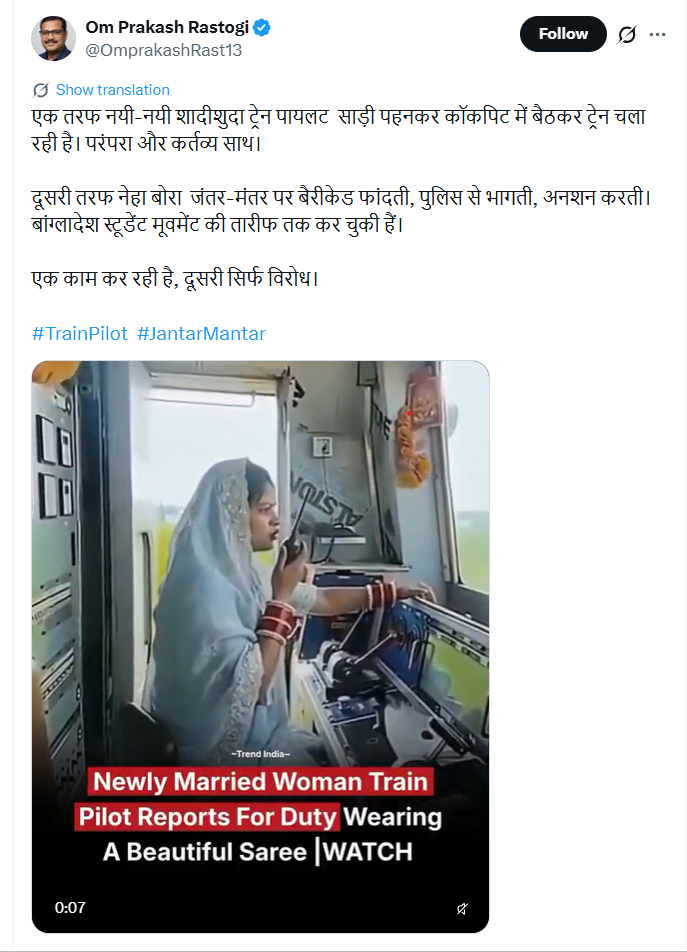
A video showing a woman dressed in a saree and appearing to work as a locomotive pilot is being widely shared on social media. The video is being circulated with the claim that she is a newly married woman who reported for duty after her wedding. The post praises the woman, presenting her as an example of balancing tradition, culture and career. Several media outlets have also published the viral video with the same claim. CyberPeace Research found the viral video to be false. The video has been created using AI and is being circulated with a misleading narrative. The claim has no basis in reality.
Claim
On October 26, 2026, X user Om Prakash Rastogi (@OmprakashRast13) shared the video with the claim: “On one hand, a newly married woman train pilot is sitting in the cockpit wearing a saree and driving a train, balancing tradition and duty. On the other hand, Neha Bora is seen jumping barricades, running from the police and staging a hunger strike at Jantar Mantar. She has even praised the Bangladesh student movement. One is doing her duty, while the other is only protesting.”
https://x.com/OmprakashRast13/status/2114665027735359627?a=3Pt242_7yXT7rAVP5oI&s=20
https://archive.ph/Se6Bg
Fact Check
We first extracted several keyframes from the viral video and then conducted a reverse search using Google Lens. We found the original video uploaded as a YouTube Short. It was uploaded on October 6, 2026. According to the information provided with the video on the YouTube channel “kumkum Kumari”, the video was created using AI.
https://www.youtube.com/shorts/ToBRXdPVn2Y
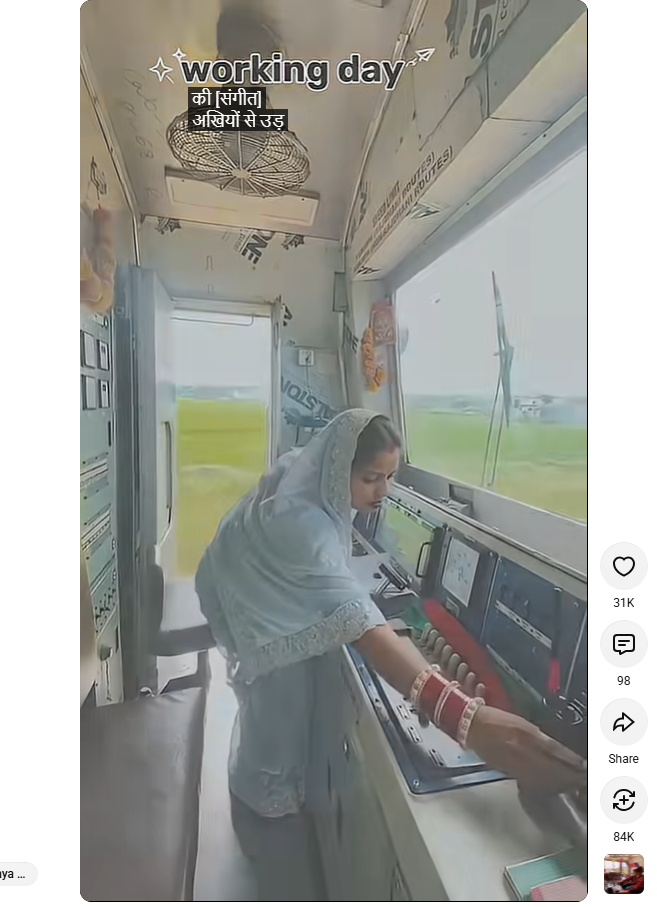
Upon examining the channel, we found several other AI-generated videos featuring women operating trains. This confirmed that the viral video is not authentic and was created using AI.

We then used the Hive Moderation tool to analyse the viral video. The results indicated that the video was AI-generated, with Hive Moderation identifying it as more than 63.3 per cent likely to be AI-generated.
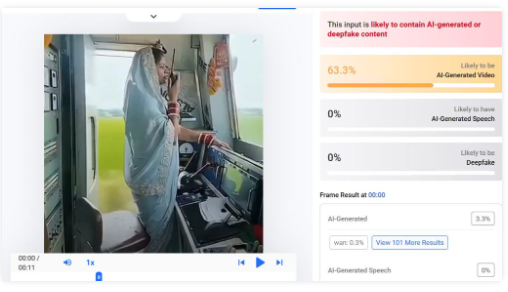
Another AI detection tool, Undetectable AI, also identified the video as 79 per cent likely to be AI-generated.

Conclusion
The evidence gathered during our research clearly establishes that the viral video showing a woman in a saree performing her duties as a locomotive pilot was created using AI.

Related Blogs

Introduction
Cybercrime is one of the most pressing concerns in today’s era. As the digital world is evolving rapidly, so do the threats and challenges to curb these cybercrimes. The complexities associated with the evolving cybercrimes make it difficult to detect and investigate by the law enforcement across the world. India is one of those countries that is actively engaged in creating awareness about the cybercrimes and security concerns across the State. At the national level, initiatives like National Cybercrime Reporting Portal, CERT-In and I4C have been established to assist the law enforcement in dealing with cybercrimes in India. According to the press release by the Ministry of Home Affairs, 12,5153 cases of Financial Cyber Frauds were reported in the year 2023, which is the second highest in State-wise Reporting after UP. Maharashtra has been highlighted as one of the States with the highest cybercrime cases for the past few years.
In response to curbing the increasing number of cases, the state of Maharashtra has launched the initiative ‘the Maharashtra Cyber Security Project’. The purpose of this project is to strengthen the system’s defense mechanism by establishing cybersecurity infrastructure, exploiting technological advancements and enhancing the skills of law enforcement agencies.
Maharashtra Cyber Department and the Cyber Security Project
The Maharashtra Cyber Department, also referred as MahaCyber was established in the year 2016 and employs a multi-faceted approach to address cyberthreats. The objective is to provide a user-friendly space to report Cybercrimes, safeguarding Critical Information Infrastructure from cyber threats, empowering the investigation law agencies ultimately improving its efficiency and creating awareness among common people.
The Maharashtra Cyber Security Project aims to strengthen the department, bringing all the aspects of the cyber security system under one facility. The key components of the Maharashtra Cyber Security Project are as follows:
- Command & Control Centre:
The Command & Control Centre will function as a 24/ complaint registration hub and grievance handling mechanism which can be accessed by calling the helpline number, mobile app or on the online portal. The Centre continuously monitors cyber threats, reduce the impact of cyber attacks and ensures that issues are resolved as soon as possible.
- Technology Assisted Investigation (TAI):
Complaints that are registered are analysed and investigated by experts using cutting edge technologies such as Computer Forensic or Mobile Forensic, Voice Analysis System, Image Enhancement Tool, Deepfake Detection Solution to name a few which helps the Maharashtra Cyber Department to collect evidence, identify weak spots and mitigate the cyber threats effectively.
- Computer Emergency Response Team – Maharashtra (CERT-MH):
The CRET-MH works on curbing cybercrimes which are especially targeted to affect the Critical Infrastructure like banks, railway services, electricity of the State and threats related to national security using technologies such as Deep web and Dark web analysis, Darknet & Threat Intelligence Feeds, Vulnerability Management, Cyber Threat Intelligence Platform, Malware Analysis and Network Capture Analysis and coordinates with other agencies.
- Security Operations Centre (SOC):
The SOC looks after the security of the MahaCyber from any cyber threats. It 24/7 monitors the infrastructure for any signs of breach or threats and thus aids in early detection and prevention of any further harm.
- Centre of Excellence (COE):
The Centre of Excellence focuses on training the police officials to equip them with desired tools and technologies to deal with cyber threats. The Centre also works on creating awareness about various cyber threats among the citizens of the state.
- Nodal Cyber Police Station:
The Nodal Cyber Police Station works as a focal point for all cybercrime related law enforcement activities. It is responsible for coordinating the investigation procedure and prevention of cybercrimes within the state. Such Cyber Police Stations have been established in each district of Maharashtra.
Funds of Funds to scale up Startups
The government of Maharashtra through the Fund of Funds for Startups scheme has invested in more than 300 startups that align with the objective of cyber security and digital safety. The government is promoting ideas and cyber defence innovation which will help to push the boundaries of traditional cybersecurity tools and improve the State’s ability to tackle cybercrimes. Such partnerships can be a cost-effective solution that proactively promotes a culture of cybersecurity across industries.
Dynamic Cyber Platform
The government of Maharashtra has been working on creating a dynamic cyber platform that would assist them in tackling cybercrimes and save hundreds of crores of rupees in a short span of time. The platform will act as a link between various stakeholders such as banks, Non-Banking Financial Companies (NBFCs) and social media providers to provide a technology-driven solution to the evolving cybercrimes. As a part of this process, the government has invited tenders and has called top IT companies from the world to participate and aid them in setting up this dynamic cyber platform.
Why Does The Initiative By Maharashtra’s Government Act As A Model For Other States
The components of the Maharashtra Cyber Security Project and the dynamic cyber platform create a comprehensive system which aims at tackling the increasing complexities of cyber threats. The initiative with integration on cutting edge technologies, specialised institutions, expert professionals from various industries and real-time monitoring of cybercrimes sets an example that Maharashtra is well-equipped to prevent, detect and respond to cybercrimes being reported in the State. The project collaborates between government and law enforcement agencies, providing them proper training and addressing grievances of the public. By working on four key areas, i.e. centralised platform for reporting, collaboration between government and private sectors, public awareness and use of advanced technologies, the Cyber Security System in Maharashtra serves as a model for creating secure digital space and tackling cybercrime effectively on a large scale.
Other States in India could certainly adopt similar models and achieve success in curbing cybercrimes. They need to create a dedicated response team consisting of trained personnel, invest in advanced software as used by Maharashtra, foster partnerships with companies or startups involved in AI and technology to build resilient cybersecurity infrastructures. The government of Maharashtra can extend hands to assist other states to establish a model that addresses the evolving cybercrimes efficiently.
References
- https://pib.gov.in/PressReleaseIframePage.aspx?PRID=2003158
- https://mhcyber.gov.in/about-us
- https://www.youtube.com/watch?v=jjPw-8afTTw
- https://www.ltts.com/press-release/maharashtra-inaugurates-india-first-integrated-cyber-command-control-center-ltts
- https://theprint.in/india/maharashtra-tackling-evolving-cyber-crimes-through-dynamic-platform-cm/2486772/
- https://www.freepressjournal.in/mumbai/maharashtra-dynamic-cyber-security-platform-in-the-offing-says-fadnavis

Introduction
Cybersecurity remains a crucial component in the modern digital era, considering the growing threat landscape caused by our increased reliance on technology and the internet. The Karnataka Government introduced a new ‘Cyber Security Policy 2024’ to address increasing cybercrimes and enhance protection measures for the State's digital infrastructure through awareness, skill development, public-private collaborations, and technology integration. Officials stated that the policy highlights various important aspects including raising awareness and providing education, developing skills, supporting the industry and start-ups, as well as forming partnerships and collaborations for enhancing capacity.
Key Highlights
- The policy consists of two components. The initial segment emphasizes creating a robust cyber security environment involving various sectors such as the public, academia, industry, start-ups, and government. The second aspect of the policy aims to enhance the cybersecurity status of the State's IT resources. Although the initial section will be accessible to the public, the second portion will be restricted to the state's IT teams and departments for their IT implementation.
- The Department of Electronics, IT, BT and S&T, the Department of Personnel and Administrative Reforms (e-Governance),and the Home Department, in collaboration with stakeholders from government and private sectors, have collectively formulated this policy. The Indian Institute of Science, the main institute for the state's K-tech Centre of Excellence for Cyber Security (CySecK), also examined the policy.
- The Department of Electronics, IT, BT and S&T, the Department of Personnel and Administrative Reforms (e-Governance),and the Home Department, in collaboration with stakeholders from government and private sectors, have collectively formulated this policy. The Indian Institute of Science, the main institute for the state's K-tech Centre of Excellence for Cyber Security (CySecK), also examined the policy.
- Approximately ₹103.87 crore will be spent over five years to implement the policy, which would be fulfilled from the budget allocated to the Department of Information Technology and Biotechnology and Science & Technology. A total of ₹23.74 crore would be allocated for offering incentives and concessions.
- The policy focuses on key pillars of building awareness and skills, promoting research and innovation, promoting industry and start-ups, partnerships and collaborations for capacity building.
- Karnataka-based undergraduate and postgraduate interns will receive a monthly stipend of INR 10,000- Rs15,000 fora maximum duration of three months under the internship program. The goal is to support 600 interns at the undergraduate level and 120 interns at the post-graduate level within the policy timeframe.
- Karnataka-based start-ups collaborating with academic institutes can receive matching grants of up to 50% of the total R&D cost for cybersecurity projects, or a maximum of ₹50 lakh.
- Reimbursement will be provided for expenses up to a maximum of INR 1 Lakh for start-ups registered with Karnataka Start-up Cell who engage CERT-In empanelled service providers from Karnataka for cyber security audit.
- The Karnataka government has partnered with Meta to raise awareness on cyber security. By reaching out to educational institutions, schools and colleges, it is piloted to provide training to 1 lakh teachers and educate 1 million children on online safety.
CyberPeace Policy Wing Outlook
The Cyber Security Policy, 2024 launched by the Karnataka government is a testament to the state government's commitment to strengthening the cyber security posture and establishing cyber resilience. By promoting and supporting research and development projects, supporting startups, and providing skill training internships, and capacity building at a larger scale, the policy will serve asa positive step in countering the growing cyber threats and establishing a peaceful digital environment for all. The partnership and collaboration with tech companies will be instrumental in implementing the capacity-building initiatives aimed at building cognitive and skill defenses while navigating the digital world. The policy will inspire other state governments in their policy initiatives for building safe and secure cyber-infrastructure in the states by implementing strategies tailored to the specific needs and demands of each state in building safe digital infrastructure and environment.
References:
- https://www.hindustantimes.com/cities/bengaluru-news/karnataka-govt-launches-new-cyber-security-policy-amid-frequent-scams-101722598078117.html
- https://ciso.economictimes.indiatimes.com/amp/news/grc/karnataka-govt-launches-new-cyber-security-policy/112214121
- https://cybermithra.in/2024/08/09/karnataka-cyber-security-policy/

Introduction
We were all stunned and taken aback when multiple photos of streets in the U.S. surfaced with heavily drugged individuals loosely sitting on the streets, victims of a systematically led drug operation that has recently become a target of the Trump-led “tariff” war, which he terms as a war on drug cartels. The drug is a synthetic opioid, fentanyl, which is highly powerful and addictive. The menace of this drug is found in a country that has Wall Street and the largest and most powerful economy globally. The serious implications of drug abuse are not about a certain economy; instead, it has huge costs to society in general. The estimated cost of substance misuse to society is more than $820 billion each year and is expected to continue rising.
On June 26, the International Day against Drug Abuse and Illicit Trafficking is observed globally. However, this war is waged daily for millions of people, not on streets or borders, but in bloodstreams, behind locked doors, and inside broken homes. Drug abuse is no longer a health crisis; it is a developmental crisis. The United Nations Office on Drugs and Crime has launched a campaign against this organised crime that says, “Break the Cycle’ attributing to the fact that de-addiction is hard for individuals.
The Evolving Drug Crisis: From Alleyways to Algorithms
The menace of Drug abuse and illicit trafficking has also taken strides in advancement, and what was once considered a street-side vice has made its way online in a faceless, encrypted, and algorithmically optimised sense. The online drug cartels operate in the shadows and often hide in plain sight, taking advantage of the privacy designed to benefit individuals. With the help of darknet markets, cryptocurrency, and anonymised logistics, the drug trade has transformed into a transnational, tech-enabled industry on a global scale. In an operation led by the U.S. Department of Justice’s Joint Criminal Opiod and Darknet Enforcement (JCODE) and related to Operation RapTor, an LA apartment was only to find an organised business centre that operated as a hub of one of the most prolific methamphetamine and cocaine distributors in the market. Aaron Pinder, Unit Chief of the FBI Hi-Tech Organised Crime Unit, said in his interview, “The darknet vendors that we investigate, they truly operate on a global scale.” On January 11, 2025, during the Regional Conference on “Drug Trafficking and National Security,” it was acknowledged how cryptocurrency, the dark web, online marketplaces, and drones have made drug trafficking a faceless crime. Reportedly, there has been a seven-fold increase in the drugs seized from 2004-14 to 2014-24.
India’s Response: Bridging Borders, Policing Bytes
India has been historically vulnerable due to its geostrategic placement between the Golden Crescent (Afghanistan-Iran-Pakistan) and Golden Triangle (Myanmar-Laos-Thailand), and confronts a fresh danger from “click-to-consume’ narcotics. Although India has always adopted a highly sensitised approach, it holds an optimistic future outlook for the youth. Last year, to commemorate the occasion of International Day against Drug Abuse and Illicit Trafficking, the Department of Social Justice & Empowerment organised a programme to engage individuals for the cause. The Indian authorities are often seen coming down heavily on the drug peddlers and cartels, and to aid the cause, the Home Minister Amit Shah inaugurated the new office complex of the NCB’s Bhopal zonal unit and extension of the MANAS-2 helpline to all 36 states and UTs. The primary objectives of this step are to evaluate the effectiveness of the Narcotics Coordination Mechanism (NCORD), assess the progress of states in fighting drug trafficking, and share real-time information from the National Narcotics Helpline ‘MANAS’ portal with the Anti-Narcotics Task Force (ANTF) of states and UTs.
The United Nation’s War on Narcotics: From Treaties to Technology
The United Nations Office on Drugs and Crime (UNODC) is leading the international response. It offers vital data, early warning systems, and technical support to the states fighting the drug problem. The UNODC incorporates cooperation in cross-border intelligence, overseeing the darknet activities, encouraging the treatment and harm reduction, and using anti-money laundering mechanisms to stop financial flows. India has always pledged its support to the UN led activities, and as per reports dated 26th March, 2025, India chaired the prestigious UN-backed Commission on Narcotic Drugs (CND) meeting held in vienna, wherein India highlighted the importance of opioids for medical purposes as well as the nation’s notable advancements in the field.
Resolution on June 26: From Commemoration to Commitment
Let June 26 be more than a date on the calendar- let it echo as a call to action, a day when awareness transforms into action, and resolve becomes resistance. On this day, CyberPeace resolves the following:
- To treat addicts as victims rather than criminals and to pitch for reforms to provide access to reasonably priced, stigma-free rehabilitation.
- To integrate anti-drug awareness into digital literacy initiatives and school curricula in order to teach frequently and early.
- To demand responsibility and accountability from online marketplaces and delivery services that unwittingly aid traffickers
- To tackle the demand side through employment, mental health services, and social protection, particularly for at-risk youth.
References
- https://www.gatewayfoundation.org/blog/cost-of-drug-addiction/#:~:text=The%20estimated%20cost%20for%20substance,Alcohol%3A%20%24249%20billion
- https://www.unodc.org/unodc/en/drugs/index-new.html
- https://www.fbi.gov/news/stories/global-operation-targets-darknet-drug-trafficking
- https://www.thehindu.com/news/national/dark-web-crypto-drones-emerge-as-challenges-in-fight-against-drug-trafficking-amit-shah/article69088383.ece
- https://www.pib.gov.in/PressReleaseIframePage.aspx?PRID=2028704
- https://www.newindianexpress.com/nation/2025/Mar/26/in-a-first-india-chairs-un-forum-on-narcotics-pledges-to-improve-access-to-pain-relief-and-palliative-care
