
#FactCheck-AI-Generated Video Falsely Shared as Real Footage of Iran Attack
Executive Summary
A video showing flames and thick smoke rising over a densely populated city at night is being widely circulated on social media. The video is being shared with the claim that it shows the actual visuals of explosions and destruction caused by an attack on Iran. CyberPeace Research Wing ’s research found the viral claim to be false. Our research revealed that the video is not real footage but an AI-generated video, which is being circulated with a false claim.
Claim
A user on social media platform Instagram shared the viral video on July 17, 2026, claiming that it shows the real visuals of an attack on Iran and the massive explosions caused by it.
https://www.instagram.com/reel/Da1_gaXyyoP/?utm_source=ig_web_copy_link&igsh=NTc4MTIwNjQ2YQ==

Fact Check
To verify the authenticity of the viral claim, we extracted multiple keyframes from the video and conducted a reverse image search using Google Lens. During the research, we did not find any credible news report, verified video, or authentic source confirming that the footage was related to any attack on Iran. To further examine the authenticity of the video, we analysed it using multiple AI detection tools. First, we scanned the video using Hive Moderation. The tool’s analysis indicated that the video had a 94.9% probability of being AI-generated, suggesting that the footage may have been created using Artificial Intelligence.
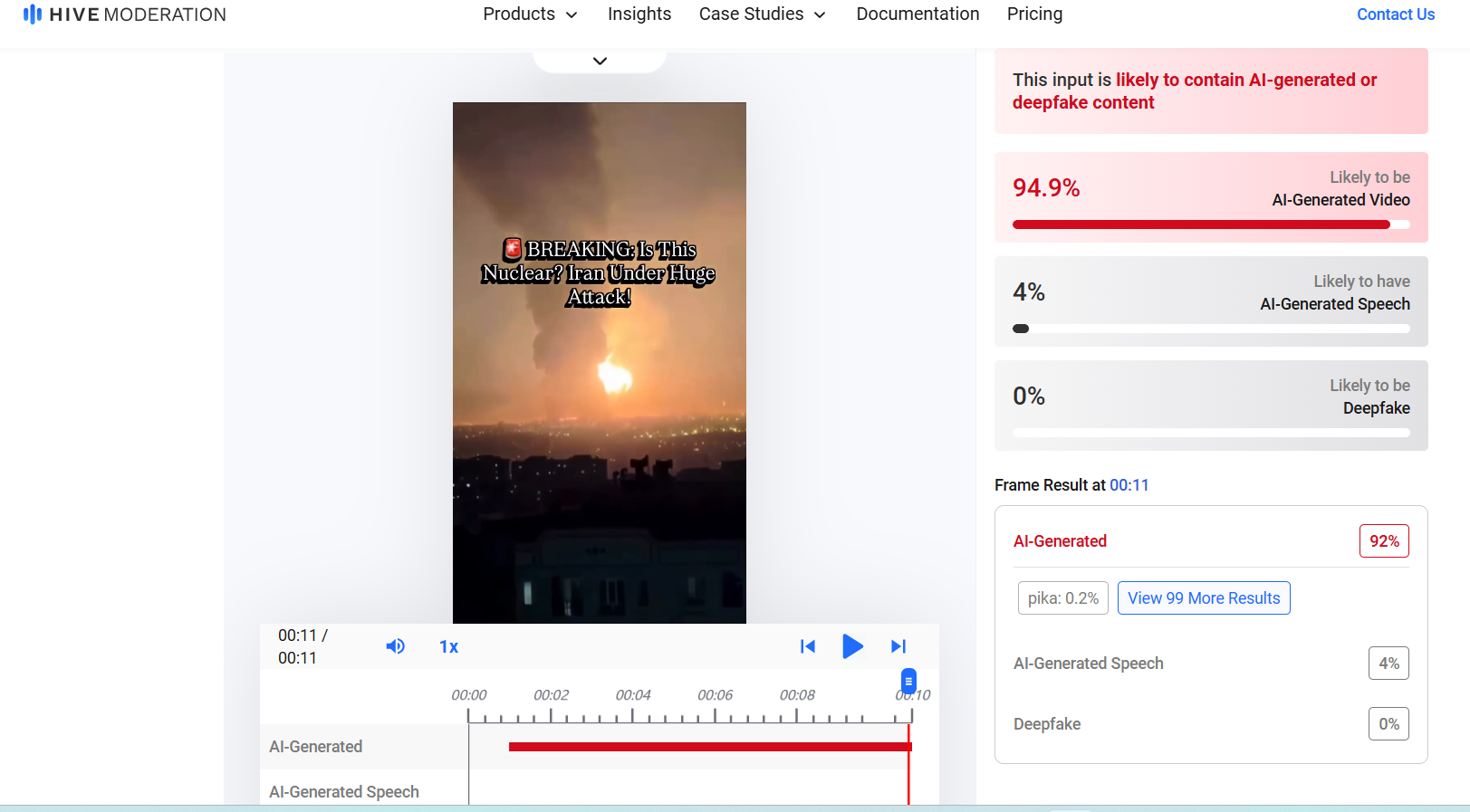
For additional verification, we analysed the video using DetectVideo AI. The tool also indicated that the video was likely AI-generated, with an estimated 80% probability.

We further checked the video using another AI detection tool, AI or Not, which suggested that the footage had a 64% probability of being AI-generated.

At the final stage of verification, we used WasIt.AI, which also indicated that the video was likely AI-generated, with an 88% probability.

Conclusion
CyberPeace Research Wing ’s research found that the viral video does not show real footage of an attack on Iran.The video was created using Artificial Intelligence (AI) and is being falsely shared as authentic visuals of explosions and destruction caused by an attack on Iran. Users are advised to verify such sensational claims before sharing them online.

Related Blogs

Introduction
The spread of information in the quickly changing digital age presents both advantages and difficulties. The phrases "misinformation" and "disinformation" are commonly used in conversations concerning information inaccuracy. It's important to counter such prevalent threats, especially in light of how they affect countries like India. It becomes essential to investigate the practical ramifications of misinformation/disinformation and other prevalent digital threats. Like many other nations, India has had to deal with the fallout from fraudulent internet actions in 2023, which has highlighted the critical necessity for strong cybersecurity safeguards.
The Emergence of AI Chatbots; OpenAI's ChatGPT and Google's Bard
The launch of OpenAI's ChatGPT in November 2022 was a major turning point in the AI space, inspiring the creation of rival chatbot ‘Google's Bard’ (Launched in 2023). These chatbots represent a significant breakthrough in artificial intelligence (AI) as they produce replies by combining information gathered from huge databases, driven by Large Language Models (LLMs). In the same way, AI picture generators that make use of diffusion models and existing datasets have attracted a lot of interest in 2023.
Deepfake Proliferation in 2023
Deepfake technology's proliferation in 2023 contributed to misinformation/disinformation in India, affecting politicians, corporate leaders, and celebrities. Some of these fakes were used for political purposes while others were for creating pornographic and entertainment content. Social turmoil, political instability, and financial ramifications were among the outcomes. The lack of tech measures about the same added difficulties in detection & prevention, causing widespread synthetic content.
Challenges of Synthetic Media
Problems of synthetic media, especially AI-powered or synthetic Audio video content proliferated widely during 2023 in India. These included issues with political manipulation, identity theft, disinformation, legal and ethical issues, security risks, difficulties with identification, and issues with media integrity. It covered an array of consequences, ranging from financial deception and the dissemination of false information to swaying elections and intensifying intercultural conflicts.
Biometric Fraud Surge in 2023
Biometric fraud in India, especially through the Aadhaar-enabled Payment System (AePS), has become a major threat in 2023. Due to the AePS's weaknesses being exploited by cybercriminals, many depositors have had their hard-earned assets stolen by fraudulent activity. This demonstrates the real effects of biometric fraud on those who have had their Aadhaar-linked data manipulated and unauthorized access granted. The use of biometric data in financial systems raises more questions about the security and integrity of the nation's digital payment systems in addition to endangering individual financial stability.
Government strategies to counter digital threats
- The Indian Union Government has sent a warning to the country's largest social media platforms, highlighting the importance of exercising caution when spotting and responding to deepfake and false material. The advice directs intermediaries to delete reported information within 36 hours, disable access in compliance with IT Rules 2021, and act quickly against content that violates laws and regulations. The government's dedication to ensuring the safety of digital citizens was underscored by Union Minister Rajeev Chandrasekhar, who also stressed the gravity of deepfake crimes, which disproportionately impact women.
- The government has recently come up with an advisory to social media intermediaries to identify misinformation and deepfakes and to make sure of the compliance of Information Technology (IT) Rules 2021. It is the legal obligation of online platforms to prevent the spread of misinformation and exercise due diligence or reasonable efforts to identify misinformation and deepfakes.
- The Information Technology (Intermediary Guidelines and Digital Media Ethics Code) Amendment Rules 2021 were amended in 2023. The online gaming industry is required to abide by a set of rules. These include not hosting harmful or unverified online games, not promoting games without approval from the SRB, labelling real-money games with a verification mark, educating users about deposit and winning policies, setting up a quick and effective grievance redressal process, requesting user information, and forbidding the offering of credit or financing for real-money gaming. These steps are intended to guarantee ethical and open behaviour throughout the online gaming industry.
- With an emphasis on Personal Data Protection, the government enacted the Digital Personal Data Protection Act, 2023. It is a brand-new framework for digital personal data protection which aims to protect the individual's digital personal data.
- The " Cyber Swachhta Kendra " (Botnet Cleaning and Malware Analysis Centre) is a part of the Government of India's Digital India initiative under the (MeitY) to create a secure cyberspace. It uses malware research and botnet identification to tackle cybersecurity. It works with antivirus software providers and internet service providers to establish a safer digital environment.
Strategies by Social Media Platforms
Various social media platforms like YouTube, and Meta have reformed their policies on misinformation and disinformation. This shows their comprehensive strategy for combating deepfake, misinformation/disinformation content on the network. The platform YouTube prioritizes eliminating content that transgresses its regulations, decreasing the amount of questionable information that is recommended, endorsing reliable news sources, and assisting reputable authors. YouTube uses unambiguous facts and expert consensus to thwart misrepresentation. In order to quickly delete information that violates policies, a mix of content reviewers and machine learning is used throughout the enforcement process. Policies are designed in partnership with external experts and producers. In order to improve the overall quality of information that users have access to, the platform also gives users the ability to flag material, places a strong emphasis on media literacy, and gives precedence to giving context.
Meta’s policies address different misinformation categories, aiming for a balance between expression, safety, and authenticity. Content directly contributing to imminent harm or political interference is removed, with partnerships with experts for assessment. To counter misinformation, the efforts include fact-checking partnerships, directing users to authoritative sources, and promoting media literacy.
Promoting ‘Tech for Good’
By 2024, the vision for "Tech for Good" will have expanded to include programs that enable people to understand the ever-complex digital world and promote a more secure and reliable online community. The emphasis is on using technology to strengthen cybersecurity defenses and combat dishonest practices. This entails encouraging digital literacy and providing users with the knowledge and skills to recognize and stop false information, online dangers, and cybercrimes. Furthermore, the focus is on promoting and exposing effective strategies for preventing cybercrime through cooperation between citizens, government agencies, and technology businesses. The intention is to employ technology's good aspects to build a digital environment that values security, honesty, and moral behaviour while also promoting innovation and connectedness.
Conclusion
In the evolving digital landscape, difficulties are presented by false information powered by artificial intelligence and the misuse of advanced technology by bad actors. Notably, there are ongoing collaborative efforts and progress in creating a secure digital environment. Governments, social media corporations, civil societies and tech companies have shown a united commitment to tackling the intricacies of the digital world in 2024 through their own projects. It is evident that everyone has a shared obligation to establish a safe online environment with the adoption of ethical norms, protective laws, and cybersecurity measures. The "Tech for Good" goal for 2024, which emphasizes digital literacy, collaboration, and the ethical use of technology, seems promising. The cooperative efforts of people, governments, civil societies and tech firms will play a crucial role as we continue to improve our policies, practices, and technical solutions.
References:
- https://news.abplive.com/fact-check/deepfakes-ai-driven-misinformation-year-2023-brought-new-era-of-digital-deception-abpp-1651243
- https://pib.gov.in/PressReleaseIframePage.aspx?PRID=1975445

Executive Summary:
This report deals with a recent cyberthreat that took the form of a fake message carrying a title of India Post which is one of the country’s top postal services. The scam alerts recipients to the failure of a delivery due to incomplete address information and requests that they click on a link (http://iydc[.]in/u/5c0c5939f) to confirm their address. Privacy of the victims is compromised as they are led through a deceitful process, thereby putting their data at risk and compromising their security. It is highly recommended that users exercise caution and should not click on suspicious hyperlinks or messages.
False Claim:
The fraudsters send an SMS stating the status of delivery of an India Mail package which could not be delivered due to incomplete address information. They provide a deadline of 12 hours for recipients to confirm their address by clicking on the given link (http://iydc[.]in/u/5c0c5939f). This misleading message seeks to fool people into disclosing personal information or compromising the security of their device.

The Deceptive Journey:
- First Contact: The SMS is sent and is claimed to be from India Post, informs users that due to incomplete address information the package could not be delivered.
- Recipients are then expected to take action by clicking on the given link (http://iydc[.]in/u/5c0c5939f) to update the address. The message creates a panic within the recipient as they have only 12 hours to confirm their address on the suspicious link.
- Click the Link: Inquiring or worried recipients click on the link.
- User Data: When the link is clicked, it is suspected to launch possible remote scripts in the background and collect personal information from users.
- Device Compromise: Occasionally, the website might also try to infect the device with malware or take advantage of security flaws.
The Analysis:
- Phishing Technique: The scam allures its victims with a phishing technique and poses itself as the India Post Team, telling the recipients to click on a suspicious link to confirm the address as the delivery package can’t be delivered due to incomplete address.
- Fake Website Creation: Victims are redirected to a fraudulent website when they click on the link (http://iydc[.]in/u/5c0c5939f) to update their address.
- Background Scripts: Scripts performing malicious operations such as stealing the visitor information, distributing viruses are suspected to be running in the background. This script can make use of any vulnerability in the device/browser of the user to extract more info or harm the system security.
- Risk of Data Theft: This type of fraud has the potential to steal the data involved because it lures the victims into giving their personal details by creating fake urgency. The threat actors can use it for various illegal purposes such as financial fraud, identity theft and other criminal purposes in future.
- Domain Analysis: The iydc.in domain was registered on the 5th of April, 2024, just a short time ago. Most of the fraud domains that are put up quickly and utilized in criminal activities are usually registered in a short time.
- Registrar: GoDaddy.com, LLC, a reputable registrar, through which the domain is registered.
- DNS: Chase.ns.cloudflare.com and delilah.ns.cloudflare.com are the name servers used by Cloudflare to manage domain name resolution.
- Registrant: Apart from the fact that it is in Thailand, not much is known about the registrant probably because of using the privacy reduction plugins.

- Domain Name: iydc.in
- Registry Domain ID: DB3669B210FB24236BF5CF33E4FEA57E9-IN
- Registrar URL: www.godaddy.com
- Registrar: GoDaddy.com, LLC
- Registrar IANA ID: 146
- Updated Date: 2024-04-10T02:37:06Z
- Creation Date: 2024-04-05T02:37:05Z (Registered in very recent time)
- Registry Expiry Date: 2025-04-05T02:37:05Z
- Registrant State/Province: errww
- Registrant Country: TH (Thailand)
- Name Server: delilah.ns.cloudflare.com
- Name Server: chase.ns.cloudflare.com
Note: Cybercriminals used Cloudflare technology to mask the actual IP address of the fraudulent website.
CyberPeace Advisory:
- Do not open the messages received from social platforms in which you think that such messages are suspicious or unsolicited. In the beginning, your own discretion can become your best weapon.
- Falling prey to such scams could compromise your entire system, potentially granting unauthorized access to your microphone, camera, text messages, contacts, pictures, videos, banking applications, and more. Keep your cyber world safe against any attacks.
- Never reveal sensitive data such as your login credentials and banking details to entities where you haven't validated as reliable ones.
- Before sharing any content or clicking on links within messages, always verify the legitimacy of the source. Protect not only yourself but also those in your digital circle.
- Verify the authenticity of alluring offers before taking any action.
Conclusion:
The India Post delivery scam is an example of fraudulent activity that uses the name of trusted postal services to trick people. The campaign is initiated by using deceptive texts and fake websites that will trick the recipients into giving out their personal information which can later be used for identity theft, financial losses or device security compromise. Technical analysis shows the sophisticated tactics used by fraudsters through various techniques such as phishing, data harvesting scripts and the creation of fraudulent domains with less registration history etc. While encountering such messages, it's important to verify their authenticity from official sources and take proactive measures to protect both your personal information and devices from cyber threats. People can reduce the risk of falling for online scams by staying informed and following cybersecurity best practices.

Introduction
Cybercrime in India is developing at a rapid rate in terms of depth and volume, with culprits leveraging technology, anonymity, and social engineering to exploit unsuspecting victims. In a high-profile instance of coordinated police action, the Delhi Police Crime Branch recently cracked a large-scale pan-India cybercrime syndicate with its arms stretching across Delhi, Rajasthan, and Uttar Pradesh. The syndicate used to be involved in a range of cybercrimes, from sextortion and online fraud to fake call centres and cloning of bank accounts. With over ₹5 crore of illicit financial transactions revealed, the operation highlights the critical role of proactive cyber policing, data security and public awareness in India's war against digital crime.
A Multi-State Operation: Crime Network across States
On May 24, 2025, on receiving a tip-off, the Delhi Police conducted a specific raid in New Ashok Nagar to catch a suspect consignment said to be used for cybercrime. This resulted in a multi-layered investigation that revealed a large crime syndicate. Police recovered 28 mobile phones, 30 SIM cards, 15 debit cards, 8 cheque books, and two laptops, equipment said to have been used in crimes ranging from sextortion to fake loan scams.
Three of the initial arrests revealed the use of fake kits like pre-activated SIMs and counterfeit documents to create phoney digital identities and bank accounts. They were being used to bypass KYC norms and make untraceable transactions, illustrating how cyber thieves exploit digital identity as well as financial authentication loopholes in the system.
Fake Call Centre Falsely Claiming to be a Lender
Tracing the leads, the investigation then led the police to Mundka, a semi-residential and industrial area in Delhi, where a fake call centre in the name of a loan assistance service was operating. Suspects were allegedly operating the business. With deceptive scripts, their telemarketing staff lured victims with the offer of instant personal loans. When a prospective victim replied favorably and was willing to go further, he was asked to send identification documents and was then forced to pay a "processing fee." Once the payment was made, the accused would cut off contact immediately, leaving the victims shortchanged.
During the raid, seven individuals were apprehended, six of whom were trained tele-callers with a reasonable level of technical skill. In spite of possessing educational certificates and receiving a meagre pay of between ₹8,000 and ₹9,000 a month, these individuals had been enticed into the cybercrime network, demonstrating how educated youth are now more commonly being exploited or recruited by such scam networks in return for quick money.
Uncovering the Sextortion Racket
The most shocking disclosure was that of a sextortion racket being run from New Ashok Nagar, a residential area located in West Delhi, New Delhi. Suspects tricked victims with fraudulent Facebook profiles, contacted them on Messenger, and then changed to WhatsApp video calls. Pornographic videos were played on such calls while the reactions of the victim were secretly recorded. These were later utilised for extortion by threatening to share them with the whole world. The ability of such a group to blackmail and psychologically manipulate the victims indicates the psychological nature of cybercrime and the need for online safety education.
Impact and Significance: A Wake-Up Call for Law Enforcement and Public Awareness
This crackdown is uncovering some ominous trends that reflect the changing face of cybercrime in India. The syndicate's framework highlights the organised and multi-state nature of cybercrime, mostly operating through systemic loopholes. Misuse of social media sites and fintech apps is also rampant, and these are being leveraged for scams, sextortion, and monetary fraud. One of the most concerning trends is young people becoming more engaged in cybercrime, either out of economic necessity or enticed by easy cash. Most of these scams increasingly involve psychological manipulation, particularly in sextortion, where shame and fear are employed as tools. Digital identity fraud has also been facilitated through false documents and lenient Know Your Customer (KYC) checks, with fraudsters being able to evade verification processes.
These observations underscore the necessity of strong reporting channels. There also needs to be an urgent implementation of stringent verification standards in the telecom and banking industries, along with extensive community-level digital literacy initiatives to sensitise citizens to online threats and preventive measures.
CyberPeace Vision: Building a Safe Digital India
India needs a multi-level cyber security approach, comprising people awareness, AI-driven detection systems, and coordination of inter-state policing. Precedence needs to be given to:
- Capacity building of cyber police units.
- Real-time exchange of scam intelligence among law enforcement.
- Schools, colleges, and workplaces should be aware of digital hygiene.
- Rehabilitation of cyber-offenders, especially youth.
- Countering online misinformation and disinformation through fact-checking and public education campaigns
- Ensuring inclusivity in cyber safety policies so vulnerable populations, including rural users, senior citizens, and linguistic minorities, are not left behind
The breakdown of the syndicate is a major victory, but the absence of difficulty with which these networks function highlights the need for cybercrime prevention initiatives, not after the fact.
Conclusion
The Delhi Police bust of a pan-India cybercrime gang is evidence of the increasing reach and audacity of cyber crooks from one corner of India to another. From sextortion and social engineering to financial fraud and identity theft on the web, the bust demonstrates how deep and pervasive cybercrime gangs have become. It is also a reminder that anyone can get entangled and that education, awareness, and early reporting are our best defence. With India's online presence expanding day by day, our collective cyber awareness must keep pace. The fight against cybercrime will not be won only by arrests, but through a national effort to secure our digital spaces.
References
- https://indianexpress.com/article/cities/delhi/delhi-police-cyber-crime-syndicate-10047218/
- https://www.thehindu.com/news/cities/Delhi/delhi-police-bust-pan-india-cybercrime-syndicate/article69652694.ece#:~:text=The%20Delhi%20police%20have%20dismantled,and%20an%20orchestrated%20sextortion%20racket.
- https://cybercrime.gov.in/
- https://www.ncrb.gov.in/
- https://economictimes.indiatimes.com/wealth/save/online-scams-are-on-the-rise-learn-about-the-latest-tricks-fraudsters-are-using-to-identify-frauds-and-protect-yourself/articleshow/114162295.cms?from=mdr
