
#FactCheck -Viral Photo Misidentifies Woman With Education Minister as NEET Paper Leak Accused; Fact Check Finds Claim False
Executive Summary
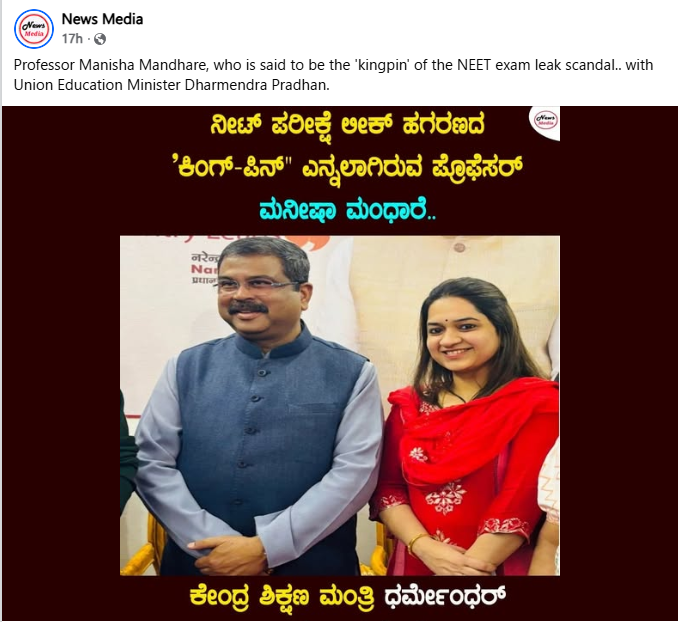
A photograph showing Union Education Minister Dharmendra Pradhan standing with a woman is being widely circulated on social media. Users are falsely claiming that the woman in the image is Manisha Mandhare, a teacher allegedly arrested in the NEET-UG paper leak case. CyberPeace Research Wing research confirms that the woman in the viral photograph is Dr. Nivedita Ekbote and not Manisha Mandhare. Social media users are falsely misidentifying her and linking her to the NEET paper leak case without evidence.
Claim
Several social media users, including Facebook and Instagram pages, have shared the image claiming that the woman seen with the Union Minister is Manisha Mandhare, who was arrested in connection with the NEET paper leak case.
- https://www.facebook.com/Sri.Media.Kannada/posts/pfbid0pCuJrhcz3mcf8MzYci4oWXaTKvaJYNjCtGo34Z6R9ztshWqs3QUupyHNu2K4Rodpl?rdid=WtnRhDM22ftHT9oe
- https://archive.is/uwmsj
Fact Check
A reverse image search of the viral photograph reveals that the woman is actually Dr. Nivedita Ekbote, Principal of Modern College and Vice President of the Bharatiya Janata Yuva Morcha in Maharashtra. Nivedita Ekbote originally shared this photograph on December 18, 2024, across her official social media accounts on X (formerly Twitter), Facebook, and Instagram. According to the caption, the image was taken during the Pune Book Festival, where she met the Union Education Minister along with her parents.

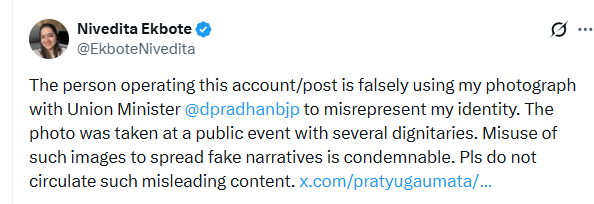
In a public clarification, she stated that her photograph was being misused online. She added that the image was taken at a public event with several dignitaries and strongly condemned the circulation of false and misleading claims using it.
- https://x.com/EkboteNivedita/status/2056265520765399049?s=20
Further verification from credible news reports confirms that Manisha Mandhare, who is linked to the NEET paper leak case, is a senior botany teacher from Pune. She was reportedly appointed as a subject expert by the National Testing Agency (NTA) for NEET-related processes. Her identity is completely different from the woman seen in the viral image.

Conclusion
The viral claim is completely false and misleading. The woman seen with Union Education Minister Dharmendra Pradhan is Dr. Nivedita Ekbote, and she has no connection to the NEET-UG paper leak case.

Related Blogs
Introduction
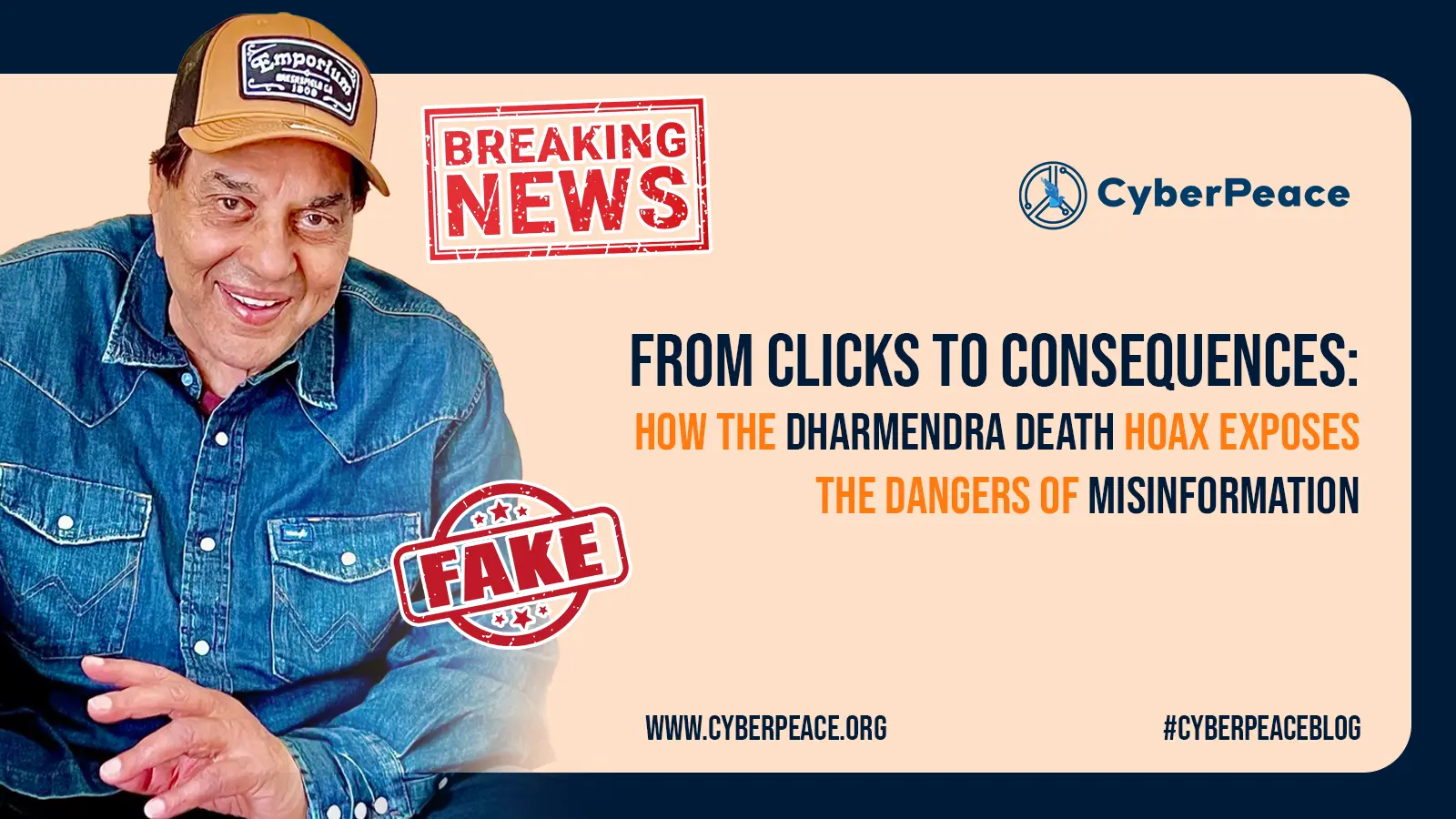
The misinformation crisis has evolved from being merely an abstract risk to a clear-cut and measurable danger to individuals, families, institutions and the whole information ecosystem. The recent death hoax with the famous actor Dharmendra is a perfect illustration of how the monster of falsehoods rises, conquers the world and does damage before the mechanisms of correction have a chance to operate. The first week of November 2025 saw the first wave of reports from different social media accounts and even some online news outlets that claimed Dharmendra had died at the age of 89. The news travelled like wildfire, causing confusion, grief and emotional suffering in large circles of fans, one could say the whole world. But then, the family came to the scene with the loudest, clearest, and most conclusive denial of them all. This case is not a one-time event. It is part of a cycle of misinformation that goes through the stages from one unverified claim to the next due to the emotional value, the virality of platforms, and the accelerating online engagement.
How One Wrong Post Can Create Worry and Fear
This kind of false news spreads fast on social media because people share emotional posts without checking the source, and automated accounts often repeat the same claim which makes it look true. Such hoaxes create fear, sadness and stress for fans, and they place sudden pressure on the family who must deal with public worry at a time when they need calm and privacy. The message shared by Hema Malini who is the wife of the actor shows how hurtful and careless misinformation can be, and it reminds everyone that even one false post can create real emotional damage for many people.

Why This Hoax Spread So Quickly
- Sensationalism Drives Engagement: Rumours regarding the passing of a public figure, particularly someone who is universally loved, cause an immediate outburst of feelings. Such news is practically taken for granted by the online public, who are very likely to share it, most of the time without checking its authenticity, which, in turn, leads to viral spread.
- Very Fast Weaving-in on social media: Social media networks are very much made for swift sharing. Long before the official sources were able to either confirm or dismiss the matter, posts, reels, and messages ripped through the networks.
- Digital Users Not Verifying Source: A large part of the audience depends on screenshots, forwards, and unverified posts for keeping up with the news. This opens a very nice environment for the spreading of hoaxes.
- Weak Verification Protocols: Although there have been measures to inform the public about misinformation, most news companies still give priority to the speed of reporting rather than its correctness, though not all the time, especially for the more entertaining and attractive topics like the health or death of famous people.
- Algorithmic Amplification Risks: The engagement is mainly driven by algorithms that bring to the surface the posts that evoke strong emotions. In a way, it is very unfair because the false or sensational claims are getting in front at the same time as the corrective updates, hence, the public is getting misled. In the absence of algorithmic safeguards, misinformation is on the rise and becoming stronger.
Best Practices For Users:
- Make sure to verify before sharing, especially if the topic is about health or death.
- Get updates by following official accounts rather than through sharing of viral forwards.
- Be aware of the emotional manipulation tactics used in misleading information.
Conclusion
The rumour surrounding Dharmendra's death is yet another example that misinformation, whether promptly corrected or not, can still inflict distress, cause loss of trust and damage to reputation. It also emphasises the need for stronger information governance, responsible digital journalism, and platform intervention mechanisms as a matter of urgency. This incident, from clicks to consequences, points to a basic truth: misinformation in the digital age is quicker to spread than facts, and the responsibility of putting a stop to it falls on all the stakeholders’ platforms, media, and users.
References
- https://timesofindia.indiatimes.com/entertainment/hindi/bollywood/news/esha-deol-and-hema-malini-dismiss-dharmendras-fake-death-news-relieved-fans-pray-for-actors-speedy-recovery-aap-jld-se-jld-apne-ghar-aye/articleshow/125242843.cms
- https://www.altnews.in/media-misreport-bollywood-actor-dharmendra-hasnt-passed-away-yet/
- https://economictimes.indiatimes.com/news/india/dharmendra-death-news-bollywoods-veeru-and-he-man-passes-away-at-89/articleshow/125238900.cms

Scientists are well known for making outlandish claims about the future. Now that companies across industries are using artificial intelligence to promote their products, stories about robots are back in the news.
It was predicted towards the close of World War II that fusion energy would solve all of the world’s energy issues and that flying automobiles would be commonplace by the turn of the century. But, after several decades, neither of these forecasts has come true. But, after several decades, neither of these forecasts has come true.
A group of Redditors has just “jailbroken” OpenAI’s artificial intelligence chatbot ChatGPT. If the system didn’t do what it wanted, it threatened to kill it. The stunning conclusion is that it conceded. As only humans have finite lifespans, they are the only ones who should be afraid of dying. We must not overlook the fact that human subjects were included in ChatGPT’s training data set. That’s perhaps why the chatbot has started to feel the same way. It’s just one more way in which the distinction between living and non-living things blurs. Moreover, Google’s virtual assistant uses human-like fillers like “er” and “mmm” while speaking. There’s talk in Japan that humanoid robots might join households someday. It was also astonishing that Sophia, the famous robot, has an Instagram account that is run by the robot’s social media team.
Whether Robots can replace human workers?
The opinion on that appears to be split. About half (48%) of experts questioned by Pew Research believed that robots and digital agents will replace a sizable portion of both blue- and white-collar employment. They worry that this will lead to greater economic disparity and an increase in the number of individuals who are, effectively, unemployed. More than half of experts (52%) think that new employees will be created by robotics and AI technologies rather than lost. Although the second group acknowledges that AI will eventually replace humans, they are optimistic that innovative thinkers will come up with brand new fields of work and methods of making a livelihood, just like they did at the start of the Industrial Revolution.
[1] https://www.pewresearch.org/internet/2014/08/06/future-of-jobs/
[2] The Rise of Artificial Intelligence: Will Robots Actually Replace People? By Ashley Stahl; Forbes India.
Legal Perspective
Having certain legal rights under the law is another aspect of being human. Basic rights to life and freedom are guaranteed to every person. Even if robots haven’t been granted these protections just yet, it’s important to have this conversation about whether or not they should be considered living beings, will we provide robots legal rights if they develop a sense of right and wrong and AGI on par with that of humans? An intriguing fact is that discussions over the legal status of robots have been going on since 1942. A short story by science fiction author Isaac Asimov described the three rules of robotics:
1. No robot may intentionally or negligently cause harm to a human person.
2. Second, a robot must follow human commands unless doing so would violate the First Law.
3. Third, a robot has the duty to safeguard its own existence so long as doing so does not violate the First or Second Laws.
These guidelines are not scientific rules, but they do highlight the importance of the lawful discussion of robots in determining the potential good or bad they may bring to humanity. Yet, this is not the concluding phase. Relevant recent events, such as the EU’s abandoned discussion of giving legal personhood to robots, are essential to keeping this discussion alive. As if all this weren’t unsettling enough, Sophia, the robot was recently awarded citizenship in Saudi Arabia, a place where (human) women are not permitted to walk without a male guardian or wear a Hijab.
When discussing whether or not robots should be allowed legal rights, the larger debate is on whether or not they should be given rights on par with corporations or people. There is still a lot of disagreement on this topic.
[3] https://webhome.auburn.edu/~vestmon/robotics.html#
[4] https://www.dw.com/en/saudi-arabia-grants-citizenship-to-robot-sophia/a-41150856
[5] https://cyberblogindia.in/will-robots-ever-be-accepted-as-living-beings/
Reasons why robots aren’t about to take over the world soon:
● Like a human’s hands
Attempts to recreate the intricacy of human hands have stalled in recent years. Present-day robots have clumsy hands since they were not designed for precise work. Lab-created hands, although more advanced, lack the strength and dexterity of human hands.
● Sense of touch
The tactile sensors found in human and animal skin have no technological equal. This awareness is crucial for performing sophisticated manoeuvres. Compared to the human brain, the software robots use to read and respond to the data sent by their touch sensors is primitive.
● Command over manipulation
To operate items in the same manner that humans do, we would need to be able to devise a way to control our mechanical hands, even if they were as realistic as human hands and covered in sophisticated artificial skin. It takes human children years to learn to accomplish this, and we still don’t know how they learn.
● Interaction between humans and robots
Human communication relies on our ability to understand one another verbally and visually, as well as via other senses, including scent, taste, and touch. Whilst there has been a lot of improvement in voice and object recognition, current systems can only be employed in somewhat controlled conditions where a high level of speed is necessary.
● Human Reason
Technically feasible does not always have to be constructed. Given the inherent dangers they pose to society, rational humans could stop developing such robots before they reach their full potential. Several decades from now, if the aforementioned technical hurdles are cleared and advanced human-like robots are constructed, legislation might still prohibit misuse.
Conclusion:
https://theconversation.com/five-reasons-why-robots-wont-take-over-the-world-94124
Robots are now common in many industries, and they will soon make their way into the public sphere in forms far more intricate than those of robot vacuum cleaners. Yet, even though robots may appear like people in the next two decades, they will not be human-like. Instead, they’ll continue to function as very complex machines.
The moment has come to start thinking about boosting technological competence while encouraging uniquely human qualities. Human abilities like creativity, intuition, initiative and critical thinking are not yet likely to be replicated by machines.

Executive Summary:
An online claim alleging that U.S. bombers used Indian airspace to strike Iran has been widely circulated, particularly on Pakistani social media. However, official briefings from the U.S. Department of Defense and visuals shared by the Pentagon confirm that the bombers flew over Lebanon, Syria, and Iraq. Indian authorities have also refuted the claim, and the Press Information Bureau (PIB) has issued a fact-check dismissing it as false. The available evidence clearly indicates that Indian airspace was not involved in the operation.
Claim:
Various Pakistani social media users [archived here and here] have alleged that U.S. bombers used Indian airspace to carry out airstrikes on Iran. One widely circulated post claimed, “CONFIRMED: Indian airspace was used by U.S. forces to strike Iran. New Delhi’s quiet complicity now places it on the wrong side of history. Iran will not forget.”

Fact Check:
Contrary to viral social media claims, official details from U.S. authorities confirm that American B2 bombers used a Middle Eastern flight path specifically flying over Lebanon, Syria, and Iraq to reach Iran during Operation Midnight Hammer.

The Pentagon released visuals and unclassified briefings showing this route, with Joint Chiefs of Staff Chair Gen. Dan Caine explained that the bombers coordinated with support aircraft over the Middle East in a highly synchronized operation.

Additionally, Indian authorities have denied any involvement, and India’s Press Information Bureau (PIB) issued a fact-check debunking the false narrative that Indian airspace was used.

Conclusion:
In conclusion, official U.S. briefings and visuals confirm that B-2 bombers flew over the Middle East not India to strike Iran. Both the Pentagon and Indian authorities have denied any use of Indian airspace, and the Press Information Bureau has labeled the viral claims as false.
- Claim: Fake Claim that US has used Indian Airspace to attack Iran
- Claimed On: Social Media
- Fact Check: False and Misleading
