
#FactCheck-Old Dehradun Video Falsely Shared as Police Assault on Women Protesters at Jantar Mantar
Executive Summary
A video showing a scuffle between a group of women and police personnel is being widely shared on social media with the claim that it shows Delhi Police assaulting women protesters at Jantar Mantar. CyberPeace Research Wing ’s research found the claim to be misleading. The viral video is not from Jantar Mantar in Delhi but from an unrelated incident in Dehradun, Uttarakhand. The old footage is being falsely circulated as a recent video from the ongoing protests.
Claim:
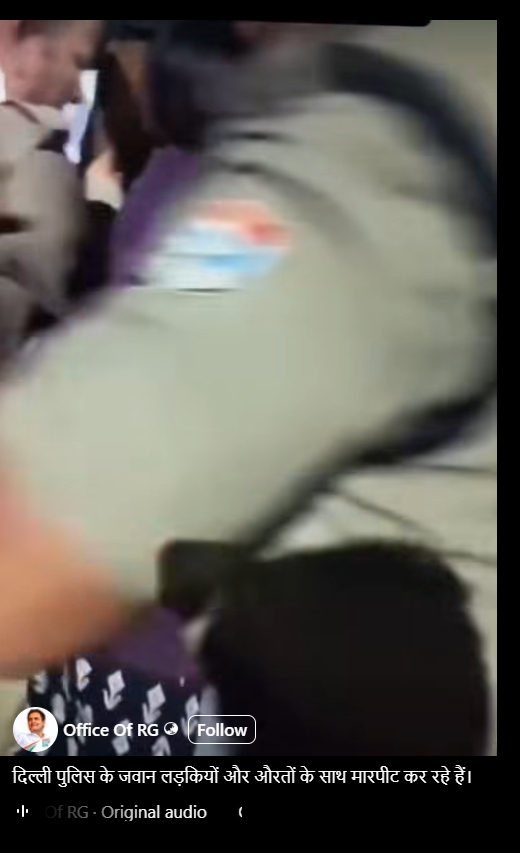
A Facebook user shared the viral video claiming that Delhi Police personnel were assaulting women and girls during the protest at Jantar Mantar.
The post link, archive link and screenshot are provided below.
https://www.facebook.com/reel/2864826433884333
Fact Check:
To verify the claim, we extracted keyframes from the viral video and conducted a reverse image search using Google Lens. This led us to the same video uploaded on the Instagram account iamvikasbaliyan on October 15, 2025.
https://www.instagram.com/reels/DP0H_SSE625/
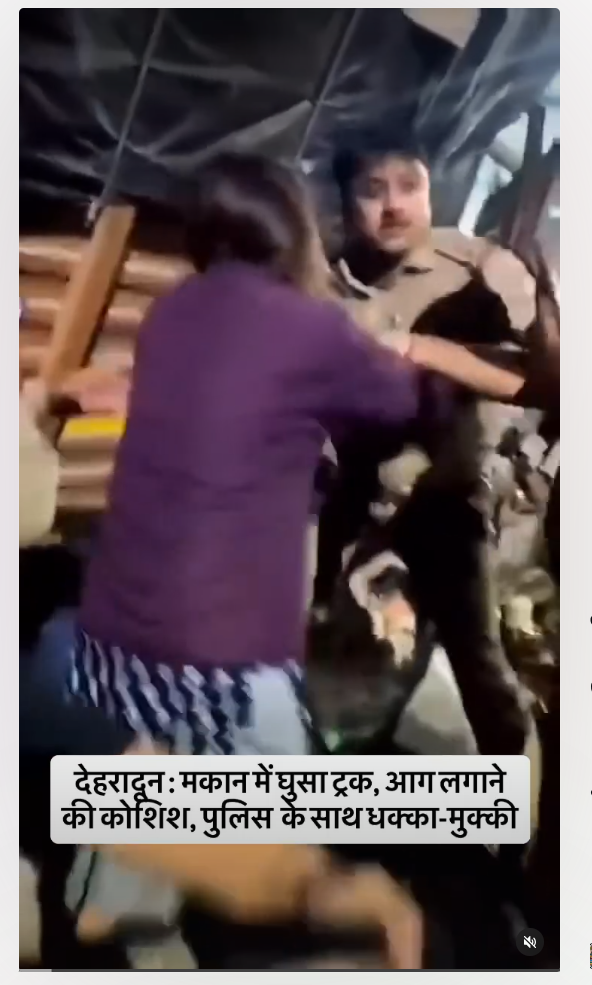
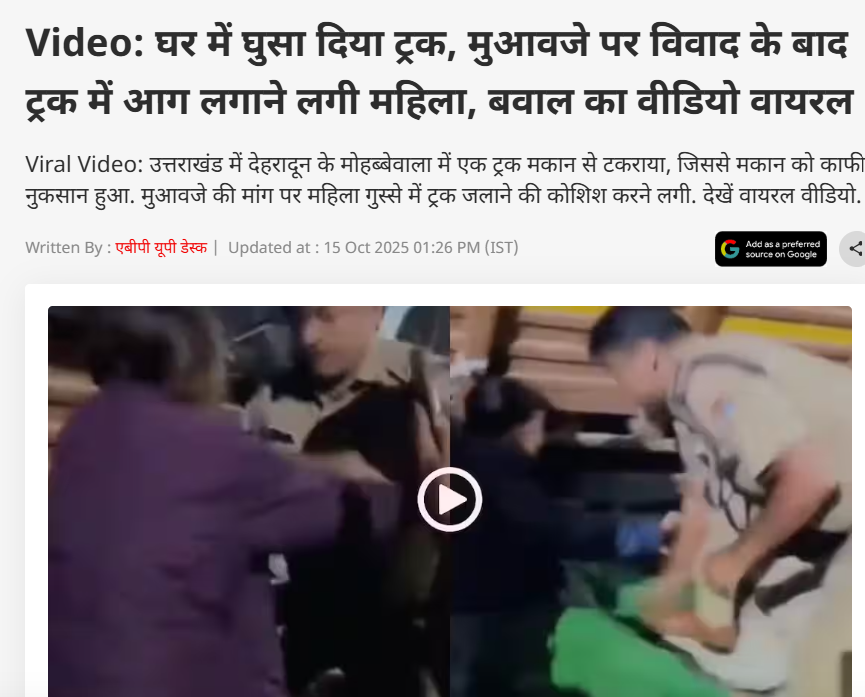
According to the information shared with the post, the incident took place in Mohabbewala, Dehradun, Uttarakhand, after a truck crashed into a house, damaging the property. The homeowner allegedly demanded compensation and, when the issue remained unresolved, attempted to set the truck on fire. When police personnel intervened to stop her, a scuffle broke out between the woman and the police. The viral video captures this incident. In the next stage of the research, we found an ABP News report published on October 15, 2025, carrying the same visuals as the viral video. The report also identified the incident as having occurred in Mohabbewala, Dehradun.
Conclusion:
CyberPeace Research Wing ’s research found the viral claim to be misleading. The video does not show Delhi Police assaulting women protesters at Jantar Mantar. It is an old video from Dehradun, Uttarakhand, showing an unrelated incident that has been falsely linked to the ongoing protests in Delhi.

Related Blogs
Procedural History:
The case started with a 2011 Madras High Court ruling that included the appellant’s personal information. In the case discussed, the court decided in 2024, the appellant went to the Madurai Bench of the Madras High Court to request that his name and other identifying information from that previous ruling be redacted. He argued that his right to privacy under Article 21 of the Indian Constitution was violated by the ongoing release of such private information into the public arena. He claimed that the revelation had hurt him in real ways, such as having his application for an Australian visa denied. Therefore, without compromising the ideals of open justice, the current procedures aimed to have the court recognize a person’s “Right to be Forgotten” within a broader framework of privacy and data protection.
Background and Factual Matrix
The appellant was charged under Sections 417 and 376 of the IPC. The trial court convicted him in 201, but later, the High Court in 2014 fully, completely and unconditionally acquitted him, which was not based on the benefit of doubt. Following the acquittal, he remarried and has three children. The judgment of both the High Court and the Trial Court has personal and intimate details about him. Being available in the public domain has caused him significant repercussions, as he was denied a visa to travel to Australia by authorities, citing the criminal cases. The appellant has filed a plea seeking a mandamus directing the Registrar General, Additional Registrar General, and Registrar (IT-Statistics) as R1, R2, R3 to redact his name and other identities from the acquittal judgment. He has sought a direction from Ikanoon Software Development Private Limited (R4) to reflect the redaction in its publication.
Issue
- Whether a writ of mandamus can lie against a High Court for redaction of personal details from its own judgment, or does such a prayer tantamount to a High Court issuing a writ against itself?
- Whether the High Court, being a Court of Record under Article 215 of the Indian Constitution, is entitled to preserve its record for perpetuity in its original form without any modification or redaction?
- Whether the ‘Right to be Forgotten' can be recognised and enforced in the absence of a specific statutory provision or Supreme Court direction, given that it constitutes an exception to the fundamental principle of open courts and open justice?
Adjudication and Reasoning
The division bench has allowed the Writ appeal and granted the following relief:
- R4 directed to take down the judgment in Crl.A. (MD) No.321 of 2011 dated 30.04.2014 forthwith.
- R1 to R3 directed to redact the name and other details of the Writ Petitioner relating to his identity from the judgment dated 30.04.2014 in Crl.A.(MD) No. 321 of 2011 and ensure that only the redacted judgment is available for publication or for uploading.
Rule
- Courts have a wide discretion in deciding whether to allow redaction or not. Such discretion can either be granted at the request of the party seeking redaction or, in appropriate cases, even suo moto by the court.
- The accused who have earned full, complete and unconditional acquittal without any benefit of doubt have a legitimate claim to move forward for redaction of personal information.
- The open Court doesn’t require absolute disclosure of all personal information, and the courts, while deciding the concern of privacy and the right to ensure that in litigations to leave behind parts of their past which are no longer relevant, have to balance the concept of open Court on the one hand and privacy concerns of a citizen on the other.
- As the High Court is the repository of a wide range of information and is entitled to preserve the original record in perpetuity. However, without diluting the sanctity of the original record, the public reflection of that record can be moderated to preserve the privacy of the person to whom that record pertains.
Reasoning
- Drawing on the judgment K.S. Puttaswamy v. Union of India, the court found Article 21 to protect not only informational privacy but also the "right to be forgotten," which gives individuals the right to request the deletion of any personal data when there is no longer any legitimate public interest in retaining such information. Such irreparable reputational damage is thus an infringement on constitutional privacy that demands judicial redaction.
- The court rejected the argument that a writ against its own order is impermissible, drawing a distinction between challenging the legal correctness of a judgment and seeking redaction of personal information. Allowing redaction will not question the validity of the judgment; rather, it will simply change its public appearance to ensure privacy.
- Since a High Court is a Court of Record with an obligation to preserve its judgments in their unaltered form forever, the court held here that such internal maintenance of complete records was not incompatible with the issuance of a redacted public version. Institutional integrity is maintained when the original kept in the archives is supplemented with a public version that masks the privacy areas.
- Open justice principles work to establish transparency, accountability, and public confidence, but these are not absolute. The court took a proportionality stance: personal identifiers, where they neither educate nor have precedential value and continue to inflict harm, may be expunged without affecting the established legal principles of judgment.
- Although the DPDP Act exempts courts from several statutory obligations, the court held that it can, by virtue of its inherent discretion, protect personal data, and in so doing, exercise that power without the need for any legislative command. Traditionally the Madras High Court rules provide for the possibility of restriction of certified copies, thus establishing redaction as feasible both legally and administratively.
.webp)
Introduction to Grooming
The term grooming is believed to have been first used by a group of investigators in the 1970s to describe patterns of seduction of an offender towards a child. It eventually evolved and began being commonly used by law enforcement agencies and has now replaced the term seduction for this behavioural pattern. At its core, grooming refers to conditioning a child by an adult offender to further their wrong motives. In its most popular sense, it refers to the sexual victimisation of children whereby an adult befriends a minor and builds an emotional connection to sexually abuse, exploit and even trafficking such a victim. The onset of technology has shifted the offline physical proximity of perpetrators to the internet, enabling groomers to integrate themselves completely into the victim’s life by maintaining consistent contact. It is noted that while grooming can occur online and offline, groomers often establish online contact before moving the ‘relationship’ offline to commit sexual offences.
Underreporting and Vulnerability of Teenagers
Given the elusive nature of the crime, cyber grooming remains one of the most underreported crimes by victims, who are often unaware or embarrassed to share their experiences. Teenagers are particularly more susceptible to cyber grooming since they not only have more access to the internet but also engage in more online risk-taking behaviours such as posting sensitive and personal pictures. Studies indicate that individuals aged 18 to 23 often lack awareness regarding the grooming process. They frequently engage in relationships with groomers without recognising the deceptive and manipulative tactics employed, mistakenly perceiving these relationships as consensual rather than abusive.
Rise of Cyber Grooming incidents after COVID-19 pandemic
There has been an uptick in cyber grooming after the COVID-19 pandemic, whereby an adult poses as a teenager or a child and befriends a minor on child-friendly websites or social media outlets and builds an emotional connection with the victim. The main goal is to obtain intimate and personal data of the minor, often in the form of sexual chats, pictures or videos, to threaten and coerce them into continuing such acts. The grooming process usually begins with seemingly harmless inquiries about the minor's age, interests, and family background. Over time, these questions gradually shift to topics concerning sexual experiences and desires. Research and data indicate that online grooming is primarily carried out by males, who frequently choose their victims based on attractiveness, ease of access, and the ability to exploit the minor's vulnerabilities.
Beyond Sexual Exploitation: Ideological and Commercial Grooming
Grooming is not confined to sexual exploitation. The rise of technology has expanded the influence of extremist ideological groups, granting them access to children who can be coerced into adopting their beliefs. This phenomenon, known as ideological grooming, presents significant personal, social, national security, and law enforcement challenges. Additionally, a new trend, termed digital commercial grooming, involves malicious actors manipulating minors into procuring and using drugs. Violent extremists are improving their online recruitment strategies, learning from each other to target and recruit supporters more effectively and are constantly leveraging children’s vulnerabilities to reinforce anti-government ideologies.
Policy Recommendations to Combat Cyber Grooming
To address the pervasive issue of cyber grooming and child recruitment by extremist groups, several policy recommendations can be implemented. Social media and online platforms should enhance their monitoring and reporting systems to swiftly detect and remove grooming behaviours. This includes investing in AI technologies for content moderation and employing dedicated teams to respond to reports promptly. Additionally, collaborative efforts with cybersecurity experts and child psychologists to develop educational campaigns and tools that teach children about online safety and identify grooming tactics should be mandated. Legislation should also be strengthened to include provisions specifically addressing cyber grooming, ensuring strict penalties for offenders and protections for victims. In this regard, international cooperation among law enforcement agencies and tech companies is essential to create a unified approach to tackling cross-border online threats to children's safety and security.
References:
- Lanning, Kenneth “The Evolution of Grooming: Concept and Term”, Journal of Interpersonal Violence, 2018, Vol. 33 (1) 5-16. https://www.nationalcac.org/wp-content/uploads/2019/05/The-evolution-of-grooming-Concept-and-term.pdf
- Jonie Chiu, Ethel Quayle, “Understanding online grooming: An interpretative phenomenological analysis of adolescents' offline meetings with adult perpetrators”, Child Abuse & Neglect, Volume 128, 2022, 105600, ISSN 0145-2134,https://doi.org/10.1016/j.chiabu.2022.105600. https://www.sciencedirect.com/science/article/pii/S014521342200120X
- “Online child sexual exploitation and abuse”, Sharinnf Electronic Resources on Laws and Crime, United Nations Office for Drugs and Crime. https://sherloc.unodc.org/cld/en/education/tertiary/cybercrime/module-12/key-issues/online-child-sexual-exploitation-and-abuse.html
- Mehrotra, Karishma, “In the pandemic, more Indian children are falling victim to online grooming for sexual exploitation” The Scroll.in, 18 September 2021. https://scroll.in/magazine/1005389/in-the-pandemic-more-indian-children-are-falling-victim-to-online-grooming-for-sexual-exploitation
- Lorenzo-Dus, Nuria, “Digital Grooming: Discourses of Manipulation and Cyber-Crime”, 18 December 2022 https://academic.oup.com/book/45362
- Strategic orientations on a coordinated EU approach to prevention of radicalisation in 2022-2023 https://home-affairs.ec.europa.eu/system/files/2022-03/2022-2023%20Strategic%20orientations%20on%20a%20coordinated%20EU%20approach%20to%20prevention%20of%20radicalisation_en.pdf
- “Handbook on Children Recruited and Exploited by Terrorist and Violent Extremist Groups: The Role of the Justice System”, United Nations Office on Drugs and Crime, 2017. https://www.unodc.org/documents/justice-and-prison-reform/Child-Victims/Handbook_on_Children_Recruited_and_Exploited_by_Terrorist_and_Violent_Extremist_Groups_the_Role_of_the_Justice_System.E.pdf

Executive Summary
A photograph is being widely circulated on social media with the claim that it shows Chinese soldiers blindfolding and escorting three Indian soldiers after entering 60 kilometres inside Arunachal Pradesh. The image is being shared as evidence of an alleged Chinese military intrusion into Indian territory.
CyberPeace Research Wing’s research found the claim to be false. Our research revealed that the viral image is AI-generated and has no connection to any real incident in Arunachal Pradesh. The Government of India and the Indian Army have also rejected claims of Chinese forces entering Indian territory.
Claim
An Instagram user, 'star8atik', shared the viral image on July 6, 2026, with the caption:"China has occupied 60 km of land in Arunachal Pradesh."
https://www.instagram.com/reel/Dac60uVtH4j

Fact Check
To verify the claim, we first performed a reverse image search using Google Lens. However, we did not find any authentic source or credible report linking the viral image to an actual incident involving Chinese troops in Arunachal Pradesh. We also conducted keyword-based searches on Google using terms related to the alleged Chinese incursion. The search yielded no credible news reports confirming that Chinese soldiers had captured Indian troops or entered 60 kilometres inside Arunachal Pradesh. We then closely examined the image and noticed several visual inconsistencies commonly associated with AI-generated content. The facial features and body proportions of the soldiers in the background appeared distorted and unnatural. Additionally, one of the Indian soldiers was shown with what appeared to be a Chinese flag patch on his arm, but its design and placement were inconsistent and visually flawed. These anomalies raised strong suspicions that the image had been generated using artificial intelligence. To verify this, we analysed the image using the AI detection tool Hive Moderation, which indicated a 98% probability that the image was AI-generated.
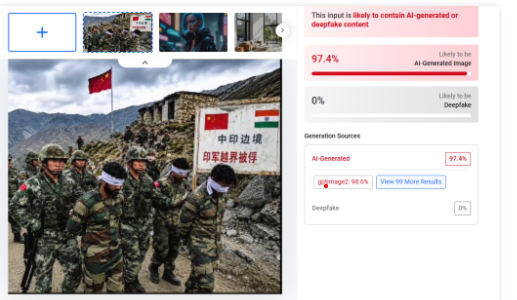
For additional verification, we also scanned the image using Undetectable AI, which found a 97% probability that the image had been digitally generated or manipulated using AI.

Conclusion
Our research found that the viral image claiming to show Chinese soldiers capturing Indian troops after entering Arunachal Pradesh is fake. The image is AI-generated and is being falsely circulated to support misleading claims of a Chinese military incursion. Furthermore, Union Minister Kiren Rijiju and the Indian Army have publicly rejected claims that Chinese forces entered Indian territory, making the viral claim baseless.
