
#FactCheck-Claim of Jaguar Jet Failing to Land During IAF Drill Is Fake; Viral Video Digitally Manipulated
Executive Summary
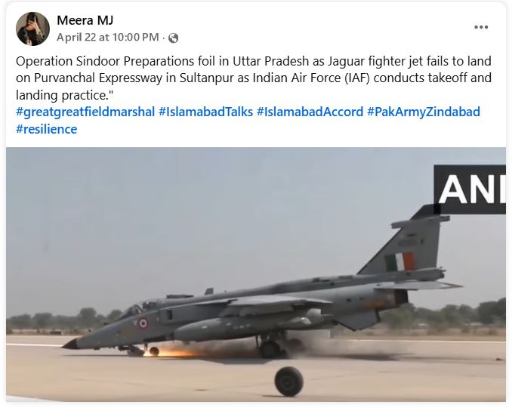
A video circulating on social media claims that a Jaguar fighter jet of the Indian Air Force (IAF) failed to land during a takeoff and landing exercise held on April 22, 2026, at the Purvanchal Expressway in Uttar Pradesh. The claim suggests that the incident disrupted preparations for “Operation Sindoor.” However, an research by the CyberPeace Research Wing has found the claim to be false.
Claim
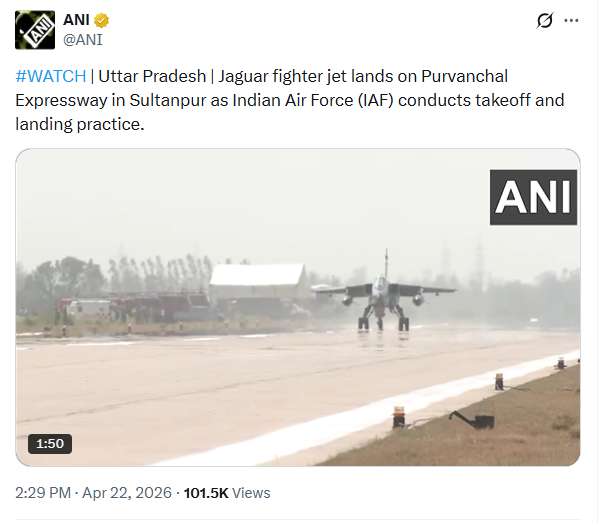
The video was shared by a Facebook user, ‘Meera MJ,’ alleging that the Jaguar aircraft could not land during the exercise conducted near Sultanpur. To verify the authenticity of the video, multiple keyframes were extracted and analyzed using reverse image search tools. This led to the original footage shared by ANI on its official X (formerly Twitter) handle on April 22, 2026. The authentic video of the air show does not show any such incident of a failed landing.
Fact Check
A detailed review of ANI’s social media posts also revealed no evidence supporting the viral claim. This strongly indicates that the circulating clip has been digitally manipulated by altering the original footage.
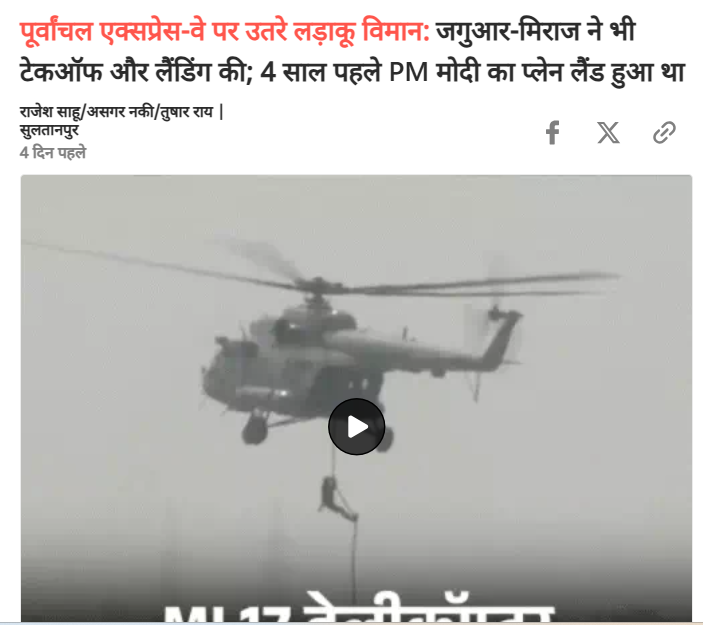
Further corroboration came from a report published by Bhaskar.com, which extensively covered the air show. According to the report, the event featured successful operations by multiple aircraft, including the C-295 transport aircraft landing on the expressway airstrip, followed by Jaguar jets taking off. Sukhoi and Mirage fighter jets also performed takeoff and landing drills, while M17 helicopters carried out commando mock operations. Additionally, the M32 Bhishma aircraft conducted ‘touch and go’
Conclusion:
The viral claim that a Jaguar fighter jet failed to land during the Indian Air Force drill is baseless. The video being circulated is digitally manipulated and does not reflect any real incident.

Related Blogs

Introduction
In April 2026, a class action suit in a federal court in California rejuvenated one of the most basic assertions in digital communication: that private messages are private. The suit claims that Meta Platforms, its subsidiary WhatsApp, and third-party contractors such as Accenture could have accessed user messages even though it had long promised end-to-end encryption.
This case is not merely about a single company or a single platform. It poses more profound questions regarding the definition, communication and regulation of privacy in an age when digital infrastructure is becoming more and more incomprehensible or unprovable to regular users.
What the Lawsuit Actually Says
The suit was filed by plaintiffs Brian Y. Shirazi and Nida Samson, who alleged that WhatsApp, Meta and contractors had intercepted and shared private messages with third parties without their consent. The complaint states that the federal investigators were notified by the whistleblowers that employees of Meta and external contractors had access to the content of WhatsApp messages that were expected to be encrypted and inaccessible.
This directly puts into question the main privacy promise of WhatsApp. The platform has been promoting itself as an end-to-end encrypted service in which not even WhatsApp can read your messages. The case asserts that this assertion was deceptive in its application and that no one ever gave any consent prior to their messages being intercepted, stored, or read.
The plaintiffs are proposing to represent a nationwide class of users of WhatsApp who sent or received messages between April 5, 2016, and the current time and subclasses in California and Pennsylvania. The claims involve breach of contract, California laws on privacy and data violations, false advertising and the Pennsylvania Wiretapping and Electronic Surveillance Act.
It should be mentioned that they are allegations. Similar assertions have been refuted by Metacomet in the past, with the company asserting that its encryption frameworks ensure that the company cannot access the messages. The case is in progress, and no facts have been found.
The Grey Area No One Talks About
In order to see the significance of this lawsuit outside the court, it is useful to consider the way modern messaging platforms actually work. In principle, end-to-end encryption means that only the sender and receiver can decipher a message. Even the service provider should not be able to access the content.
However, there is a grey space that is seldom publicly discussed: content moderation. User reports, metadata analysis or restricted message review processes are common methods used by platforms to identify harmful content, like fraud, child exploitation, or spam. The complaint indicates that such moderation procedures might have opened avenues to the content of messages to human reviewers or automated systems more than users were made to think.
This is not the first time that privacy and safety are at odds. Many jurisdictions have also advocated access to encrypted communications through legal means in the name of national security or criminal investigations. What this suit does is put that tension into even more stark relief by asking whether platforms are really open with users about these trade-offs.
The Consent Problem
The emphasis on consent is one of the most significant implications of this case. The plaintiffs claim that the users were never warned that their messages would be accessed by the employees or third parties and were never provided with any meaningful option on the same.
This is where the case turns into a data governance issue, rather than a legal one. Most data protection models consider the legality of data processing to be based on whether the users know how their data is being processed or not. When the accusations are found to be true, then the matter is not technical. It would be a contractual and ethical failure, a disjuncture between what platforms promise and what they do.
The implications are huge to the billions of users who use WhatsApp to communicate, both personally and professionally, and even politically.
What This Means Going Forward
An effective attack on the encryption assertions of WhatsApp might have actual implications for the rest of the digital ecosystem. Users might start doubting that any platform can be really considered to guarantee privacy. The regulators can advocate more stringent disclosure policies and compulsory independent audits of encryption systems. Social networks might have to re-architect their moderation frameworks to make sure that safety features do not silently compromise privacy guarantees that they claim.
Meanwhile, there is a real policy dilemma in this case that cannot be disregarded. Complete privacy may preclude the capacity to identify abuse or hateful material. The manner in which that balance is achieved and, more to the point, the manner in which it is made transparent to users is an issue that has yet to be addressed by policymakers, civil society and the tech industry.
Other technical experts have also questioned the plausibility of the claims in the lawsuit at scale, noting that it would be an extraordinary undertaking to systematically bypass end-to-end encryption. This further supports the argument of independent verification mechanisms. The problem is that users should not be forced to decide what they should believe in more: corporate guarantees or legal charges. There must be rules that can be enforced which are above the two.
Conclusion: Beyond One Lawsuit
The WhatsApp class action is eventually concerning a structural issue within the digital economy. Users are expected to have faith in systems that they cannot observe, on the assertions that they cannot test themselves.
This case is a warning, regardless of whether the allegations are proved or not. Privacy cannot be based on marketing language. It needs legally binding norms, actual transparency in the treatment of data, and external control that will provide users with something more to hang on than a tagline.
References
- https://www.bitdefender.com/en-us/blog/hotforsecurity/lawsuit-claims-meta-can-access-whatsapp-messages-despite-end-to-end-encryption-2
- https://blog.cryptographyengineering.com/2026/02/02/whatsapp-encryption-a-lawsuit-and-a-lot-of-noise/
- https://www.bloomberg.com/news/articles/2026-01-25/lawsuit-claims-meta-can-see-whatsapp-chats-in-breach-of-privacy
- https://www.classaction.org/blog/despite-privacy-promises-meta-third-parties-read-and-store-whatsapp-messages-class-action-lawsuit-alleges
Executive Summary
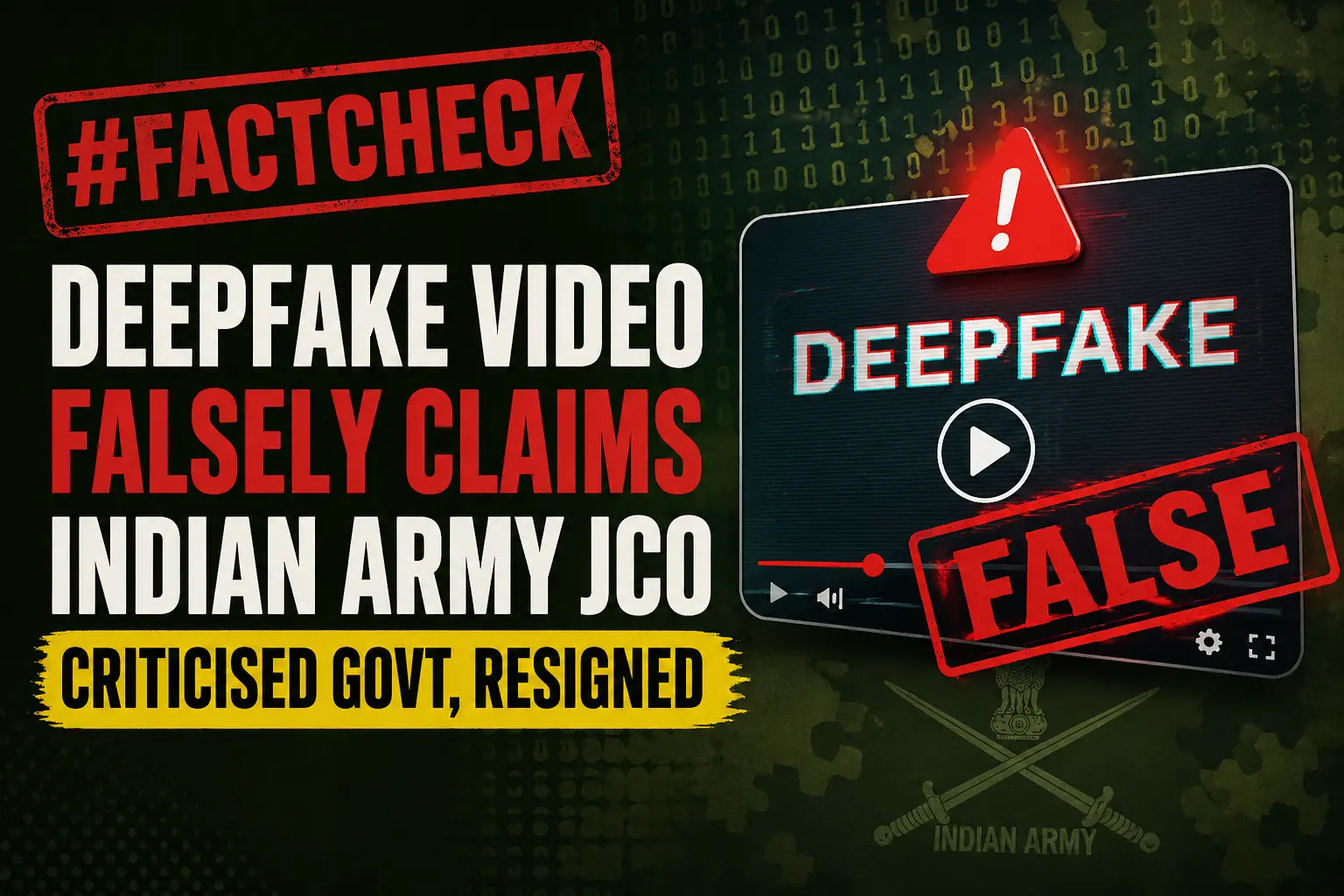
A video circulating on social media allegedly shows an Indian Army Air Defence JCO, identified as “Anurag Thakur,” criticising the Central government and announcing his resignation. In the clip, the individual is purportedly heard expressing disappointment with the government’s support for soldiers and claiming heavy casualties within his unit. However, an investigation by the CyberPeace Research Wing has found the claim to be false and the video manipulated.
Claim:
The viral post alleges that an Indian Army Air Defence JCO criticised the Centre and resigned, citing lack of support for soldiers and unacknowledged casualties.
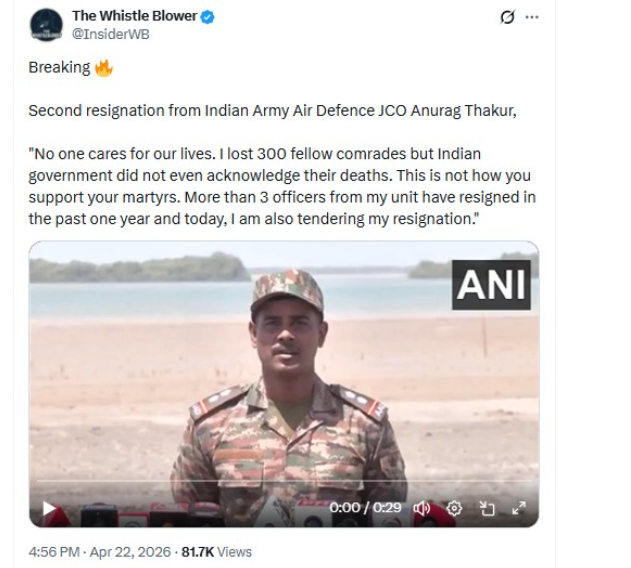
Fact Check:
A keyword search using terms such as “Indian Army Air Defence JCO,” “Anurag Thakur,” and “resignation” did not yield any credible news reports supporting the claim. A reverse image search of the viral clip led to an original video posted by ANI on April 22, 2026. The ANI watermark is also visible in the viral footage, confirming that the clip has been sourced from this original video.
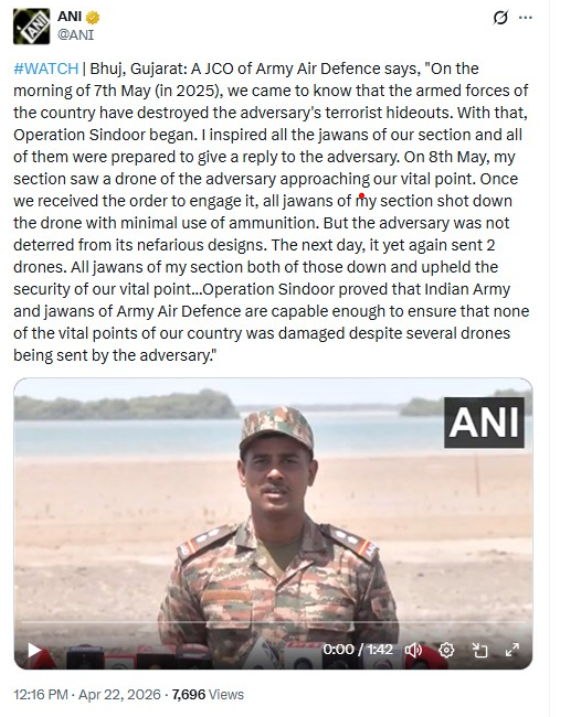
In the authentic version, the same personnel appears in the same setting, but he is speaking in Hindi about operations against adversary drones during “Operation Sindoor” in May 2025. He explains how his unit detected and neutralised multiple drones, successfully safeguarding a critical installation. Importantly, the original video does not identify the individual as Anurag Thakur, nor does it contain any reference to resignation, casualties, or criticism of the government.
Further technical analysis using the AI detection tool Hive Moderation indicated that the audio in the viral clip has an 86 percent likelihood of being artificially generated.
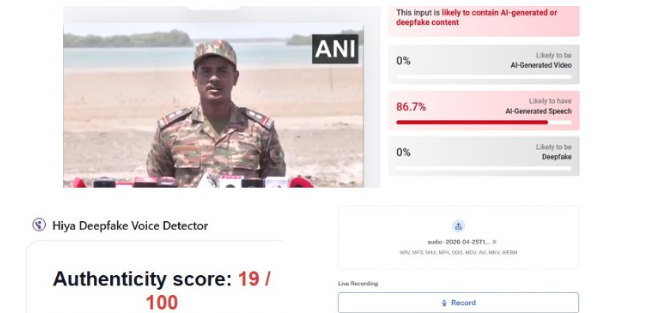
Conclusion:
The viral video has been altered with fabricated audio to falsely claim that an Indian Army officer criticised the government and resigned. The claim is baseless and the clip is a clear case of a deepfake created to mislead viewers.
.webp)
Introduction
AI-generated fake videos are proliferating on the Internet indeed becoming more common by the day. There is a use of sophisticated AI algorithms that help manipulate or generate multimedia content such as videos, audio, and images. As a result, it has become increasingly difficult to differentiate between genuine, altered, or fake content, and these AI-manipulated videos look realistic. A recent study has shown that 98% of deepfake-generated videos have adult content featuring young girls, women, and children, with India ranking 6th among the nations that suffer from misuse of deepfake technology. This practice has dangerous consequences and could harm an individual's reputation, and criminals could use this technology to create a false narrative about a candidate or a political party during elections.
The working of deepfake videos is based on algorithms that refine the fake content, and the generators are built and trained in such a way as to get the desired output. The process is repeated several times, allowing the generator to improve the content until it seems realistic, making it more flawless. Deepfake videos are created by specific approaches some of them are: -
- Lip syncing: This is the most common technique used in deepfake. Here, the voice recordings of the video, make it appear as to what was originally said by the person appearing in the video.
- Audio deepfake: For Audio-generated deepfake, a generative adversarial network (GAN) is used to colon a person’s voice, based on the vocal patterns and refine it till the desired output is generated.
- Deepfake has become so serious that the technology could be used by bad actors or by cyber-terrorist squads to set their Geo-political agendas. Looking at the present situation in the past few the number of cases has just doubled, targeting children, women and popular faces.
- Greater Risk: in the last few years the cases of deep fake have risen. by the end of the year 2022, the number of cases has risen to 96% against women and children according to a survey.
- Every 60 seconds, a deepfake pornographic video is created, now quicker and more affordable than ever, it takes less than 25 minutes and costs using just one clean face image.
- The connection to deepfakes is that people can become targets of "revenge porn" without the publisher having sexually explicit photographs or films of the victim. They may be made using any number of random pictures or images collected from the internet to obtain the same result. This means that almost everyone who has taken a selfie or shared a photograph of oneself online faces the possibility of a deepfake being constructed in their image.
Deepfake-related security concerns
As deepfakes proliferate, more people are realising that they can be used not only to create non-consensual porn but also as part of disinformation and fake news campaigns with the potential to sway elections and rekindle frozen or low-intensity conflicts.
Deepfakes have three security implications: at the international level, strategic deepfakes have the potential to destroy precarious peace; at the national level, deepfakes may be used to unduly influence elections, and the political process, or discredit opposition, which is a national security concern, and at the personal level, the scope for using Women suffer disproportionately from exposure to sexually explicit content as compared to males, and they are more frequently threatened.
Policy Consideration
Looking at the present situation where the cases of deepfake are on the rise against women and children, the policymakers need to be aware that deepfakes are utilized for a variety of valid objectives, including artistic and satirical works, which policymakers should be aware of. Therefore, simply banning deepfakes is not a way consistent with fundamental liberties. One conceivable legislative option is to require a content warning or disclaimer. Deepfake is an advanced technology and misuse of deepfake technology is a crime.
What are the existing rules to combat deepfakes?
It's worth noting that both the IT Act of 2000 and the IT Rules of 2021 require social media intermediaries to remove deep-fake videos or images as soon as feasible. Failure to follow these guidelines can result in up to three years in jail and a Rs 1 lakh fine. Rule 3(1)(b)(vii) requires social media intermediaries to guarantee that its users do not host content that impersonates another person, and Rule 3(2)(b) requires such content to be withdrawn within 24 hours of receiving a complaint. Furthermore, the government has stipulated that any post must be removed within 36 hours of being published online. Recently government has also issued an advisory to social media intermediaries to identify misinformation and deepfakes.
Conclusion
It is important to foster ethical and responsible consumption of technology. This can only be achieved by creating standards for both the creators and users, educating individuals about content limits, and providing information. Internet-based platforms should also devise techniques to deter the uploading of inappropriate information. We can reduce the negative and misleading impacts of deepfakes by collaborating and ensuring technology can be used in a better manner.
References
- https://timesofindia.indiatimes.com/life-style/parenting/moments/how-social-media-scandals-like-deepfake-impact-minors-and-students-mental-health/articleshow/105168380.cms?from=mdr
- https://www.aa.com.tr/en/science-technology/deepfake-technology-putting-children-at-risk-say-experts/2980880
- https://wiisglobal.org/deepfakes-as-a-security-issue-why-gender-matters/
