
#FactCheck-Viral Video of Monkey Saving Child Hanging From Balcony Is AI-Generated
Executive Summary
A video showing a monkey dramatically rescuing a child hanging from a balcony is being widely shared on social media. In the clip, a small child appears to be on the verge of falling when a monkey suddenly arrives, grabs the child, and saves them from falling. Many users praised the monkey’s bravery, while some even described it as a miracle. Research by CyberPeace Research Wing found that the viral video is not real and was created using AI technology before being shared with misleading claims.
Claim
An X user shared the video claiming that a monkey saved a child from falling off a balcony just in time, astonishing onlookers with its intelligence and quick action. The post described the monkey’s act as heroic and compassionate.

Fact Check
To verify the claim, we extracted keyframes from the viral video and conducted a reverse image search using Google Lens. During this process, we found the same video uploaded on April 16, 2026 by an Instagram account named Instagram user mojilo_vandro. The caption described the scene as a “miracle of God.”

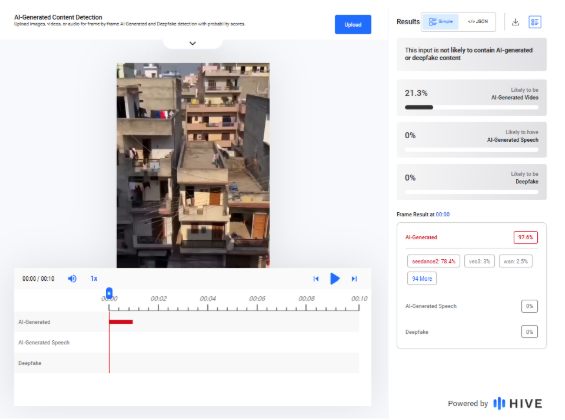
A closer review of the account revealed several similar monkey-themed videos. More importantly, the account bio clearly states that it creates AI-based fictional content. We also analyzed the clip using AI detection tool Hive Moderation, which assessed the video as having a 97.6% probability of being AI-generated
Conclusion
Our research confirms that the viral video of a monkey saving a child hanging from a balcony does not depict a real incident. It was digitally created using AI and shared online with misleading claims.

Related Blogs
.webp)
Introduction
Big Tech has been pushing back against regulatory measures, particularly regarding data handling practices. X Corp (formerly Twitter) has taken a prominent stance in India. The platform has filed a petition against the Central and State governments, challenging content-blocking orders and opposing the Center’s newly launched Sahyog portal. The X Corp has furthermore labelled the Sahyog Portal as a 'censorship portal' that enables government agencies to issue blocking orders using a standardized template.
The key regulations governing the tech space in India include the IT Act of 2000, IT Rules 2021 and 2023 (which stress platform accountability and content moderation), and the DPDP Act 2023, which intersects with personal data governance. This petition by the X Corp raises concerns for digital freedom, platform accountability, and the evolving regulatory frameworks in India.
Elon Musk vs Indian Government: Key Issues at Stake
The 2021 IT Rules, particularly Rule 3(1)(d) of Part II, outline intermediaries' obligations regarding ‘Content Takedowns’. Intermediaries must remove or disable access to unlawful content within 36 hours of receiving a court order or government notification. Notably, the rules do not require government takedown requests to be explicitly in writing, raising concerns about potential misuse.
X’s petition also focuses on the Sahyog Portal, a government-run platform that allows various agencies and state police to request content removal directly. They contend that the failure to comply with such orders can expose intermediaries' officers to prosecution. This has sparked controversy, with platforms like Elon Musk’s X arguing that such provisions grant the government excessive control, potentially undermining free speech and fostering undue censorship.
The broader implications include geopolitical tensions, potential business risks for big tech companies, and significant effects on India's digital economy, user engagement, and platform governance. Balancing regulatory compliance with digital rights remains a crucial challenge in this evolving landscape.
The Global Context: Lessons from Other Jurisdictions
The ‘EU's Digital Services Act’ establishes a baseline 'notice and takedown' system. According to the Act, hosting providers, including online platforms, must enable third parties to notify them of illegal content, which they must promptly remove to retain their hosting defence. The DSA also mandates expedited removal processes for notifications from trusted flaggers, user suspension for those with frequent violations, and enhanced protections for minors. Additionally, hosting providers have to adhere to specific content removal obligations, including the elimination of terrorist content within one hour and deploying technology to detect known or new CSAM material and remove it.
In contrast to the EU, the US First Amendment protects speech from state interference but does not extend to private entities. Dominant digital platforms, however, significantly influence discourse by moderating content, shaping narratives, and controlling advertising markets. This dual role creates tension as these platforms balance free speech, platform safety, and profitability.
India has adopted a model closer to the EU's approach, emphasizing content moderation to curb misinformation, false narratives, and harmful content. Drawing from the EU's framework, India could establish third-party notification mechanisms, enforce clear content takedown guidelines, and implement detection measures for harmful content like terrorist material and CSAM within defined timelines. This would balance content regulation with platform accountability while aligning with global best practices.
Key Concerns and Policy Debates
As the issue stands, the main concerns that arise are:
- The need for transparency in government orders for takedowns, the reasons and a clear framework for why they are needed and the guidelines for doing so.
- The need for balancing digital freedom with national security and the concerns that arise out of it for tech companies. Essentially, the role platforms play in safeguarding the democratic values enshrined in the Constitution of India.
- This court ruling by the Karnataka HC will have the potential to redefine the principles upon which the intermediary guidelines function under the Indian laws.
Potential Outcomes and the Way Forward
While we wait for the Hon’ble Court’s directives and orders in response to the filed suit, while the court's decision could favour either side or lead to a negotiated resolution, the broader takeaway is the necessity of collaborative policymaking that balances governmental oversight with platform accountability. This debate underscores the pressing need for a structured and transparent regulatory framework for content moderation. Additionally, this case also highlights the importance of due process in content regulation and the need for legal clarity for tech companies operating in India. Ultimately, a consultative and principles-based approach will be key to ensuring a fair and open digital ecosystem.
References
- https://www.thehindu.com/sci-tech/technology/elon-musks-x-sues-union-government-over-alleged-censorship-and-it-act-violations/article69352961.ece
- https://www.hindustantimes.com/india-news/elon-musk-s-x-sues-union-government-over-alleged-censorship-and-it-act-violations-101742463516588.html
- https://www.financialexpress.com/life/technology-explainer-why-has-x-accused-govt-of-censorship-3788648/
- https://thelawreporters.com/elon-musk-s-x-sues-indian-government-over-alleged-censorship-and-it-act-violations
- https://www.linklaters.com/en/insights/blogs/digilinks/2023/february/the-eu-digital-services-act---a-new-era-for-online-harms-and-intermediary-liability

Executive Summary
Iran’s Supreme Leader Ayatollah Ali Khamenei was reportedly killed in a major attack carried out by Israel and the United States, with claims circulating that Iranian state media confirmed his death early Sunday morning. Amid these claims, a video is being widely shared on social media. The viral video shows a body trapped under debris. Users sharing the clip claim that the body seen in the footage is that of Ayatollah Ali Khamenei. However, research conducted by CyberPeace found the viral claim to be false. Our research revealed that the video is not authentic but AI-generated.
Claim:
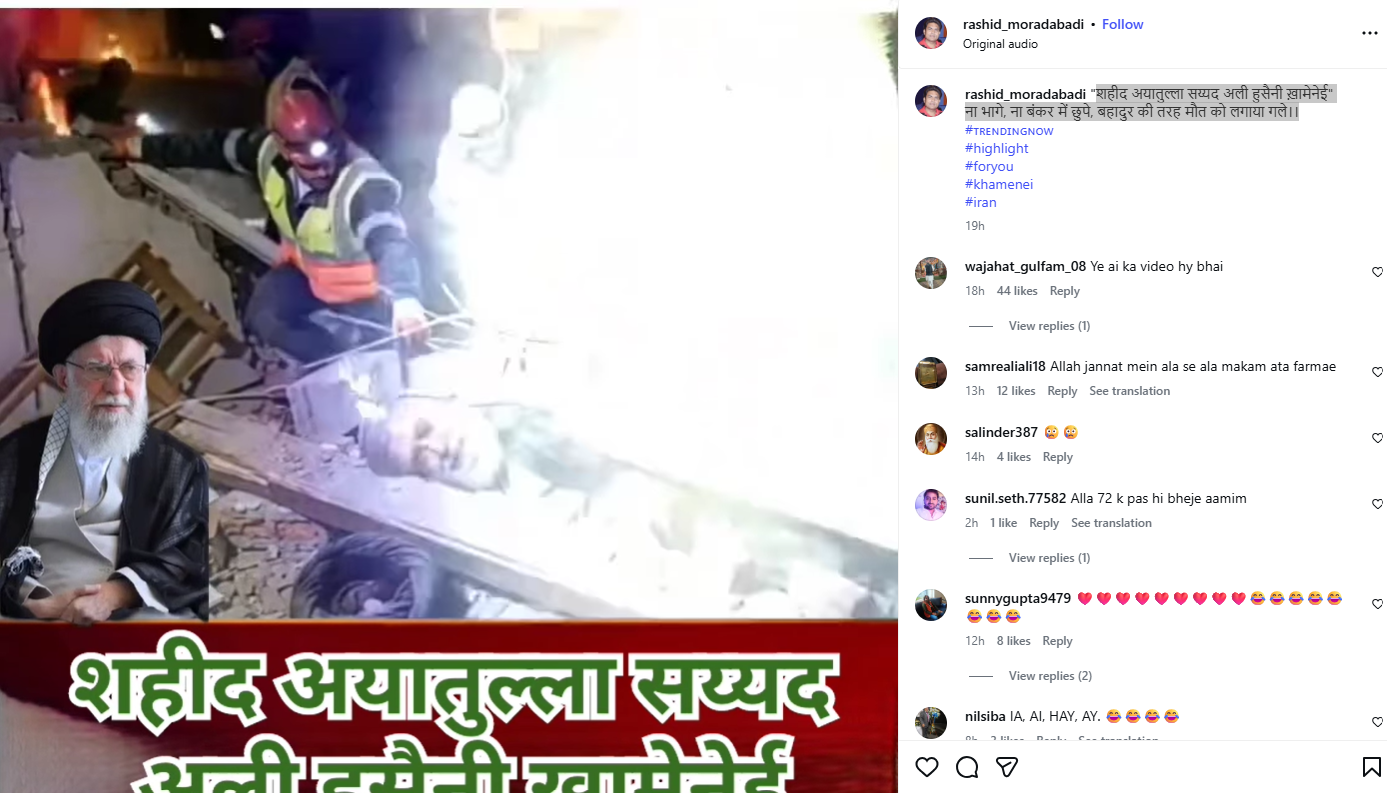
On March 1, 2026, an Instagram user shared the viral video with the caption: “Shaheed Ayatollah Sayyid Ali Hosseini Khamenei — Neither fled nor hid in a bunker, embraced death like a brave man.” The link to the post and its archived version are provided below along with a screenshot.
Fact Check:
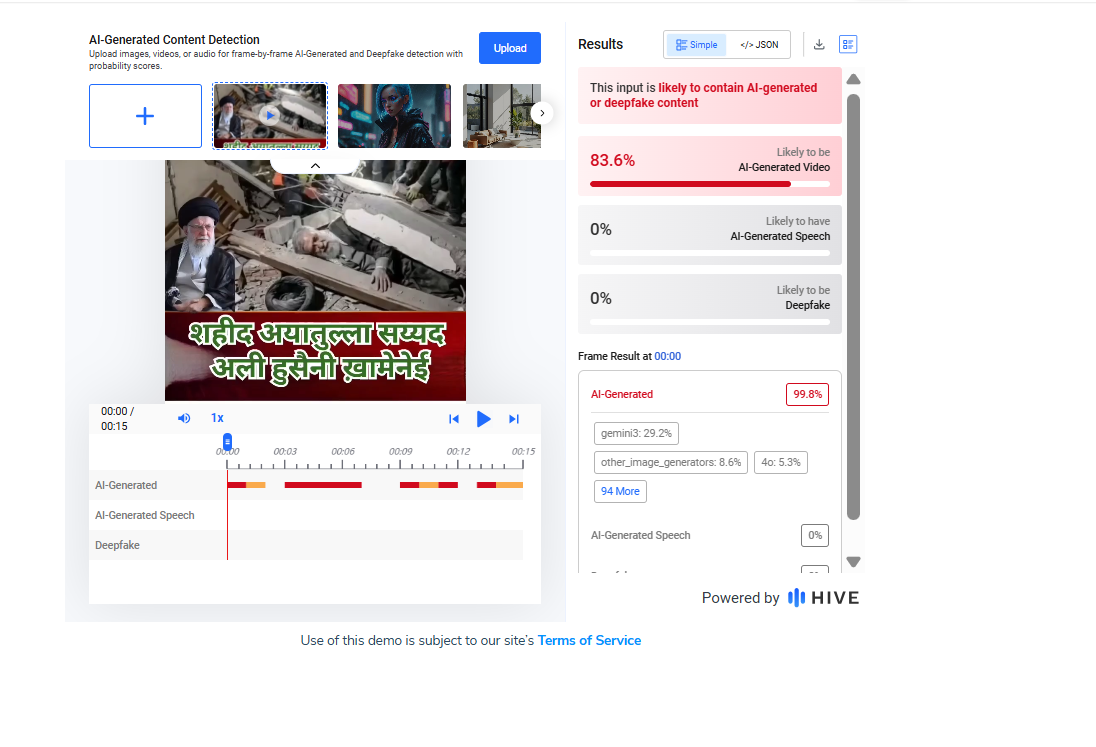
Upon closely examining the viral video, we noticed several visual irregularities and technical inconsistencies. This raised suspicion about its authenticity. We then scanned the video using the AI detection tool Hive Moderation. The results indicated that approximately 83 percent of the content showed signs of being AI-generated.
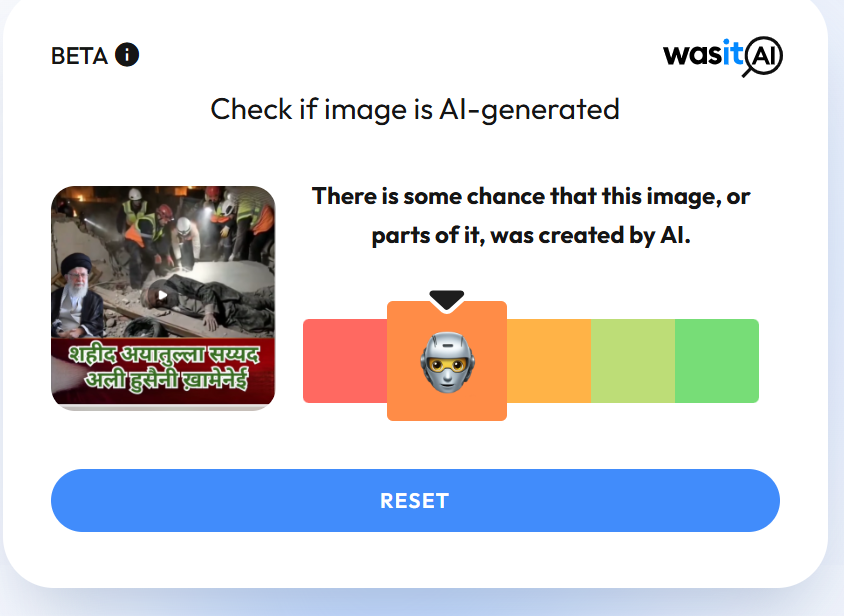
To further verify the claim, we also analyzed the video using another AI detection tool, WasItAI. The findings similarly suggested that the video was generated using artificial intelligence.
Conclusion:
Our research establishes that the viral video is not real. It has been artificially generated using AI and is being shared with misleading claims.

Executive Summary
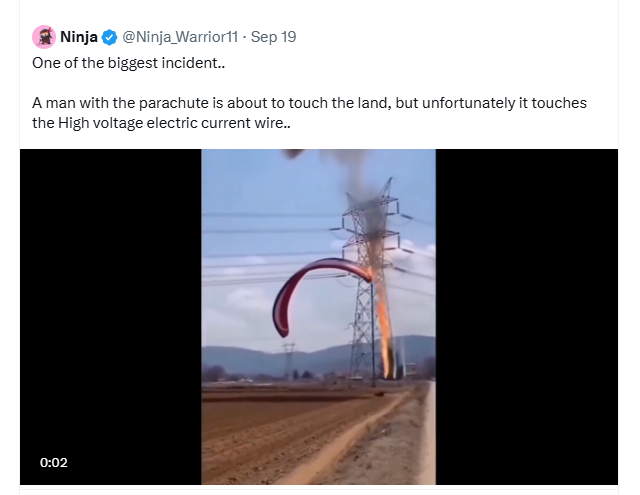
A video is being shared on social media claiming that a person who was paragliding came into contact with high-voltage electric wires during a recent incident. The video shows a paraglider coming into contact with electric wires while descending towards the ground, following which a fire can be seen breaking out. Social media users are sharing the post claiming that the incident is recent and linking it to the ongoing developments. CyberPeace Research found the viral claim to be misleading. Our research found that the viral video is not recent but dates back to a paragliding accident that took place in South Korea in June 2023. According to available media reports, on June 16, 2023, a 60-year-old man who was paragliding near Seopjikoji Beach on Jeju Island, South Korea, came into contact with high-voltage electric wires. He died in the accident.
Claim:
A video being shared on social media claims that a person descending towards the ground with a parachute unfortunately came into contact with high-voltage electric wires. The video shows the area around the person catching fire after he came into contact with the electric wires. The post is being shared on social media claiming that the incident is recent.
https://x.com/i/birdwatch/t/2101315570067189899?source=6
Fact Check
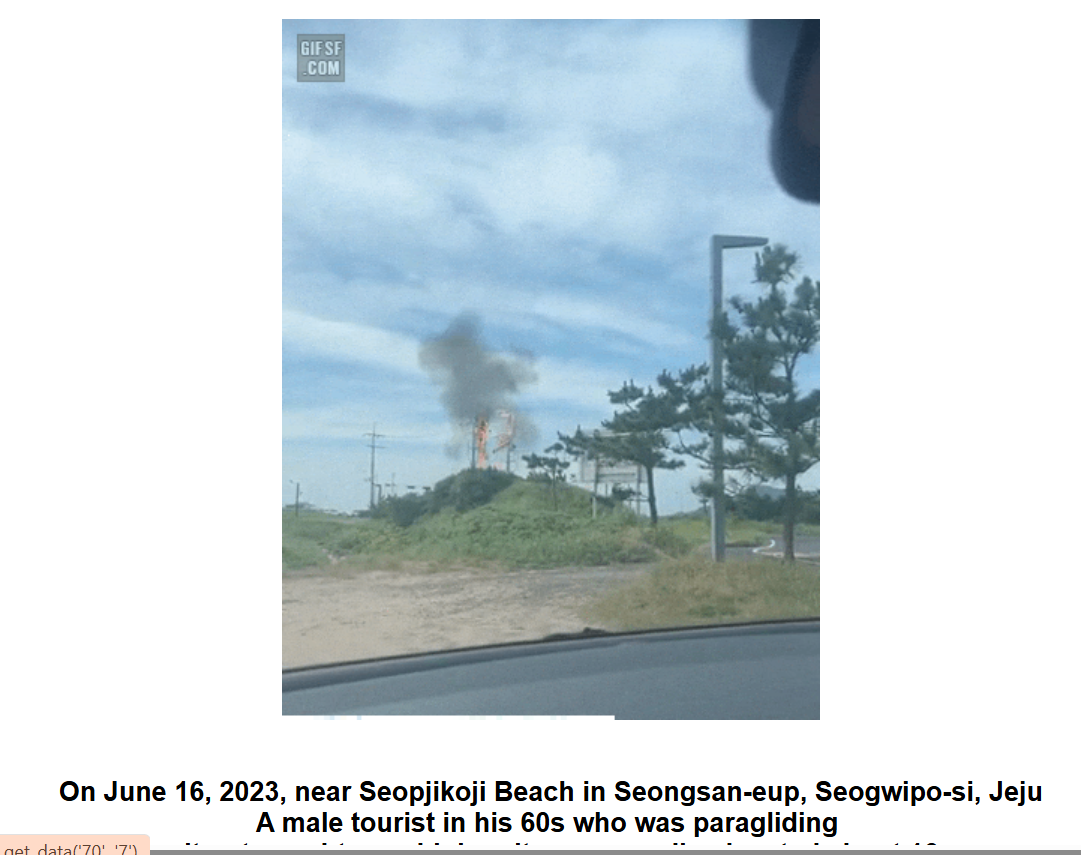
To verify the viral claim, we conducted a Google search using relevant keywords. During the search, we did not find any credible media reports related to the claim. To further verify the authenticity of the viral claim, we conducted another search on Google using relevant keywords. During the search, we found a similar video on a YouTube channel. This made it clear that the video is not recent. As part of our research, we also found the video on the South Korean website Bobaedream. According to the website, on June 16, 2023, a tourist aged around 60 came into contact with a high-voltage electric wire while paragliding near Seopjikoji Beach in Seongsan-eup, Seogwipo-si, Jeju-do Province, South Korea.
https://www.bobaedream.co.kr/bike2/board/view.php?code=strange&No=5785730
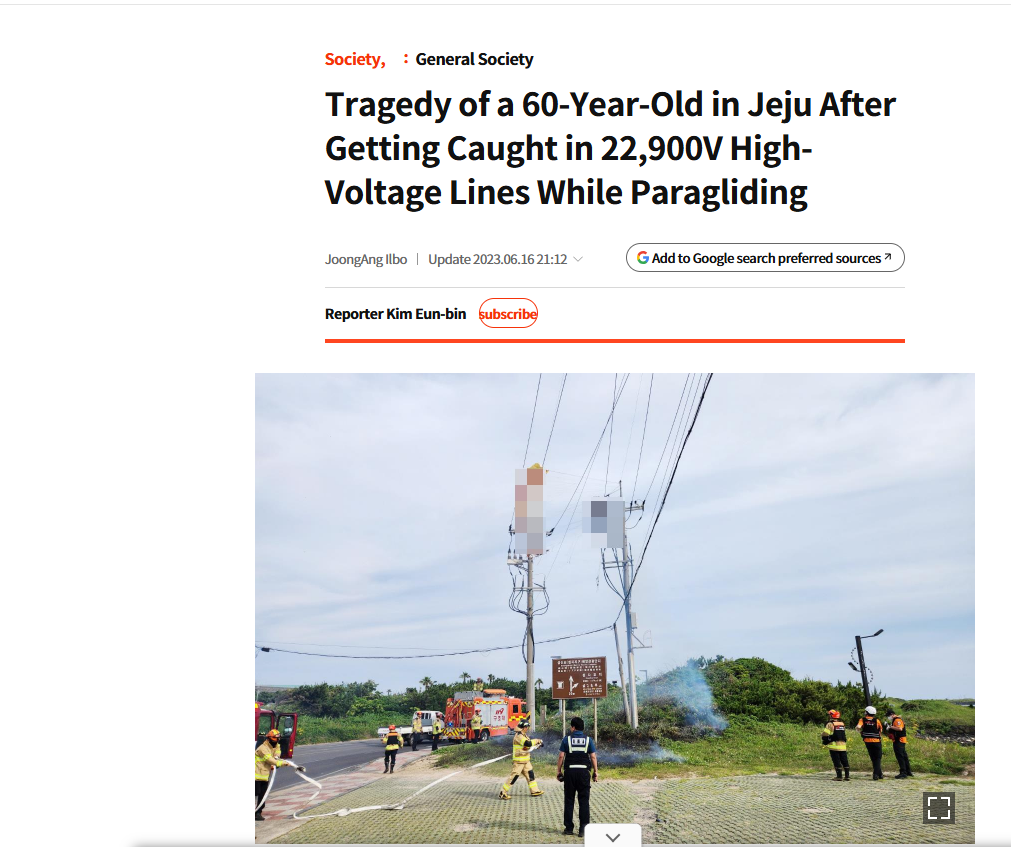
At the end of our research, we found a report published by South Korean news outlet The JoongAng on June 16, 2023. Citing the Jeju Eastern Fire Department, the report stated that at around 4:35 p.m. that day, a person flying a motorized paraglider near Seopjikoji Beach was reported to have become entangled in a high-voltage electric wire. According to the report, the person died after coming into contact with the high-voltage current.
https://www.joongang.co.kr/article/25170445#home
Conclusion
Our research found that the video being shared on social media does not show a recent incident. Available media reports and other sources confirm that the video is from a paragliding accident that took place on Jeju Island, South Korea, in June 2023. According to reports, on June 16, 2023, a man aged around 60 who was paragliding near Seopjikoji Beach became entangled in a high-voltage electric wire. He died after coming into contact with the electric current. Therefore, the claim that the video shows a recent incident is misleading.
